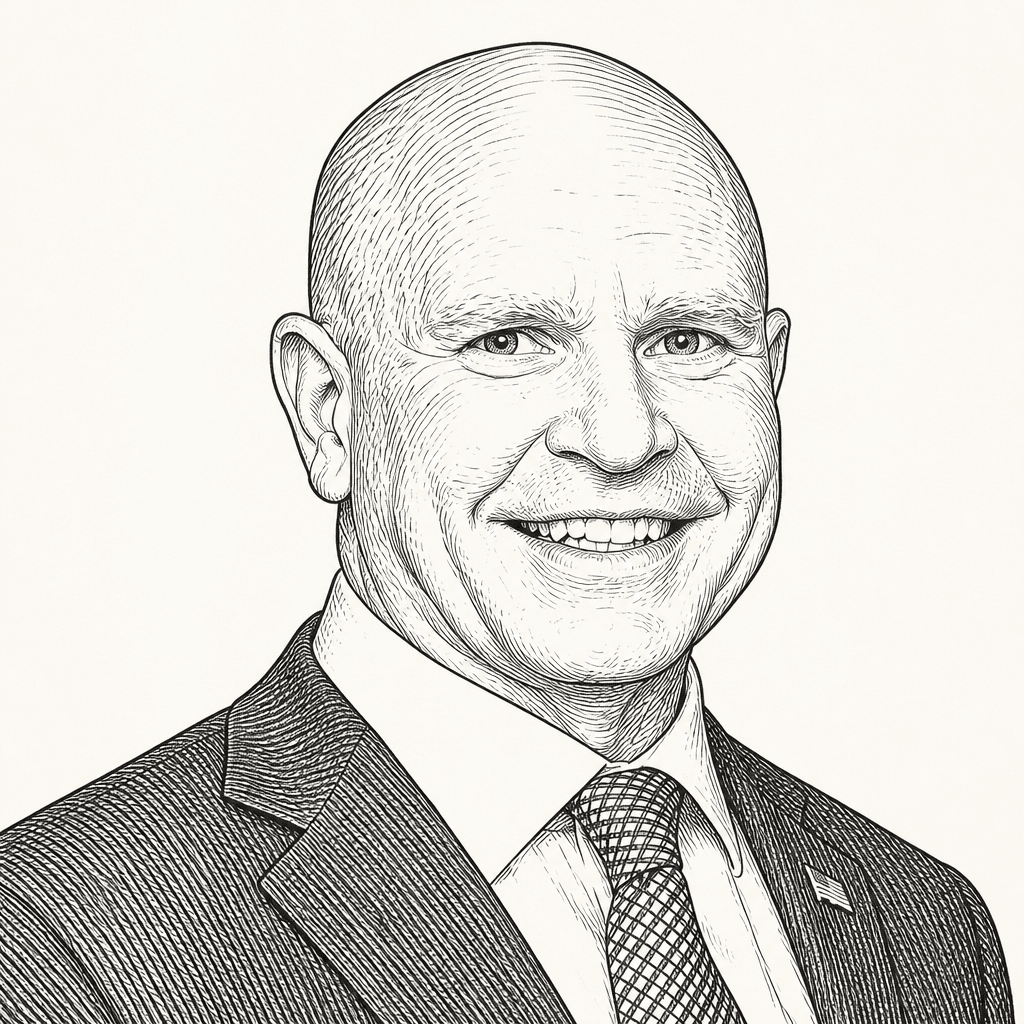
Herbert McMaster
Herbert McMaster is the Fouad and Michelle Ajami Senior Fellow at the Hoover Institution, a former U.S. national security adviser, retired U.S. Army lieutenant general, and regular GoodFellows panelist focused on national security, military history, and U.S. foreign policy.
Sweden Rebuilds Total Defence to Make Deterrence Credible
Sweden is rebuilding total defence around the premise that military deterrence is credible only if the society behind it can keep operating under attack. Civil Defence Minister Carl-Oskar Bohlin argues that resilient energy, communications, healthcare, supply chains, businesses and households are necessary to sustain a war effort and counter coercion below the threshold of open conflict. He presents the programme as Sweden’s contribution to NATO: not a claim on allied protection, but a capacity to provide security in the High North.
Economic Warfare Alone Cannot Break Iran’s Grip on Hormuz
Economic pressure on Iran cannot reopen the Strait of Hormuz or produce a durable settlement unless it is tied to clear objectives, sustained enforcement and credible military backing, John Cochrane, Niall Ferguson and H.R. McMaster argue. Cochrane doubts Washington will bear those costs; Ferguson says earlier military choices have narrowed its options, while McMaster contends that Iran can still be weakened through an integrated strategy extending beyond economic measures alone.
Norway Treats Arctic Security and Energy Infrastructure as One Defense Problem
Ine Eriksen Søreide, leader of Norway’s Conservative Party, argues that Norway’s Arctic position, offshore energy infrastructure and maritime role place it on the front line of a broader contest over European security. She says NATO’s principal test is increasingly likely to come through cyberattacks, sabotage and other gray-zone coercion designed to expose political divisions before an Article 5 response is clear. In her account, sustaining Ukraine, securing critical infrastructure and reducing industrial dependencies are parts of the same long-term task: adapting allied defense to a durable confrontation with Russia and its partners.
Iraq’s Sovereignty Depends on Fighting Corruption and Curbing Armed Groups
Former Iraqi prime minister Haider al-Abadi argues that Iraq’s central threat has shifted from ISIS to the corruption, patronage, and armed networks that weaken the state from within. He says Baghdad should use the relative respite to strengthen the judiciary, bring wartime militias under legal authority, and prevent elite theft through more transparent institutions. In his account, a durable partnership with the United States and deeper regional economic links should support Iraqi sovereignty—not substitute for it.
Ukraine’s Winter Endurance Could Determine the Path to Peace
Polish Foreign Minister Radosław Sikorski argues that Ukraine’s ability to withstand Russia’s attacks on power and heating infrastructure this winter could determine whether peace becomes possible next year. He presents Poland’s response to Russian aggression as a wider strategy: strengthen NATO’s eastern flank with permanent U.S. forces, raise European defense spending, sustain Ukraine financially and militarily, and reduce dependencies that leave Europe vulnerable to coercion.
Poland Ties NATO Deterrence to Forward Forces and Ukrainian Resilience
Polish Foreign Minister Radek Sikorski argues that Russia’s confrontation with the West is already being waged through military pressure, sabotage, disinformation and coercion, requiring NATO to make deterrence tangible on its eastern flank. His case pairs Poland’s defense buildup and industrial integration with U.S. forces positioned near Russia, European capacity to reduce strategic dependencies, and sustained support for Ukraine. A failure to break Ukraine, he contends, would demonstrate that Russian aggression cannot achieve its aims.
Japan Recasts Economic Security as Deterrence Against Coercion
Former Japanese national security adviser Shigeru Kitamura argues that Japan must treat military deterrence, economic resilience, technological protection and alliance coordination as parts of a single strategy against coercion that begins well below the threshold of war. With China’s military expansion and economic leverage reshaping the regional balance, he says Japan should reduce one-sided dependencies while building technological and industrial capabilities that make it strategically indispensable. The US-Japan alliance, in his account, must turn that approach into coordinated action on supply chains, critical technologies, energy and defense capacity.
Sanctions Work When Tied to Clear Political Objectives
H.R. McMaster argues that sanctions are effective only when they are tied to a realistic political objective and deployed alongside diplomacy, military power, and allied cooperation. Economic damage alone will not force compliance, he says: policymakers must enforce restrictions, preserve humanitarian access, act before targets adapt, and offer calibrated relief for verifiable changes in behavior.
Colombia’s Runoff Put Security Back at the Center of Democracy
Former Colombian president Iván Duque, in a Hoover Institution conversation with H.R. McMaster, argues that Colombia’s June 2026 runoff was less a left-right contest than a referendum on whether security and constitutional limits remain the basis of democratic rule. Duque says Gustavo Petro’s “total peace” policy amounted to appeasement of armed groups, and that Abelardo de la Espriella’s victory creates an opening to restore rule of law, military pressure on cartels, and investor confidence. He extends the case regionally, urging the United States to treat Colombia and the wider Americas as a strategic democratic community.
The American Revolution Was Won by Surviving Britain’s Strategic Failures
Rick Atkinson, the military historian, tells Hoover’s GoodFellows that the American Revolution was won less by overpowering Britain than by surviving an expeditionary counterinsurgency until British strategy, logistics, political intelligence and will broke down. The discussion then turns to contemporary Britain, California and the Democratic Party, where Niall Ferguson and John Cochrane argue that fiscal promises, class politics and primary incentives are pushing democracies toward policies their institutions may not be able to sustain.
American Security Requires Strategic Competence, Not Military Power Alone
H.R. McMaster argues that the greatest danger to American security is not a lack of military power but a loss of strategic competence after the Cold War. In a Hoover Institution discussion, the former national security adviser says U.S. leaders mistook a temporary unipolar advantage for a lasting condition, underestimated the political nature of war, and failed to connect military action to achievable political outcomes. That failure, he argues, now meets a more dangerous environment in which China, Russia, Iran, and North Korea are increasingly reinforcing one another.
American Strategy Fails When Untested Assumptions Become Policy
H.R. McMaster argues that American strategy often fails not for lack of information but because officials allow untested assumptions to become policy. In a Hoover Institution discussion, the former national security adviser says U.S. approaches to China, Iran, Russia and Afghanistan repeatedly projected Washington’s hopes onto adversaries rather than examining their motives, ideology and incentives. His remedy is a more disciplined process: define the problem on its own terms, test assumptions, present leaders with real options, and weigh the risks of inaction as seriously as the risks of acting.
U.S.-Iran Memorandum Trades Leverage for a Fragile Midterm Quiet
Niall Ferguson, H.R. McMaster, and John Cochrane argue that the draft U.S.-Iran memorandum looks less like a settlement than a political pause that gives Tehran money and time while leaving the nuclear question unresolved. In a Hoover GoodFellows discussion, they differ on whether unintended consequences could still weaken Iran’s regime, but largely agree that Washington had leverage in the Strait of Hormuz and failed to use it. They extend that concern to Ukraine and Cuba, framing the central problem as American pressure applied without follow-through.
U.S.-Iran Memorandum Trades Hormuz Relief for Unresolved Nuclear Questions
Hoover fellows Niall Ferguson, H.R. McMaster and John Cochrane read the reported U.S.-Iran memorandum less as a peace settlement than as a bid to reopen the Strait of Hormuz while postponing the nuclear dispute and front-loading concessions to Tehran. They largely agree the draft looks weak; their disagreement is over whether it buys time for a harder strategy later, creates space for pressure inside Iran, or signals a loss of U.S. will that allies and adversaries will now test.
Germany’s Defense Shift Recasts Europe’s Role in NATO
Norbert Röttgen, a senior CDU/CSU lawmaker in the Bundestag, argues in a Hoover Institution discussion with H.R. McMaster that Germany has belatedly accepted that Europe’s peace now depends on deterrence, defense capacity and resilience against Russian coercion. He says Berlin’s post-Cold War assumptions about trade, Russian moderation and American security guarantees cost it crucial time, but that Germany’s sharp rise in defense spending marks a real strategic shift. Röttgen’s answer is not a looser transatlantic relationship, but a new division of labor in which Europe carries more of its own defense while preserving the United States as partner and backstop.
Iran Ceasefire Debate Turns on Whether Tehran or Washington Has Leverage
Hoover Institution fellows H.R. McMaster, Niall Ferguson and John Cochrane use a mailbag discussion to test questions of war, leadership and institutional resilience against a common standard: whether policy connects means to political ends. Their sharpest disagreement is over Iran, where McMaster argues Tehran is weak and should face more pressure, while Ferguson says it has more room to wait out Washington than the Trump administration expected; Cochrane presses the underlying incentives that make voluntary Iranian nuclear concessions unlikely.
Iran Standoff Tests Whether Washington Manages Wars or Wins Them
In this GoodFellows mailbag, Hoover fellows H.R. McMaster, Niall Ferguson and John Cochrane treat the Iran standoff as the central test of American strategy. McMaster argues Washington should stop managing the conflict and intensify pressure on a weakened regime, while Ferguson warns Tehran may be waiting for oil-price and market pain to force the United States into a worse bargain; around that dispute, the three extend the same standard to war leadership, institutional decline, Europe, climate policy and populism: policy has to connect means to political ends rather than substitute rhetoric for results.
Finland Brings NATO a Border With Russia and a Whole-Society Defense Model
Finnish diplomat Kai Sauer argues that Finland’s entry into NATO is not a turn toward confrontation with Russia but a response to Moscow’s assault on Ukraine and its challenge to sovereign states’ right to choose their own alignments. In a discussion with H.R. McMaster, Sauer presents Finland as a front-line ally whose contribution rests not only on geography, but on conscription, whole-of-society resilience, energy diversification, and trusted technology capabilities. McMaster frames those strengths as part of a broader transatlantic agenda: moving burden-sharing from complaint to practical cooperation.
Fellows Split Over Whether the Constitution Is Too Hard to Amend
At the first public taping of Hoover’s GoodFellows, John Cochrane, Niall Ferguson and H.R. McMaster used the Constitution as a text for argument rather than commemoration. Cochrane warned against treating it as scripture and stressed the civic “spirit” behind it, McMaster described an imperfect founding grounded in principles, and Ferguson stated a broad First Amendment position. Their clearest split came over amendment: Ferguson said the process no longer works in practice, while Cochrane argued its history shows it has sometimes been too available.
Cuba’s Opposition Says Democratic Change Can Be Forced Within 12 Months
Cuban opposition leader Rosa María Payá tells H. R. McMaster that Cuba’s humanitarian collapse is also a political opening: the regime, she argues, survives by force, foreign patronage, military control of the economy, and regional repression, not by consent. In a Hoover Institution conversation, Payá says democratic change can be generated within 12 months if outside pressure on regime elites is paired with recognition of a prepared opposition alternative and direct support for Cubans demanding freedom.
Senior Officers Must Advise Privately and Execute Lawful Civilian Decisions
In a Hoover Institution discussion on civil-military relations, retired generals Joseph Dunford and Christopher Cavoli, with H.R. McMaster moderating, argued that the U.S. military’s democratic role depends on a hard boundary: senior officers give candid, private, nonpartisan advice; civilian leaders make policy; and the military carries out lawful orders. Their case was that this discipline is not Washington etiquette but a practical safeguard for the force, ensuring Americans are not sent into danger without an achievable political objective, clear risks, and accountable civilian decisions.