Applied AI · Monday, October 26, 2026
NVIDIA’s Agent Infrastructure Vision Meets the Work of Deployment
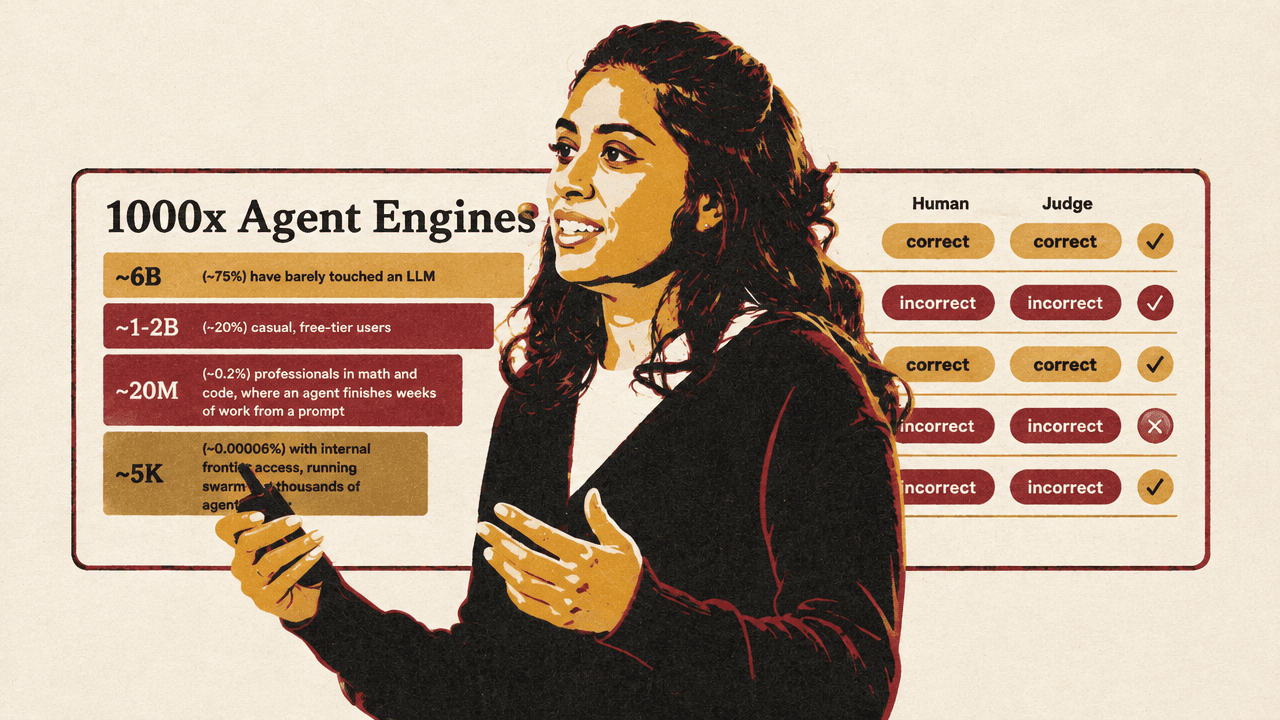
Jensen Huang argues that AI infrastructure must support agents and the systems around them, not just model inference. Accounts from Arize AI’s Aparna Dhinakaran and ElevenLabs’ Mati Staniszewski show how deployment also depends on monitoring and evaluation, and on adapting interactions to people, languages and tasks.
6 min read
Applied AI · Sunday, October 25, 2026
AI Capacity Is Arriving Before Its Returns Are Clear
Blackstone CEO Stephen Schwarzman describes investing in data centers ahead of visible demand, while Laurie Voss says AI coding agents are producing far more code than teams are shipping in releases. Both accounts point to a gap between new capacity and demonstrated outcomes—and to the judgment, review and training needed to close it.
5 min read
Applied AI · Friday, October 23, 2026
AI Agents Move Into Work as Compute Costs and Returns Remain Unsettled
OpenAI CFO Sarah Friar describes a shift from prompting AI to delegating tasks, but adoption is uneven and the productivity gains remain unproven. Across compute providers, product builders and investors, the central question is whether agents can fit real workflows and turn growing infrastructure costs into durable results.
8 min read
Applied AI · Saturday, October 17, 2026
NVIDIA Pitches Local AI on One Laptop as Tesla–SpaceX Tie-Up Remains Speculative
NVIDIA’s RTX Spark campaign places local AI alongside gaming and creative work on a single laptop, while leaving its technical capabilities unspecified. Separately, Bloomberg Intelligence analyst Matthew Bloxham sees Tesla and SpaceX’s existing AI and data links as part of a possible merger story, but Tesla has made no deal announcement.
4 min read
Applied AI · Friday, October 16, 2026
AI’s Growth Race Faces Tests on Returns, Financing, and Governance
Anthropic’s $67.2 billion annualized third-quarter revenue run rate has intensified questions about investor expectations and the economics behind growth. Separately, Gil Luria distinguishes demand for AI capacity from whether debt-financed builders can earn a return, while Mark Levine and Kevin Roose raise concerns about Anthropic’s IPO timetable and the pace of AI development.
8 min read
Applied AI · Tuesday, October 13, 2026
Enterprise AI’s Test Extends Beyond the Model
Meta’s Muse may strengthen the company’s AI offer, but Bloomberg Intelligence’s Mandeep Singh says enterprise adoption also depends on integration and cost. Across internal tools, bank deployments, agent systems and Microsoft’s Maia plans, the practical question is whether the surrounding organization and infrastructure can make AI dependable for real work.
7 min read
Applied AI · Sunday, October 11, 2026
AI Gateways Aim to Pair Model Choice With Runtime Controls
Remy Guercio of Tailscale argues that teams need room to change models and tools, while Gravitee CTO Sam demonstrates a gateway denying agent requests that lack permission. The shared control point can route traffic, enforce policies, and log activity, but only for requests it can see—and its reach depends on identity and configuration.
4 min read
Applied AI · Wednesday, October 7, 2026
From Model Decisions to End-to-End Workflows
OpenAI’s Decisions API narrows a model’s task to choosing among defined actions, while Langfuse’s Marc Klingen describes using production traces and evaluations to improve agent behavior. Google’s Amin Vahdat and Microsoft’s AI for Good Lab’s Sparrow Studio examples widen the frame: useful AI depends on the infrastructure, data, and human oversight around the model.
8 min read
Applied AI · Sunday, October 4, 2026
Enterprise AI’s Shift From Model Choice to Operational Control
OpenRouter’s Alex Atallah and Replit CEO Amjad Masad argue that companies need to keep choices open across models, deployment and agent access as costs and capabilities change. Their discussion also leaves a central question unresolved: what evaluations and controls can show that these systems work reliably in enterprise settings?
5 min read
Applied AI · Saturday, October 3, 2026
AI Delegation Shifts Costs, Control and Accountability
OpenAI’s ChatGPT sign-in could let app users cover model inference with an existing allowance, while Lockheed Martin says one F-35 could control as many as eight autonomous Vectis aircraft. In consumer software, military operations and digital finance, the cases raise different questions about who authorizes delegated systems, retains control and answers when something goes wrong.
7 min read
Applied AI · Wednesday, June 10, 2026
AI Moves From Answers To Default Work Surfaces
John Coogan and Jordi Hays read Apple’s AI moment as a fight over the Siri button, private cloud path, and camera roll, while OpenAI’s Codex demo presents enterprise AI as a place where analysis is produced, inspected, revised, and delivered. Across retrieval, GPU deployment, coding revenue, compute scarcity, and employee ownership, the day’s applied-AI question is less which model wins a benchmark than who controls the working surface and who captures the gains.
17 min read
Applied AI · Tuesday, June 9, 2026
AI Moves From Model Capability To System Design
Apple, OpenAI, Balyasny, Cloudflare, Brilliant, and mental-health researchers are all pointing to the same applied-AI test: whether models can be embedded into trusted systems that preserve context, control, and safety. The work is shifting from producing fluent answers to building the operating layers, workflow harnesses, context systems, runtimes, and guardrails that let AI act in real settings.
13 min read