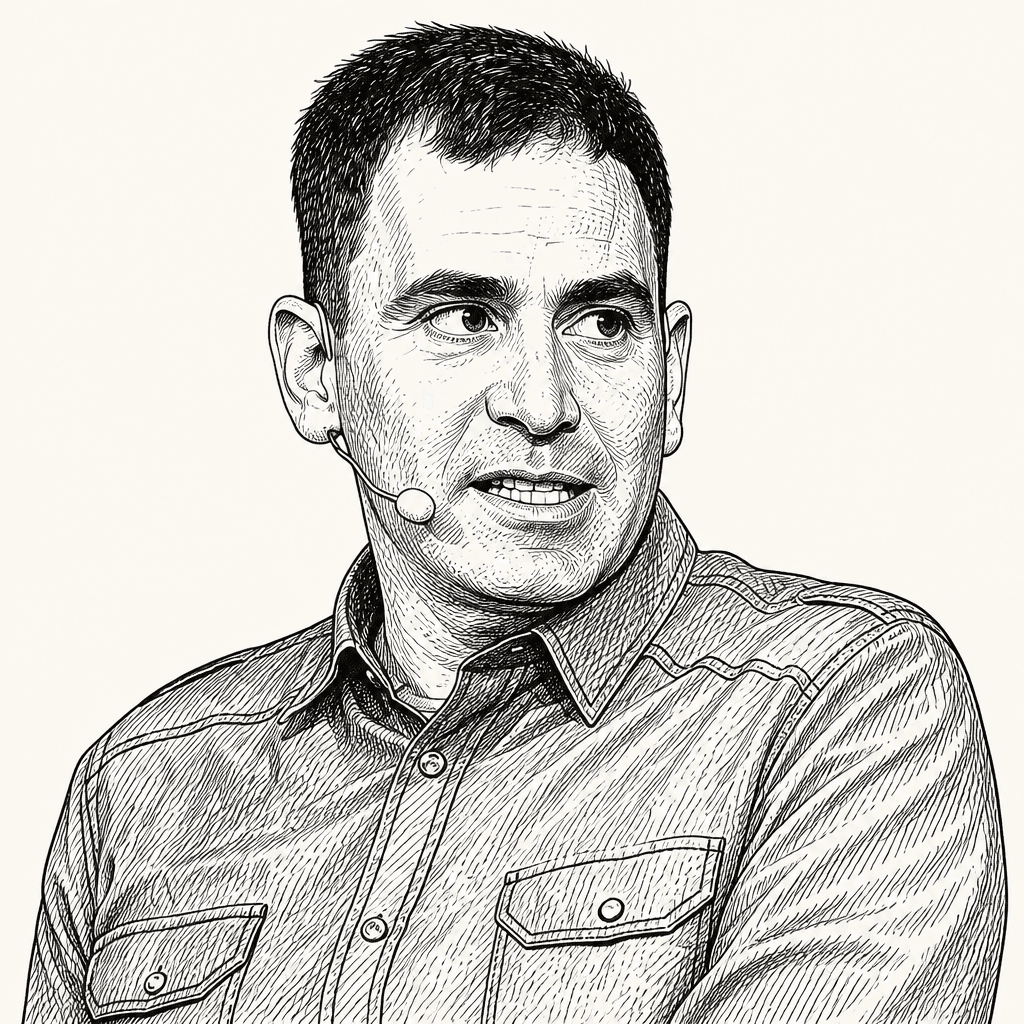
Elad Gil
Technology entrepreneur, investor, and host of the AI podcast No Priors. He runs Gil&Co, previously held leadership roles at Twitter and Google, and has invested in and helped build AI companies.
Arm Moves From Chip IP Licensing to Physical Products
Arm chief executive Rene Haas argues that AI’s demand for accelerators has not diminished the CPU’s role as the system that schedules and coordinates computation. As Arm moves from licensing chip IP toward supplying more integrated systems and selected physical products, Haas says the company must compete not only on design but on access to wafers, memory, packaging, capital and deployment capacity. He also makes the case that US semiconductor manufacturing and data-center construction are strategic industrial assets, despite growing public resistance to their expansion.
Founders Must Separate Trillion-Dollar Ambition From Revenue Reality
Elad Gil argues that AI’s unusually fast creation of trillion-dollar valuations is distorting both investor expectations and founder behavior: most large markets cannot produce the revenue, margins, and speed needed for that outcome, while some strong founders are avoiding opportunities out of fear that frontier labs will absorb them. Sarah Guo agrees that founders should not let lab competition substitute for strategy, but argues that AI can expand markets beyond conventional seat-based spending and that financing conditions can still constrain companies with sound long-term theses. Their tension is that AI may change both the scale and pace of opportunity, but neither inflated valuation expectations nor fear of the labs replaces a realistic assessment of market capture, competitive advantage, and the capital required to pursue a thesis.
Private Evals Are Becoming the Core IP of Enterprise AI
Microsoft chief executive Satya Nadella argues that the AI frontier is shifting from single models to company-specific systems built from private evals, traces, tools, data and multi-model harnesses. In a Microsoft Build conversation with Sarah Guo, Elad Gil and Shawn Wang, Nadella says those private evaluation loops may become a company’s most important intellectual property, allowing enterprises to build their own specialist intelligence rather than merely consume frontier models. He also frames the broader test for AI as legitimacy: whether customers, workers and communities see measurable gains from the technology and the infrastructure behind it.
Companies Can Build Frontier Intelligence Without Owning the Frontier Model
Satya Nadella used Microsoft’s Build 2026 AI announcements to argue that the next phase of AI will be defined by ecosystems, not by companies consuming a single frontier model. In a crossover conversation with No Priors and Latent Space, Microsoft’s chief executive said enterprises and startups should be able to build their own “frontier intelligence” from models, tools, data, context, and private evaluations. His case is that durable value will accrue to companies that control those loops, rather than simply rent intelligence from a general-purpose provider.
AI Startups Are Selling Labor, Not Software Seats
Elad Gil argues that generative AI is changing the basic unit of enterprise technology from software seats to “human labor equivalents” — work product, labor hours and cognition that buyers can purchase directly. In a Tim Ferriss interview, the investor says that shift is reopening markets that once looked structurally unattractive, from legal software to other white-collar categories, because AI is giving companies something materially different to sell. Gil’s broader case is that this is a rare consensus moment: buyer openness is high, language models plug into existing commercial workflows, and weak growth from an AI company is therefore a sign that something is wrong.
Cerebras’ Wafer-Scale AI Bet Fuels a $63 Billion IPO
Cerebras founder and CEO Andrew Feldman argues that the company’s roughly $63 billion public-market debut is the result of a decade-long wager on wafer-scale computing: a dinner-plate-sized chip architecture built for AI rather than a modified GPU. In a discussion with Elad Gil and Sarah Guo, Feldman says Cerebras survived years when the technology worked before the market cared, and that demand arrived only once AI became daily work and fast inference became commercially decisive.
Pax Silica Aims to Secure the Full AI Supply Chain
U.S. Under Secretary of State for Economic Affairs Jacob Helberg argues that AI dominance depends on securing the full industrial supply chain behind compute, not just advanced semiconductors. In an interview with Sarah Guo and Elad Gil, Helberg presents Pax Silica as a 14-country economic-security coalition meant to build commercially viable allied supply-chain platforms, starting with a 4,000-acre industrial zone in the Philippines. He frames the strategy as a private-sector-led alternative to China’s Belt and Road model, combining domestic reindustrialization with partner-country specialization in critical inputs such as minerals, robotics components, and processing capacity.
Longevity Stack Stays Conservative as Rapamycin and Bioelectric Medicine Remain Watchlist Items
Elad Gil describes a longevity regimen built less around biohacking novelty than around sleep, exercise, diet, and a narrow supplement base. In a conversation with Tim Ferriss, Gil argues for waiting on more powerful interventions until the evidence and drugs improve, while Ferriss applies a similar caution under the heuristic of “no biological free lunch.” The discussion treats rapamycin, ketones, ibogaine, anesthesia, neurosensory aging, and bioelectric medicine as watchlist items rather than settled parts of a personal stack.
Long Lake’s $6.3 Billion Amex GBT Deal Tests AI-Led Buyouts
Long Lake Management co-founder and CEO Alexander Taubman argues that AI can change the economics of services businesses when the buyer owns the workflow, not just the software layer. In a conversation with Elad Gil about Long Lake’s announced $6.3bn take-private of American Express Global Business Travel, Taubman presents the firm’s model as acquiring trusted services companies, embedding its Nexus AI platform into day-to-day operations, and using productivity gains to drive growth, customer service and employee retention rather than short-term cost cuts.
Most AI Startups Should Consider Selling Within 18 Months
Elad Gil, the investor and former operating executive, argues that many AI companies should consider selling within the next 12 to 18 months, not because AI is overhyped but because most companies formed in major technology cycles do not survive them. In a conversation with Tim Ferriss, Gil says the exceptions are the few durable winners — likely including leading foundation-model labs and deeply embedded application companies — while many others may be nearing their best exit window before growth slows, models commoditize their products, or larger competitors move in.