Cerebras’ Wafer-Scale AI Bet Fuels a $63 Billion IPO



Cerebras founder and CEO Andrew Feldman argues that the company’s roughly $63 billion public-market debut is the result of a decade-long wager on wafer-scale computing: a dinner-plate-sized chip architecture built for AI rather than a modified GPU. In a discussion with Elad Gil and Sarah Guo, Feldman says Cerebras survived years when the technology worked before the market cared, and that demand arrived only once AI became daily work and fast inference became commercially decisive.

Cerebras’ public-market story rests on a long wafer-scale gamble
Andrew Feldman describes Cerebras as a company that builds “AI computers”: systems designed and optimized to accelerate AI workloads. The company’s current claim, as Feldman states it, is not just that it competes with GPUs, but that it is “15, 18, 20x faster than GPUs” for inference. Elad Gil introduced Cerebras as recently public and worth about $63 billion in the stock market; Sarah Guo referred to it as roughly a $60 billion market cap at the time of the discussion. Feldman tied that public-market scale to a backlog “north of $20 billion,” a large OpenAI agreement, and a wafer-scale architecture that critics had long dismissed as too strange to work.



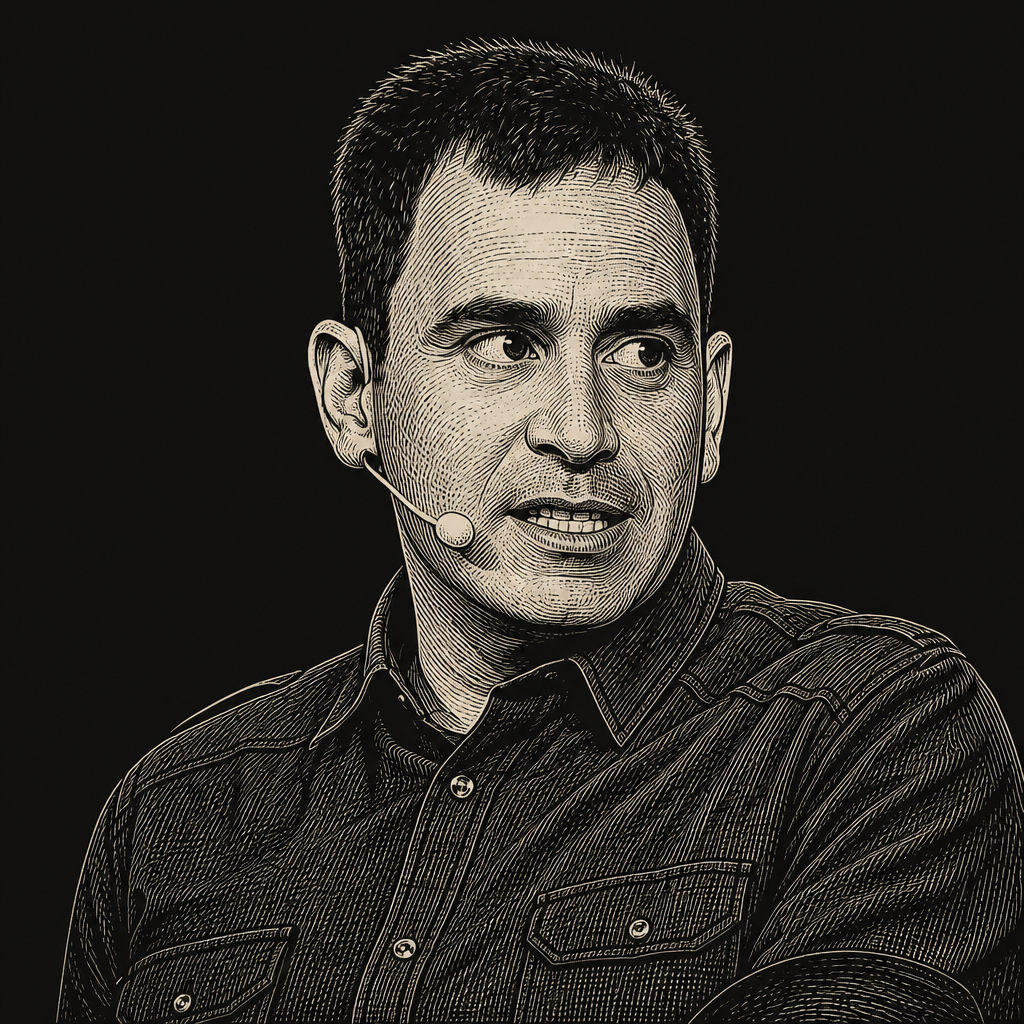


When Gil asked whether Cerebras’ speed advantage applies broadly or only in specific cases, Feldman said it is “across the board”: big models and small models, U.S. models and Chinese models, trillion-parameter models and one-billion-parameter models.
The architecture behind that claim is the company’s original contrarian bet. Cerebras chose wafer scale: a chip roughly 46,000 square millimeters, “the size of a dinner plate,” rather than the postage-stamp-sized chips most of the industry builds. Feldman said critics told Cerebras it was “out of our mind,” that the approach would never work, and produced lists of reasons it was impossible.
His answer is that radical performance improvements do not usually come from modest changes to an incumbent architecture. “You’re not going to get 15 or 20 times better than the GPU with a minor modification to their architecture,” he said. For Cerebras, the necessary premise was that a new workload creates an opening for a new architecture.
If you’re going to aspire to a radical improvement, your design has to be different.
Feldman framed that premise historically. In mature x86 computing, he said, “nothing new is happening there and nothing has happened for generations,” making it very hard to enter. But when graphics emerged, Nvidia and the discrete GPU emerged with it; when mobile compute arrived, ARM became central. In those shifts, companies that looked well positioned from the prior paradigm did not necessarily win. Cerebras saw AI as the next new workload, one that would consume large amounts of compute and require a dedicated architecture that was “very different” rather than derivative.
That bet was not immediately rewarded. Feldman said Cerebras had built a very fast machine “and for a long time nobody cared.” AI, in his account, had not yet crossed from novelty to daily work. From roughly 2023 to early 2025, people pointed at AI, but “nobody used it every day in their work.” Speed mattered only once the models became useful enough to be integrated into day-to-day workflows.
His market analogy was blunt: there is no market for slow search, and no market for dial-up internet. “That’s how big the market for slow inference will be,” he said. In his telling, the key change arrived in 2025, when AI models became smart enough to be useful and usage began to surge across companies including Cognition, Cursor, Lovable, OpenAI, and others. Once people rely on AI for work, he argued, inference latency becomes a core adoption constraint rather than a nice-to-have.
The company spent years proving the machine could work before the market cared
Andrew Feldman separated Cerebras’ difficulty into two problems: first, proving wafer-scale computing could work at all; second, surviving the period when the technology existed before the market demanded it.
On the technical side, he said Cerebras was attempting something that had defeated prior efforts across the 70-year history of computing. He cited Gene Amdahl, whom he called one of the “fathers” of the field, as someone who had failed to build a wafer-scale product. Between mid-2017 and mid-2019, Cerebras could not build it either.
During that period, Feldman said the company was spending about $8 million a month and holding board meetings every six weeks at which the update was essentially: “I can’t build it. No, still not working.” Each failure analysis improved the process a little. In summer 2019, the company yielded the chip and it began to work.
Feldman described the first successful run as a moment of stunned silence. The team was in a makeshift office in downtown Los Altos, in a building “not designed for hardware guys,” staring at a computer. “It’s working,” he recalled. “We just couldn’t speak for half an hour.”
That breakthrough still did not produce immediate mainstream demand. Cerebras had solved “the hardest problem in the computer industry,” Feldman said, and “nobody cared.” The first generation may have sold about a dozen units. The second generation probably sold 300. The third generation is now selling “in the tens of thousands,” according to Feldman.
The customers who did care at first were the kind that have historically adopted new computer architectures early: supercomputing centers and organizations with long-standing appetite for compute. Cerebras “ran the table” in supercomputing, Feldman said, naming Argonne National Labs, Lawrence Livermore, Sandia, the European Parallel Computing Centre, and LRZ. The company also found customers in oil and gas and pharma.
But he described that as a known pattern with a known limitation. Supercomputing customers like speed and tolerate immature software, but they do not provide the volume required to reach the mainstream. Cerebras still needed a bridge across the “giant chasm” between early technical adoption and large-scale commercial deployment.
That bridge, in Feldman’s account, was G42, which he described as a sovereign customer, strategic partner, and close friend of the company. He said G42 placed a billion-dollar order and helped Cerebras transform its supply chain and test deployments at scale. Hardware companies, he noted, cannot always reproduce customer-scale deployments inside their own QA labs; “you can’t put a hundred million dollars in your QA lab worth of your own gear.” Working with G42 allowed Cerebras to train models, run inference, and battle-test large clusters before later demand arrived from OpenAI and AWS.
Sarah Guo emphasized the path dependence: the jump from tens or hundreds of millions of dollars in orders to more than $20 billion of backlog requires something in between. Feldman’s answer was simple: “It’s years of work.” In hardware, scaling requires manufacturing partners to find power, rent buildings, add production lines, and make test fixtures. Feldman said Cerebras is trying to increase manufacturing 10x this year, which he characterized as “about as fast as anybody in the history of hardware.”
The software stack took comparable time. Feldman recalled that at the company’s beginning, co-founder Gary told him it would take about 10 years to build a compiler. Feldman initially dismissed that as “big company talk” and thought it could be done in five. “Takes about 10 years,” he said. “It is an extraordinarily difficult piece of software.” Cerebras now has, in his words, a good software stack.
Fast inference became valuable when AI became work, not novelty
Andrew Feldman grounded Cerebras’ commercial acceleration in a specific view of AI adoption: the market changed when inference speed became connected to everyday productivity. AI is made through training, he said, but used through inference. Once people began using models in their work, “speed became fundamentally important,” and Cerebras was “crushed with demand.”
He tied that demand to two major business developments. At the end of the year, in Feldman’s account, Cerebras signed what he described as one of the biggest deals ever in Silicon Valley: an OpenAI agreement “north of $20 billion.” In March, he said, Cerebras signed an agreement with AWS under which Cerebras will be deployed in AWS data centers going forward.
The OpenAI deal began, Feldman said, with a mid-summer 2025 conversation with Sam Altman. According to Feldman, Altman said OpenAI had been focused on keeping up with demand and now saw the importance of fast inference. That led to trials and testing. Cerebras was “so much faster than the competition,” Feldman said, that the fit became clear.
He also described the selling process as consistent with the kind of customer he prefers. Feldman said he does not want to build consumer products, joking that if his mother buys it or uses it, he does not want to make or sell it. He wants “super smart customers” doing interesting things with Cerebras’ technology. OpenAI’s technical teams, in his account, saw the system and understood why it mattered.
The transaction moved quickly. Cerebras signed a term sheet the night before Thanksgiving and then signed a master agreement on December 24. For a deal above $20 billion, Feldman called completing it in four and a half weeks “exceptional.” OpenAI “can fly,” he said, and both sides were working seven days a week, with several law firms involved.
Sarah Guo called that speed a “crazy characteristic” of the current AI market: everyone is trying to keep up with demand. Feldman agreed and broadened the point. He cited Cognition buying Windsurf over a weekend, Elon Musk’s pace in building data centers, and the idea that things previously treated as speed-of-light constraints have turned out to be faster than expected. “The art of the possible has been expanded by this push,” he said.
Feldman used Netflix’s move from mailed DVDs to streaming-era content production as his analogy for what speed can unlock. Netflix once delivered DVDs in envelopes and thought its competition was Blockbuster. When the internet became fast, he said, Netflix did not merely deliver DVDs more efficiently; it became a movie studio. Speed opened a fundamentally different business.
He expects fast AI to do the same. The first and obvious phase is replacing visible workflows: coding, design, and existing SaaS tools. The larger productivity jump, he argued, will come when work is reorganized around AI, much as the PC first replaced typewriters and general ledger accounting, but the larger change came later through the cloud, SaaS, and tools that became broadly affordable. Feldman expects new business models and “fundamental jumps in productivity” once companies stop mapping AI onto existing work and instead redesign work around it.
AI coding is already changing the engineering floor, but unevenly
Inside Cerebras, Andrew Feldman said AI-generated coding has become “hugely” relevant. He quantified the change through token spending: eight months earlier, Cerebras was not spending $1,000 per engineer on tokens; now, he said, it is probably spending $25,000 to $30,000 and “ripping.”
But he did not describe the productivity gain as uniform. Some people, he said, have the “perfect mindset” for AI coding. They run eight or 10 agents around the clock and have changed their coding style from direct production to governing agents. They think about QA as part of the system, including running QA agents, and they account for weaknesses in the coding models, such as verbosity or cutting out comments.
For that subset, the effect has been dramatic: some have gone from being “10x guys” to “100x guys.” For everyone else, including himself, the process is more tentative. Feldman said the rest of the company is “limping along,” trying to understand how the tools apply to roles such as CEO, CFO, accounting, and marketing. Cerebras is trying to show people best practices from those who have adapted most effectively.
That distinction matters because Feldman does not treat AI tools as magic productivity applied evenly to an organization. In his account, the value depends on workflow redesign, taste, oversight, and a person’s ability to manage multiple agents and their failure modes. His comments on coding mirror his broader claim about fast AI: the productivity jump comes not merely from replacing a task, but from reorganizing the work around the new capability.
Feldman’s operating concern is that scale will make Cerebras less fearless
Cerebras has about 800 to 850 people, according to Andrew Feldman. Sarah Guo noted that this implies a large amount of market capitalization per employee. Asked where the company goes next, Feldman’s first answer was delivery: with backlog north of $20 billion, he said, delivery matters every day.
But his deeper concern was cultural. As companies grow to 1,000, 2,000, or 3,000 employees, he said, they can stop taking the risks that made them important. A “fearless engineering culture” can become a culture oriented around what can fit into the next revision cycle. Feldman sees that as damaging.
He described Cerebras’ desired posture this way: “We would much rather fail in pursuit of the extraordinary than succeed in the ordinary.” Hiring is central to preserving that posture. When a company has many open roles, Feldman said, it becomes easy to settle and simply put “a butt in a seat.” He called that “death” and said he spends a meaningful part of every day speaking with candidates.
His comments on leadership were personal rather than procedural. Being CEO is “extraordinarily lonely,” he said, especially for leaders who are drawn to problems others say cannot be solved. That opposition can become fuel. When someone says a problem cannot be solved, Feldman said, the founder’s internal response is: “You can’t solve it.”
He framed his own career around that psychology. Cerebras is his fifth startup. He described himself as a “professional David” who competes against Goliaths. Competing with Nvidia, he said, is not an easy way to make money; there are easier ways. The point is the contest itself: every dollar Cerebras sells is, in his framing, revenue that incumbent muscle would have taken “in a heartbeat” if Cerebras’ brains had not won it.
You got to love being a David, right? I’m a professional David. This is my fifth startup. I compete against Goliath.
Elad Gil pushed on the harder question of persistence: when should a founder give up? Feldman’s answer was not “never.” If a team lays out hypotheses about what it will take to win and they all come back negative, he said, “it is clearly the right time to give up.”
Gil noted the trap: founders often test one more thing, then one more thing after that. Feldman called that “the slippery slope,” something to guard against in business and ethics alike. His suggested protection is outside accountability from former CEOs or seasoned entrepreneurs who are on the founder’s side but can remind them of their own prior commitments: a year ago, you said that if you reached this point without achieving this milestone, you would stop.
Feldman called it being accountable to your own thinking. If the founder can articulate what has to change for the company to work, and attach a timeframe, persistence may be justified. But he also said many efforts probably should be truncated, with people redeploying their effort toward new ideas.
Going public was about capital, legitimacy, and becoming an AI pure play for public investors
Elad Gil asked why Cerebras chose to go public, given the changing private-market environment. Andrew Feldman described an IPO first as an exchange of investor base: replacing professional venture investors who specialize in technology with a broader class of investors, and in doing so reducing the cost of capital somewhat. “Suddenly we go from pros like you to my dad,” he said. The tradeoff is that the company accepts a stringent set of public-company rules.
He acknowledged that the question has changed because, for the first time, a small number of companies can raise huge amounts of capital without going public. He named OpenAI, Anthropic, and possibly Databricks as examples of companies that have been able to raise public-market money at public-market valuations while private.
That is not the historic norm. Feldman and Gil noted that the standard four-year Silicon Valley option vesting schedule originally reflected roughly how long it took a company to go public. Cerebras took 10 years. Feldman said that difference forced the company to think differently about liquidity. Cerebras opened the secondary market so employees could sell modest amounts along the way; if people were going to bet large portions of their careers on the company, he said, it was reasonable for them to find some liquidity.
For most companies, public markets still offer high valuations, legitimacy, and credibility, Feldman argued. Large companies in the U.S. have historically preferred doing business with other public companies, he said. Audited books and public visibility allow counterparties to understand who they are dealing with in a way that differs from private companies.
Cerebras also believed it could offer public investors something distinct: in Feldman’s words, the first and, for some period, only AI pure play. He said 100% of Cerebras’ revenue comes from the AI market. There is “no gaming, no graphics, no PC.” That made the IPO not only a financing event but a differentiator: a public investor who wanted direct exposure to this market, in Feldman’s framing, was being offered a company whose revenue was entirely tied to AI compute.
Feldman allowed that there are other ways to create liquidity and returns, including creative structures that allow employees and investors to sell over time. But for Cerebras, he said, going public was more than liquidity mechanics. It was an opportunity “to graduate from corporate adolescence to corporate adulthood.”
Open source has kept pressure on the frontier and fed the market
Sarah Guo asked how Andrew Feldman thinks about open source and post-trained workloads, especially given the growth of companies such as Cognition and Cursor and the experience of running coding products on Cerebras. Feldman’s answer was that open source has “fed this market.”
When closed source was too expensive, he said, the open-source community kept interest alive and “kept the flame going.” It also pushed closed-source companies. Feldman pointed specifically to techniques from some Chinese model makers as a signal that frontier companies cannot rest on the advantages of bigger training clusters and more data.
The result, in his view, is a more vibrant ecosystem: open source has allowed creativity to take root and produce interesting results. For an infrastructure company, Feldman said, that is part of the reward. It is fun to see other people’s ideas do interesting things on Cerebras hardware. “If you don’t love that, your infrastructure is not right for you,” he said. “You gotta love other people’s ideas to take flight on what you built.”
That claim connects back to how Feldman describes Cerebras’ role. He does not cast the company as trying to own every end-user application workflow. His emphasis is on providing compute fast enough that customers and developers can discover applications, workflows, and business models that were not previously possible.