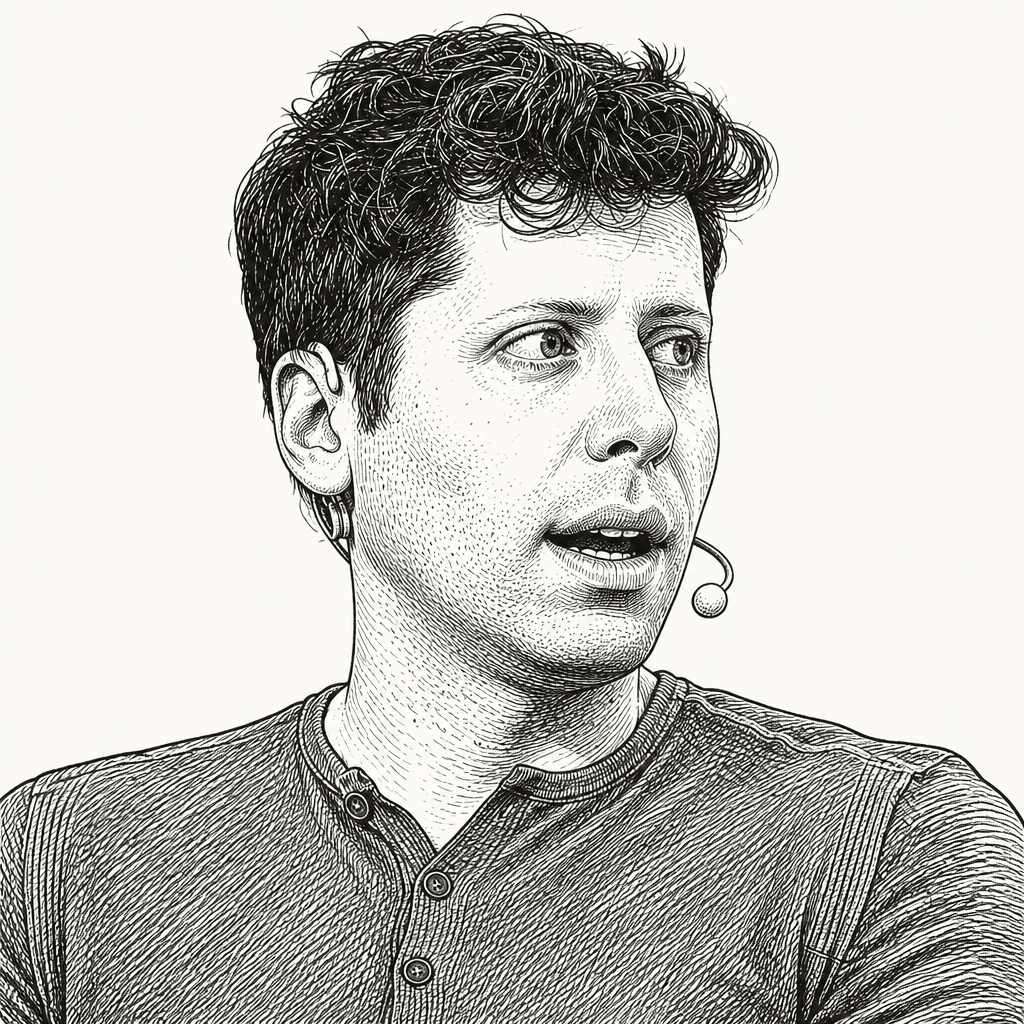
Sam Altman
Co-founder and CEO of OpenAI, the AI research and deployment company behind ChatGPT and DALL·E. Previously led startup accelerator Y Combinator from 2014 to 2019 and is a prominent public voice on AI deployment, governance, and safety.
Nvidia Seeks to Turn AI Compute Into Financeable Infrastructure
Nvidia CEO Jensen Huang argues that profitable AI token demand justifies a far larger buildout of computing capacity—and is seeking to make that buildout financeable through platforms with major private-capital firms. The plan depends on lenders treating standardized AI data centers less like rapidly depreciating venture-backed equipment and more like infrastructure, despite unresolved questions about GPU residual values and the private labs whose demand is meant to support the assets.
Leverage and Rising Yields Expose the AI Trade’s Fragility
The All-In hosts argue that the AI boom’s long-term productivity promise is colliding with immediate financial and political constraints: a chip-stock selloff exposed the danger of leverage, while higher Treasury yields are raising the cost of betting on distant AI returns. David Sacks maintains that frontier labs’ revenue and compute access support the infrastructure buildout, but Chamath Palihapitiya and David Friedberg question where the economics will ultimately accrue as open models, energy limits and cheaper alternatives reshape the market. They also cast the fight over AI safety, training data and regulation as a contest over who gets to control the technology’s future.
AI’s Broad Access Will Depend on Concentrated Compute Infrastructure
Sam Altman argues that OpenAI’s task is to make advanced AI as broadly available as electricity while building the concentrated compute, energy and data-center infrastructure required to produce it. He says demand for cheap, capable intelligence could be effectively uncapped, making large-scale inference revenue the basis for ever-larger training runs. But Altman also warns that cyber risks and the concentration of frontier capabilities could undermine the human agency that, in his account, widespread AI is meant to expand.
AI’s Startup Boom Depends on Keeping Power Widely Distributed
OpenAI chief executive Sam Altman argues that AI gives startups an unusually large opportunity to take on work once reserved for far bigger organizations, but that their role is also political: keeping economic and technological power from concentrating in a few institutions. In a conversation with Y Combinator’s Garry Tan, Altman says founders should use agents and cheaper compute to pursue more ambitious ideas while maintaining safeguards against serious loss-of-control risks.
Tokens Can Now Substitute for 100-Person Startup Engineering Teams
In a Stanford CS153 lecture, OpenAI chief executive Sam Altman argued that AI has already rewritten the startup playbook, allowing small teams to buy capabilities with tokens that once required large engineering organizations. He used OpenAI’s experience with ChatGPT, Codex and model scaling to make a broader case: scale keeps producing capabilities that experts underestimate, but the institutions around AI — from education and research pipelines to compute markets and governance — are not adapting as quickly. Altman said the central choice ahead is whether intelligence becomes a broadly available utility or remains concentrated in a few companies.
OpenAI Folds Codex Into ChatGPT for a Unified Enterprise Workflow
OpenAI used its Intelligence at Work enterprise event to argue that workplace AI is moving from separate tools into a single operating workflow for companies. Sam Altman framed the roadmap as a response to customer demand to bring OpenAI’s products together, while executives pointed to ChatGPT and Codex integration, role-specific agents, annotations in existing tools, and deployment through Sites as the product layer for enterprise adoption. BNY chief executive Robin Vince supplied the customer case, saying the bank chooses AI optimism because it sees the technology as a capacity creator.