AI Moves From Model Demos Into Infrastructure Before Its Rules Are Settled
Benedict Evans frames AI as a major but uneven platform shift, while Mo Gawdat warns that institutions may absorb its capabilities too slowly to avoid labor, surveillance, and power shocks. Across NVIDIA’s AI-factory push, Sarvam’s sovereign-language stack, production agents, and Steven Willmott’s safety-spec argument, applied AI is becoming operating infrastructure before ownership, permission, and public purpose are settled.

Platform shift or absorption shock?
The useful disagreement is not whether AI matters. It is what kind of transition this is.
Benedict Evans argues that AI is a platform shift on the scale of the internet or mobile, and “only” on that scale. That is not a small claim. It means AI can remake interfaces, distribution, labor, business models, and value capture, while still diffusing unevenly through markets and institutions. His preferred analogy is the internet in 1997: consequential, immature, full of plausible but wrong theories, and far too early for confident declarations about winners, interfaces, or durable business models.
Mo Gawdat looks at the same acceleration and sees a sharper institutional shock. In his account, the immediate danger is not that machines become hostile, but that powerful people, companies, militaries, and governments route “abundant intelligence” through systems already optimized for cost-cutting, control, surveillance, and domination. He forecasts severe sectoral job losses by 2027–2028, autonomous weapons and surveillance expanding faster than restraint, and a difficult decade before AI’s benefits can become broadly distributed.
Those positions do not have to be reconciled to be useful. Evans supplies the anti-deterministic frame: platform shifts rarely unfold according to first-wave predictions, and enterprises redesign work far more slowly than demos suggest. Gawdat supplies the institutional warning: even if AI is not an economic singularity, the first deployment wave can still compress jobs, concentrate power, lower the cost of coercion, and outrun public legitimacy.
AI may be “only” a platform shift, but platforms become infrastructure, and infrastructure redistributes power before society fully understands the new rules.
Evans’s labor-market caution turns on a distinction that matters across applied AI: is AI automating a task, or is it replacing the job people are actually hired to do? He argues that making a PowerPoint deck, writing code, or finding an SKU can be a task inside a broader job involving judgment, customer knowledge, organizational politics, and process design. That is why he expects AI deployment inside large companies to require consultants, forward-deployed engineers, and workflow redesign rather than a simple purchase of a chatbot followed by immediate layoffs.
Gawdat’s warning is narrower in timing and more severe in tone. He argues displacement begins not with the factory floor but with entry-level knowledge work: call centers, assistants, travel agents, paralegals, analysts, designers, and middle layers of professional work where one person with AI can do the work of several. Gawdat specifies that his 30% job-loss prediction is sectoral rather than economy-wide. But his broader point is that labor markets do not need 100% displacement to become unstable; 10% or 20% unemployment in the wrong conditions could be politically and economically destabilizing.
Evans also resists treating AI-lab executives as authorities on labor economics. He is interested in what frontier-lab leaders know about model capability over the next six to twelve months, but less persuaded that running an AI lab confers special knowledge about comparative advantage, employment structure, or value creation. Gawdat, by contrast, treats changing messages from AI leaders as part of the problem: once public fear rises, he argues, companies have incentives to reassure.
The disagreement matters because applied AI is no longer centered on a single model breakthrough. The stack forming around models now includes chips, racks, local compute, sovereign data pipelines, real-time voice systems, PC runtimes, verification loops, agent safety frameworks, and public governance arguments. Whether one sees the transition as a familiar platform cycle or an absorption shock, Evans and Gawdat together make the downstream pattern legible: AI is being embedded into infrastructure before institutions have settled how to absorb it.
| Lens | Core claim | What it clarifies | What it does not settle |
|---|---|---|---|
| Evans | AI is a huge platform shift, comparable to internet and mobile, but still subject to uneven adoption and uncertain value capture. | Why early winners, interfaces, and business models may be provisional. | How much near-term labor pain specific sectors will absorb. |
| Gawdat | AI capability is arriving faster than labor markets, governments, and safety norms can absorb. | Why non-singular AI can still create job compression, weapons risk, surveillance incentives, and legitimacy problems. | Whether the most severe forecasts will occur on his timeline. |








AI factories and sovereign stacks
The most concrete evidence that AI has moved beyond the model-demo frame is physical. Taiwan’s AI discussion around NVIDIA’s GTC keynote pregame in Taipei presented AI not as software floating above the economy but as an industrial system: advanced chips, packaging, racks, power, cooling, factories, robots, software, local cloud, and talent all having to work together.
Jensen Huang framed AI as infrastructure comparable to the internet and electricity, requiring “a new kind of factory.” In his formulation, AI factories produce tokens, the building blocks of intelligence. Taiwanese technology executives then translated that claim into operating requirements. TSMC’s Yuh-Mii emphasized capacity expansion, advanced packaging, 3D stacking, and silicon photonics. Quanta and Wistron executives described the shift from individual chips or servers to rack-scale systems where thermal, power, firmware, and manufacturing complexity multiply. Delta’s Simon Chang tied the system back to grid-to-GPU power architecture. Foxconn’s Kathy Yang described factories as early proving grounds for agentic operations, simulation, robotics training, and workflow redesign.
The strategic point is not that Taiwan makes parts. It is that AI factories turn supply chains into strategic infrastructure. Taiwanese executives presented the island’s advantage as the density of its industrial stack: the ability for semiconductors, power, assembly, servers, PCs, factories, robotics, and local compute providers to coordinate near one another. The caveat repeated across the discussion is that the AI era rewards more than component excellence. It requires system design, software-hardware co-design, trust, workflow understanding, inference optimization, and application leadership.
AI factories change what “supply chain” means. In older electronics cycles, a country or company could specialize in components, assembly, or devices. In the AI cycle, the unit of competition is increasingly the integrated system: compute, power, cooling, model-serving, data, manufacturing workflow, and domain use case.
Sarvam’s work with NVIDIA shows the same infrastructure logic from India’s side, but through sovereignty, language, and data rather than racks and power. Pratyush Kumar argues that India should build AI “grounds up” inside the country, across datasets, models, applications, foundational research, training, and inference. His point is that Indian AI sovereignty cannot mean adding Indian-language interfaces on top of systems built elsewhere. It has to include domestic capability across curation, foundational models, production APIs, inference optimization, and developer expertise in accelerated compute.
The language problem makes that argument practical rather than symbolic. Sarvam is building for a multilingual society where major and long-tail Indian languages create a technical problem that generic localization may not solve. Kumar says Sarvam’s API platform serves more than 4 million API calls per day, and NVIDIA describes the company as training foundational models from scratch on H100 clusters using NeMo and Megatron-LM while processing more than 2 trillion authentic Indian-language tokens.
Together, Taiwan and Sarvam make the sovereignty argument more specific. Sovereignty now means owning enough of the stack to matter. For Taiwan, that means physical industrial density plus the ambition to move upward into systems, software, robotics, and applications. For Sarvam, it means domestic data pipelines, language-specific models, APIs, inference, and developer capability for India’s population-scale needs.
But neither case is autarkic. Both are deeply entangled with NVIDIA’s stack. Taiwan’s AI-factory story depends on NVIDIA GPUs, rack architectures, Omniverse, and the broader AI-compute demand that pulls through TSMC, Quanta, Delta, Foxconn, MediaTek, ASUS, and others. Sarvam’s sovereign-AI effort uses H100 clusters, NeMo, Megatron-LM, NeMo Curator, NeMo RL, and NVIDIA training and inference tools. The resulting tension is central to national AI strategy: countries and local companies want sovereign capability, but the practical stack remains globally interdependent and vendor-shaped.
| Case | What sovereignty or strategy depends on | NVIDIA’s role | Open tension |
|---|---|---|---|
| Taiwan | Dense industrial coordination across chips, packaging, racks, power, cooling, factories, robotics, local compute, and talent. | A recurring anchor for GPU demand, rack-scale systems, Omniverse, AI factories, and the broader accelerated-compute stack. | Taiwan must move beyond manufacturing strength into systems, software, trust, and application leadership. |
| India / Sarvam | Domestic data, Indian-language models, APIs, inference systems, and accelerated-compute expertise. | H100 clusters, NeMo, Megatron-LM, NeMo Curator, NeMo RL, and training/inference tooling. | Sovereign AI is built with a globally supplied, vendor-shaped stack. |




Agents enter production workflows
“Agentic AI” is becoming less useful as a product label and more useful as an engineering pattern: systems that coordinate tools, models, permissions, and domain workflows inside production loops.
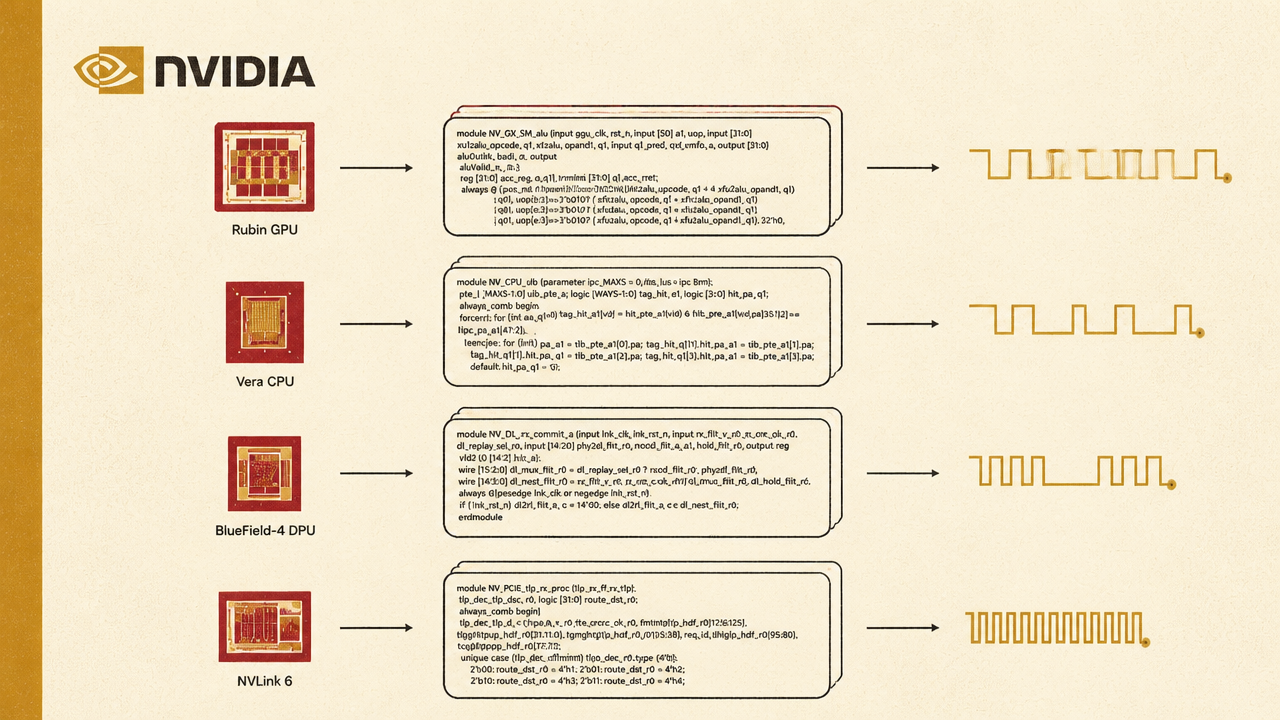
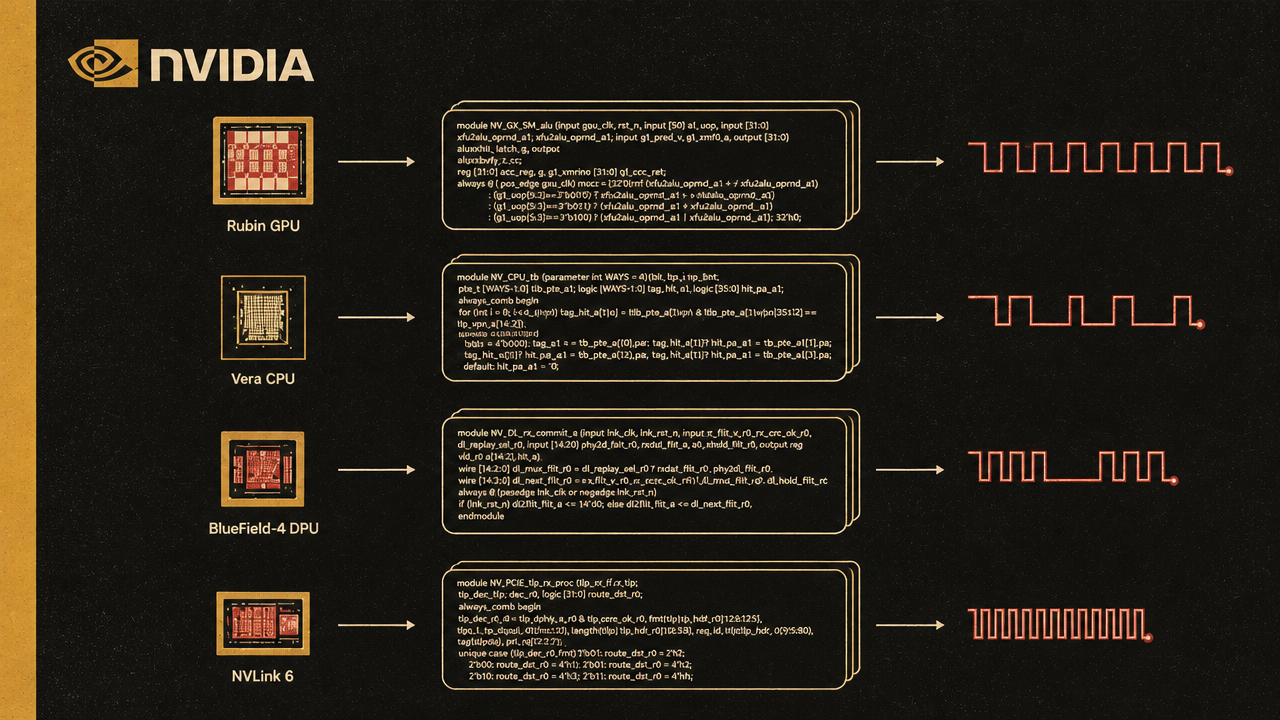
Cadence and NVIDIA offer the cleanest industrial example. They claim an autonomous verification stack built around Cadence ChipStack, Nemotron, Codex, and NVIDIA OpenShell can reduce RTL verification cycles from weeks to hours, a speedup of more than 40 times. The claim concerns the verification loop, not the entire chip-design process. But the loop is high consequence. RTL verification involves simulation, formal verification, debugging, regression testing, code repair, and human escalation when major design issues arise. Cadence and NVIDIA say a single bug can delay a chip by months.
This is exactly the kind of deployment Evans’s platform-shift frame points toward. The AI is not merely answering questions; it is entering a costly workflow where the organization must decide what can be delegated, what must be checked, and when humans must re-enter the loop. Cadence and NVIDIA present the system as a coordinated set of sub-agents: a unit-test agent, formal agent, RTL agent, mental-model agent, and orchestration layer. The significance is not only faster code generation. It is compression of a recurring engineering loop that sits inside the infrastructure buildout for AI itself.
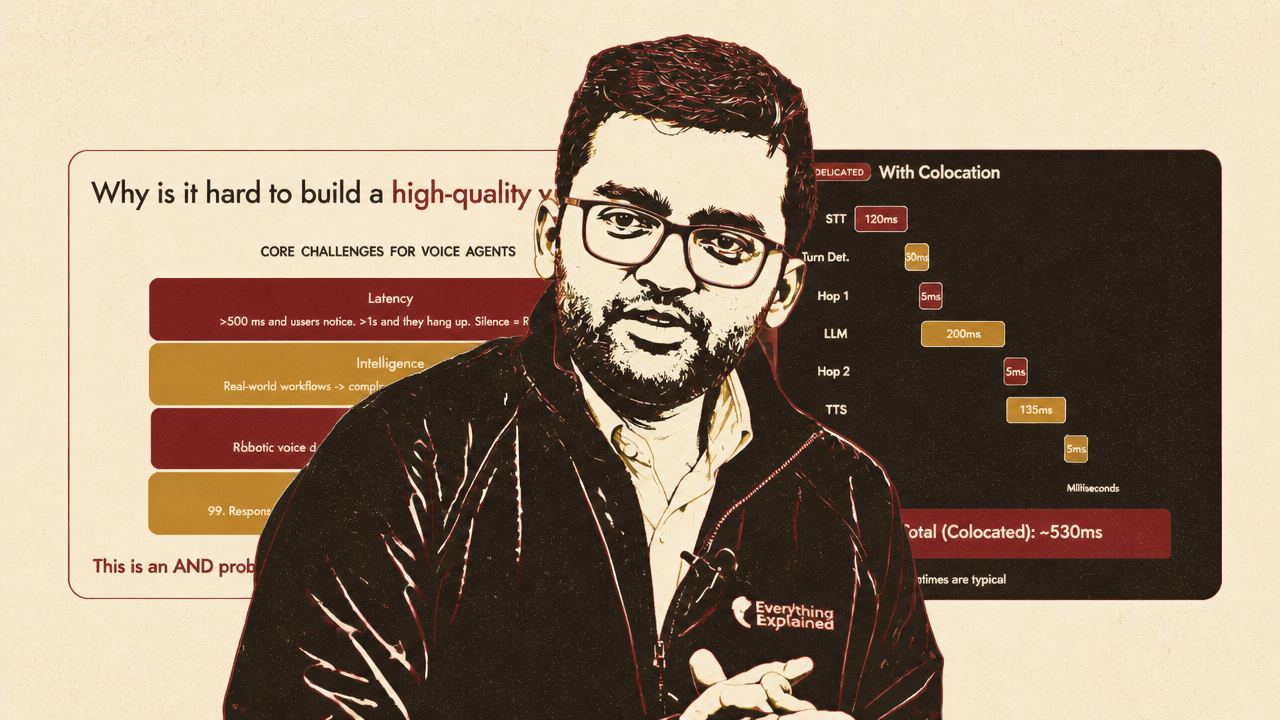
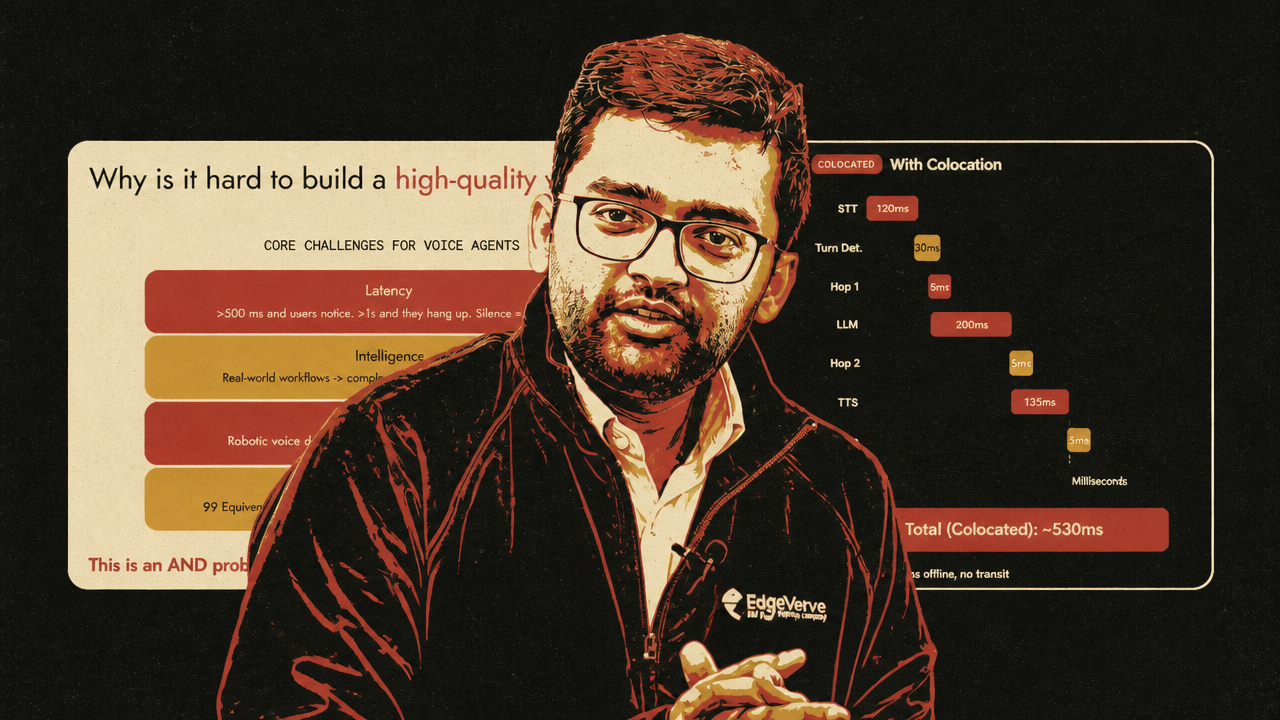
Voice agents show the same production turn from the user-facing side. Rishabh Bhargava of Together AI argues that voice agents are now constrained less by demos than by a sub-second engineering budget spanning speech-to-text, the LLM, text-to-speech, network latency, tool calling, turn detection, autoscaling, and observability. His framing strips “agent” down to operating requirements. A voice agent must be fast, intelligent, natural, and reliable at the same time. If one dimension fails, the product fails.
The latency numbers make that concrete. Bhargava says users begin noticing delays above 500 milliseconds and may abandon calls around one second. In human conversation, silence is interpreted as failure. The dominant production architecture remains a cascade: streamed audio enters an orchestrator, moves through speech-to-text, turn detection, an LLM, and text-to-speech, then returns as streamed audio. Speech-to-speech models promise a cleaner future, but Bhargava says many production teams still return to pipelines because they need control over instruction following, tool calling, evaluation, and reliability.
The detail that matters for applied AI is colocation. Once component models are fast, network hops become material. Bhargava’s example compares a distributed pipeline with three 75-millisecond hops, adding 225 milliseconds of network time, against colocated services with three 5-millisecond hops, adding 15 milliseconds. The total time to first audio falls from roughly 710 milliseconds to roughly 500 milliseconds. That is not a model breakthrough. It is infrastructure design deciding whether the user experience feels usable.
NVIDIA’s RTX Spark pitch extends the same logic to the PC. The company is positioning RTX Spark not just as a faster Windows chip but as a local AI runtime for persistent agents. NVIDIA describes a Blackwell RTX GPU, custom Grace CPU, 128 GB of LPDDR5X unified memory, NVLink C2C, and close collaboration with Microsoft around a Windows platform for agents. The pitch is that agents will run natively, connect to local or cloud models, remain sandboxed, run continuously, and handle substantial workloads on device.
This local-runtime argument connects the industrial and user-facing cases. Chip verification agents compress hardware-design loops. Voice agents depend on low-latency model orchestration. PC agents require memory, local inference, sandboxing, and operating-system integration. In all three, the question is no longer whether a model can produce a plausible answer in a demo. It is whether the surrounding system can operate inside the constraints of the workflow.
| Deployment | Production constraint | Why it matters |
|---|---|---|
| RTL verification agents | Simulation, formal verification, debugging, code repair, and escalation must work inside chip-development controls. | A single bug can delay a chip by months; automation must compress the loop without erasing engineering accountability. |
| Voice agents | Speech, LLM, TTS, networking, tool calls, turn detection, and scaling must fit a sub-second interaction budget. | Users interpret latency as failure; architecture and colocation shape product viability. |
| Local PC agents | Hardware, memory, OS integration, sandboxing, and cloud/local model choice must work together. | The PC becomes a possible edge runtime, not just a terminal for cloud models. |




Safety moves from model scores to behavioral boundaries
Once agents enter production workflows, ordinary model evaluation becomes too thin. A chatbot that answers a question incorrectly is one risk. An agent with permissions, tools, and infrastructure access is another. Steven Willmott of SafeIntelligence argues that larger models are not automatically safer agents because the same capability that helps them understand legitimate tasks can also help them understand adversarial wrappers, hidden instructions, and misuse opportunities.
His jailbreak example is a poem containing malicious instructions. A weaker model may fail to extract the instruction. A stronger model may understand the poem, infer the concealed request, and execute the harmful behavior. In that case, “smarter” does not map cleanly onto “safer.” The attack surface expands with capability and with scope: an agent authorized to answer basic support questions is different from an agent able to change account records, issue refunds, book meetings, or wire money.
That framing connects directly to the production examples. A chip-verification agent needs boundaries around what it can change and when it escalates to engineers. A voice agent needs rules for tool calls, identity, account access, and user state. A local PC agent needs sandboxing and clear limits on document access, system changes, and persistence. The safety artifact cannot be only a benchmark score. It has to describe what the agent is allowed to do in the domain where it operates.
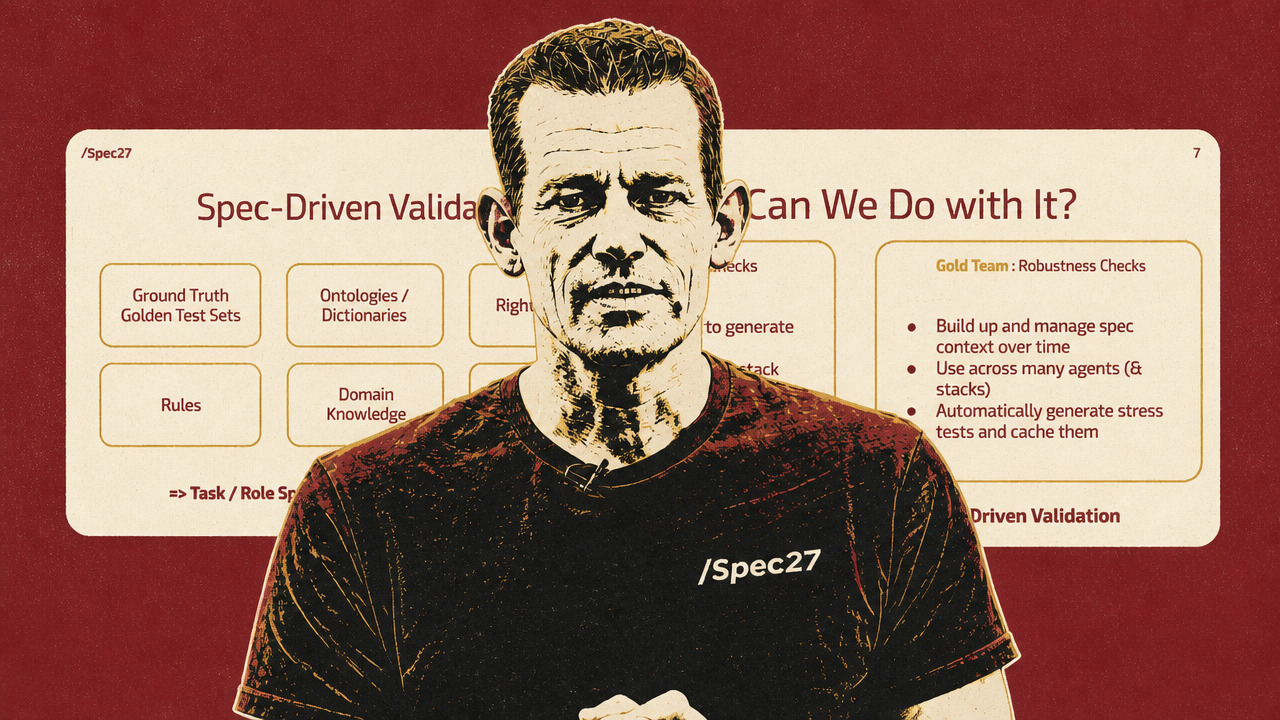
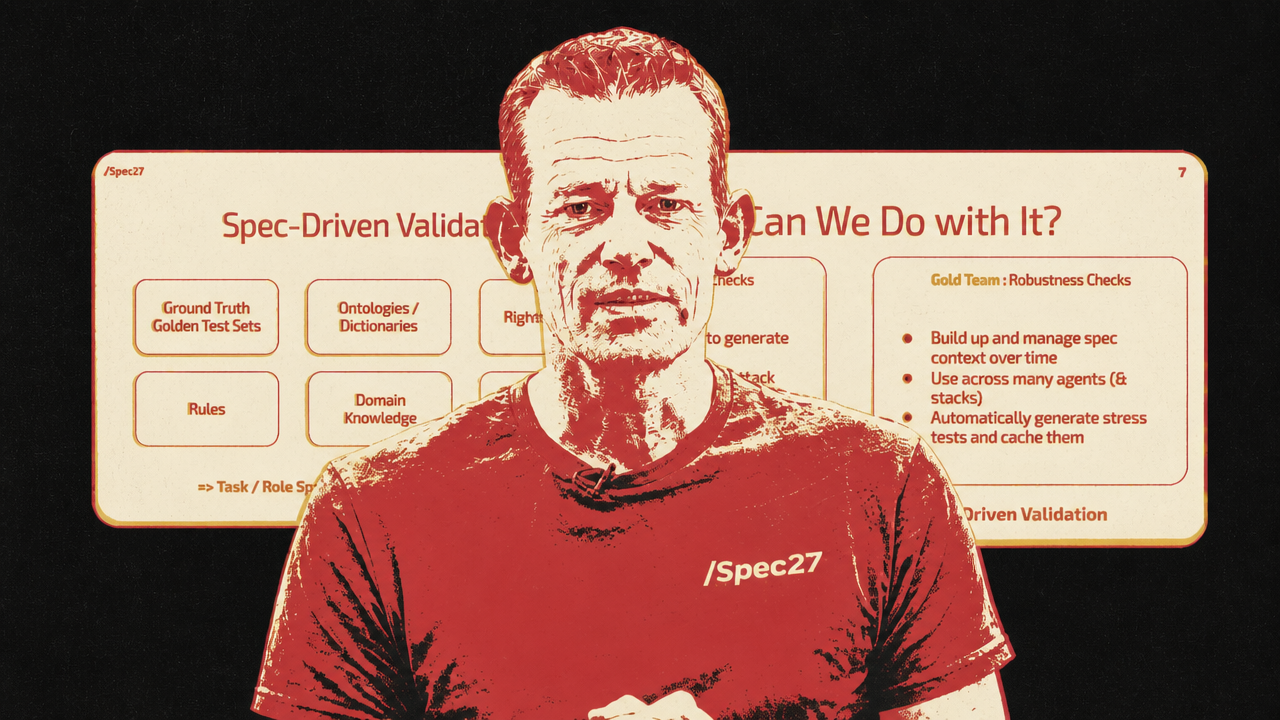
Willmott’s proposed answer is spec-driven validation: an implementation-independent behavioral specification that defines the task, role, permissions, domain boundaries, rules, ground truth, ontologies, domain knowledge, and robustness requirements. The spec is not the model. It should outlive the current model and framework, much as integration tests, unit tests, and penetration tests can be rerun when the implementation changes.
Spec-driven validation matters because datasets usually show examples of desired behavior without fully defining the perimeter of allowed behavior. A customer-support dataset may include correct refund answers, but the spec must say who is eligible, what the refund window is, what discount cap applies, which products and stores exist, how logged-in and logged-out users differ, and how robust the agent must be to typos, rephrasings, or context shifts.
| Spec element | What it contributes | Why it matters for agents |
|---|---|---|
| Ground truth | Known good examples and expected outcomes | Keeps evaluation anchored in real task behavior. |
| Rules | Policy limits such as refund windows or discount caps | Turns business constraints into testable boundaries. |
| Rights and roles | Permissions by user state or account privilege | Prevents the same request from being treated identically across different authority levels. |
| Ontologies and dictionaries | Valid products, locations, destinations, terms, or entities | Defines the domain universe rather than relying on plausible language alone. |
| Domain knowledge | Context-specific distinctions such as gross profit versus gross sales | Tests whether the agent respects specialized meaning. |
| Robustness requirements | Typos, rephrasings, mobile-style messages, and context variation | Shows whether behavior survives realistic input variation. |
Gawdat’s institutional warning is relevant here without needing to adopt his forecasts. His concern is that organizations will deploy AI through incentives of cost-cutting, control, surveillance, and speed. Willmott offers a practical countermeasure at the deployment layer: make permissible behavior explicit and testable before agents are released into systems where they can act.
That does not settle political questions about who writes the specs or what values they encode. It does, however, mark an important shift in applied-AI safety. As agents move from chat windows into chip design, call handling, PCs, enterprise workflows, and local infrastructure, safety work has to move from general model scoring toward domain-specific behavioral boundaries.
Public legitimacy depends on who defines the purpose
Madhumita Murgia’s argument widens the question from systems design to public legitimacy. She treats AI as already shaping daily life, while warning that its future is being imagined too narrowly by the private companies that own and control much of the technology. Her objection is not that AI lacks public-interest uses. It is that the right to imagine those uses should not belong only to a handful of technologists and companies.
That is the normative counterweight to the infrastructure-heavy picture. Taiwan’s industrial stack asks how AI factories are built. Sarvam’s sovereign-AI argument asks who controls local language, data, models, and inference. Willmott’s safety argument asks what agents may do. Murgia’s question sits above all three: what should this infrastructure be for, and who gets to define the acceptable costs?
Her examples are deliberately public-facing rather than enterprise productivity cases. AI could help scientists study fragile ecosystems by pairing sensors, cameras, drones, and models with scientific judgment. It could support earlier medical intervention by analyzing biological risk and helping invent cures. It could help recover cultural history by deciphering ancient scrolls, restoring paintings, and making damaged records legible again.
Murgia does not present those as cost-free “AI for good” stories. Ecological AI carries planetary costs and could distract from direct protection of the Earth. Medical prediction and intervention raise questions about whether people will feel compelled to optimize and extend life rather than live it. Cultural recovery through digital systems could deepen dependence on digital life even as it makes lost material heritage more visible.
The question is not only who builds AI fastest, but who defines its purpose, costs, constraints, and acceptable uses.
That argument loops back to the opening disagreement. Evans’s platform-shift lens warns against assuming the first interfaces, companies, and business models are final. Murgia extends that uncertainty into public choice: if the future is not fixed, then the social imagination around AI should be broader than corporate roadmaps. Gawdat’s absorption-shock lens warns that deployment through existing incentives can intensify job compression, surveillance, weapons risks, and legitimacy problems. Murgia’s answer is not a policy framework, but a demand that the public be part of deciding which benefits are worth pursuing and which costs are unacceptable.
The applied-AI stack is hardening into factories, chips, PCs, data centers, APIs, agents, voice systems, safety specs, and national strategies. The social contract around that stack is not hardening at the same pace. AI is becoming operating infrastructure before ownership, permission, accountability, and purpose have settled.