NVIDIA Positions RTX Spark as a Local AI Runtime for Windows PCs
NVIDIA is pitching RTX Spark as more than a faster Windows PC chip: it says the Blackwell-and-Grace “superchip” is the hardware basis for a new class of personal AI computers built around local agents. Developed in close collaboration with Microsoft, the platform is framed as a Windows architecture for agents that can run natively, use local or cloud models, remain sandboxed, and handle substantial on-device AI workloads alongside creation and gaming.
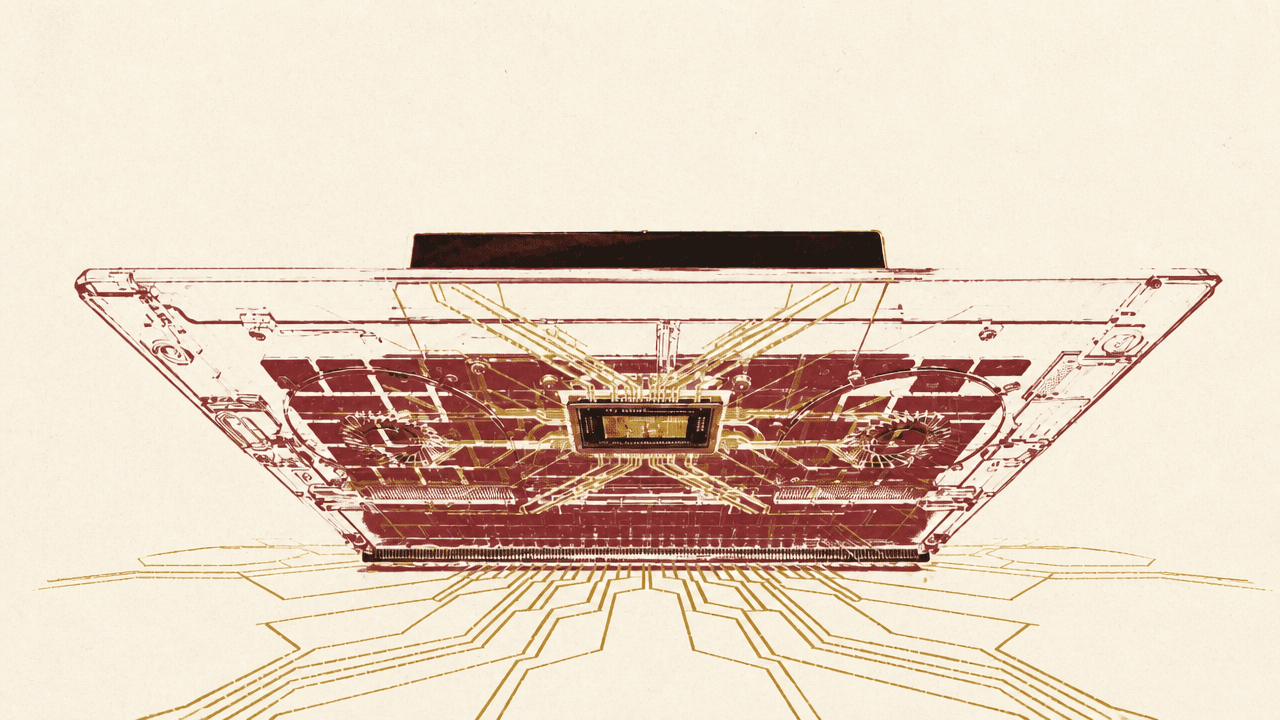
NVIDIA frames the next PC around local agents
NVIDIA’s claim for RTX Spark is not simply that a new chip makes Windows laptops faster. The company presents it as a redesign of the personal computer around AI agents: software that can run natively, connect to models locally or in the cloud, remain sandboxed for security, run continuously, and “get work done.”
The opening question is explicit: “What becomes of our personal computer in a world of agents?” NVIDIA’s answer is architectural. If agents are to become a persistent part of personal computing, the company says “the chips and the OS must evolve.” RTX Spark is positioned as that hardware shift, paired with what NVIDIA calls, in close collaboration with Microsoft, “a Windows platform for agents.”
The examples shown are not generic chatbot screens. One on-screen interface depicts a node graph for “Comprehensive dataset documentation for exploration,” with connected categories and labels including “Discovery,” “Data Analysis Agent,” “Literature Review Agent,” and “New Finding.” Another shows a diagnostic workflow around DNS resolution and routing, including the visible warning: “VPN Full-Tunnel Routing Breaks Microsoft 365 / Outlook Modern Authentication.” The visuals illustrate the kinds of agent-adjacent workflows NVIDIA wants to associate with the platform: data documentation and analysis on one side, network diagnosis and remediation on the other.
Agents running natively. Connected to models. Local or in the cloud. Our personal AI. Sandboxed for security. Running continuously. Getting work done.
The resulting PC is framed as a local AI computer: a machine with enough memory, GPU throughput, and Windows agent-platform support to run substantial AI workloads on-device while still reaching cloud models when needed.
RTX Spark combines Blackwell graphics, Grace CPU cores, and unified memory
NVIDIA describes RTX Spark as “everything we’ve learned over 33 years, distilled into one chip.” The chip combines a Blackwell RTX GPU, a custom Grace CPU, and a large unified memory system connected by NVLink.
The GPU specification shown on screen is a “NVIDIA Blackwell RTX GPU” with 6,144 CUDA cores and “1 petaFLOP FP4 AI Performance.” NVIDIA then identifies the CPU as a “20-Core Grace CPU,” custom built with MediaTek. The memory system is described as “Unified Memory With NVLink C2C,” with 128 GB of LPDDR5X and 600 GB/s GPU-to-CPU bandwidth, displayed as “5X PCIe Gen 5.”
The source also states that the chip uses TSMC’s 3 nanometer process and contains 70 billion transistors.
| Component or capability | Specification shown or stated |
|---|---|
| GPU | NVIDIA Blackwell RTX GPU |
| CUDA cores | 6,144 |
| AI performance | 1 petaFLOP FP4 |
| CPU | Custom 20-core Grace CPU built with MediaTek |
| Memory | 128 GB LPDDR5X unified memory |
| Interconnect | NVLink C2C |
| GPU-to-CPU bandwidth | 600 GB/s, shown as 5X PCIe Gen 5 |
| Process | TSMC 3 nanometer |
| Transistors | 70 billion |
NVIDIA does not present RTX Spark as a conventional split between CPU memory and discrete GPU memory. It presents a fused chip intended to let AI, graphics, and creator workloads draw on 128 GB of unified memory. That specification is later tied to the displayed agent claim: “120B Parameter Agents With 1M Context.” In NVIDIA’s product framing, the memory capacity is part of what makes the “personal AI computer” plausible: not just a PC that calls remote models, but one built to handle substantial local AI workloads alongside graphics and media tasks.
The Windows PC pitch extends from agents to creating and gaming
Although agents are the strategic frame, NVIDIA does not limit RTX Spark to agent workflows. The company presents it as the basis for a new class of Windows PCs spanning creation, gaming, and local AI.
The laptop design shown is described as a “Peak Efficiency Max-Q” system with a tandem OLED G-SYNC panel, a 14 mm thin chassis, and all-day battery life. NVIDIA’s source description also says RTX Spark powers “the slimmest, most beautiful RTX laptops ever and small, ultra-efficient desktops,” while the visible sequence emphasizes laptops.
For creators, NVIDIA shows a laptop running a complex 3D environment and lists two workload claims: rendering 90 GB 3D scenes and editing 12K video with 4:2:2. For gaming, the displayed claim is “100 FPS 1440p Gaming” with ray tracing and DLSS.
The agent-specific capability shown later is more explicit: “Purpose-Built for Agents,” with “Full NVIDIA AI Stack,” “120B Parameter Agents With 1M Context,” and “Windows Agent Framework.” Those claims tie the earlier hardware specifications back to the agent premise. NVIDIA is presenting memory capacity, GPU AI performance, and Windows integration as parts of one platform: a personal computer intended to create, play, and run agent workloads locally.
The platform claim depends on Microsoft as much as silicon
NVIDIA says it is “reinventing the personal computer” for the first time in 40 years. RTX Spark is presented as the starting point of that reinvention, not merely a faster RTX part.
The hardware claims explain why the pitch is not confined to raw performance, but the platform claim depends on Windows integration. NVIDIA says RTX Spark is being developed “in close collaboration with Microsoft” for “a Windows platform for agents,” and the visual materials refer to a “Windows Agent Framework.” In NVIDIA’s framing, the future Windows PC is not only a place where AI applications are launched. It is a platform where local agents, cloud-connected models, graphics, media creation, and gaming are meant to share the same personal-computing foundation.
The displayed “120B Parameter Agents With 1M Context” claim makes the local-agent ambition concrete. NVIDIA is saying these PCs are meant to support very large agent workloads as part of the machine’s native role, alongside RTX creating and gaming.