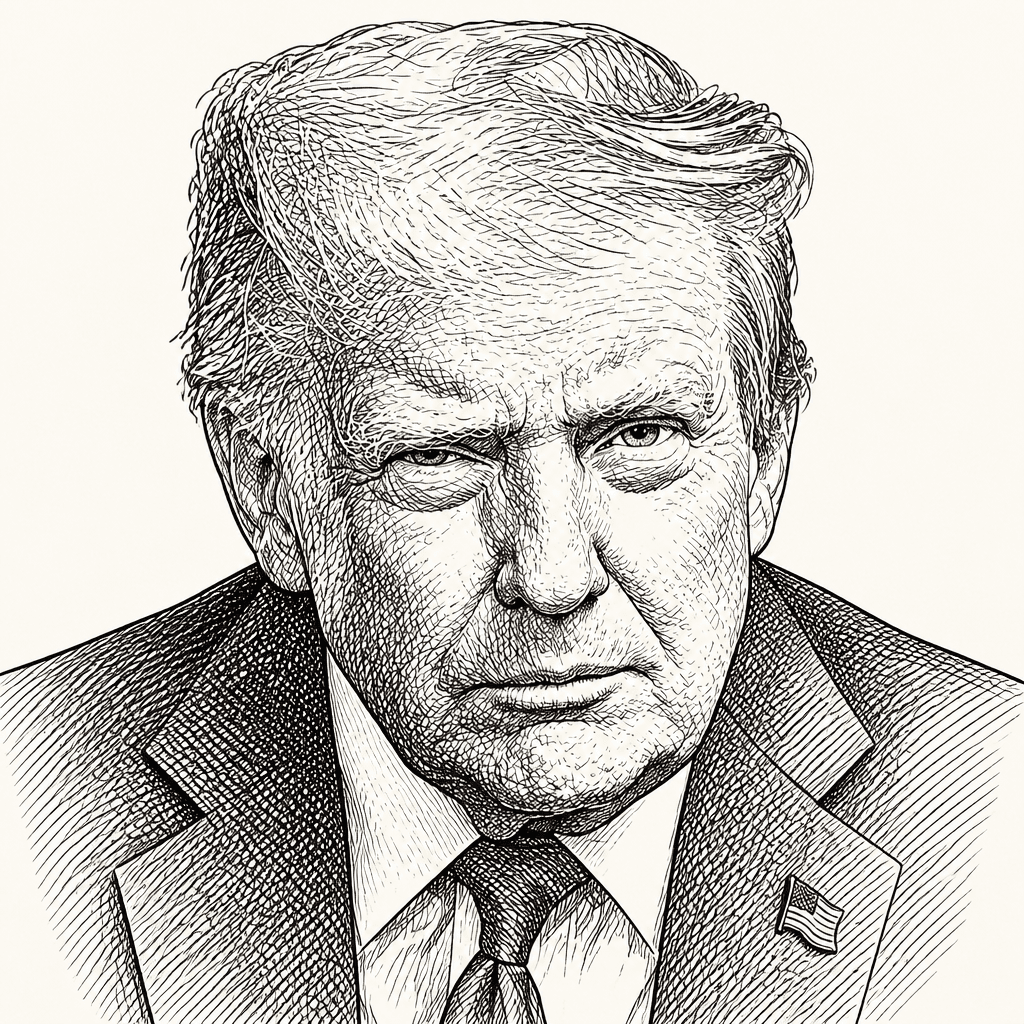
Donald Trump
47th president of the United States. In January 2025, he described China’s DeepSeek AI release as a wake-up call for U.S. industry and urged a focus on competing in AI.
AI Leadership Will Be Decided by Deployment, Not Model Ownership
Nvidia chief executive Jensen Huang argues that AI policy should target demonstrable failures at frontier labs rather than catastrophic forecasts he calls ungrounded. In a discussion joined briefly by President Donald Trump, Huang says US leadership will depend less on owning every important model than on deploying AI broadly through open and closed systems, compute, power, data centers and industrial capacity. He also contends that “superintelligence” already exists in bounded applications such as autonomous driving and protein science, making practical deployment—not speculative thresholds—the central challenge.
Frontier AI Pacing Proposal Pits Safety Oversight Against Competition
Dario Amodei’s call to “pace the frontier” would place outside evaluators and government-backed co-operation inside a competitive AI race, raising questions about antitrust, incumbent advantage and whether restraint can be made credible internationally. John Coogan says the plan seeks institutional safeguards across frontier labs and coordination with China, while David Sacks argues that companies concerned by their own models can slow development voluntarily rather than seek Washington’s approval for collective action. Gavin Baker, relayed by Jordi Hays, presents documented duty of care and third-party review as a possible source of accountability in future liability cases.
Germany’s Industrial Model Is Buckling Under Energy Costs and Chinese Competition
Germany’s industrial model has become a drag on growth, Bloomberg’s Marilen Martin argues, as the advantages that sustained it—cheap Russian gas, open global trade and leadership in high-value manufacturing—have eroded. Economist Martin Ademmer says the decline in output since 2018 increasingly reflects a lasting loss of economic potential rather than a cyclical downturn. Higher energy costs, Chinese competition and a more protectionist trading environment now leave Berlin trying to defend industry with limited fiscal and political room to maneuver.
A Super El Niño Threatens Crops, Shipping and Energy Systems
A potentially historic El Niño is unfolding in a world already 1.4°C warmer than before industrialisation, creating conditions in which a natural Pacific cycle can intensify heat, drought and flooding and carry local shocks into the global economy. Akshat Rathi says the added ocean heat can make existing extremes more severe; in Panama, reduced rainfall has already prompted cargo limits at the canal, threatening to disrupt trade flows and energy markets beyond the country.
Russian Arms Demand Drove North Korea’s $22 Billion Windfall
Bloomberg Economics estimates that North Korea earned as much as $22 billion abroad from 2022 to 2025, nearly four times its revenue in the previous four years, despite sweeping sanctions. The source argues that Russia’s demand for weapons has supplied the largest windfall, while cryptocurrency theft and trade with China provide convertible currency and essential imports. Adam Farrar says the result is not broad prosperity but greater capacity for Kim Jong Un’s regime to fund military modernization and preserve its rule.
Alien Life Is Probable, but UFO Claims Still Lack Physical Evidence
Neil deGrasse Tyson, the astrophysicist and Hayden Planetarium director, argues that the scale and chemistry of the universe make alien life highly probable, but says claims of alien visitation still require physical evidence. In a Diary of a CEO interview built around his book Take Me To Your Leader, Tyson applies the same standard to UFO footage, whistleblower testimony, religion, psychedelics and simulation theories: uncertainty is not proof, and belief should not outrun what can be measured.
FIFA’s Expanded World Cup Pushes Costs Onto Fans and Host Cities
Bloomberg argues that the expanded 2026 World Cup is built to generate record revenue for FIFA while shifting much of the cost and risk onto fans and host cities. The tournament’s 48-team, three-country format creates more matches, broadcast inventory and ticketing opportunities, but dynamic pricing, resale fees, transport costs, visas and security obligations are making attendance and hosting more expensive. The result, the piece says, is a World Cup marketed as a mass global event while increasingly priced and managed like a premium spectacle.
Oregon Lawyers Challenge ICE Detentions That Outrun Access to Counsel
Bloomberg Investigates follows Portland-based Innovation Law Lab as it challenges the Trump administration’s immigration enforcement in court and tries to free detainees before transfer or fast-track deportation makes relief harder to obtain. The lawyers’ central argument is that due process is being eroded not only by arrests and detention, but by speed: immigrants may have formal rights, they say, yet be unable to exercise them without timely access to counsel. DHS disputes that account, saying ICE does not deny counsel as a matter of policy and that any denials are isolated or justified.
ICE Courthouse Arrests Turn Case Dismissals Into Fast-Track Deportations
Bloomberg Investigates follows Portland legal aid group Innovation Law Lab as it challenges the Department of Homeland Security over President Donald Trump’s deportation campaign. The lawyers argue that ICE is turning immigration court appearances into arrest opportunities by seeking dismissals, detaining people after hearings and moving them into faster deportation proceedings with fewer rights. Executive director Stephen Manning frames the fight as a due-process battle over whether immigrants can still use the legal system without being exposed to detention.
AI Competition Shifts From Models to Chips, Power, and Supply Chains
Bloomberg Technology framed the latest AI race less as a contest over individual products than as a fight over infrastructure constraints, from Nvidia chip export politics and U.S. semiconductor labor to cloud spending, energy, memory and data-center capacity. Ed Ludlow, Caroline Hyde and Bloomberg reporters treated Donald Trump’s discussion of Nvidia’s H200 chips with Xi Jinping as emblematic of that shift: significant for markets, but short of any clear export deal. The program’s interviews with Goldman Sachs’ Eric Sheridan, OpenAI CFO Sarah Friar and Figma CEO Dylan Field similarly argued that compute, distribution and ownership of the stack are becoming the decisive limits on AI growth.
Governments Commit $10 Billion to Loosen China’s Rare-Earth Grip
Bloomberg argues that China’s rare-earth power rests less on ownership of mineral deposits than on its dominance of refining and magnet production, the chokepoints that turn ore into components for cars, electronics and weapons. The report says Beijing has already used that position as leverage, including against Japan in 2010 and in renewed trade tensions with the US, where automakers warned that magnet shortages could shut factories. Western governments are now putting billions into alternative supply chains, but the article frames the realistic goal as diversification over many years, not independence from China.