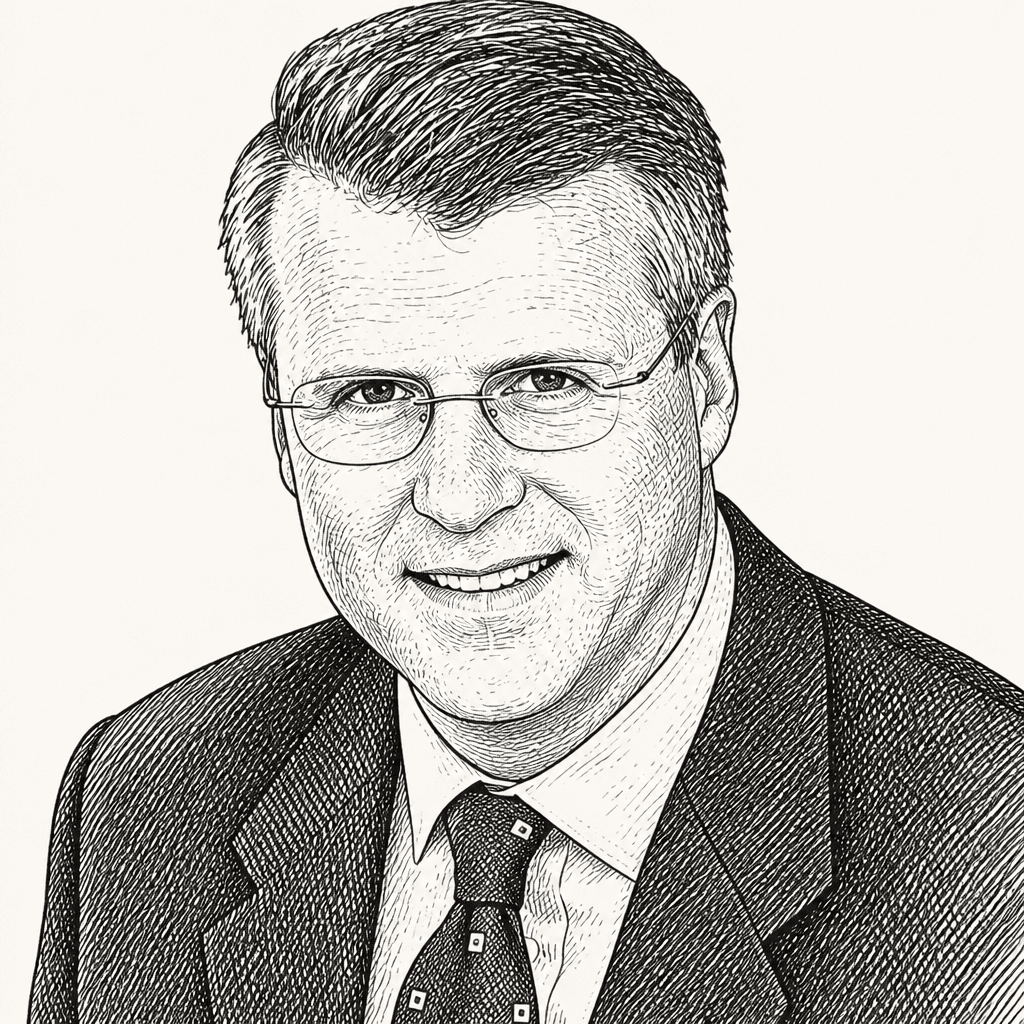
Peter Robinson
Murdoch Distinguished Policy Fellow at the Hoover Institution and host of its Uncommon Knowledge interview series. A former White House speechwriter for Vice President George H. W. Bush and President Ronald Reagan, he writes about business and politics and is the author of several books.
Churchill’s 1940 Decision Shows How Leaders Can Redirect History
Historian Andrew Roberts argues that broad economic and social forces set the conditions of history, but individual leaders can still determine its course in moments of crisis. In conversation with Peter Robinson, he presents Winston Churchill’s decision to fight on in 1940 as the clearest case, defends Churchill against recent accusations over war and empire, and contends that historical judgment depends on chronology, intent and close reading rather than political mythmaking.
Churchill’s 1940 Decision Shows How Leaders Still Shape History
Historian Andrew Roberts argues that Winston Churchill’s decision to keep Britain fighting in 1940 demonstrates why individual judgment can still redirect history, even amid the constraints of geography, economics and public opinion. In conversation with Peter Robinson, Roberts defends Churchill against charges ranging from racism to responsibility for the Bengal famine, while arguing that Churchill understood Nazism’s character more clearly than contemporaries willing to seek accommodation. His broader case is that, as wartime memory recedes, serious study of leaders’ choices is necessary to understand statecraft.
Charles Murray’s Evidence-Based Case for Taking Religion Seriously
Charles Murray, the social scientist and author of Taking Religion Seriously, argues that a lifetime of casual agnosticism has become intellectually untenable. In a conversation with Peter Robinson, he says evidence and questions that materialism does not resolve—especially consciousness, near-death experiences, the historical grounding of the Gospels, and the Shroud of Turin—have led him to take God and Christianity seriously, though not to claim settled faith. Murray’s case is cumulative: religious belief, he argues, should be judged for its truth rather than defended merely for its civic utility.
The Founding’s Strength Is Its Capacity for Self-Correction
Victor Davis Hanson argues in an Uncommon Knowledge interview with Peter Robinson that the American founding should be judged less by the country’s failures in 1776 than by the standard and structure it created for correcting them. Hanson says the Declaration’s equality claim gave abolitionists and civil-rights leaders a principle to wield against slavery and racial hierarchy, while the Constitution’s checks and balances were built for flawed human beings, not enlightened rulers. His defense of the founding extends to federalism, institutional restraint, and ordered liberty as the system’s answer to both administrative rule and calls for refounding.
Soviet Power, Not Popular Support, Put Mao in Control of China
Hoover Institution historian Frank Dikötter argues that Mao’s conquest of China was not the triumph of a popular peasant revolution but the result of Soviet sponsorship, wartime opportunity, American misjudgment, and Communist coercion. Drawing on Chinese Communist Party internal materials and Russian Comintern records, Dikötter says the party was marginal for much of its early history, repeatedly sustained by Moscow, and later legitimized by myths that still shape Western accounts. He connects that history to the present, arguing that a regime unable to examine its origins remains governed by paranoia and insecurity.
America Remains Dominant If It Stops Defeating Itself
Stephen Kotkin argues that the United States remains the world’s dominant power, not a late-stage empire in British-style decline, but that it risks weakening itself through overextended commitments, depleted military capacity, damaged alliances, and domestic institutional decay. In a Hoover Institution Uncommon Knowledge interview with Peter Robinson, Kotkin applies that argument to Iran, China, Ukraine, and America’s internal politics: Washington can still deter rivals and lead allies, he says, if it stops treating postwar exceptional dominance as the normal measure of American power.
America Must Rebuild Defense Manufacturing to Arm Allies Against China
Anduril founder Palmer Luckey tells Peter Robinson that the United States should stop acting as “the world police” and instead become a far more capable “world gun store,” arming allies that are willing to fight for themselves. His case links defense procurement, autonomous weapons, manufacturing capacity, China, patents, and Silicon Valley culture into one argument: America cannot deter its rivals if it keeps rewarding slow weapons programs, outsourcing real engineering, and treating national loyalty as optional.