America Must Rebuild Defense Manufacturing to Arm Allies Against China
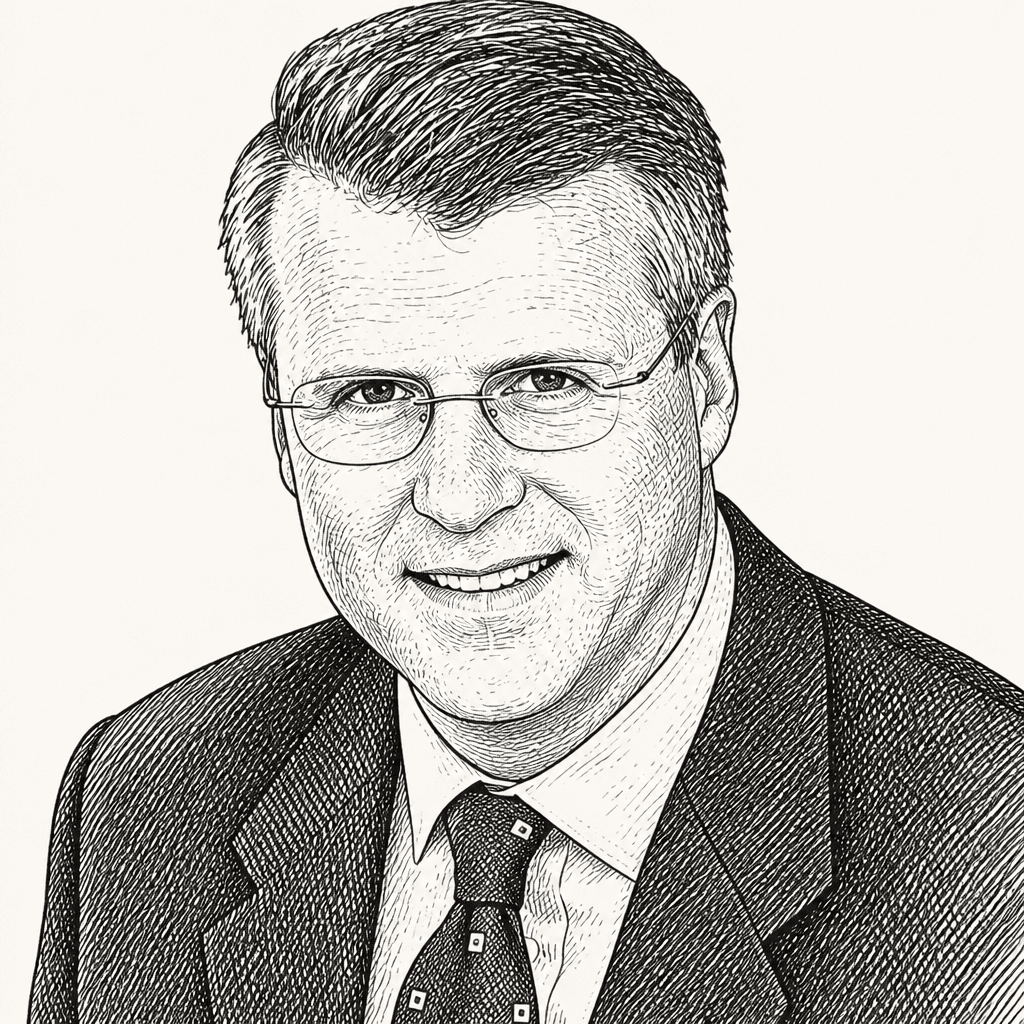

Anduril founder Palmer Luckey tells Peter Robinson that the United States should stop acting as “the world police” and instead become a far more capable “world gun store,” arming allies that are willing to fight for themselves. His case links defense procurement, autonomous weapons, manufacturing capacity, China, patents, and Silicon Valley culture into one argument: America cannot deter its rivals if it keeps rewarding slow weapons programs, outsourcing real engineering, and treating national loyalty as optional.

America should arm allies, not fight their wars for them
Palmer Luckey’s foreign-policy premise is blunt: the United States, he says, should stop trying to be “the world police” and become “the world gun store.” The distinction changes the central obligation from dying for other countries to equipping them to defend themselves.


Luckey does not argue that the United States should never act abroad. He leaves room for cases where intervention serves U.S. interests. But as a general rule, he says, it does not make sense for Americans to die for “a country or a form of government” that is not directly aligned with U.S. interests if the people in that country are not willing to fight for it themselves. He points to Afghanistan as evidence: once the United States withdrew, he says, the system America had spent years defending did not hold because the people there “didn’t really care much to maintain what we had been saying was what they wanted the whole time.”
The “gun store” analogy is also an indictment of American execution. If the United States wants to be the supplier that allies and partners rely on, Luckey says, it has to behave like a serious store: deliver on time, keep inventory in stock, and recognize that it is no longer the only store available. Countries can buy from China and Russia. The United States, in his view, cannot keep acting as though customers have no alternatives.
There is a strategic objection embedded in the analogy, and Luckey acknowledges it. One could argue that the United States should keep tight control of advanced weapons, not sell them broadly, and not assume countries such as Japan or Germany should be trusted to build their own military capacity. He calls that a “reasonable critique.” But he argues that the practical constraint is decisive: the United States does not have the political will for another large, long ground war fought for someone else.
He goes further. He says he does not think America has “another D-Day” in it, even for a just cause. His reason is not that Americans are incapable of sacrifice in the abstract, but that recent experience has made the public deeply skeptical of open-ended intervention. Wars can begin as morally compelling causes, he says, and become 20-year, multi-trillion-dollar slogs with diffuse benefits, broken highways at home, and jobs people still do not have.
If you're going to be the world's gun store, you need to do things that a store would generally do to stay in business.
That is the frame for Luckey’s defense-industrial argument: America’s role in the world has to be matched by a production system capable of arming countries that are willing to fight for themselves, quickly enough and cheaply enough to matter.
Anduril was built against the incentives of cost-plus defense
Luckey’s explanation for founding Anduril starts before Oculus. As a teenager, he says, he worked in an Army-funded research center on BRAVEMIND, a virtual-reality exposure-therapy program for veterans with PTSD. The USC Institute for Creative Technologies material shown in the discussion described BRAVEMIND as a VR exposure-therapy system shown in multiple clinical trials to reduce PTSD symptoms, including across VA, Defense Department, and university clinical test sites.
That work, Luckey says, was his first exposure to how technology could matter directly to people in the military. It was also where he first saw how badly defense procurement worked. His critique centers on cost-plus contracting: a model in which, as he describes it, companies make more money when programs take longer, use more material, and cost more. In that system, nobody in academia or industry was strongly interested in cutting production time or product prices in half. If a company turns a $6 million product into a $3 million product, he says, it is “literally just losing money.”
The money from Oculus gave him a chance, in his telling, to do something about that incentive structure. The other motive came from Silicon Valley. After Facebook acquired Oculus, Luckey spent several years in the Valley and concluded that a “national divorce” was taking place between the technology industry and the national-security apparatus. That divorce, he argues, was historically abnormal. Silicon Valley itself had been started and funded around Defense Department projects, and the United States had traditionally had its most innovative people working on national-security problems.
Luckey describes the alternative as dangerous: technology companies refusing to work with the military while remaining vulnerable, in his view, to foreign pressure. He singles out the inconsistency of companies that claim to value identity and representation, then ignore or downplay Taiwan when China is involved. Anduril, he says, was meant to “save taxpayers hundreds of billions of dollars” and move talented people out of advertising and entertainment companies into work on tools that could hold adversaries at bay.
The operating distinction he draws between Anduril and the large defense primes is not that the primes build nothing useful. Luckey says they build “cool products,” have long histories, and often work with Anduril. The difference is that Anduril is a product company. It uses its own money to decide what to build, builds it, and then sells it to the government. Luckey presents this as normal in most of the U.S. economy and abnormal in defense.
To explain the failure mode of cost-plus, he compares it to residential renovation. If the job runs longer, the contractor makes more money; if subcontractor invoices grow, the general contractor’s percentage fee grows. Luckey sees the same incentive logic in defense. Under Anduril’s model, he says, the company makes more money when products get cheaper and when it delivers faster.
He says Anduril has put all revenue back into research and development, in contrast with other defense companies that, in his telling, put roughly 1% to 3% of revenue into internal R&D, with much of that cost-matched by the government.
Luckey concedes this cannot last forever. Investors eventually may expect returns outside R&D. But he says he has “pulled it off for eight years and change,” sees a roadmap for another four or five years, and believes U.S. capital markets will tolerate it as long as the company is growing. He compares the logic to Amazon’s long period without profits under Jeff Bezos: if a business is healthy and could “turn that switch,” investors may allow reinvestment.
When Peter Robinson presses him on revenue and valuation — citing roughly $1 billion in 2024 revenue, a projected $4.3 billion for the current year, and a valuation around $60 billion — Luckey responds that those figures capture only public projects. Anduril, he says, has “two showrooms”: one public, one government-only.
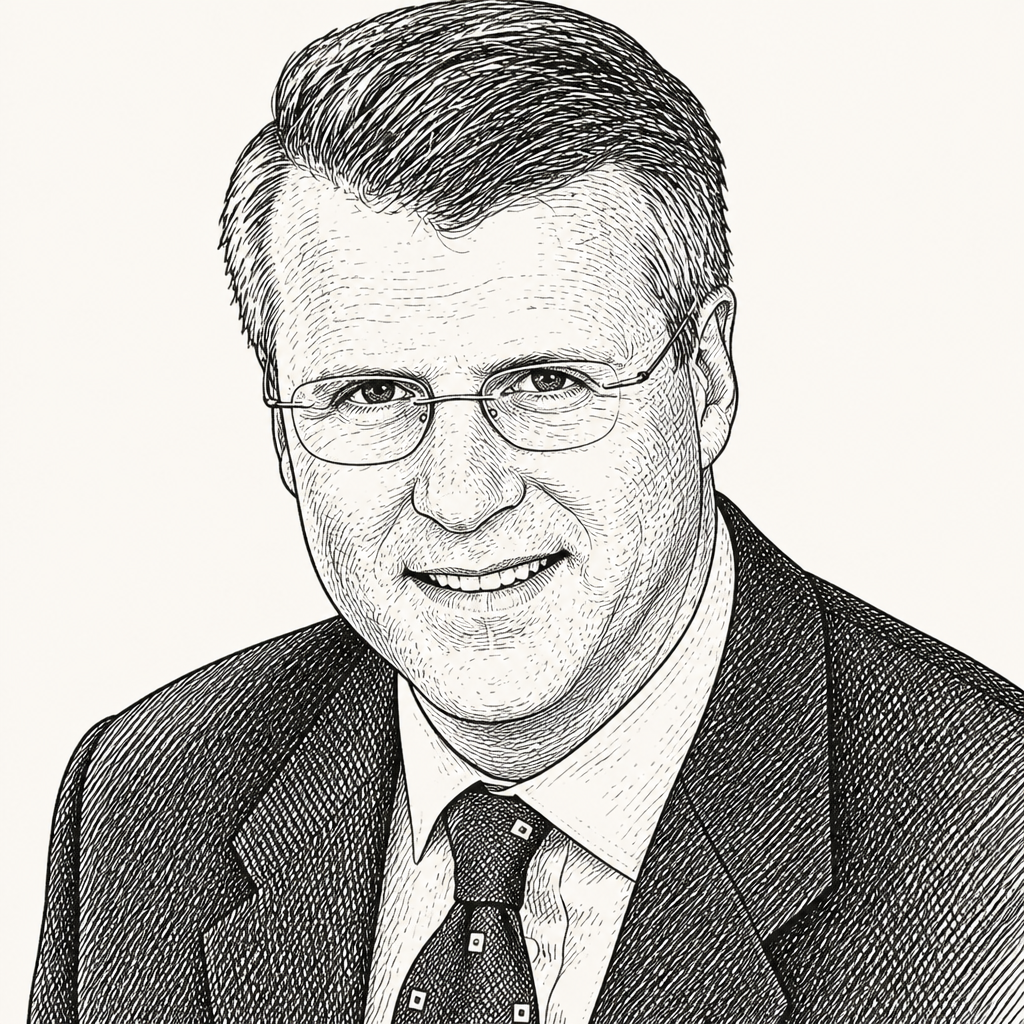

He says he is not worried about profitability because on Anduril’s most mature products the company makes about a 40% profit margin while selling at one-tenth the price of competitors. That is central to his claim: Anduril is not cheaper because it accepts lower margins. Luckey says it is cheaper in absolute terms and still more profitable, both in percentage terms and sometimes in absolute dollars, because competitors are often working under single-digit cost-plus contracts. The margin, he says, is being spent on products that may not make money for years but are important enough to fund now.
Autonomy changes the scale of the force, not every procurement rule
Asked to choose one Anduril product category, Palmer Luckey chooses the YFQ-44 Fury, which he calls the United States Air Force’s first autonomous fighter jet. A Hoover visual identified it as “Anduril’s YFQ-44 Fury ‘Fighter’ Drone,” showing a gray fighter-style aircraft in flight. Luckey says Anduril competed against Boeing, Lockheed, and Northrop Grumman for the contract and won after investing $900 million of its own money in the platform and factory. From signing the government contract to first flight, he says, took 556 days.
Luckey calls it the fastest new fighter-development program in a long time, then qualifies the claim: he found one Korean War example that “might have been as fast,” and World War II examples can be debated because they involved propeller aircraft and often derivatives rather than clean-sheet jet-age designs. The point, for him, is that the Air Force’s Collaborative Combat Aircraft program recognizes that newer companies can build systems of critical national importance. The government does not have to rely only on the traditional primes.
But Luckey resists the idea that everything should be built according to Anduril’s speculative product model. Nuclear aircraft carriers, he says, are too expensive to build privately in the hope the government buys one. There is no meaningful secondary market; the United States is not going to sell nuclear aircraft carriers to Russia, and even allies are not necessarily plausible buyers. He also cites the nuclear arsenal and bioweapon defense as areas where government involvement is necessary. A private bioweapons lab, he argues, would create disastrous incentives: a company that built a defense against a pathogen would also have reason to demonstrate how dangerous that pathogen could be.
The broader force-design claim emerges most clearly in his discussion of the Navy. Robinson describes a fleet of 11 carriers, just under 300 other surface combat ships, about 70 nuclear submarines, and only a handful of unmanned ships and small drone boats. Luckey says the United States cannot do much in three years; in five years, it can start making useful contributions; in 10 years, the “really interesting” changes become possible.
His target is not a 300-ship Navy but roughly 1,000 ships or more. That does not mean every vessel is unmanned. Some ships will be fully autonomous, but the more common change may be lightly manned ships whose jobs have been automated: an aircraft carrier with 120 people instead of 5,000, a destroyer with 50 instead of 1,000. The reductions would come from robotics, automation, and materials that require less constant maintenance, including anti-corrosion work.
Luckey’s personnel argument is straightforward. If the Navy has three times as many ships, it cannot have three times as many sailors. The training and maintenance burden also matters. A new ship cannot simply sit idle until war; it must be crewed, exercised, sailed, and sustained. In some cases, he says, doing nothing costs almost as much as fighting.
Autonomy could change that cost curve. Luckey describes a “Twinkie ship” concept: mostly autonomous ships built and then preserved in storage, wrapped in a protective environment such as a giant cellophane wrapper filled with argon gas. The point is not the wrapper itself, but the accounting. If the cost of a Navy could become closer to the cost of building ships, rather than maintaining, sustaining, and replacing them as they wear out in peacetime, the force could be much larger.
The 10-year vision is automated shipyard production, fewer or similar total personnel, higher-paid and more specialized sailors, and three to five times as many ships. In Luckey’s argument, autonomy matters less as a science-fiction substitute for humans than as the enabling condition for scale.
The Pentagon has learned to work with technologists who do not look like it
Peter Robinson frames the cultural problem through the older Silicon Valley of David Packard and Bill Hewlett. Robinson’s point is that their generation’s defense establishment and technology establishment shared assumptions about patriotism and America’s place in the world. Packard served as assistant secretary of defense in the Nixon administration. Hewlett served in the Second World War. In Robinson’s telling, they were “the same kinds of human beings with the same reading on the world.”
That is no longer the obvious arrangement. Today, Robinson says, much of the most interesting technological activity is in the private sector, outside the old military-industrial complex, while the Pentagon remains disciplined, hierarchical, and buttoned-up. The leaders of defense-technology companies may look and behave differently. Some, as Robinson puts it, wear Hawaiian shirts.
Luckey’s answer is that people rise to what is expected of them. A person who spent college “smoking pot” and coding for a tech company may respond differently once exposed to a serious national-security problem and a real briefing about the threat. Smart people, he says, can comprehend the stakes and “rise to the occasion.” That does not mean they stop wearing hoodies, but it can mean they stop working on advertising, video games, or other lower-stakes problems.
He also says the Pentagon has become more practical about talent that does not fit the traditional military mold. If officials only work with people who look and talk like them, they will miss useful capability. In fact, Luckey says the pattern matching may have gone a little too far in the other direction: a larger-than-life person with a mullet and a Hawaiian shirt may now do better than he should because some people expect breakthroughs from the caricatured outsider rather than the conventional engineer.
The cultural overlap between Anduril and the military is not only theatrical. Robinson notes that Anduril has about 7,000 employees. Luckey says about 4,400 are in California, and roughly 1,000 are service veterans — down from an earlier period when veterans may have represented about 30% of the company, to something closer to 15% or 20%. That is still far above what Robinson implies would be typical at a company such as Meta.
Luckey says Anduril does not hire veterans as “welfare.” It hires them because people with real-world military experience often understand the problems best, especially when they later acquire relevant technical training through the GI Bill or other routes. Veterans also shape the company’s field culture. Luckey says Anduril sends people far forward with its systems and has them iterate on features in the field. He says Anduril has people in the Middle East now, more than before a recent conflict started, and that the company had people and weapons in Ukraine in the second week of the war. Luckey says he went to Kyiv in the early days of the war to help train users on Anduril systems.
The point is less that Anduril resembles the Pentagon than that it tries to connect technical builders directly to the people and places where the systems are used. In Luckey’s account, veterans are one mechanism for making that culture real.
China’s advantage is manufacturing depth, not just military spending
Peter Robinson frames the China problem as an apparent mismatch between spending and outcomes. He says the United States has a Pentagon budget “upwards of 900 billion dollars” and describes Chinese spending as far below the U.S. level. The transcript contains an apparent spoken slip when Robinson gives an estimate in “million” rather than “billion”; the substantive question is why the United States is not clearly ahead despite spending much more.
Palmer Luckey first says the Pentagon could spend its money “50% better.” But he argues that China’s production advantage is much larger than that. Based on his experience making millions of virtual-reality headsets in China and visiting Shenzhen, Luckey says China can get “10X” value for some kinds of development work. A project that might cost $1 million in the United States could cost $50,000 or $100,000 there, he says.
He rejects the old explanation that the advantage is merely cheap labor. China automates many labor-intensive processes, and its people, in his account, are genuinely excellent. He specifically cites battery engineers, metallurgists, and optical engineers.
The deeper problem, he argues, is that American companies and universities have hollowed out real engineering capacity. U.S. engineering education, in his view, increasingly trains people to be high-level design shops: they assemble a design package that gets sent to China, where “the real engineers” figure out how to manufacture it. He applies this criticism even to mechanical and electrical engineering programs. Americans are becoming “architecture astronauts,” choosing components and laying them out nominally, while the hard work of building manufacturing lines, iterating boards through emissions and interference requirements, and making the product manufacturable happens in China.
Robinson summarizes the point as the inseparability of innovation and manufacturing. Luckey agrees and widens it: manufacturing, materials, and feedstocks all matter. If the United States does not control its raw materials and depends on its largest strategic adversary for the inputs that underpin its quality of life, he says, it is “fundamentally not in control” of its destiny.
He dramatizes the situation through a Cold War analogy. If a Tom Clancy-style novel during the Reagan era had imagined that, within 20 years, the Pentagon’s secure command-and-control terminals, information displays, and electronic devices would be made by the Soviet Union under Kremlin supervision and bought by the millions, Luckey says it would have been unbelievable even as fiction. Yet Luckey says something analogous is happening today. He specifically asserts that the Pentagon’s largest laptop manufacturer is Lenovo, which he describes as China-owned and headquartered beneath a flagpole bearing the Chinese Communist Party flag and the Lenovo logo.
China also has a narrower military problem. Luckey argues that Beijing is building one military for one purpose: invade Taiwan, occupy it through an amphibious landing, and then use remaining capacity to seize islands associated with Japan, the Philippines, and Korea. The United States, by contrast, is trying to build a force that can fight two to two-and-a-half fronts anywhere in the world, across every climate, terrain type, enemy type, and weapon system, while also solving allies’ problems. Luckey says he would rather have China’s problem.
Patents can become instruction manuals for adversaries
Because innovation is central to Robinson’s China question, he asks how America can keep China from stealing it. Luckey’s first answer is: stop patenting everything.
He calls patents “Chinese instruction manuals.” The current bargain, he argues, was not designed for a globalized economy in which the entire patent office can be downloaded every morning and used by an adversary. Western companies file patents to trade disclosure for temporary exclusivity. In practice, Luckey says, China can copy the disclosed invention immediately, while Western companies must wait roughly 20 years before they can legally copy it.
The result, in his view, is a repeated asymmetry: the United States pays the research-and-development costs, publishes the technical details, and lets adversaries use the information without paying the cost of discovery. He says he now gets very few patents, except occasionally for defensive reasons, because the patent system allows others to sue for infringement.
Luckey’s proposed solution is not to abolish intellectual property but to expand national-security patents. Classified patents already exist, he says: a person or company can maintain exclusive rights while being prohibited from publicly disclosing the invention. He wants that process massively expanded, along with the categories covered by mandatory national-security disclosure. During the Cold War, he says, sensors and microcomputer technology were covered by such rules because policymakers feared the consequences if the Soviet Union obtained the technology without paying the development cost.
In Luckey’s view, some artificial-intelligence patents filed by companies such as Google are of national-security importance and should not be publicly disclosed. He does not necessarily want every such invention fully classified or accessible only to cleared personnel. He suggests a broader, lower-bar regime in which access may require U.S. citizenship, a controlled location such as the Library of Congress, or an access card. He concedes spies may still get in. His goal is not perfect security but friction. Even one, two, or three years of delay could be worth the effort; one year alone, he says, would justify trying.
On zero-to-one innovation, however, Luckey still sees a U.S. advantage. Asked whether China can produce founders like him, he says the United States is “still kicking their butt” and that the gap is “not even close.” China does have exceptional people, including DJI founder Frank Wang, whom a Hoover visual identified as founder and CEO of DJI. Luckey describes Wang as a kind of Chinese Palmer Luckey: a polymath with strong technical understanding across lasers, engineering, self-driving cars, computing, AI, aerodynamics, and batteries. But he says such figures are rarer in China because the education system tracks people early and makes reinvention difficult. The system, in his phrase, produces fewer “queen bees” and many “worker bees.”
American capital markets are part of that difference. Luckey says his own path depended on Peter Thiel giving him $1 million when he was a 19-year-old with a minimum-wage job, no college degree, and a 19-foot camper trailer. That, he says, does not happen in China. He contrasts the U.S. system, where capital can flow in strange ways toward people with a chance to make a difference, with a more centrally planned Chinese system. DJI, in Luckey’s telling, succeeded partly because the Chinese government basically anointed it as the chosen drone provider and supplied technology transfers, free land, factories, manufacturing subsidies, and shipping subsidies into foreign markets.
The audience applauds the patent discussion, which Robinson notes as unusual. Luckey’s reply is the compressed version of his position: “Chinese instruction manuals, we have to stop it.”
Defense spending needs a surge now and a different cost structure later
Peter Robinson frames the budget question against Cold War levels. He says President Trump has proposed increasing the Pentagon budget from about $900 billion to $1.5 trillion, a more than 40% increase that would still amount to roughly 4% of GDP. During the first decades of the Cold War, Robinson says, the United States spent 8% to 10% of GDP on defense; under Reagan, spending stood around 5% when he took office, peaked at 7%, and was 6% when he left.
A Hoover chart shown during the discussion displayed U.S. defense spending as a share of GDP from 1985 to 2026, with annotations for the Cold War peak, the post-9/11 wars, the current era, and Trump’s budget proposal. The visual underscored Robinson’s point: the proposed increase sounds enormous in dollars, but smaller when compared with Cold War-era shares of national output.
Palmer Luckey jokes that he cannot say the proposed budget is too much money because he might get less of it. But his substantive answer is more conflicted. On the one hand, he says Anduril’s pitch deck opens with the claim that the company will save taxpayers hundreds of billions of dollars per year by making tens of billions per year. His long-run goal is a defense system that does more for less.
On the other hand, he argues that budgets are written around the weapons and force structure that actually exist, not the future systems one might prefer. The “Twinkie ship” Navy is not ready. The United States needs to respond to current threats, refill depleted magazines, and restore equipment that is corroded, out of service, or worn down. That includes not only missiles but ordinary small-arms ammunition. He says the military has “tons of weapons” in bad condition or depleted stocks.
Tomahawk missiles are his example of the transition problem. It may be possible to build a cheaper, more manufacturable replacement for a missile designed decades ago, but the existing force is built around Tomahawk: doctrine, ship launchers, training, and allies such as Japan. Replacing it would take years, and the replacement would require training, bug-finding, and integration. So while Luckey wants a more efficient future, he sees Trump’s proposed budget as a reaction to the world and force America has now.
His preferred path is a near-term surge to overcome accumulated rot, followed by a much smaller requirement later because the military has changed how it buys, builds, maintains, and stores weapons. “I hope that we can get a $1.5 trillion budget this year,” he says, “and I hope that 10 years from now, it’s a fraction of that.”
Luckey rejects the idea that military AI is inherently unknowable
Peter Robinson introduces a warning from Henry Kissinger, who wrote that a U.S.-China war involving artificial-intelligence weapons could become a world of “potentially total destructiveness” because no one could know what would happen when AI fighter planes on both sides interacted. Robinson says there is a serious anxiety around AI weapons and around people like Luckey building them.
Palmer Luckey says that fear is “very reasonable” when put that way, but he rejects Kissinger’s premise. Very smart people, including those speaking in or near their areas of expertise, can be wrong, he says. The idea that two AI fighter jets meeting in combat would produce unknowable behavior misunderstands the systems involved.
His distinction is between large language models and military autonomy. The AI associated with ChatGPT is non-deterministic, hallucinates, and can behave strangely. The systems used to fly a fighter jet or classify a ship, Luckey says, are radically different. He says software can be formally verifiable and can respond consistently and deterministically, even when it includes AI systems.
The example he gives is maritime identification. A fishing boat and a Chinese destroyer, he says, cannot be confused if the system uses thermal signature, visible outline, electromagnetic emissions, wave profile, wake profile, and other sensor data. He says he would bet his life on such detections. The public, in his view, imagines military AI through Hollywood: Terminator-like, free-form, sentient, self-interested, and less subordinate to human control than it is.
Luckey does not dismiss all AI risk. He says a future system that is truly sentient, conscious, self-evolving, self-teaching, and self-interested would be a different category. He invokes the Terminator line about a machine that “never sleeps” and “won’t stop until you’re dead,” but says that kind of AI is far away. It is not absent from his list of fears, but it is low on it.
The higher fears he names are biological: bioweapons tailored to kill particular ethnic or family lines, or AI-assisted development of bacteria that could destroy agricultural reserves. He also warns readers not to trust him uncritically. He is the person making billions from arms sales, he says, and his pitch deck explicitly says he wants to make tens of billions selling weapons for taxpayer money. People should “take everything I say with a pound of salt” and talk to the military operators developing doctrine for these systems.
He cites the Air Force’s Experimental Operations Unit, which he says is operating Anduril autonomous fighter jets and developing doctrine for future war. If Kissinger asked those operators whether two AI fighters meeting could lead to unknowable total war, Luckey says, they might be polite in the room, but their private reaction would be very different. Those, he argues, are the people to listen to.
The argument ends in national identity, not procurement
Peter Robinson’s final question turns from weapons to patriotism. He quotes Samuel Huntington’s description of “Davos Men”: transnational elites with little need for national loyalty, who see borders as fading obstacles and national governments as outdated facilitators of global operations. Robinson says he once looked around Silicon Valley and thought Huntington was right. He cites Mark Zuckerberg’s Harvard commencement language about global community, Google employees forcing the company to drop a Pentagon contract in 2018, and a recent Washington Post report shown in the discussion that more than 600 Google workers signed an open letter to the CEO expressing concern about negotiations between Google and the Pentagon. The displayed headline read: “Google workers petition CEO to refuse classified AI work with Pentagon.”
Palmer Luckey’s answer is that one does not need Huntington’s vocabulary to understand the problem. He says many Americans already do. In his account, members of the transnational elite belong to a “mono party” or “uni party” in the United States and abroad, absorbing political and social values they did not decide for themselves while being insulated from their consequences.
His example is Facebook. Luckey says that during his time there, the campus flew a pirate flag, an Instagram flag, a gay pride flag, a world peace flag, and at times a Black Lives Matter fist, but no American flag. He says that if one asked whether Facebook was an American company, the official answer was that it was an international organization transcending borders; he presents this as the company’s testimony under oath to Congress. He attributes part of that posture to tax structure — headquarters for tax purposes in Dublin — but says the culture matched it. Employees saw themselves as part of a Davos-style elite.
He adds that “half the people at Facebook weren’t born in America.” He is careful to say that immigration is not inherently bad. His point is cultural: when a company has many people who did not grow up in America and its values, he argues, the institution will tend to center concerns outside the United States and prioritize non-U.S. perspectives. He also mentions Anthropic’s Claude constitution, which he describes as publicly instructing the system not to unduly privilege Western perspectives or values. For Luckey, that means explicitly discounting principles the West has identified as important: self-government, freedom of association, and freedom of speech.
The people who understood the problem first, he says, were not the intelligentsia but blue-collar workers in Detroit. They grasped the cost of elite transnationalism more clearly than the people who attend Davos. Asked whether he is a blue-collar worker in his head, Luckey points to his background: a father who sold cars, a mother who was a homemaker, and his own job sweeping a boatyard for minimum wage when he started Oculus. He says it is hard to think of himself as blue-collar now, but he feels he comes from that background.
Luckey’s case is not only that Anduril is faster than the primes, or that autonomy can increase scale, or that patents leak innovation to China. It is that national survival depends on whether America’s most capable technologists still think they belong to a country, and whether that country can still build the material base required to defend itself and arm those willing to stand with it.