Churchill’s 1940 Decision Shows How Leaders Can Redirect History


Historian Andrew Roberts argues that broad economic and social forces set the conditions of history, but individual leaders can still determine its course in moments of crisis. In conversation with Peter Robinson, he presents Winston Churchill’s decision to fight on in 1940 as the clearest case, defends Churchill against recent accusations over war and empire, and contends that historical judgment depends on chronology, intent and close reading rather than political mythmaking.
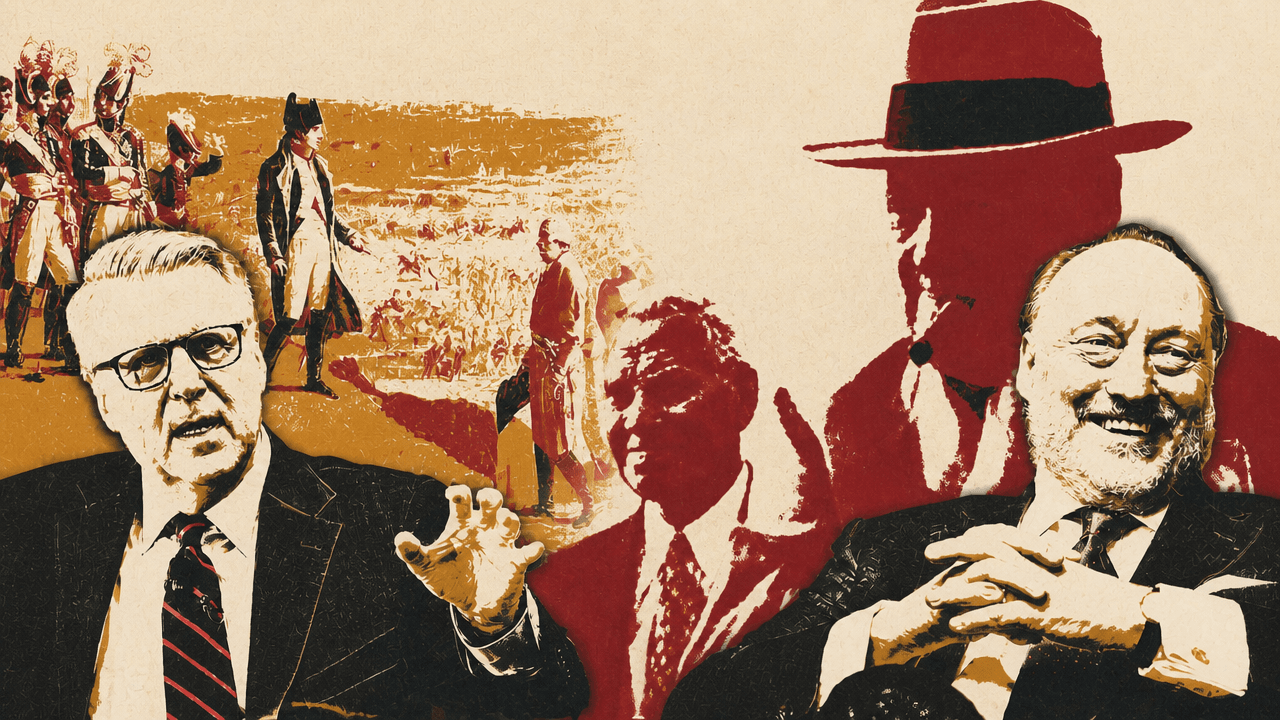
Great individuals do not replace forces; they direct them
Andrew Roberts rejects the view that historical actors are merely “surface disturbances” on deeper tides of demography, geography, and economic structure. Those forces exist, he says, and they matter greatly in subjects such as industrialization or the development of science. But they do not eliminate the causal significance of decisions made by particular people, especially in war and political crisis.


Roberts’s basic test is counterfactual: if the individual had not been present, would the event have happened in the same way? France would not have invaded Russia in 1812 without Napoleon Bonaparte, he says. Britain’s decision to continue fighting Germany in 1940 likewise depended on Winston Churchill. Large impersonal conditions furnish the setting, but leadership gives them direction. In Roberts’s adaptation of the metaphor used by historians who minimize events and rulers, “it requires the specks of foam to direct them.”
Churchill himself offered a more modest formulation of his role. At his eightieth-birthday celebration, he said that the British nation and its wider “race” had possessed “the lion’s heart,” while he had merely been called upon to “give the roar.” Roberts regards that as an unusual moment of modesty from a man not otherwise known for it. But he thinks Churchill understated the case.
In that key decision in May 1940 to fight on, pretty much everybody would have put up with some kind of a negotiated settlement after it seemed that we had been utterly defeated in France.
A settlement, Roberts contends, would not have provoked Churchill’s removal by the Conservative Party, the House of Lords, the press, the monarchy, or the Church of England. It might instead have relieved much of the British establishment. Lord Halifax, the foreign secretary and, in Roberts’s phrase, “the personification of the establishment,” was pressing in that direction. Churchill made a decision that other people with authority could plausibly have avoided.
That is why Roberts’s preferred historical “what if” remains Churchill’s absence in May 1940. Had Halifax become prime minister and arranged an “ignoble peace” with Hitler, Germany could, he suggests, have directed its full military strength eastward rather than retaining forces in the West. Stalin might have been pushed beyond the Urals; Nazi power might have extended from Brest to the Urals. Roberts does not present that outcome as certain. The counterfactual is his way of insisting that history sometimes turns on the presence of a leader willing to make an unpopular decision when compromise looks easier.
Churchill saw Hitler as an enemy who could not be accommodated
Peter Robinson asks why Churchill, more than Halifax or the broader British establishment, understood that compromise with Hitler would not secure Britain. Roberts offers three explanations.


First, Churchill was an historian. He understood Hitler’s threat as part of a long British experience of continental powers seeking dominance: Philip II’s planned invasion, Louis XIV’s ambitions, Napoleon’s challenge, and the Kaiser’s Germany. Churchill had also fought in the First World War. That historical frame, Roberts suggests, prevented him from treating the crisis as another diplomatic dispute that could be settled by concessions.
Second, Churchill’s philosemitism gave him insight into Nazism’s character. Churchill had grown up around Jews, vacationed with Jews, supported the Balfour Declaration, and regarded Jews as central to Judeo-Christian civilization. In an England where antisemitism was widespread, Roberts says, Churchill recognized the significance of Nazi antisemitic fanaticism in a way many contemporaries did not. It revolted him morally and helped him understand the regime he faced.
Third, Churchill had encountered violent ideological and religious fanaticism firsthand. Roberts points to Churchill’s military service on the Northwest Frontier and in Sudan. The point is not simply that Churchill had lived an adventurous early life. He was learning while fighting and writing about those experiences. In The River War, Roberts identifies a passage about what he calls Islamism that Churchill later removed while serving as colonial secretary responsible for 300 million Muslims.
These three things all come together to allow Churchill an almost unique insight into the mind of Hitler.
Roberts connects that account to the Allied insistence on unconditional surrender. He rejects Vice President J.D. Vance’s statement that the Second World War ended through negotiation: Roosevelt and Churchill declared unconditional surrender as the Allied war aim at Casablanca in January 1943, he notes; Germany surrendered after Hitler’s suicide and Dönitz’s capitulation; Japan surrendered after the atomic bombs.
Roberts also rejects the proposition that Japan would have surrendered without the atomic attacks. After Hiroshima, he says, the Imperial War Council chose to continue fighting despite knowing that roughly 80,000 people had been killed. The second bomb preceded Japan’s ultimate surrender. Robinson adds that even after the second bomb the Japanese cabinet was deadlocked and the emperor had to intervene. Both men treat the episode as evidence that a regime can persist beyond what democratic observers regard as rational calculation.
Roberts’s reference to later conflicts is framed as an analogy, not further evidence about 1940. He cites Hamas continuing to fight in Gaza until military defeat and Iran using diplomacy while trying, in his words, to hold on to the last possible moment. The point he draws is broader: democratic societies can misread ideological adversaries when they assume losses, incentives, and negotiation will work on them as they might on democratic governments.
Churchill’s racial thought and political loyalties were not the same thing
Roberts does not deny that Churchill held views now regarded as racist. Churchill believed in a hierarchy of races with whites at the top, he says, a view connected to what was then treated as scientific knowledge. Today, Roberts calls that thinking “obscene and absurd.”
But he distinguishes Churchill’s paternalist racial assumptions from what he describes as a modern racist desire to inflict harm on supposedly inferior peoples. Churchill, Roberts maintains, repeatedly acted to protect colonial subjects: Punjabi farmers on the Northwest Frontier, enslaved people in Sudan, African groups during his premiership, and Black South Africans oppressed by the Boers. Churchill’s conception of imperial responsibility rested on noblesse oblige: Britain owed obligations to the peoples within its empire.
He likewise separates Churchill’s language about the “English-speaking peoples” from race. The category, as Churchill used it, included nonwhite English-speaking communities in the Caribbean and elsewhere. It referred to law, literature, representative institutions, outlook, and shared language—not simply to whiteness. The concepts overlap in Churchill’s thought, Roberts concedes, but they are not identical.
The distinction matters because Churchill’s idea of political community was not reducible to biology. It joined inherited racial categories that Roberts acknowledges were objectionable with a civic and cultural inheritance—language, law, parliamentary institutions, and common purpose—that Churchill thought could be shared more broadly.
The Bengal famine charge turns on an allegation of intent
The most pointed recent accusation discussed is that Churchill deliberately caused mass deaths in the Bengal famine of 1943. A National Portrait Gallery video installation accused him of “wilful” mass starvation. The source displayed an Independent report describing Roberts’s objection to the installation and a BBC report announcing that the gallery had withdrawn the display after the controversy.
Roberts calls the allegation a “foul lie.” He says he organized a letter counter-signed by 50 peers from across political parties, after which the gallery removed the work. The question, as he frames it, is not whether Bengal suffered a famine or whether millions died. It is whether the evidence supports the assertion that Churchill wanted Bengalis to die.
Roberts attributes the famine first to a cyclone that struck Bengal in October 1942 and damaged the rail and road networks through which rice and other food had historically reached the region. Japan, he says, controlled Burma, Malaya, and Thailand, areas from which Bengal had also received rice, while Japanese submarines operated in the Bay of Bengal.
The grain figure is central to his rebuttal because it is offered as evidence of Churchill’s effort to alleviate the famine rather than to produce it. Roberts says Churchill appealed to Roosevelt and to the prime ministers of Australia, New Zealand, and Canada, resulting in 900,000 tons of grain being shipped to Bengal. That does not erase the catastrophe or its death toll in his account; it bears on the claim that Churchill deliberately starved Bengalis.
Millions died, Roberts acknowledges. His rejection is specific to the allegation of intent. He says historians examining the evidence have not supported the proposition that Churchill wanted Bengalis to die, apart from what he describes as two Hindu nationalist writers who continue to advance the charge. For Roberts, assigning responsibility for a calamity shaped by war, destroyed transport, lost food supplies, and weather is different from accusing Churchill of deliberately starving a population.
Revisionist attacks fail on chronology and definitions, Roberts says
Roberts applies the same emphasis on intent, chronology, and documentary particulars to attacks on Churchill from the right. Darryl Cooper’s description of Churchill as “the chief villain of World War II,” he says, conflicts with the sequence of events. Churchill was not a cabinet minister when war began on September 1, 1939. He became First Lord of the Admiralty later that day and did not become prime minister until Germany had already invaded Poland, Denmark, the Netherlands, Belgium, and Luxembourg. By then, Roberts says, the war was already plainly a vast conflict.
He also challenges Tucker Carlson’s characterization of Oswald Mosley’s British Union of Fascists as Britain’s “opposition party.” It had no members of Parliament, Roberts says; Mosley himself had earlier been an MP for the Conservatives and Labour but was never elected as a fascist.
Mosley was interned under Regulation 18B from May 1940 until November 1943, according to Roberts, when the threat of a German invasion had receded. Roberts disputes Carlson’s description of Mosley as a great First World War hero. While Mosley served briefly in the trenches and later joined the Royal Flying Corps, he was not among the 38,000 people decorated for gallantry. After an aircraft crash, Roberts says, Mosley spent the rest of the war in a desk job.
Roberts acknowledges that some members of the British Union of Fascists joined Britain’s armed forces and fought bravely after the war began. But he emphasizes that the organization was overtly fascist, modeled its Blackshirt activity on continental fascist movements, and included figures such as William Joyce, who went to Germany and became a Nazi propagandist. Britain had already seen collaboration in occupied Europe, including France, the Netherlands, and Belgium. In his account, the government could not know how Mosley’s supporters would behave during an invasion. Internment was legal, authorized by Parliament, and ended when the invasion threat was no longer acute.
The larger disagreement is over what counts as a politically relevant description. Calling Mosley an opposition leader omits the character and parliamentary standing of the party he led, Roberts contends. Calling Churchill responsible for starting or widening the war omits when he acquired power. Moral rhetoric, in this account, cannot substitute for sequence and definition.
American partnership was a British necessity, not a sentimental alliance
Churchill’s dealings with American presidents cannot be reduced to personal chemistry, Roberts says. Churchill met nearly every president from Theodore Roosevelt onward, got on poorly with Theodore Roosevelt personally, and privately preferred Adlai Stevenson to Dwight Eisenhower in both 1952 and 1956. He thought Eisenhower’s Cold War strategy risked becoming too aggressively nuclear and perhaps producing a third world war.
Yet Churchill’s operating principle was to preserve British interests by maintaining a working relationship with the United States. Roberts says that is how Churchill would have dealt with Donald Trump: whatever his private views, he would have tried to get on with the American president because the relationship mattered to Britain.
That framework qualifies a familiar story about Churchill and Berlin. Churchill urged Eisenhower to take Berlin before the Soviets. But Roberts says Montgomery was not in a position to absorb the roughly 80,000 casualties suffered by Soviet forces in taking the city. Churchill was also party to a late-1943 agreement establishing Soviet and Western demarcation lines. A unilateral Western drive on Berlin would have torn up those arrangements and potentially begun a war with Russia immediately after defeating Germany. Roberts therefore describes some of Churchill’s messages on the subject as “performative.”
The wartime partnership with Roosevelt was also less harmonious than its public image suggests. Roberts says there were about 200 more telegrams and cables from Churchill to Roosevelt than there were replies in the other direction, and that the relationship had effectively broken down by autumn 1944. The later Churchill-Eisenhower relationship remained formally courteous—Churchill gracious, Eisenhower professional—but Roberts agrees that Eisenhower eventually seemed to have had enough of Churchill.
For Roberts, the American alliance was indispensable but not frictionless. Churchill’s statecraft consisted in managing strategic dependence without pretending that interests, judgments, or personalities always aligned.
Churchill is a guide to Britain’s strategic alignment, not a warrant for every policy
Churchill’s record has become a resource in current British arguments, but Roberts distinguishes strategic orientation from a mechanical set of answers to domestic policy. His position on Brexit rests on Churchill’s stated view of a “United States of Europe.” Churchill supported European reconciliation because he did not want France and Germany to return to war. But in speeches at The Hague and Strasbourg, Roberts says, Churchill made clear that Britain itself should not be part of that European state.
That is why he rejects Nicholas Soames’s suggestion that Churchill would have opposed Brexit. Rather than speculate about Churchill in 2016, Roberts says, readers should examine what Churchill said in 1946 and 1948. Churchill’s strategic identity, in Roberts’s reading, lay with the open sea, the Commonwealth, and the English-speaking world.
He traces the same view to Churchill’s exchange with Charles de Gaulle on the day before D-Day. Churchill told de Gaulle that nothing would come between Britain and its friendship with Roosevelt, and that whenever Britain had to choose between the continent and the open sea, it would choose the open sea. The phrase could encompass the Commonwealth as well as America. De Gaulle, Roberts says, retained that impression, helping to explain his later resistance to Britain’s entry into the Common Market.
Churchill’s domestic record is more mixed. He read Hayek’s The Road to Serfdom in 1945 and ran on a free-enterprise platform that year, only to be decisively defeated. In his second premiership, he ended rationing and moved cautiously toward freer markets. But Roberts also calls him, with David Lloyd George, a founder of Britain’s welfare state.
The line Roberts wants to preserve is between social insurance and socialism. He traces a welfare tradition through Bismarck, Disraeli, Lloyd George, and Churchill: the state has a responsibility to protect vulnerable people against unemployment, accidents, and destitution. What it should not attempt, he argues, is equality through making the rich poorer.
His criticism of the Burnham government follows from that distinction. He describes its planned expansion of public control, land and wealth taxes, and regional redistribution as more ideological than Labour politics under Keir Starmer. He considers nationalizing energy companies economically implausible and sees the programme as a renewed attempt to “roll back Thatcherism.”
Roberts also calls the Conservative government’s post-Brexit immigration policy a “massive disaster.” Britain had the votes for Brexit and a large 2019 electoral majority, he says, but lacked the willingness to leave the European Court of Human Rights and the 1951 Refugee Convention, which he says courts and lawyers used to prevent deportations. He places hope in Kemi Badenoch’s stated intention to withdraw from the European Court of Human Rights.
Those are Roberts’s present political judgments rather than conclusions dictated by Churchill’s biography. Churchill serves instead as the example through which he states a larger preference: Britain should know where its strategic loyalties lie and should not confuse a social safety net with a programme of economic equalization.
When living memory disappears, history has to do its work
Roberts grew up in a Britain still physically and psychologically marked by the Second World War. Bombed-out gaps remained in London streets during his childhood; many became car parks before later redevelopment. His great-uncle had won the Distinguished Flying Cross and Bar in Bomber Command. Schoolchildren read Second World War magazines and watched war films. Churchill, who died when Roberts was 18 months old, was nevertheless ever-present.
That proximity has vanished. Roberts interviewed roughly 120 to 150 people for his Churchill biography who had known or worked with Churchill. Every one is now dead. Churchill’s niece, who died at 100, was the last.
Peter Robinson connects that loss to Abraham Lincoln’s warning in his 1838 Lyceum address: after the revolutionary generation died, “a living history” in families disappeared under “the silent artillery of time.” Roberts calls the phrase extraordinary and accepts Lincoln’s premise. But he draws the opposite of resignation from it. The disappearance of firsthand witnesses makes history more necessary, not less.
A chance conversation with a Chelsea Pensioner illustrates what is lost. Roberts once bought a pint for an elderly man in the scarlet uniform of the Royal Hospital Chelsea, who then told him about serving in First World War trenches. Roberts was young; the veteran was old. Yet the man made the experience sound immediate. Roberts’s children and grandchildren will not have such encounters. The transmission of historical experience must therefore move from family memory and living witnesses to reading, learning, and serious historical work.
Study history, study history, for therein lies all the secrets of statecraft.
Roberts attributes those words to Churchill, who gave the advice to a young American student crossing Westminster Hall on the day of Queen Elizabeth II’s coronation in 1953. For Roberts, the line is an answer to the problem Lincoln identified: historical knowledge is how later generations retain contact with truths and values that living memory can no longer carry.
He is pessimistic about the condition of public discourse. The American founders, he says, combined unusually capable organizers, writers, and political thinkers—John Adams, Thomas Jefferson, George Washington, Alexander Hamilton, and James Madison—in one decade. The Federalist Papers and the Constitution represent a level of political literacy and intellectual construction that Roberts finds difficult to imagine today.
Social media has coarsened public discourse, he says, borrowing Niall Ferguson’s description of the internet as “the universal lavatory wall.” Roberts also points to what he says are scientific reports and surveys showing collapsing attention spans over the last two decades. Education may offer part of the remedy, but he is unconvinced that formal education alone will solve the problem. He is especially alarmed by antisemitism among students and graduates at elite universities, arguing that one finds much of it “not at the bottom of society” but among the highly educated.
Roberts says he can diagnose the problem and see its symptoms, but not the cure. His answer is more demanding than nostalgia: read history closely enough that the loss of eyewitnesses does not become the loss of judgment.