Fed Officials Call for Better Classification Tools Under Economic Uncertainty
 John Cochrane
 Alejandra Edwards
 Austan Goolsbee
 Mary Daly
 Amit SeruPablo Villanueva
 Steven Davis
 Michelle Bowman
 Paola Sapienza
 Jim BullardChristopher WallerHoover InstitutionMonday, June 1, 202621 min read
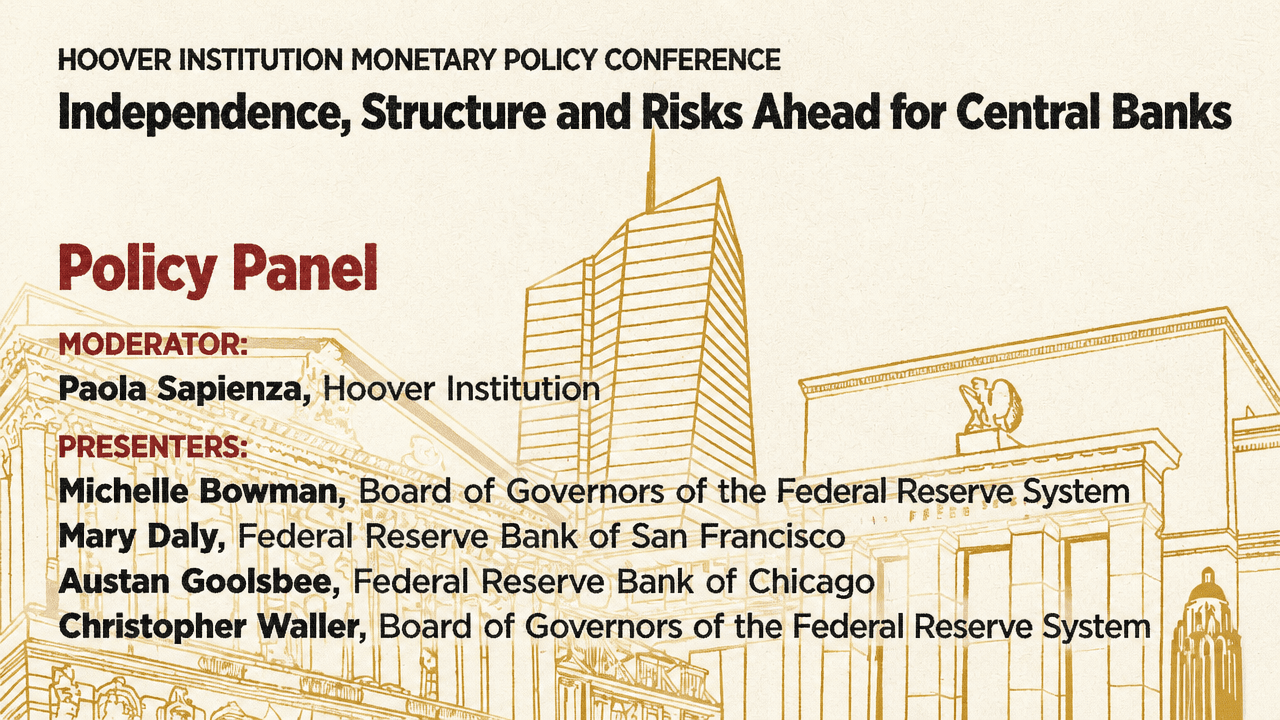
At a Hoover Institution policy panel on central-bank independence, structure and emerging risks, Federal Reserve officials Michelle Bowman, Mary Daly, Austan Goolsbee and Christopher Waller each argued that the Fed’s next problems turn on classifying risks before they are obvious in hindsight. Bowman focused on capital rules and private credit, Daly on distinguishing temporary from persistent inflation shocks, Goolsbee on whether expected AI productivity gains lower or raise the appropriate rate path, and Waller on which Fed functions require regional autonomy rather than centralized operations.
The regulated perimeter is being reshaped by capital rules, not just by markets
Michelle Bowman framed the growth of private credit as a problem created partly inside the regulatory system itself. Her concern was not that non-bank lenders should be eliminated, or that private credit is intrinsically a threat. It was that post-crisis capital and supervisory rules have made some ordinary bank lending disproportionately costly relative to its risk, pushing activity outside the regulated banking system for reasons not necessarily related to efficiency or safety.
Bowman’s starting point was a shift in corporate credit. Since 2015, she said, banks’ share of corporate lending has fallen from 48% to 29% in 2025. The private credit market in the United States has grown to about $1.4 trillion, roughly comparable in size to the leveraged loan market and the high-yield bond market. Still, she stressed that private credit remains only about 10% of total U.S. corporate borrowing.
The issue, as Bowman described it, is an incentive structure in which banks can receive more favorable capital treatment for lending to private credit funds than for lending directly to creditworthy corporations. That structure, she argued, encourages banks to finance intermediaries rather than serve end borrowers themselves. It can leave what she called an “undersupply of credit” to traditional bank business borrowers, even when banks have the underwriting relationships and monitoring capacity to make those loans.
Her account drew a distinction between different kinds of non-bank financial institutions, or NDFIs. The broad category includes private credit funds, business development companies, insurance companies, private equity firms, broker-dealers, hedge funds, special purpose entities, and other vehicles. Bowman emphasized that these entities vary materially: in the borrowers they serve, the quality of underwriting and risk management, the ability to work with borrowers under stress, the stability of funding, and the degree of connection to the banking system.
Private credit funds and some business development companies mainly raise capital from institutional investors, including pension funds and insurance companies. Other BDCs provide access to retail investors. Banks, meanwhile, are connected to these vehicles through revolving credit lines and term loans. Bowman said bank lending to NDFIs has grown faster over the past decade than any other bank loan category.
That growth creates a monitoring problem. Recent bankruptcies have imposed losses on banks and NDFIs, and Bowman said they have raised questions about loan quality among private credit providers. She also pointed to newer concerns about exposure to industries vulnerable to artificial intelligence, including software. Another possible transmission channel is investor withdrawal: some private credit funds, especially BDCs with limited redemption rights, have experienced redemptions after losses or failure to meet targeted returns.
Bowman did not describe current bank exposures as obviously dangerous. She said banks have continued to extend credit to BDCs and other private credit vehicles, with commitments and outstandings growing significantly over the past year. Those loans generally appear well-collateralized, she said, and default and loss rates would have to be “abnormally high” before banks were at risk. But her supervisory conclusion was that the Fed lacks enough granular information to understand these connections well.
Her policy response had three parts.
First, she endorsed recently proposed Basel III changes that would reduce what she sees as punitive capital treatment for traditional bank lending. For corporate and business lending, the proposal would generally reduce the risk weight from 100% to 65% for corporates that the lending bank considers investment grade. Bowman argued that narrowing the gap between risk weights on loans to non-financial businesses and loans to non-bank financial companies would let banks compete more effectively for creditworthy borrowers, while maintaining strong capital in the banking sector.
Second, she argued for preserving complementary roles between banks and NDFIs. Non-banks, in her account, serve legitimate functions: specialization, faster origination, flexible credit terms, and lending to borrowers that may be smaller, riskier, or unsuitable for banks. Bowman said BDCs make most of their loans at spreads of 400 basis points or more, while large banks make most of their loans at 200 basis points or less. Her proposed division of labor would allow banks to serve traditional creditworthy borrowers while leaving some higher-risk lending to vehicles funded by investors willing to accept illiquidity and higher expected returns.
Third, Bowman called for better reporting on bank lending to NDFIs. Current regulatory reporting, she said, relies on industry classification codes too broad to assess concentration risk or interconnectedness. A category such as “other financial vehicles” can include hedge funds, private equity funds, BDCs, special purpose entities, and asset-backed security insurers without distinction. The Board, she said, will update reporting so that the largest banks provide information about NDFIs to which they extend credit, including total assets, net income, and leverage.
In practical terms, Bowman’s proposal was not to pull all activity back into banks. It was to stop regulation from artificially pushing creditworthy borrowers out of banks while giving supervisors better visibility into the non-bank channels that remain.
Bowman’s supervisory agenda separates capital calibration from exam discipline
The question from Amit Seru pushed Bowman from capital rules into supervisory architecture. If capital requirements are being recalibrated at the same time that supervision is being streamlined, Seru asked whether the combined changes could overcorrect. Bowman’s answer was that supervision is being modernized not to do less, but to focus more clearly on the risks that actually cause banks to fail.
Her answer separated three related but distinct reforms.
The first was capital recalibration. Bowman said the post-Dodd-Frank framework risk-weighted many ordinary banking activities in ways that made banks less willing to continue them, pushing activity into less regulated spaces where supervisors had less visibility. She treated the new Basel capital rules as an opportunity to bring some of that activity back into the banking system and to position bank regulation for the next 10 or 20 years, not only for the last crisis.
The second was CAMELS reform. Bowman pointed to her role as chair of the FFIEC and said changes were coming to the CAMELS framework, which she described as not having been reviewed or updated in 50 years. Her critique was especially directed at the “M” component, the management rating. Bowman said the management rating had “been abused” in ways that were “not transparent,” including by incorporating issues not necessarily related to management and contributing to downgrades of a financial institution’s composite rating.
The third was cleanup of supervisory findings, especially matters requiring attention, or MRAs. Bowman connected that critique to Silicon Valley Bank. She said reports in spring 2022 showed problems at the bank, with later reports in the fall showing those problems worsening, but supervisors did not respond as well as they should have. As vice chair, she said, she initiated an independent review of SVB’s failure and suggested that prior reviews had shortcomings, including that people outside of the Federal Reserve were not interviewed.
Her concern was that supervision had become cluttered with findings that did not sufficiently prioritize material financial risk. SVB, she said, had more than 30 MRAs, but only a handful concerned the material financial risks that brought the bank down. If a bank cannot understand which findings are most important or what must be done to remediate them, she argued, supervisors should not be surprised when the process fails to focus attention on the risks that matter.
Bowman also criticized the persistence of old MRAs. She said some had remained on the books since 2001, which to her suggested that the tool was not being used properly: if the issue was important enough to cite, it should have been followed up; if mitigated, it should have been lifted; if repeated, a new MRA should be issued rather than allowing an old one to linger indefinitely.
When Paola Sapienza characterized the change as making MRAs more practical rather than weakening supervision, Bowman agreed. She emphasized that the Fed would continue supervising cyber risks, BSA and AML issues, and other regular components of supervision. Her stated aim was to ensure that examiners do not miss “those things that actually lead to bank failures, like material financial risk.”

The lesson Daly draws from transitory inflation is not model rejection but model discipline
Mary Daly used inflation shocks to argue for a disciplined way of checking conventional wisdom before policy mistakes become obvious. The conventional taxonomy she presented is simple: if a shock is temporary, policymakers can look through it; if it is persistent, they should respond or at least consider responding. The taxonomy also asks whether the shock is supply- or demand-driven. Daly’s argument was that this framework remains useful, but it can fail unless it is constantly tested against broader evidence.
She used the pandemic inflation episode as the example of failure. Policymakers did not merely say inflation was transitory while hoping it would be; Daly said the forecast was genuinely that inflation would be temporary. That forecast was wrong. The question, for her, is how to improve the process for distinguishing a temporary shock from a persistent one before the answer is visible in hindsight.
Daly reached back to the labor-market debate after the global financial crisis. The question then was whether the large rise in unemployment reflected a secular deterioration that monetary policy could not offset, or a long-lasting cyclical shock that could be worked down. She cited Narayana Kocherlakota’s estimate that the natural rate of unemployment had risen to 8.9%, and John Williams’s model-based estimate that it could be as high as 7%. Kocherlakota’s argument, in Daly’s telling, was that “you can’t make construction workers into nurses.” Williams relied on model estimates such as Laubach-Williams.
The way out of that dispute, Daly said, was not to choose a favorite model. It was to produce more information. The San Francisco Fed and others developed labor-market dashboards and heat maps, collecting indicators that were above or below historical norms and asking which indicators led, which lagged, and which could reveal a cyclical upswing. Daly said even that was not enough, because more data can simply create arguments over which indicator to prefer. So she and Bart Hobijn, Ayşegül Şahin, and Rob Valletta worked on disciplining the evidence through theory, separating factors that move the job creation curve and the Beveridge curve into cyclical and structural categories and assessing whether they were likely transitory or persistent.
That work yielded an estimate closer to 5.6% for the natural rate of unemployment. Over time, Daly said, policymakers’ views of the natural rate moved lower as evidence accumulated that the labor market was more flexible than the higher estimates implied. Construction workers might not become nurses, but they could change industries and do other work. The broader lesson was methodological: when models disagree about persistence, dig for information that can discipline the judgment.
She applied the same logic to inflation. Traditional inflation gauges—headline and core PCE, CPI, trimmed mean measures, median measures, producer prices, the employment cost index—and expectations measures were not enough. Inflation itself is backward-looking, while expectations can be hard to interpret when they move around. Daly said the San Francisco Fed built an inflation dashboard using analyses that went beyond standard inflation categories: demand-driven versus supply-driven inflation, cyclical versus acyclical sectoral responses, an inflation shock momentum index, vacancy-to-unemployment ratios, labor-market tightness measures, supply-chain indexes, and expectations indicators.
| Question | Evidence Daly emphasized | What the evidence was meant to test |
|---|---|---|
| Was post-GFC unemployment cyclical or secular? | Labor-market heat maps, leading and lagging indicators, Beveridge-curve and job-creation-curve analysis | Whether unemployment could fall without requiring a higher natural-rate estimate |
| Was pandemic inflation temporary or persistent? | Demand- and supply-driven inflation, cyclical and acyclical inflation, shock momentum, supply-chain pressure, labor tightness, expectations | Whether inflation pressure was broader and more persistent than the conventional supply-shock reading implied |
| Can current tariff and oil shocks be looked through? | Heat-map readings, business contacts on pass-through, supply-chain pressure, oil and commodity indicators | Whether one-off price shocks are becoming persistent inflation pressure |
The heat map she showed for 2020 to 2022 was central to the point. Its rows included the San Francisco Fed’s inflation shock momentum index, demand- and supply-driven inflation measures, cyclical and acyclical inflation, the New York Fed’s global supply chain pressure index, vacancy-to-unemployment ratios, labor-market tightness indexes, Kansas City Fed labor-market conditions indicators, and short- and medium-run inflation expectations. The colors were not forecasts by themselves; as Daly later explained, they represented distance from historical norms, with deeper red indicating larger deviations.
Looking back at 2021, Daly said many elements that would have signaled persistent inflation pressure were already “flashing red,” certainly by September. She did not claim that the dashboard existed in time for the March or September 2021 Summary of Economic Projections. Her narrower claim was that such a dashboard would likely have helped policymakers see that more persistence was present than the conventional wisdom suggested.
For the current moment, Daly treated tariffs and oil differently but through the same framework. The conventional view of tariffs is that they are one-off: they raise the price level as they roll through, but do not keep raising inflation. Daly said dashboards and business contacts gave her more confidence, though not complete confidence, that looking through the tariff shock was reasonable while remaining watchful. With the oil shock layered on top, she said the evidence was newer and more limited, with data through April, but red was beginning to appear in the expected places. She singled out the New York Fed’s global supply chain pressure index because supply-chain disruptions, once clogged, can take a long time to unwind. That matters because it can turn a shock into more persistent inflation pressure, even if it does not guarantee persistent inflation.
The message from all of this isn’t that you can do perfectly by looking at more data.
Daly’s answer to Alejandra Edwards clarified how to read the heat maps: the colors represented standard deviations from historical norms. Two standard deviations away from the norm would be red, with gradations below that. The point was not that any one square answers the policy question. It was to develop what Daly called a “preponderance of evidence” mentality.
That same mentality shaped her answer to John Cochrane, who asked about Bob Hall and Marianna Kudlyak’s observation that flat inflation implied the economy may have been at the natural rate all along. Daly said she and Kudlyak, who is on the San Francisco Fed staff, have debated that view. Her response was that when inflation is unexpectedly flat for a long time—as during the Great Moderation and after the financial crisis, when inflation was “stuck basically at 1.8”—it becomes less useful as a calibrating measure for the natural rate. Policymakers learned experientially how far unemployment could fall without spurring inflation. In her words, it is hard to tell Americans that job growth must be constrained when price stability is being maintained.
Productivity can lower rates if it surprises, but raise them if everyone sees it coming
Austan Goolsbee argued that the monetary-policy implications of an AI-driven productivity boom depend critically on expectations. A productivity boom that arrives unexpectedly can justify lower interest rates. A productivity boom that everyone expects in advance can require higher rates, even if inflation initially falls.
Goolsbee situated the argument against the 1990s. Information technology and the internet raised annual productivity growth more than a full percentage point above the prior trend. Alan Greenspan, then Fed chair, inferred faster productivity growth from strong corporate profits, declining unemployment, rising wages, and falling inflation before the productivity acceleration was obvious in the data. On that basis, Greenspan argued against raising rates. By the late 1990s, however, Goolsbee noted that Greenspan was also warning that if people expected structural productivity gains, they might pull aggregate demand forward before the productivity gains arrived. Inflation rose significantly by 1999 and 2000, and the Fed raised rates six times in less than a year.
To isolate the mechanism, Goolsbee described a simple New Keynesian representative-agent model with sticky wages and prices, no capital, constant returns to scale, and a Taylor rule that tracks the natural rate of interest and responds to inflation and the output gap. The Chicago Fed exercise added a productivity growth increase of one percentage point per year for 10 years.
The first scenario was a repeated surprise. Actual productivity growth rises by one percentage point for 40 quarters, but people do not expect it; each year it arrives unexpectedly. In that case, wages are slow to catch up with higher productivity, marginal costs fall, production rises, and inflation falls. Output rises above potential, producing a positive output gap, but the lower inflation more than offsets that gap in the Taylor rule. The nominal rate falls. Goolsbee said that scenario resembled the mid-1990s: productivity growth lands on the economy, and the appropriate Fed response is lower rates.
The second scenario used the same productivity path, but with perfect foresight. Everyone expects one percentage point of additional productivity growth per year for 10 years. Inflation still falls and the output gap still rises, but the interest-rate implication reverses. Because households expect to be richer in the future, they try to consume more today. Yet much of the productivity gain has not arrived, so current capacity has not expanded enough to meet that demand. The central bank must raise the return to saving to push that consumption back into the future. The natural rate rises, and the nominal rate should rise.
| Scenario | Expectation assumption | Mechanism | Rate implication in Goolsbee’s model |
|---|---|---|---|
| Repeated surprise | The productivity gain arrives year by year without being expected | Sticky wages mean marginal costs fall; inflation declines enough to dominate the positive output gap | Nominal rate falls |
| Perfect foresight | Everyone expects the productivity gain before most of it arrives | Households try to pull future wealth into current consumption before capacity expands | Natural rate and nominal rate rise |
| Wait for realized overheating | The central bank does not track the natural-rate movement | Demand runs ahead until inflation and the output gap force a larger later response | Rates eventually rise more |
| Disappointing productivity | People keep expecting a boom that falls short | Pulled-forward spending generates inflation, then realized productivity cannot support the spending path | Goolsbee said the model can produce stagflation |
Goolsbee then considered a central bank that waits for actual inflation or overheating before reacting, rather than tracking changes in the natural rate. In the model, that “wait for it” approach produces higher inflation and a more overheated economy. Once inflation and the output gap appear, the Taylor rule requires rates to rise more than they would have if the central bank had incorporated the natural-rate movement earlier.
His practical implication was to watch for evidence that activity is being pulled from the future into the present. He named wealth effects on consumer spending, including high-end spending visible around Palo Alto; data-center investment driven by stock-market valuations; and AI-related demand that raises costs for land, electricians, and computer chips for non-AI industries. The more these effects appear, the more an expected productivity boom may push the ideal interest rate up rather than down.
Goolsbee also cited survey evidence led by Ezra Karger at the Chicago Fed, covering economists, technology workers, and the general public. He said the median respondent in all three groups expected AI to raise productivity by about one percentage point per year for the next 10 years, broadly similar to projections he attributed to the OECD and McKinsey. If so, the “lion’s share” of the AI productivity boom would still be in the future, creating incentives to borrow against it or otherwise pull activity forward.
His conclusion was deliberately mixed. Productivity growth is a boon. If it arrives unexpectedly, rates should probably fall. If it is widely expected before it arrives, it can raise the natural rate and require tighter policy to prevent overheating. The bigger the hype, the bigger the concern. Goolsbee emphasized that this argument did not rely on asset bubbles; it was about fundamentals.
Christopher Waller immediately challenged part of the mechanism. The wealth effect Goolsbee described, Waller said, is familiar from models including the forward-guidance puzzle, where promises of low future rates should generate enormous consumption booms that were not observed. He suggested that if half of consumers are hand-to-mouth or face borrowing constraints, they cannot bring future wealth forward; habit persistence can also make consumption adjust slowly. Those features would dampen Goolsbee’s model.
The audience developed the same pressure point. Steven Davis said an Atlanta Fed CEO survey he is involved in asks firms about AI’s expected productivity impact on their own companies over the next three years and produces a lower but broadly consistent estimate: about 75 basis points per year of extra productivity growth, rather than 100. He also emphasized that AI investment is extremely skewed. In firm-level data, the employment-weighted mean of AI investment spending is about 14 times the median. That skewness matters because the ability to pull future wealth into current consumption or investment is uneven.

Pablo Villanueva asked whether the mechanism could reverse if the general population expects AI to destroy jobs. If people fear job loss, they may save more rather than borrow against future abundance. Edwards asked a similar question about unemployment from productivity growth.
Goolsbee accepted that precautionary saving would work in the opposite direction and reduce concern about overheating. But he warned against concluding that borrowing constraints eliminate the issue. If the economy is K-shaped, with equity values surging and the top of the distribution spending aggressively out of stock-market wealth, no one needs to borrow for the aggregate pattern to resemble his model. He also told Cochrane that not working today because one expects to be rich tomorrow is itself a form of present consumption—consuming leisure. An unexpected drop in labor supply or participation among the same groups benefiting from AI wealth would be another warning sign.
Jim Bullard asked what happens if expected productivity gains fail to materialize. Goolsbee showed a withheld slide in which productivity growth continually disappoints expectations: people think a 10-year boom is coming, it falls off halfway through, but they keep expecting it to return. In that setup, the economy can experience stagflation. The earlier expectations pulled spending forward and generated inflation; the disappointment then produces a downturn because spending exceeded what realized productivity could support. Goolsbee said the exercise was less robust than the core scenarios, but the intuition was clear: if people overestimate future productivity and keep waiting for gains that do not arrive, the recession can be larger.

Operational centralization is Waller’s route to preserving, not weakening, Fed independence
Christopher Waller’s main subject was not monetary policy but the internal structure of the Federal Reserve System. His claim was that the Fed’s decentralized regional design supports monetary-policy independence by ensuring a range of regional interests and views in policy discussions, and that this should be preserved. But he separated that purpose from day-to-day operations that do not require 12 different versions.
The distinction he drew was between functions where geography matters and functions where it does not. Monetary-policy votes by Reserve Bank presidents, research supporting presidents, community outreach, community development, supervision, and discount-window operations belong in districts and should remain locally run. But information technology, human resources, financial management, enterprise risk management, and payments, he argued, are essential services that do not need to be provided separately by each Reserve Bank.
Waller’s proposal was to standardize and centralize back-office functions across the system. The services would still be needed by every Reserve Bank, but not produced independently by every Reserve Bank. The benefit would be lower operating costs, better risk management, and more consistent service delivery.
He acknowledged objections that this might conflict with the Federal Reserve Act’s regional structure and Reserve Bank independence. His answer was that the Reserve Banks can make independent decisions collectively rather than bank by bank. The Board of Governors would provide oversight, not day-to-day decision making. A single Reserve Bank could centrally lead a function such as human resources, acting as a contractor for the others under service-level agreements. The responsible bank would have authority to allocate resources and operate efficiently; other banks would give up day-to-day decision rights over how the contractor bank provides that service.
That model requires a change in governance and culture. Waller said Reserve Bank presidents and first vice presidents need to adopt a “system first, bank second” mindset. Historically, a “bank first, system second” approach may have worked when everything was local. But in his view, operational modernization requires banks to trust one another and delegate.
He also criticized consensus as a governance model for operations. Consensus may be useful for difficult policy decisions, he said, but it is not obviously successful for running complex and critical operations, because one bank can block systemwide action. Moving away from consensus would require rethinking how operational decisions are made.
Cochrane’s objection went straight at the word “centralization.” He compared the instinct to centralize for efficiency with arguments for eliminating state governments, consolidating steel mills, or putting universities under one HR system. Waller’s response was blunt: he was talking about exploiting economies of scale and lowering costs while providing the same level of service. He characterized that as straightforward economics and stewardship of taxpayer dollars.
Paola Sapienza asked whether the reorganization might also strengthen independence from banks, not just from government, by insulating regional banks from banking-system pressure. Waller did not take up that broader frame. He said he was focused on back-office operations and how to perform them efficiently without reducing service.
On governance, Waller said the Reserve Bank presidents had developed a framework, the Board would retain oversight rather than day-to-day decision-making authority, and operational control would remain collectively with the Reserve Banks. He said the Board and Reserve Banks had moved rapidly over the preceding six months toward an approach that could modernize operations and improve efficiency while enhancing service delivery. Details remained, especially given the criticality of Reserve Bank services, including moving trillions of dollars in payments every day for commercial banks and the U.S. Treasury.
Real-time classification is the institutional problem
The common problem across the officials’ arguments was not whether existing categories still matter. It was how a central bank should classify new conditions quickly enough to act before the classification is obvious.
Bowman’s classification problem is the boundary between useful non-bank credit and regulation-induced migration. If non-banks are serving borrowers that banks should not serve, private credit is part of a useful division of labor. If creditworthy borrowers are leaving banks because capital rules overstate the risk of ordinary lending, the regulatory system is changing the market in a way supervisors should reconsider. That is why her proposal paired lower risk weights for investment-grade corporate lending with more granular NDFI reporting.
Daly’s classification problem is shock persistence. A tariff shock, an oil shock, or a supply-chain disruption cannot be judged only by its label. Her answer was not to discard the conventional taxonomy of supply, demand, temporary, and persistent shocks. It was to test that taxonomy with dashboards, historical norms, theory, business contacts, and what she called a preponderance of evidence.
Goolsbee’s classification problem is whether productivity is realized, expected, or overexpected. The same one-percentage-point productivity gain has opposite rate implications in his model depending on whether it arrives as a surprise or is anticipated before capacity expands. His empirical question was therefore not simply whether AI will raise productivity, but whether expectations of future AI gains are already changing spending, investment, and labor-supply behavior.
Waller’s classification problem is institutional: which Federal Reserve functions require regional autonomy, and which are operational services that can be standardized without weakening the regional structure. He defended decentralization for monetary-policy representation and district-specific work, while arguing that back-office duplication weakens the Fed’s stewardship of public resources.
Those distinctions are not semantic. They determine whether bank capital rules are recalibrated, whether inflation shocks are looked through or resisted, whether expected AI productivity lowers or raises the policy-rate path, and whether Reserve Bank independence is protected through local control or through systemwide operational discipline.