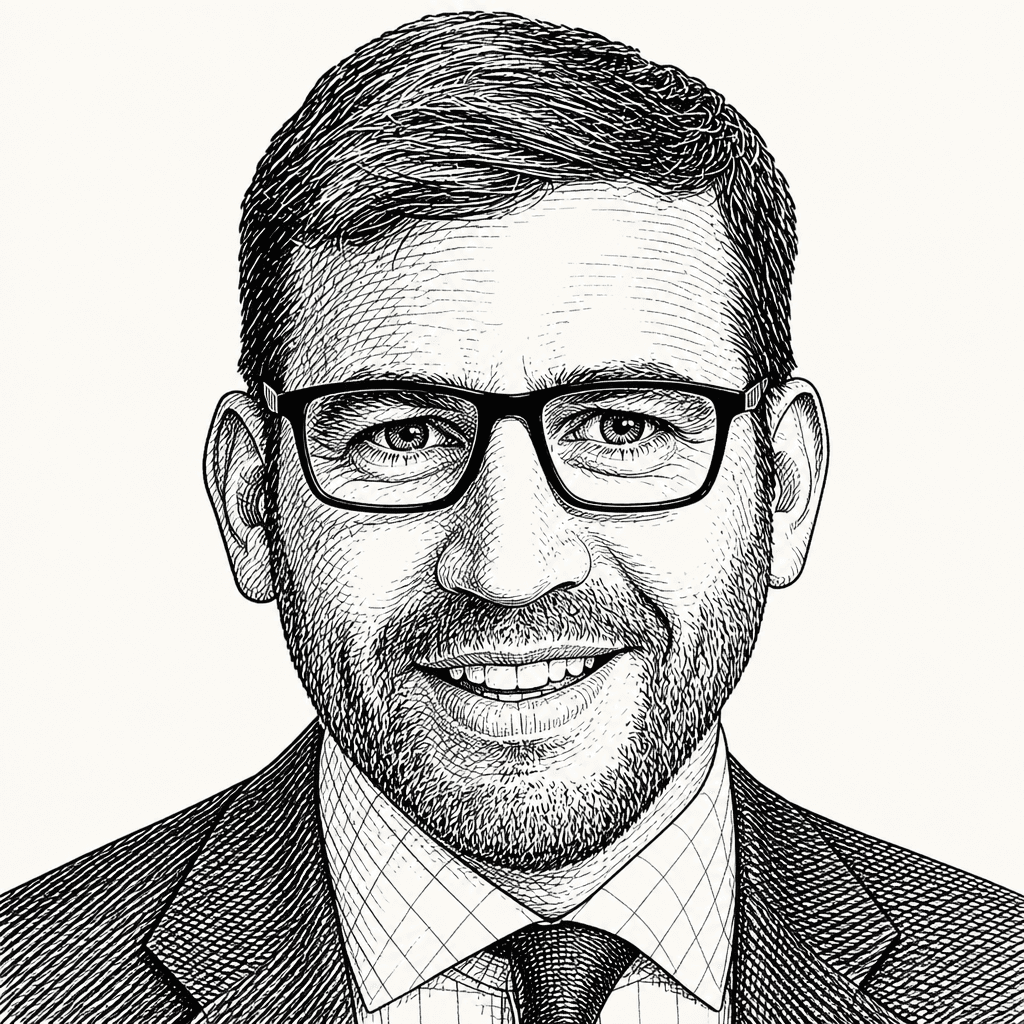
Josh Good
The description appears to misname the introducer: the Aspen Institute identifies Josh Good as director of its Religion & Society Program, the role matching the event context. His work focuses on religion’s influence on American politics and public life.
The Declaration’s Promise Outran the Founders’ Narrow Vision
Ken Burns argues that the founding’s importance lies not in a settled promise of freedom but in language of liberty and equality that later generations could use to challenge its exclusions. In a conversation with David Brooks, Burns describes a republic built to check human ambition and a commitment to religious toleration shaped by practical need and the risks of sectarian conflict. Both speakers present the founding as unfinished: its principles can guide efforts to repair the country, but do not resolve its present divisions.
An American Pope Makes Catholic Teaching a U.S. Political Force
Paul Elie and Christine Emba argue that Pope Leo XIV has made longstanding Catholic teaching newly consequential in U.S. politics not by changing it, but by making it harder to ignore. As an American pope confronting an American administration, Leo has become a legible moral countervoice on war, migration, technological power, and human dignity, while his restrained style leaves unresolved the Church’s own disputes over authority, gender, and tradition.
Pluralism Requires Religious Liberty for Beliefs Majorities Do Not Endorse
Treating religion as a fixed, private or uniform identity obscures the ways it shapes public life, argue Simran Jeet Singh, Diane L. Moore and Asma Uddin in Faith Angle’s discussion of Modeling Religious Pluralism. They define religious literacy as understanding traditions as diverse, evolving and entangled with social power, and argue for a pluralism that protects strong commitments without allowing any one community to make its norms the public default.
The “Nones” Category Obscures Americans’ Spiritual and Moral Lives
Harvard’s Richard Parker and USC’s Diane Winston argue that journalists should not treat the 29% of Americans labeled religious “nones” as people without belief, moral commitments or sources of meaning. In a Faith Angle Forum discussion, Winston contends that the secular-sacred divide obscures how religion, politics, markets, culture and technology shape one another, while Parker warns that survey categories and polling trends cannot provide a full account of a person’s life. Their shared prescription is to report beyond affiliation labels without collapsing every cultural or political commitment into religion.
Political Neutrality Leaves Immigration Advocacy Threshold Unresolved
Latter-day Saint apostle Clark Gilbert argues that the Church of Jesus Christ of Latter-day Saints should remain politically neutral on immigration while serving members affected by enforcement through legal aid, education, humanitarian assistance and local ministry. At the Faith Angle Forum, journalists pressed him on whether care within the existing system is enough when detention and deportation threaten congregations. Gilbert defended neutrality as protection against partisan capture but did not identify when public opposition to government policy would be required.
Partisan Identity Is Reshaping Religious Belief and Political Mobilization
University of Notre Dame political scientist David Campbell argues that religion and politics shape each other: partisan identity can drive changes in religious affiliation, moral judgment, and the meaning Americans attach to labels such as Christian or secular. In a Faith Angle Forum discussion with New York Times *Believing* newsletter writer Lauren Jackson, he says Republican appeals to threatened Christian identity remain potent but limited, while Jackson hears from religiously and politically unsettled readers seeking belonging, hope, and a public language that does not reduce faith to a voting bloc.
Pope Leo XIV Frames AI Governance as a Test of Human Dignity
Pope Leo XIV’s first encyclical, Magnifica Humanitas, argues that artificial intelligence should be judged first by its effects on human dignity, agency and power, not by its technical promise. In a panel moderated by Vivian Schiller, Vilas Dhar, Kim Daniels and Josh Good read the document as an effort to bring Catholic social teaching into AI debates over work, education, autonomous weapons, institutional accountability and the moral limits of markets and technology.
Pope Leo XIV’s AI Encyclical Ties Safety Rules to Human Dignity
A panel convened by Aspen Digital treated Pope Leo XIV’s first encyclical, Magnificent Humanity, as an authoritative Catholic intervention in AI governance rather than a narrowly theological text. Kim Daniels, Vilas Dhar, and Josh Good argued that the document judges AI by its effects on human dignity, especially for workers, students, creative professionals, and vulnerable communities, while pointing to safety regulation, retraining, and education as practical tests. The unresolved problem, Daniels said, is whether the Church can move that teaching from Rome into parishes, civic institutions, classrooms, and technology work.
Anti-Muslim Politics Is Testing the Limits of Religious Liberty
Anti-Muslim politics in the US and UK works by recasting Islam not as a religion but as an ideology, racial threat or civilizational enemy, according to legal scholar Asma Uddin, journalist Hannah Allam and British commentator Fraser Nelson. Uddin argues that this move can push Muslims outside religious-liberty protections; Nelson sees it as a revival of sectarian tribalism dressed in Christian language; and Allam warns that journalism and national-security policy have helped make Muslims a suspect category whose logic now extends to others.