Partisan Identity Is Reshaping Religious Belief and Political Mobilization
 McKay Coppins
 David Campbell
 Samuel Benson
 Josh Good
 Barbara Hagerty
 Mitchell Atencio
 Bill Barrow
 Corey Nathan
 Lauren Jackson
 Nina Shapiro
 Deena Prichep
 Sam Kestenbaum
 Christian Paz
 Carl CannonThe Aspen InstituteFriday, July 10, 202616 min read
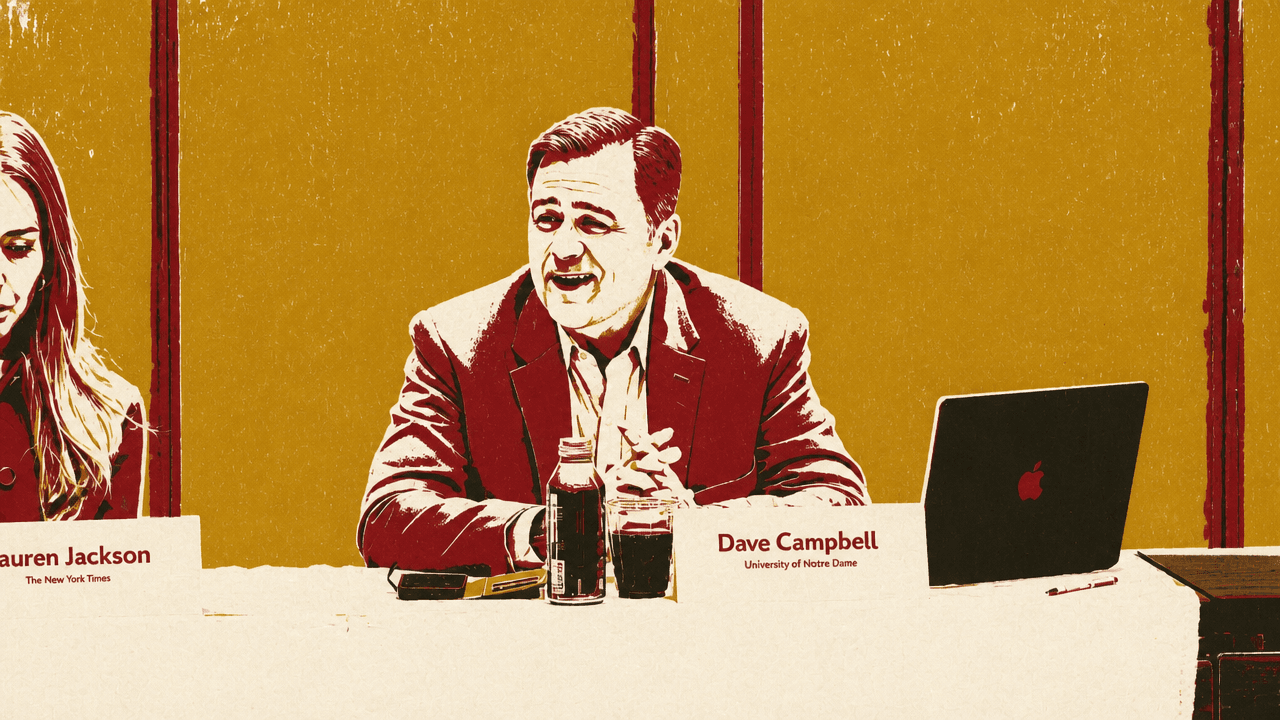
University of Notre Dame political scientist David Campbell argues that religion and politics shape each other: partisan identity can drive changes in religious affiliation, moral judgment, and the meaning Americans attach to labels such as Christian or secular. In a Faith Angle Forum discussion with New York Times *Believing* newsletter writer Lauren Jackson, he says Republican appeals to threatened Christian identity remain potent but limited, while Jackson hears from religiously and politically unsettled readers seeking belonging, hope, and a public language that does not reduce faith to a voting bloc.
Religion does not explain American politics in one direction
David Campbell argues that the familiar “God gap”—more religious Americans tending Republican—is real but radically incomplete. It applies principally to white Americans, he says, not to Black Americans, who are both highly religious and not particularly Republican. Latino politics is more complicated still. Treating religiosity as a simple predictor of party preference obscures the ways race, community, identity, and partisan coalitions interact.


The same simplification affects discussion of secular Americans. Campbell rejects “the Nones” as a sufficiently useful catchall. In his account, the secular population contains at least three distinct groups:
- Non-religionists: people with no conventional religious affiliation or practice, often relatively disengaged from civic life as well.
- Secularists: people who do not merely lack religion but affirm a worldview in which truth, meaning, and guidance come from sources such as science, philosophy, or other nonreligious traditions.
- Religious secularists: people who remain attached to a religious community or identity while also embracing a secular worldview.
Campbell places secularists at roughly 25 to 30 percent of the population—larger than the non-religionist group. The categories are not fixed types. People can move among them over a lifetime, and spirituality can appear in all of them. But the distinction is political as much as sociological: secular America is not a passive, homogeneous residue left behind by religious decline. It is diverse, and parts of it are highly engaged.
The more consequential reversal, Campbell says, is causal. Political analysis often assumes that religion comes first: a person’s faith produces a partisan preference. He argues that politics can also shape religious identity, beliefs, and participation.
The rise of the secular population over the past few decades, he contends, is in substantial part an “allergic reaction” to the Religious Right. Young Americans who associate religion with conservative politics or the Republican Party may resolve the conflict between their own political commitments and a religious identity by changing the latter. The politics remains stable; the religious identification changes.
That argument does not require people to become committed atheists. Many may never adopt that label. The relevant shift is that religion comes to feel politically incompatible with who they are: “religion equals Republican, and they’re not Republican, therefore they’re not religious,” as Campbell puts it.
Campbell applies the same logic in the other direction to the reported revival of religion among young white men. He does not say there is no evidence at all for such a revival. But the evidence he sees in national surveys is principally about identity: calling oneself Christian, or saying religion matters. It is not evidence of sustained participation in congregations or religious communities.
That distinction matters because, in Campbell’s view, religion’s positive civic effects arise from congregational life—relationships, obligations, and the social capital built among people who worship and serve together. Online religious identity does not produce the same thing. A partisan form of Christianity may repel people who reject the politics attached to it while attracting young men for whom “Christian” is part of a MAGA or “real American” identity.
What it means to be Christian is owning the libs and not loving your neighbor.
He places Christian-nationalist rhetoric in that same category. Claims that America must be restored as a Christian nation, that Christians are under attack, or that Christianity should govern the country can be powerful without requiring a coherent account of history or doctrine. The rhetoric works, he says, because it activates a sense of threat. It is reinforced through videos, memes, and online networks rather than necessarily through worship or formal religious instruction.
The parties are competing for different forms of religious attachment
For Republicans, David Campbell expects continuity. The party’s incentive is to keep using Christian-nationalist language that treats Christianity as an embattled identity and frames believers as under threat. Opposition to transgender rights, he suggests, functions in the present much as opposition to same-sex marriage did two or three decades ago: as a socially conservative issue with mobilizing power among politically active religious voters.
That does not mean all religious Americans are available to that message. Campbell describes the politically activated “religionists” in the Republican base as a comparatively small share of the country, though one with high turnout and organizational energy. The message can mobilize them, and perhaps some non-religionists as well, but it has limits.
Nor does Campbell expect a rapid rupture between white evangelicals and the Republican Party. The occasional Trump provocation—even an image depicting him as Jesus—may register negatively in polling, but he does not see such moments as likely to undo a durable political attachment. A long-term shift would require more than Republican overreach. Democrats would need to become an affirmative alternative that religious conservatives find appealing, and the parties would need to alter how they present themselves over time.
Individual candidates may win votes from white evangelicals in particular places; that is different from changing voters’ default partisan home. Campbell’s test for a meaningful shift is not a few crossover votes in a difficult race, but a change in the party voters regard as their natural political home.
The Democratic opportunity, as Campbell sees it, lies less with committed secularists than with religious secularists: politically engaged people whose religious connections coexist with a more secular orientation. Secularists are already reliably Democratic and often among the party’s progressive activists. Religious secularists are more contestable.
Contrary to a common Democratic anxiety, Campbell says there is no evidence that secular Democratic voters are alienated when Democratic politicians use religious language. The problem is authenticity. A party whose core white activist base has become strongly secular may struggle to produce candidates who can speak about faith without sounding as though they have learned the language for a campaign.
The unsettled voters Jackson hears from are looking for recognition
Lauren Jackson sees a related political problem in the messages sent to her newsletter, Believing. She stresses that its readers are not a representative sample of the electorate and that her analysis is not polling. It is an account of a self-selecting audience, not a measure of national opinion.


Still, Jackson says its readers include people in swing states and people whom both parties hope to reach: college-educated suburban women, moderate Catholics concerned about immigration enforcement, younger voters who need hope to turn out, and older voters uncertain where to put their vote. Her working description for many of them is “seekers”: people on the edges of institutions, in emotional or practical transition, who want to be recognized.
Their messages contain what Jackson calls “American longing”: a desire for purpose, community, moral seriousness, political belonging, and a public life less contemptuous than the one they perceive around them. That longing is not synonymous with a desire to return to church. Some readers have left childhood religious communities and do not intend to return. Others remain religious but no longer recognize their faith in its most visible political expressions. Still others want the infrastructure religion has historically supplied—belief, belonging, ritual, and behavior—without accepting a particular institution’s theology or politics.
A 19-year-old Christian in Wheaton, Illinois, told Jackson that she believed in Jesus as savior, friend, God, and king, but did not find belonging in “the majority American church,” which she saw as dealing “in the currency of power rather than the currency of love.” A 61-year-old in Pennsylvania wrote that he wanted to pray and believe in God but had lost hope, felt the far right had taken over Christianity, and did not fit politically anywhere.
Jackson identifies three recurring forms of longing in these messages.
The first is a demand for more accurate representation. Readers tell her that public discussion flattens religion by conflating it with race, class, region, geography, and party. They feel religious beliefs are dismissed intellectually, rendered as crude voting cues, or treated as evidence that someone belongs to a predictable political tribe. Jackson cited Pew research finding that most Americans do not discuss religion outside their families and that many avoid such conversations with people who disagree with them. The result, she says, is an impoverished public vocabulary for discussing conviction.
The second is a desire for a hopeful national future. Jackson says secularization has paused, at least for now, after decades of decline in institutional religious affiliation. She cautions against turning that pause into a claim of mass revival. The question is deeper than whether young men shaped by the manosphere are joining Orthodox churches or adopting Christian labels. Many people, she argues, are looking for a cosmology of hope and a politics able to manifest it.
The third is belonging among people without religion. These readers often envy the “one-stop shop” that religion can provide: beliefs, practices, relationships, and a place in which one’s life is known. The pandemic sharpened this absence for many, Jackson says. Isolation, mortality, and disrupted family ties sent people in search of community. Some returned to houses of worship; many did not.
People tell me how they want a more purposeful public life, a more generous politics, a place to belong.
The political implication is not that a candidate can solve civic or spiritual deficit through better wording. But Jackson hears from people on the left who want a party able to speak to spiritual as well as material concerns. An Episcopal priest in Massachusetts told her that liberal Christians had “unwittingly ceded the field” to louder conservative voices claiming Christianity as their own.
Democratic clergy are making faith part of a policy argument
Jackson points to a relative increase in Christian clergy running as Democrats, including James Talarico in Texas, Sarah Trone Garriott in Iowa, and Matt Shultz in Alaska. Vote Common Good counts roughly 30 Christian clergy running as Democrats this cycle, according to Jackson.
Their significance, in her account, is not simply that they are Christians running against Republicans. They are trying to use religious language as an explicit policy vocabulary: tying Christian commitments to health care, the cost of living, reproductive rights, immigration, and public compassion.
Christian nationalism is central to that vocabulary’s adversarial side. Talarico calls it “a cancer on our religion” and frequently quotes scripture. Garriott, an ordained Lutheran minister and Iowa state senator, describes political work as continuous with pastoral responsibility: “Faith is important to people, and speaks to how we live together as a community, and that’s what politics does too.”
Jackson does not present this approach as free of strategy or selective interpretation. Asked whether Talarico’s use of scripture differs in kind from conservative political uses of scripture, she said that he too quotes selectively for political ends. His references to the Annunciation and consent in arguments about reproductive rights are selective readings. The difference, she suggests, is not a nonpolitical Christianity. It is a campaign approach that makes Christian teaching the stated basis for a competing moral account of public policy.
The model has precedents. Carl Cannon raised Raphael Warnock, a pastor who won in Georgia while speaking a religious language he had long used. Jackson agreed that Warnock deserves more recognition. Campbell suggested that religious rhetoric from a Black Democratic politician may attract less attention because it fits public expectations in a way religious rhetoric from a white Democrat does not.

Talarico’s prominence, Jackson says, comes partly from the medium. His politics have been built around highly shareable state-house clips and a campaign style designed for visual, short-form circulation. But the core political distinction is more consequential than the platform: private religiosity is not the same as a candidate explicitly grounding policy claims in a religious moral framework.
Whether that framework can persuade moderate Christians who once leaned Republican remains open. Viral clips are not evidence of a coalition shift. The test is whether a candidate can make religious language feel like a credible public ethic rather than a campaign device.
Political allegiance changed the moral standard for white evangelicals
David Campbell offers the changing treatment of private morality among white evangelicals as a particularly clear case of politics reshaping religious judgment. Before 2016, survey respondents generally said that an elected official who behaved immorally in private could not be trusted to behave ethically in public. White evangelicals were especially likely to take that view.
After the release of the Access Hollywood tape, those attitudes shifted sharply among evangelicals. When asked again whether private morality affected public conduct, they increasingly said it did not. Campbell and his colleagues returned to the question two years later and found that the reversal remained.
He does not use that finding to settle the normative question of whether voters should judge a politician’s private conduct. His point is that what had appeared to be a deeply held moral conviction changed quickly and persisted. Political allegiance made it possible to reinterpret or suspend the earlier standard.
Campbell places the change in a longer history. The Christian Right did not begin with Trump, and its absorption into Republican politics did not stop at abortion, women’s rights, or LGBTQ rights. Over time, he says, a movement organized around moral concerns also adopted Republican orthodoxy on tax cuts, foreign policy, and defense spending—positions whose connection to Christian teaching was less clear and could, in some cases, be in tension with it.
The result, in his view, is a loss of moral authority beyond the Republican base. Religious leaders tightly identified with one party cannot easily address a broader public on moral questions, because audiences outside that coalition hear them as partisan actors first.
That does not mean Trump erased religious difference as a liability for candidates. Asked whether Trump’s rise had made it easier for Vivek Ramaswamy, a Hindu Republican, to run in Ohio, Campbell said no. Trump may have changed the standard applied to a politician who claims Christian identity while behaving in ways many Christians consider immoral. A candidate from a religious tradition some voters regard as unfamiliar or unsettling faces a different challenge.
Ramaswamy may win, Campbell said, but not because Trump opened a broad path for non-Christian candidates. His efforts to connect Hindu belief to Christianity may work for some voters and strike others as glib. Religious difference remains something he will have to address.
Campbell’s explanation for Trump’s continued support among many evangelicals is instrumental rather than devotional. A committed supporter may see Trump as chosen to save America, restore Christianity, or advance anti-abortion goals. In that frame, he need not pass a conventional sincerity test. He can be rough, unorthodox, and morally suspect while still being useful to a political cause.
Jackson adds a qualification. Trump’s remarks on Air Force One about worrying whether he would get into heaven struck her as a moment of genuine religious concern, if not necessarily settled belief. The exchange did not resolve what that concern means for his political relationship with religious voters. It did underscore that support for Trump cannot be read as a straightforward endorsement of his theology or conduct.
Immigration turns religious duty into a contest over threat
For the midterms, David Campbell expects abortion to be less central than it was before Dobbs. Abortion was once a comparatively simple issue for Republicans, he says; after Dobbs, it has become more complicated, which is why Republican candidates speak about it less.
Rather than one dominant social issue, Campbell expects Republicans to rely on a broader framing: Christians and the country are under threat. Immigration, transgender rights, and claims of Christian persecution can all be combined into that narrative.
The threat frame can reconcile conflicting moral impulses. A person may hear at church that neighbors deserve care, but view immigrants differently once they are portrayed principally as lawbreakers. Campbell expects that framing to be a central Republican resource even when its subjects vary.
Lauren Jackson questioned whether that approach will work as effectively on immigration as it has on other issues. She sees substantial backlash within religious communities against treating immigrants as a source of fear. Campbell agreed that this is the live contest: political messaging about security and lawbreaking versus religious teaching and local clergy who emphasize immigrants’ rights and human dignity.
Jackson sees the economy and cost of living as the overarching issues of the election. Immigration may affect turnout and contribute to fractures in the coalition that elected Trump, including among Latino voters. But Campbell’s larger point is that Republicans can connect several disputes to a single narrative of threat. The Democratic opening is more contingent: candidates must make compassion, community, and religious pluralism feel like a credible public ethic rather than a tactical vocabulary.
Political journalism misses the story when it treats religion as a bloc
Lauren Jackson resists treating “seeker” as a way station on the route back to institutional religion. Asked whether the people who write to her belong to a durable tradition of noninstitutional spirituality rather than simply lacking a place to land, she offered a broader answer: seeking is an operative condition of human life.
Some seek through psychedelic retreats, astrology apps, psychics, or other practices outside formal institutions. Others seek through formal traditions, returning to congregations, studying doctrine, or experimenting at the edges of an inherited faith. Believing, Jackson says, is meant to give people permission to see that search as universal rather than aberrant.
David Campbell agrees that spirituality is woven through every group in his typology, including highly religious “religionists.” But he cautions against assuming that “spiritual but not religious” is a large, stable constituency. When Americans are directly offered that description, many may say it fits them. Yet the share who consistently describe themselves that way is very small, he says.
For many Americans, “spiritual” simply means “religious.” For others it marks a genuine distance from organized religion. Campbell’s point is that spiritual and religious identities are fluid and overlapping: a person who sees themselves as deeply secular can encounter a family relationship, crisis, or curiosity that prompts experimentation with faith.
Jackson similarly resists a hard opposition between “seekers” and “dwellers.” Her audience includes people deeply settled in a denomination, including clergy, who are nonetheless interested in pluralism and other forms of lived religion. The relevant distinction, she suggests, may be openness rather than institutional status.
That complexity is also Jackson’s argument for changing how political journalism approaches religion. Coverage can handle the Vatican, the White House, religious institutions, and electoral coalitions well, she says. It is less adept at covering the human longing that draws people toward or away from those institutions. That longing is often treated as soft, private, or secondary; Jackson considers it central to public life and to the media’s relationship with audiences who feel misunderstood.
The task is not devotional journalism, nor a substitute for rigorous institutional reporting. It is the ability to “speak in a secular fashion of God,” borrowing a phrase she attributes to Dietrich Bonhoeffer: to report on meaning, spiritual need, and belief without presuming readers share a faith.
Jackson said plainly that religious literacy at The New York Times is poor—not because its journalists lack intelligence or ability, but because many grew up in urban, nonreligious, secular Jewish, or otherwise lightly religious environments. The idea that religion is central to understanding many major stories, she said, remains new enough to require internal advocacy.
Bill Barrow offered a practical example of what familiar frames can obscure. He recalled that United Methodist bishops opposed the Iraq War on just-war grounds and met with President George W. Bush, himself a United Methodist. The episode received limited coverage. A later dispute over whether John Kerry should receive Catholic communion because of his abortion-rights position became a far more prominent political story. Both involved a politician at odds with a church. The latter fit a familiar partisan conflict; the former complicated it.


Campbell distinguishes between reporters who closely cover religion and politics and those who call only when a high-profile controversy breaks. Beat reporters are often highly literate and teach him things, he says. But in stories about Trump depicted as Jesus or J.D. Vance disputing papal theology, he regularly finds himself explaining basic concepts that should not need explanation.
Jackson’s own experience with Believing also leads her to favor formats that can hold contradiction. She initially imagined the project as “Modern Love” for belief, built around personal essays. After commissioning roughly 40 writers and publishing only a handful, she concluded that religious and spiritual experience often resists the plot and propulsion conventional essays require—especially when a publication cannot assume readers share doctrinal knowledge or even agree that the subject matters.
Newsletters, audio, and video can be better suited to the work, she says, because they retain pauses, hesitation, and emotional ambiguity that a conventional news story compresses. The point is not that every political story needs personal disclosure or spiritual testimony. Jackson is explicit that a political reporter disclosing their vote would be damaging, and that an institutional reporter does not need to foreground their own religious biography.
But coverage that reduces religion to a turnout mechanism or party label risks missing the political force Campbell and Jackson both describe: people are not only sorting themselves into voting blocs. They are also trying to determine what kind of community, moral language, and public recognition their political commitments permit.