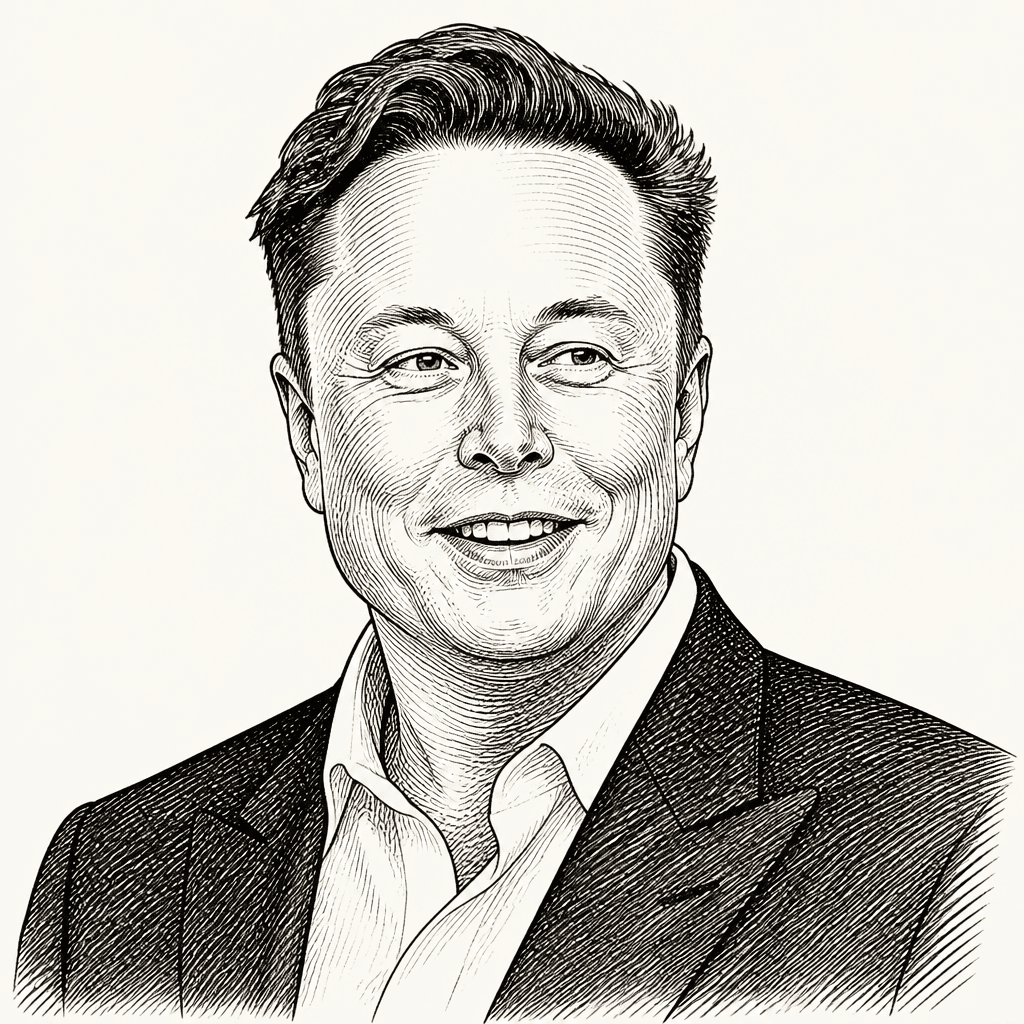
Elon Musk
Technology entrepreneur and executive known for leading Tesla and SpaceX and founding xAI. In the summit footage, he discusses AI’s energy demands and intelligence per watt.
Musk Frames SpaceX IPO as Proof of a Once-Unlikely Space Bet
At SpaceX’s Nasdaq opening bell ceremony, Elon Musk framed the company’s IPO less as an inevitable Wall Street milestone than as the outcome of a venture he once thought had less than a 10 per cent chance of survival. Musk argued that SpaceX was founded because incumbent aerospace companies were not pursuing the technologies needed to make humanity multiplanetary, and said the company’s purpose is to make travel to the Moon, Mars and beyond possible for more than a small group of astronauts.
China’s Brain-Chip Startups Race Toward Commercial Medical Use
Bloomberg Primer reports on the race to commercialize brain-computer interfaces through NeuroXess, a Shanghai startup testing an implanted device in a paralyzed patient. The source presents BCI less as near-term human enhancement than as an assistive medical technology still facing safety, regulatory and reimbursement tests, while arguing that China’s policy support could help its companies compete with better-funded US rivals.
AI Capex Boom Meets Higher Rates and Public-Market Scrutiny
Bloomberg’s Ed Ludlow framed the day’s tech selloff as a test of the AI trade’s practical limits: higher rate expectations after a solid jobs report, pressure on chip stocks after Broadcom’s outlook, and the capital demands of SpaceX’s looming IPO. Across interviews with economists, executives and investors, the program argued that enthusiasm for AI and space infrastructure remains strong, but the market is increasingly focused on whether compute, energy, supply chains and public investors can absorb the scale of spending required.
Neuralink Says 20-Patient Scale Is Advancing Brain-AI Interfaces
Neuralink co-founder and president DJ Seo told Sequoia partner Shaun Maguire at AI Ascent 2026 that the company has moved from a single human implant demonstration to more than 20 patients, while still treating its current work as restoration of lost function rather than elective enhancement. Seo argued that Neuralink’s larger aim is not faster computer control but a higher-bandwidth interface between brains and AI, eventually enabling direct, multimodal transfer of concepts. The path there, he said, depends less on a single implant breakthrough than on scaling surgery, robotics, manufacturing, clinical evidence and neural-data models.
AI Demand Pushes Beyond Nvidia Into Power, Memory, and Compute Markets
Bloomberg Technology framed Nvidia’s earnings as a test of the wider AI infrastructure trade rather than a simple chip-demand story. Caroline Hyde, Ed Ludlow and Bloomberg Intelligence’s Mandeep Singh said investors were looking past headline growth to constraints around China access, margins, memory prices, inference workloads and supply, while a $67 billion NextEra-Dominion deal showed how the data-center boom is already reshaping power markets. The program’s broader argument was that AI demand remains strong, but the bottlenecks have moved across the physical and financial stack.