Kled Founder Alleges Luel Copied Its Human Data Marketplace
 Jason Calacanis
 Alex Wilhelm
 Immad Akhund
 Avi PatelThis Week in StartupsThursday, May 21, 202623 min read
This Week in Startups put two founder arguments side by side: Mercury chief executive Immad Akhund said the fintech’s new $200mn round is meant to create strategic flexibility for a profitable company seeking a bank charter, while Kled founder Avi Patel argued that an alleged copycat in the human-data marketplace category threatens trust in a business built on consent and compliance. Jason Calacanis treated Patel’s dispute with Luel, Y Combinator and General Catalyst less as an intellectual-property case than as an ethics and diligence signal for investors.
Mercury is raising for leverage, not survival
Immad Akhund described Mercury’s new $200 million Series D less as a financing necessity than as a strategic instrument. The company announced the round at a $5.2 billion valuation after years of profitability. Akhund said Mercury has been profitable for four years, and Alex Wilhelm later credited the company for talking about profitability on both non-GAAP and GAAP bases. Akhund also said “the bank is fully capitalized.” That made the financing question central: why raise another $200 million at all?


Akhund’s answer was straightforward. A new round creates a marketing moment, helps hiring, supports acquisitions, and gives the company more flexibility. He did not describe a large acquisition roll-up strategy. Mercury has done two acquisitions so far: Central, an AI-native payroll, benefits, and compliance company for startups, and Teal, an accounting-related company founded by Bench founders Ian Crosby and Adam Saint. Akhund framed both as ways to buy time in categories Mercury already wanted to enter — in payroll, perhaps three years of progress.
Mercury launched in April 2019 after Akhund began building the company in late 2017. He said the idea dated back to 2013, born from his own frustration as an entrepreneur with banks that were “annoying” for founders. At launch, the company focused tightly on startups. That early focus remains part of Mercury’s identity, but Akhund said tech companies now make up about 25% of its customers. The broader base includes digital-first businesses such as e-commerce and professional services. Mercury now serves about 300,000 businesses.
Jason Calacanis cited Mercury’s previously reported annualized revenue run rate of $650 million. Akhund said the current number is higher, but declined to update it. Wilhelm pushed him on the point: the $650 million figure dated from late 2025, and a major funding announcement is usually the time to “flex.” Akhund replied that venture investors would not have funded him if the business had flatlined, but that Mercury’s communications team wanted another news moment later in the year.
The business model, as Akhund described it, is diversified across several sources. Mercury earns interchange from corporate credit cards and debit cards, revenue share from deposits held through partner banks, foreign exchange revenue, and a few other fees. He emphasized that most common Mercury actions remain free and that the company tries to keep pricing simple and transparent.
The new capital sits against a larger strategic transition: Mercury has received conditional approval for a bank charter. Akhund said the company is currently not a bank; it works with partner banks. At Mercury’s present scale, however, he said the company is larger than its partner banks. In his view, Mercury is already effectively a regulated entity, but “regulated by proxy.” A direct charter would give it a direct regulatory relationship and more control over customer experience.
That control matters because the partner-bank model that made Mercury possible at nine people has become a constraint at scale. Akhund said launching with a charter would have been impossible at the beginning. Partner banks were the reason the company could go live. But as Mercury grows, the ability to execute around its own priorities becomes more important than abstracting away regulatory complexity.
Calacanis put the operational logic plainly: if Mercury is itself a bank, it does not need to ask a partner bank whether it can do something. Akhund agreed: Mercury can focus on its own priorities and execute against them.
Wilhelm asked where Mercury is in the charter process. Akhund described it as multi-year, especially for a scaled fintech. The work now is not merely waiting for approval; it means upgrading procedures, controls, processes, and staffing to the standard required to “open the bank doors.”
Going public is on the horizon, but not urgent. Akhund said Mercury is still a young company, having launched in 2019, and he wants to build it for the long term. He said Mercury never wants to sell. He also said it would be “nice” for customers to own part of Mercury, noting that the company ran a Wefunder crowdfunding campaign in 2021 through which about 3,000 customers bought shares via a Regulation CF fundraise open to non-accredited investors.
His rough threshold for an IPO is scale: he suggested a company probably wants to be around a $10 billion market capitalization before going public. Mercury’s priorities before then are getting the bank charter live and reaching the necessary scale.
Mercury wants to turn banking data into operating workflows
Immad Akhund grounded Mercury’s early product-market fit in a narrow founder truth: he was finally building a startup for himself. He knew the specific deficiencies he wanted to solve. Mercury needed wires, which he said made it the first U.S. neobank with wire support. It needed smooth workflows and multi-user permissions. The company spent a year and a half building before launch and went through multiple bank partners because it was doing things that did not have much support.
Akhund said Mercury had instant product-market fit on launch, especially among early-stage startups. Part of the reason was that startups are product-minded and eager to use better tools. Another part was network distribution. He said more than 50% of each Y Combinator batch uses Mercury, which helped the company become viral inside the startup ecosystem. Startups also grow quickly, and banking is sticky if the provider continues delivering support and features. Mercury began with early-stage companies and now has many customers that have raised more than $100 million.
That customer growth explains Mercury’s expansion beyond banking into invoicing, corporate cards, bill pay, payroll, and potentially accounting services. Akhund’s thesis is that a company’s money stack should be unified because money movement, finance operations, and back-office workflows are deeply connected. He said customers do not want to sign up for many separate tools; banking is where their money is and where the finance team is, so Mercury should let them do everything in one place.
The Central acquisition fits that strategy. A Mercury page shown on-screen announced “Mercury enters payroll” and said Mercury had acquired Central, an “AI-native payroll, benefits, and compliance platform for startups.” The visible text said Central uses AI agents and human experts to handle payroll, benefits, PTO, HR, state compliance, and more for founders. Akhund said Central is being run independently while slowly integrating into Mercury and is expected to become Mercury Payroll later in the year.
He gave a concrete version of what integration could make possible: a founder could say they had hired an employee, and Mercury could set up payroll, issue a card, configure expenses, and complete related steps in a few actions. The power of AI increases, he said, when Mercury has data across banking, invoicing, cards, bill pay, and payroll.
Akhund said his science-fiction reading shapes his view of the next decade: everyone will have a personal agent doing things for them, and Mercury wants to be an enabler of that. Mercury has launched a CLI and already has an MCP, so customers are connecting Mercury into tools such as Claude Code, ChatGPT, and other workflows. Some customers already give Mercury virtual cards to agents so they can perform tasks.
Akhund distinguished between users already comfortable with agentic workflows and those who want AI inside the Mercury app itself. Mercury Insights lets customers ask questions about transactions and receive summaries, such as whether an AWS bill has risen 30%. Later in the summer, he said, Mercury plans to launch Mercury Command, which would let users request more complex workflows — for example, “pay my landlord 5k” — with Mercury setting it up and the user approving.
Calacanis compared this to the durability of multi-product platforms. He recalled Jerry Yang telling him Yahoo wanted users to use 2.4 Yahoo services because once they used email plus finance or sports, they were unlikely to leave. Akhund accepted the general idea but argued Mercury’s opportunity is stronger because these are not loosely connected consumer products. Money movement products compound when they sit inside the same system. Mercury tracks whether customers use three or more products; Akhund said roughly 15% to 20% do. His phrase for the desired state was that every money movement is “a blue box,” meaning inside Mercury.
Akhund added a possible change in startup strategy: because software development, especially new feature development, is becoming easier, multi-product expansion may happen earlier than before. Wilhelm cautioned that founders still need to hold multiple business units in their heads. Calacanis later sharpened that point: as software gets easier, the finite resource shifts from engineers to founder energy, enthusiasm, and creative cycles.
Stablecoins fit Mercury’s strategy as an augmentation rather than a replacement. Calacanis framed the question in the context of bank charters, money laundering risks, offshore stablecoins, and the desire to bring activity onshore and under regulation. Akhund said stablecoins have real use cases, especially globally, where many people want access to U.S. dollars and stable currency. Stablecoin accounts and international money movement can be powerful. Mercury will probably allow customers to send and receive stablecoins soon.
But Akhund does not see stablecoins replacing the existing system. He does not currently plan to buy a stablecoin startup or launch a Mercury stablecoin. USDC, he said, is already “pretty good” and has a network effect. Mercury would consider its own stablecoin only if it found a customer-driven reason.
Kled’s complaint was not that competitors exist; it was that reputation and compliance are the product
Avi Patel came to the dispute with Luel and General Catalyst by first describing what Kled is trying to build: “the first human data marketplace.” The company lets people upload personal data and get paid for it. Patel compared it to Mercor or Scale AI, but with a distinction: those companies focus mainly on labeling, while Kled focuses on aggregation.


Kled’s reported scale was substantial. Patel said the company had collected more than 1.1 billion files in the previous four months, receives more than 5 million files uploaded per day, has more than 300,000 users, reached number one in the App Store in multiple countries, and has raised more than $10 million.
The underlying business is a reversal of the Meta model as Calacanis described it. Consumer internet platforms provide free services, collect user data, and monetize that data while the user receives no direct payment. Kled’s model asks people to consent to upload their data, then licenses that data and pays users a portion. Patel added that explicit payment changes participation: Kled can guide users toward specific tasks requested by leading AI labs.
The company uses a mobile app rather than browser extensions or desktop tools because Patel believes the phone is the easiest consumer form factor. Users see a feed of tasks from labs and can also upload general data, including their camera rolls. Patel said this general data is surprisingly valuable because it is consent-driven. He argued that buyers, including companies such as OpenAI in the example he gave, cannot risk buying “bad data” that is not legally licensed. Kled’s pitch, as Patel put it, is that uploaders give “100% consent across the board,” giving buyers confidence they will not be sued.
The economics can be significant. Asked what Calacanis might be paid for uploading 100,000 images, Patel said it depends on quality but could be around $500 at the higher end. He then described a recent lab, which he did not name, willing to offer $1,000 for the selfies in a person’s full camera roll and seeking 100,000 people. Wilhelm immediately noted that this would be a $100 million contract.
Patel said the blocker is not demand; it is fraud detection. At scale, the platform must prevent duplicate uploads, plagiarized images from the internet, AI-generated images, and task-specific invalid submissions. If a task asks for a video of someone taking out the trash with both hands visible, head-down angle, and a specific time of day, then five seconds with a hand out of frame can make the video unusable. Patel said the company needs to detect such failures at scale because giving bad data to a lab can end the relationship.
That is why Patel framed the Luel dispute as more than ordinary startup competition. A human data marketplace depends on trust. It deals in personal data. Users must believe the platform is legitimate, and buyers must believe the data is licensed, compliant, and high quality. Patel said Kled needs to grow in the United States and other lower-fraud markets such as Malaysia and Indonesia, and that public reputation is central to winning. In his view, if a company in the category is publicly accused of wage theft, questioned over compliance, or suspected of inflated metrics, the concern is not only that it competes; it can damage the market’s trust.
Patel alleged a combined pattern: copied design, questionable traffic, and disputed compliance claims
Avi Patel said he woke up to a post from Yuri at General Catalyst announcing a $31.5 million seed round into Luel, a Y Combinator company. Patel said he had been speaking extensively with General Catalyst, had more than five meetings with the firm, and was going to meet Hemant — whom Patel characterized as “the owner of the fund” — to discuss what Patel described as the same terms: a $30 million investment at the same valuation.
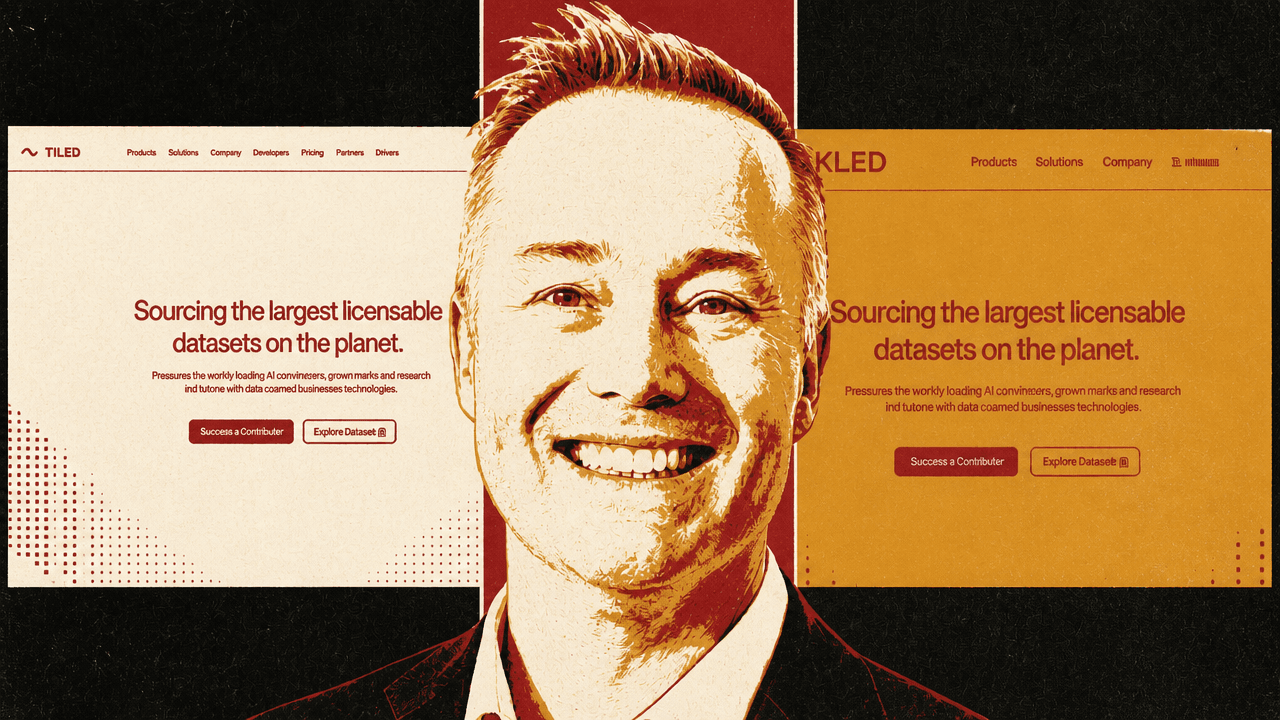
He clicked through to Luel’s site and saw what he described as a “very, very glaring resemblance” to Kled’s website. The side-by-side visual shown compared the Kled and Luel homepages. Kled’s header read: “Sourcing the largest licensable datasets on the planet. Powering the world’s leading AI companies, governments, and research institutions with data sourced from verified contributors.” Luel’s read: “The Frontier of Data. Luel is where the next generation of AI training data is created, curated, and licensed.” The pages used similar layouts and typography. Calacanis described it as looking like Luel had “photocopied” Kled’s website “to a level that was absurd.” Patel agreed and called it a complete ripoff.
The X post that started the dispute was shown on-screen from Patel’s account. It read: “General Catalyst just co-led a $31.5 million seed round into a blatant rip-off of my company, Kled.” Patel continued that he would typically not speak on such things, but called the copycatting “egregious and completely unacceptable” and said it needed to be made an example of. He described it as one of hundreds of YC startups engaging in “disgusting behavior” and “unimaginative slop” rewarded by nepotism.
General Catalyst just co-led a $31.5 million seed round into a blatant rip-off of my company, Kled. (skip to 40 seconds if you want to skip context) I would typically not speak on things like this, but this level of blatant copycatting is egregious and completely unacceptable, and needs to be made an example of. This is one of hundreds of YC startups who have conducted this disgusting behavior. Unimaginative slop that continues to get rewarded due to nepotism.
View postPatel was careful to say that copying a website alone was not the entire issue. He said many companies have copied Kled’s website or tried the same model. What made this case unacceptable, in his view, was the combination of factors: the timing with General Catalyst, the scale of the round, the alleged design copying, what Patel characterized as Luel’s weaker app relative to Kled, the geographic traffic pattern, compliance claims, and accusations Patel said were attached to Luel.
His traffic allegation centered on Nigeria. Patel said Luel supposedly had 500,000 or 600,000 users, but 50% of its web traffic came from Nigeria. Kled, he said, had banned Nigeria from its app the prior week because of what he described as a 95% fraudulent upload rate. Patel alleged that Luel had only a small amount of organic monthly traffic — he cited Semrush and similar services as showing 113 to around 300 people — and that the rest was paid. His accusation was that Luel paid to acquire users in a region Kled had found to be high-fraud in order to bolster user numbers and look better to investors.
Patel also challenged Luel’s compliance presentation. He said Luel used Delve for compliance and asserted on its website that it had SOC 2, GDPR, CCPA, and HIPAA compliance. According to Patel, a second video he posted showed Luel’s website making those claims, while Luel’s Delve compliance portal showed only SOC 1 compliant and SOC 2 in progress. Calacanis described Delve as a Vanta competitor accused of “AI slop” SOC 2 compliance that damaged customer reputations. Patel added, “God knows if the SOC 1 was actually compliant or not.”
Another allegation concerned Luel’s on-site metrics. Patel said that if one inspected the site’s elements, the live-user counter was a manual number counter going up and the heat map was manually set to show where people were located. His conclusion was that no one could know whether the 600,000-user claim was real.
Wilhelm asked whether Luel had been founded after Patel was already talking to General Catalyst. Patel said Luel announced after Kled was talking to GC and was founded well after Kled started, more than a year earlier. Asked whether Luel entered Y Combinator with the same idea or pivoted into it, Patel said Luel came to YC with the same idea.
The question then became whether Y Combinator knew Kled existed. Patel said yes. His basis was that on the day Kled announced its fundraising video, YC announced demos for three “exact replica products” to Kled, one of which he thought was Luel. Patel said Kled had been building in public for a year and had gone viral many times.
Wilhelm pressed Patel on his use of the word “nepotism” in the original public post. Patel said his reasoning involved nonpublic factors. He had messaged several people from General Catalyst, whom he did not name. He said one of the most important investors in a major data company in GC’s portfolio — a person he described as a rite-of-passage meeting for companies in the space — had no idea Luel existed before the investment and had nothing to do with the deal. Patel called that strange and said he did not know how many people inside GC knew about the deal.
Patel said Luel had not addressed the allegations publicly and had not messaged or spoken to anyone, in his view because doing so could amount to an admission. He also said Luel had changed its trust page after being called out, including fixing what he described as misleading compliance practices.
Calacanis treated the copycat case as an ethics signal, not an IP case
Jason Calacanis framed his judgment of the Kled-Luel dispute around the difference between legal enforceability and ethical signal. Copying a website pixel by pixel may not be a practical lawsuit for a startup to pursue. Calacanis said Patel cannot stop his business and spend $10 million suing over a website. But for investors and accelerators, visible copying is a “glaring alarm signal” that should trigger deeper diligence.


His ruling on Y Combinator was mixed. He argued that YC encourages hacking behavior because rule-benders who are competent often win. He placed this in the broader startup mythology of companies that reinterpret rules — Airbnb around lodging, Uber around ride sharing — and said some rule breaking produces important companies. The problem is that when an accelerator selects for people willing to bend or break rules, some will cross into unethical, immoral, or criminal behavior.
Calacanis said YC should be clearer at the margins: fast following and pivoting are normal in accelerators, and no accelerator can promise to back only one company in a vertical because most companies pivot. But blatant rip-offs, photocopying, and stealing are “lame and unethical,” and YC should say so explicitly.
If somebody is willing to do something that's unethical, immoral, then that means you need to investigate if they are doing other things that are immoral, unethical, or illegal.
He then judged Luel based on Patel’s account. The company looked, to Calacanis, lame, unethical, and immoral if it had stolen Kled’s website “pixel by pixel.” He did not render a verdict on all of Patel’s other allegations, but said those allegations are exactly why the initial ethical signal matters: investors should now double-click on metrics, contracts, customers, pay, equity, and fundraising claims.
Calacanis drew on his own investing experience. In his first 400 investments, he said, three companies behaved in the zone of unethical, immoral, and potentially illegal conduct, including securities fraud, option pricing issues, and misleading fundraising claims. He recalled asking counsel about a startup that claimed people worked for it when they did not, while raising money. Counsel told him that if the claim appeared in a fundraising deck, it was securities fraud. The lesson he teaches startups is to be precise: do not mix pipeline with customers; say trial, paid trial, unpaid trial, or paying customer accurately; do not exaggerate contract value or revenue.
Avi Patel added that in a human data marketplace, reputational risk is existential. The company must persuade users to trust it with personal data and persuade labs that the data is valid. Public allegations, Reddit threads, and a damaged reputation are not peripheral; they affect the user base and future growth.
Calacanis’s ruling on Patel was favorable. He said Patel had limited options. A lawsuit would be too expensive and distracting. Silence would invite more attacks. Publicly presenting evidence and calling out the firm was, in his view, the correct move.
You had no choice but to stand your ground on this.
Patel said the public post initially alarmed some of his own investors. In the first five minutes, he received messages from roughly three investors saying they loved him but that he needed to take the post down immediately. An hour later, he said, they were telling him, “Avi, I love you, never change.” That became the consistent reaction among his seed investors.
Calacanis argued the public response could also help Kled: higher visibility, more VC attention, recruiting interest, and a stronger contrast between what Patel claimed was the original company and the copycat. Patel resisted turning the moment into opportunistic fundraising. He said he had turned down almost everyone that asked to invest because he wanted to raise his Series A on revenue and numbers rather than Twitter virality. His stated objective was only to call out the company’s reputation properly.
Calacanis disagreed with that fundraising restraint after Patel left. In his view, Patel should immediately open a note, price it between the last round and the expected Series A, and build up the company’s “chip stack” to compete more aggressively. His broader advice was to channel the anger into product, growth, hiring, fundraising, and winning. “Winning is the greatest revenge,” he said.
General Catalyst received more disagreement between the hosts. Calacanis gave GC some grace. He said it is a great firm and may have made a speed error: the category is emerging, many companies are pursuing it, and GC may have picked one without vetting it deeply enough. If Patel’s allegations are true, Calacanis said, perhaps Luel did not present itself honestly to GC and the firm was “taken for a ride.” He imagined GC may now be confronting the company privately or even trying to unwind the relationship.
Alex Wilhelm was less charitable. He said his view of General Catalyst had dropped dramatically because of the behavior and the unwillingness to admit a possible mistake. He had known investors there and had been to the firm’s “elevator pitching room,” but said he no longer viewed GC as a serious actor in the same way. Patel said people from GC told him they had been asked not to communicate with him at all, so they were not apologizing or addressing it with him.
Calacanis ultimately cast the broader phenomenon as inevitable in a world where software is easier to build. Fast following can be legitimate: investors can see Uber or Airbnb work and decide to fund a silver or bronze medalist, perhaps with a different model or better margins. Facebook was a fast follower of Myspace and Friendster; Uber followed Lyft into ridesharing after beginning as a black-car service. But the distinction, for Calacanis, is between competing in a new market and copying without originality. Founders who merely clone for money often quit when it gets hard. What cannot be copied, he said, is resilience, enthusiasm, self-reliance, and refusal to quit.
OpenAI’s token offer was read as market intelligence with equity attached
Alex Wilhelm introduced Sam Altman’s offer to current Y Combinator startups: $2 million in OpenAI credits in exchange for equity. Wilhelm described the likely structure as a SAFE or perhaps, jokingly, a “TAFE” — tokens for future equity. His question was whether YC companies should accept the value or reject it.
Jason Calacanis answered bluntly: founders should treat the offer as letting “the fox into the henhouse.” His concern was not that OpenAI needs the equity return. It was that OpenAI could use the credits, relationship, and ownership stake to observe which startups are breaking out, understand their usage patterns, and then acquire, compete with, or copy the most promising ideas.
He compared the dynamic to historical platform behavior. Windows, Android, iOS, Facebook, and Apple all study the app layer and eventually make the best features native defaults, he argued. He said Apple tends to be more conservative, often letting a robust ecosystem develop before adding features such as sleep scoring or breathing exercises. But in his view, platforms generally learn from developers and incorporate successful patterns.
In the OpenAI-YC case, Calacanis argued the offer is “brilliant and dangerous.” He said OpenAI could see which YC companies move from $2 million in token usage to much higher usage and direct business development or product teams to study them. Even without unethical access to code or private information, he argued, usage growth alone is market intelligence. The most charitable interpretation, he said, is that this is a market-intelligence play. His harsher characterization was that OpenAI is using the offer “to steal ideas from early-stage startups.”
Wilhelm disagreed at first. Many AI startups already use OpenAI or Anthropic for inference. If they are already sending usage through OpenAI’s models commercially, he asked, how much incremental risk does the token-for-equity offer create? To him it looked like subsidized API inference for a while, not a fundamentally different risk.
Calacanis responded by focusing on the individual making the offer. He described Altman as cutthroat and, in Calacanis’s telling, said recent events had raised questions about Altman’s ethics and approach to business. Calacanis referenced a recent trial, Mira Murati leaving, the OpenAI nonprofit board “blowing up,” and a New Yorker article in which he said people shared their experiences. Calacanis said he likes Altman interpersonally and thinks he is incredibly smart, but believes what Altman did to Elon Musk was immoral and unethical. His advice to founders was to be thoughtful and consider alternatives including open source, Anthropic, xAI, Gemini, or other providers that may have different reputational or acquisition dynamics.
Wilhelm narrowed the practical lesson: if a deal seems too good to be true, it might be.
He also noted a separate implication of the offer. The prior year’s concern about OpenAI’s compute buildout now looks different to him if the company can reset Codex limits frequently and offer $2 million in credits to large numbers of YC startups. Wilhelm described that as potentially $800 million in compute credits if applied across hundreds of startups. He suggested observers should have been more positive about OpenAI’s compute work because it appears to be enabling current capacity, while Anthropic is, in his characterization, scrambling for GPUs, TPUs, or ASICs to meet inference demand.
The labor coda made wages a proxy for constrained supply
Alex Wilhelm said hotel housekeepers covered by New York City’s Hotel and Gaming Trades Council would see income rise over time to more than $100,000. He later clarified the mechanics: wages would rise by about 50% over eight years, or roughly 5% compounded annually, moving housekeeper pay from about $40 to about $60 per hour by 2034. The $100,000 figure depends on annualizing those hourly wages and on the timing of the contract. Wilhelm cautioned that $100,000 in New York City in 2034 will not mean what it means today and said median income for families with children is far higher in parts of the city: $186,000 in Manhattan and $113,000 in Staten Island.
Jason Calacanis found the number striking because housekeepers elsewhere earn far less. Wilhelm supplied a comparison figure of about $39,000 for average housekeeper pay. Calacanis interpreted the hotel outcome as a case study in regulatory capture and constrained competition. He said New York City has banned Airbnb, hotel supply is limited, occupancy is high, and hotel rates are expensive. Wilhelm added that New York City has the highest average hotel cost at $335 per night and an 84% occupancy rate. Calacanis argued that hotels benefit from limited competition, unions know the economics, and wages rise accordingly.
The broader labor argument shifted to immigration and the minimum wage. Calacanis said that if the United States restricts immigration, it should expect wages of $30, $40, or $50 an hour for work such as valet, barista, or housekeeper jobs. He compared that to New Zealand, Australia, and Nordic countries, where he said minimum wages around $15 to $25 have been workable.
Calacanis said his own prior bias was against minimum-wage increases because he believed they eliminated jobs. Watching portfolio companies in automation, he saw aggressive city-level minimum-wage increases in places like San Francisco, New York, and Seattle accelerate automation. But he said the jobs were being automated anyway, and the wage increase mostly pulled the timeline forward.
His revised view was incrementalism. He suggested raising the federal minimum wage slowly — perhaps $1 a year for five years, or 50 to 75 cents annually over a longer period — rather than jumping to $25 or $50, which he described as a shock to the system. Even if many workers already earn above the federal minimum, he said, keeping it at $7 looks socially indefensible. A gradual increase would make coffee, hamburgers, and fries somewhat more expensive but create more consumers because people earning under $100,000 generally spend rather than save.
Wilhelm agreed with the wage argument but objected when Calacanis approvingly cited Jeff Bezos saying the country should stop taxing a nurse in Queens making $75,000. Wilhelm argued the United States needs more revenue, not less, because, in his account, long-dated government debt yields are rising, borrowing is unsustainable, and the country cannot afford to cut taxes further. Calacanis agreed that neither party is serious about cutting spending and said each recent administration has contributed to a pattern of rising debt.
The investment advice Calacanis drew from that risk was simple: own equities. He named companies such as Google, Amazon, Apple, Uber, Airbnb, and Coinbase as international businesses that transcend any one region or currency. They may be affected by market seizures or devaluation, he said, but people will still use Amazon, AWS, and iPhones, even if replacement cycles slow. Wilhelm agreed with the practical version: index funds, broad exposure, and ownership of the major technology companies.