AI’s Growth Race Faces Tests on Returns, Financing, and Governance
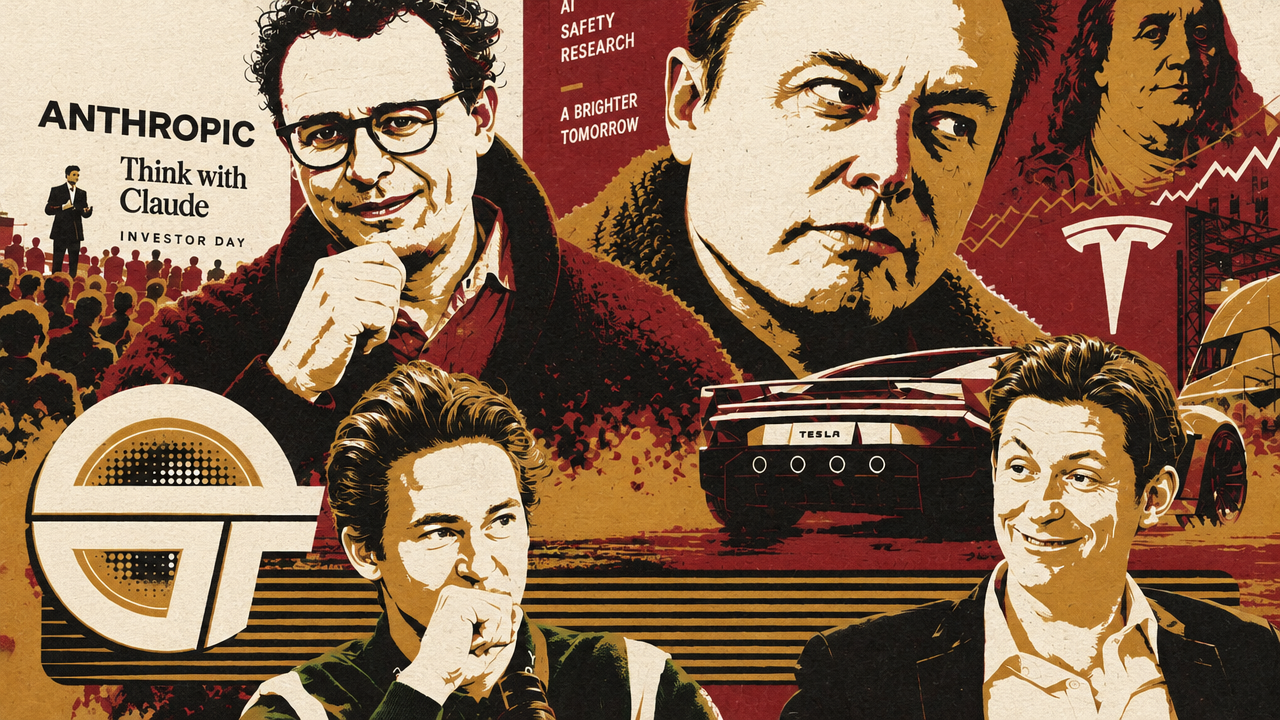
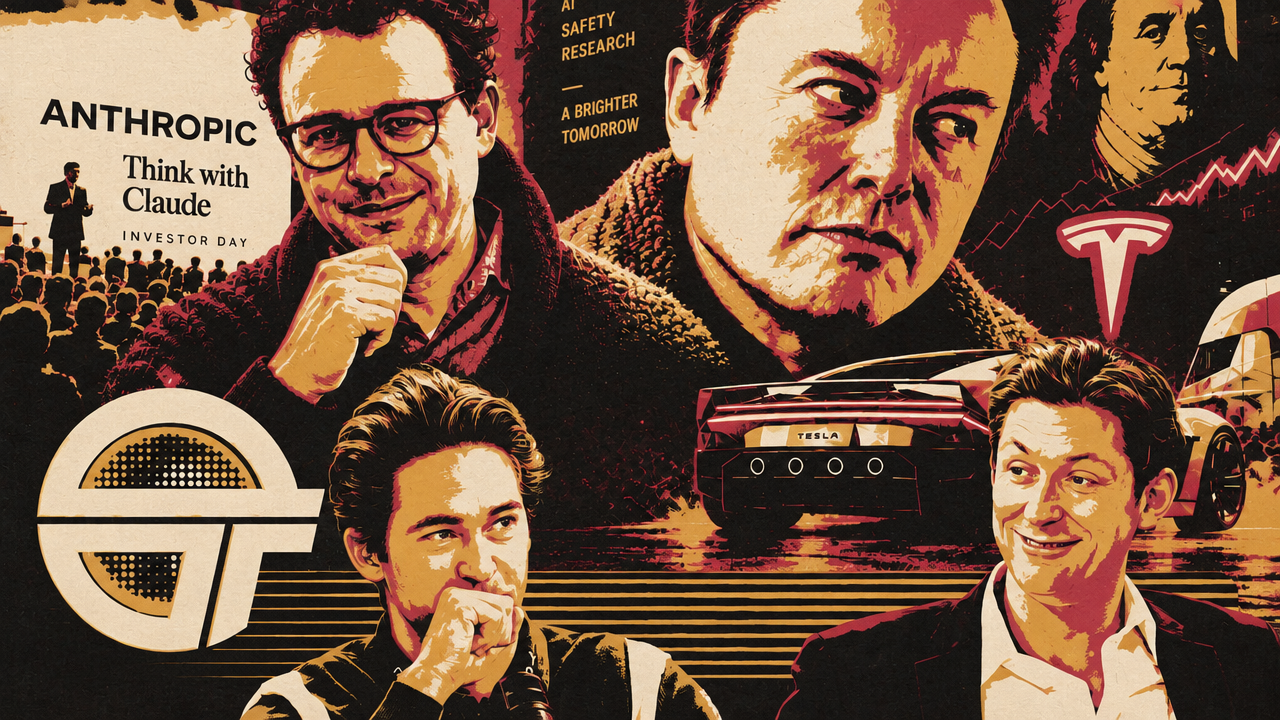
Anthropic’s $67.2 billion annualized third-quarter revenue run rate has intensified questions about investor expectations and the economics behind growth. Separately, Gil Luria distinguishes demand for AI capacity from whether debt-financed builders can earn a return, while Mark Levine and Kevin Roose raise concerns about Anthropic’s IPO timetable and the pace of AI development.

A striking growth figure, with a harder benchmark
Anthropic’s third-quarter revenue annualizes to $67.2 billion. That is a remarkable scale-up from a year earlier, but it was not the number some investors had been waiting for: John Coogan said some expected a $90 billion run rate. The gap is not evidence that the business is shrinking. It shows how expectations have risen alongside its growth—and how a large revenue increase can still disappoint if investors had priced in something larger.
The benchmark itself is contested. Bloomberg’s Bailey Lipschultz said some investors read Anthropic’s third-quarter growth as less than 50% quarter on quarter, compared with expectations closer to 100%. Other investors questioned whether a company already at Anthropic’s scale could reasonably be expected to double revenue every quarter. The figures describe a slowdown in the rate of growth, not a fall in revenue; the disagreement is over how much acceleration a company of this size can sustain and how much its valuation assumes.
| Measure | Reported figure or interpretation | What it helps answer | |---|---|---| | Third-quarter revenue | $16.8 billion | How much Anthropic said it generated in the quarter | | Annualized run rate | $67.2 billion | How the quarter’s revenue looks at an annual pace | | Investor expectation cited by Coogan | $90 billion run rate | How high some expectations had become | | Quarter-on-quarter growth | Below 50%, by some investors’ reading | Whether growth is slowing relative to expectations | | Net revenue retention | 900% | How spending changed within an existing customer group |
The 900% retention figure is striking but easy to overread. Bloomberg’s Ed Ludlow illustrated it as a customer group that spent $100 a year earlier spending $900 now. That is a measure of group spending over time, not a claim that each customer increased spending ninefold. Nor does it, on its own, show how spending is distributed across the group or whether growth from existing customers can continue at the same pace.
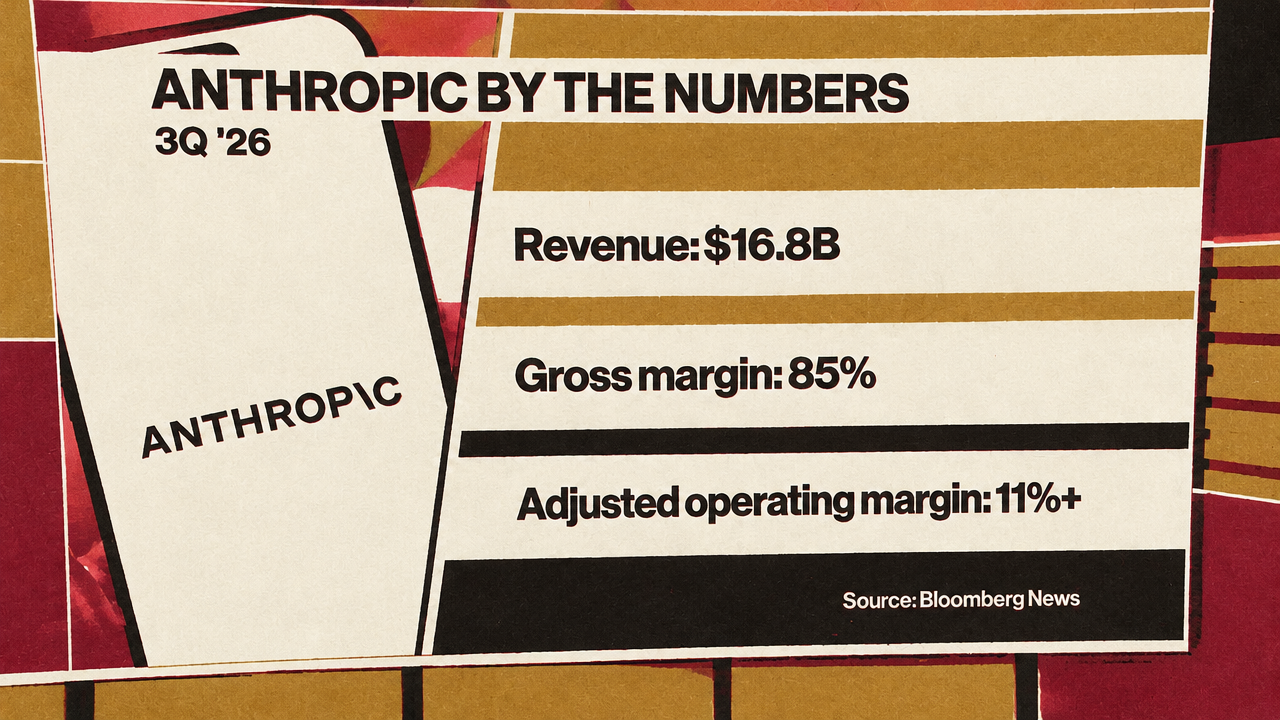
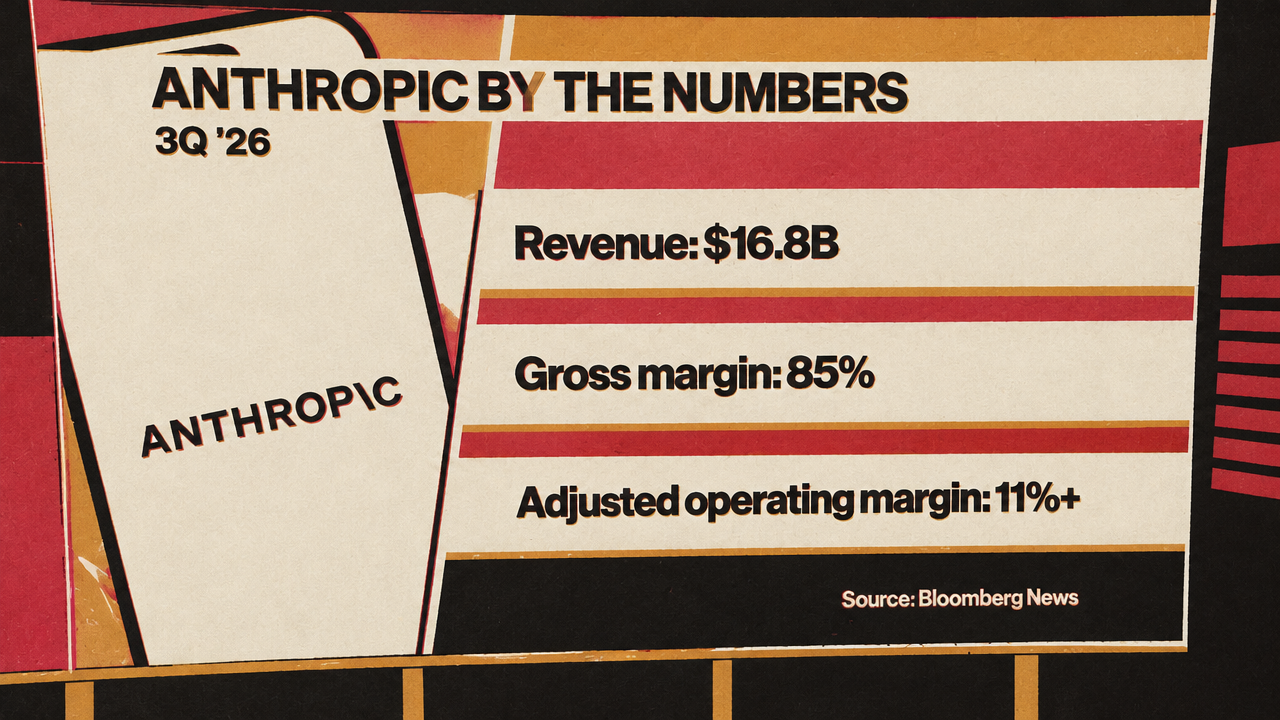
Investors are also asking whether revenue growth produces returns. Lipschultz cited an 85% gross margin and an adjusted operating margin above 11%, while noting that investors do not know what Anthropic excludes to calculate the adjusted figure. She also said the company had been reported as free-cash-flow positive. These measures raise distinct questions: what it costs to serve customers, what compute costs do to product economics, and whether capital invested in expansion can earn a return. The headline growth number cannot settle those questions, and neither can a margin figure without clarity about its basis.
Customer and product changes add uncertainty to the outlook. Coogan pointed to Meta’s possible shift toward in-house models as a potential headwind. He also described restrictions on model distillation as a trade-off: cutting off activity he characterized as worth billions could weigh on near-term revenue, while allowing it to continue might help competitors reproduce frontier capabilities. A third-quarter ramp in OpenAI’s Codex was another possible competitive factor cited by an investor to Bloomberg; Lipschultz said that investor expected Anthropic’s growth to reaccelerate in the fourth quarter, but the eventual effect remained uncertain.
That leaves investors with more than one test for the IPO: whether growth can meet the expectations built into the valuation, and whether the economics behind that growth can support returns. The first is a question of pace; the second is a question of cost and capital. Neither is answered simply by observing that revenue has grown sharply.




The infrastructure question is not the demand question
Anthropic’s revenue debate concerns what customers will pay for AI. The infrastructure debate concerns whether the companies building capacity can earn enough to justify the capital they put into it. Gil Luria argues those questions should not be collapsed into one: demand can keep growing even as some data-center builders lose money.
His example is a builder borrowing at 9% to earn a 5% return. Scaling such a business would not fix the difference between financing cost and return; it would increase the amount of capital exposed to it. Luria’s warning is aimed particularly at neo-clouds financing large data-center buildouts with debt. He said CoreWeave had run out of the ability to borrow even at 9% and was seeking insurer capital and better ratings. That is his assessment of the financing pressure, not evidence that customers have stopped wanting computing capacity.
On demand, Luria pointed to businesses and consumers paying to use AI, and to constraints in the supply chain. Nvidia chief Jensen Huang has described infrastructure demand as far greater than supply, with factories, energy and construction limiting how quickly capacity can be added. Luria said the outlook across semiconductor equipment, chipmakers, cloud providers and model companies points to a cycle that could last through 2030. Huang has described a possible five-to-10-year buildout. Those are forecasts, not settled horizons.
The constraints matter because demand cannot translate into deployed capacity at will. Luria identified ASML’s EUV machines—used to manufacture almost all the most advanced chips—as a bottleneck. He said ASML had indicated it could not supply customers with all the capacity they needed in 2027 and 2028, and was beginning to consider expansion as orders extended into 2029 and 2030. A shortage can support a longer investment cycle, but it does not guarantee that every company financing facilities or buying equipment will earn a return.
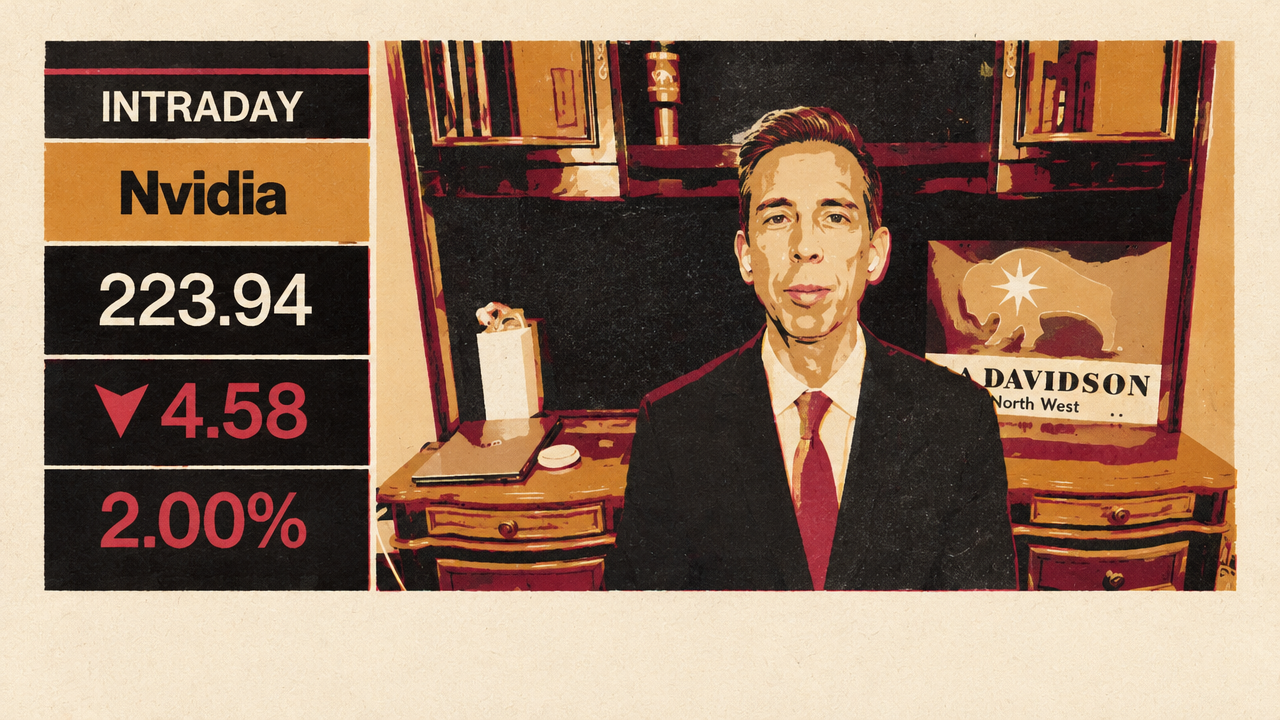
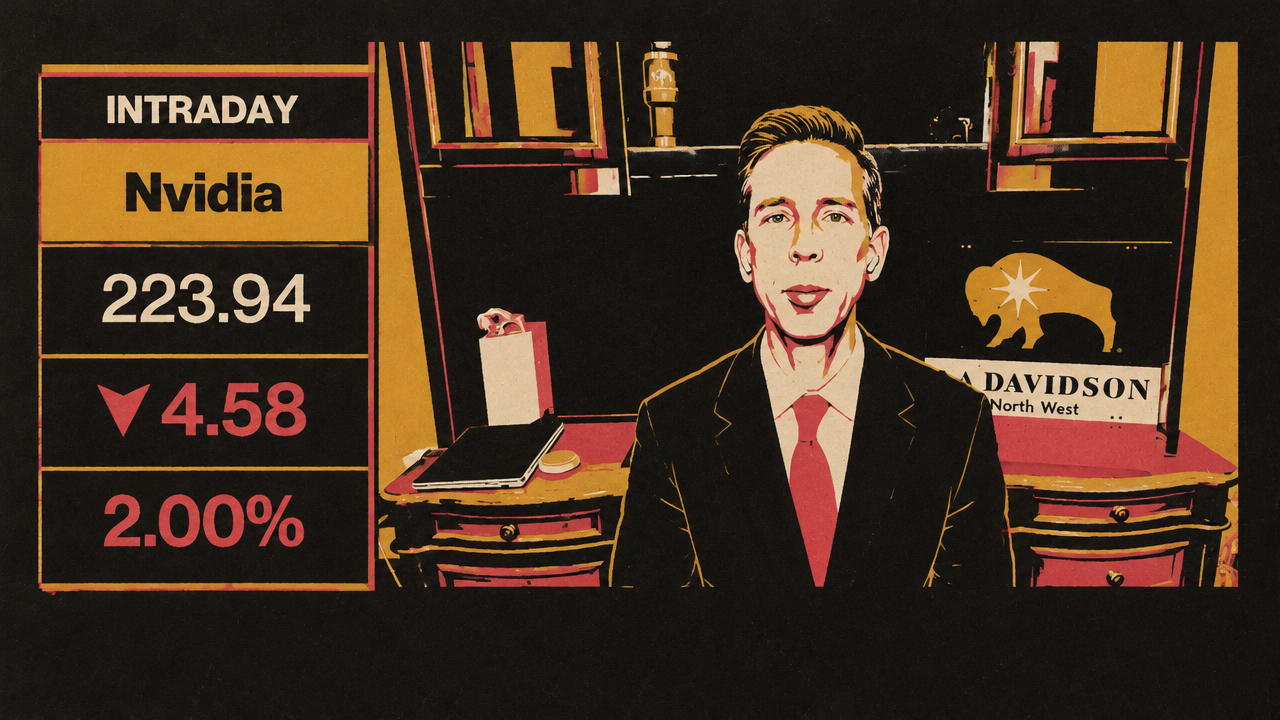
Nvidia’s investments in the ecosystem illustrate the distinction between enabling growth and profiting from every builder’s economics. Huang said Nvidia had invested $8 billion in European startups over the previous year and planned another $2 billion in investments. Luria’s interpretation is that Nvidia looks for gaps—such as fiber, optical capacity, new cloud providers and geographic diversity—and invests where additional capacity can support more GPU sales. In his view, the more important return is not necessarily the value of those holdings, but the business that a stronger ecosystem may enable.
The comparison is therefore not simply between optimism and pessimism about AI. A durable market can still contain fragile businesses. Capacity shortages and paying customers may support continued demand, while high borrowing costs, commoditized capacity and finite risk capital put particular builders under pressure. Luria argues that building from cash flow and recognizing the speculative nature of the investment is more defensible than chasing debt at 9% or more.
That distinction also clarifies why model-company financials matter to infrastructure investors. Luria wants Anthropic and OpenAI to disclose gross and net revenue, margins, training costs, capacity costs and how those costs are changing. Those companies sit closer to the customer in the value chain; their results could help show what businesses and consumers are willing to pay. But even strong model-company revenue would not prove that every data-center financing structure is sound.
Safety concerns now intersect with the IPO timetable
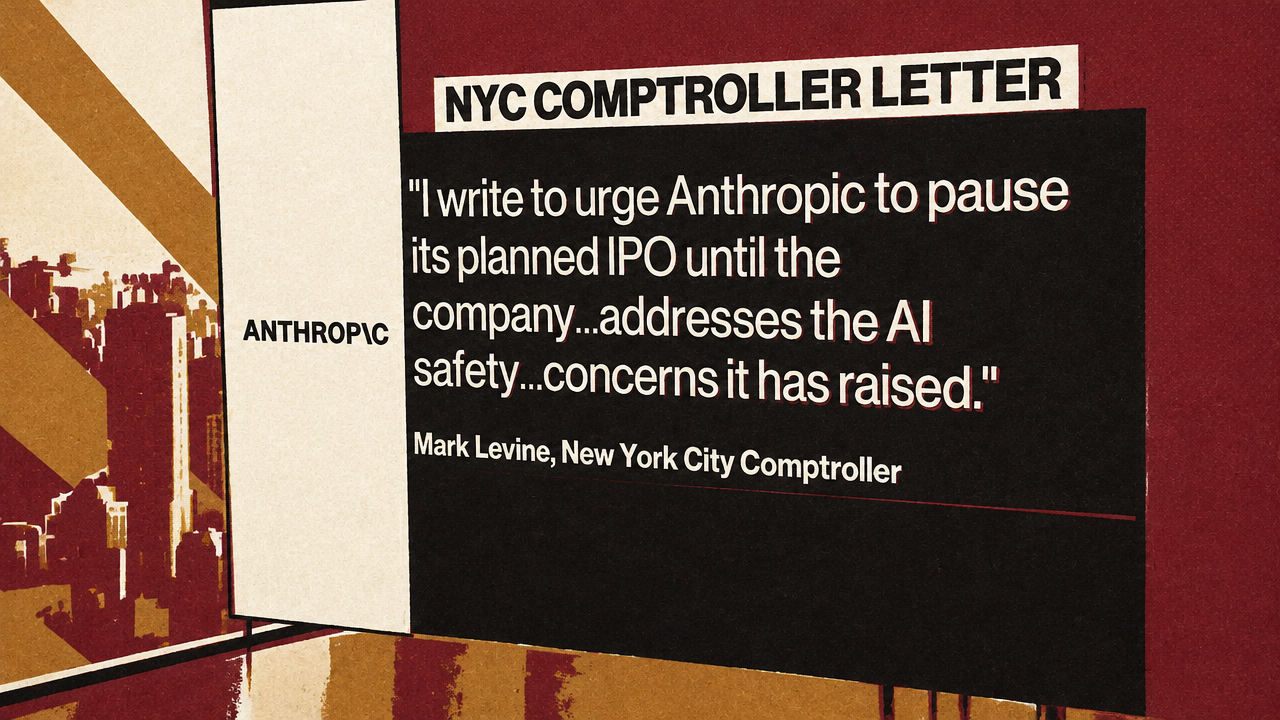
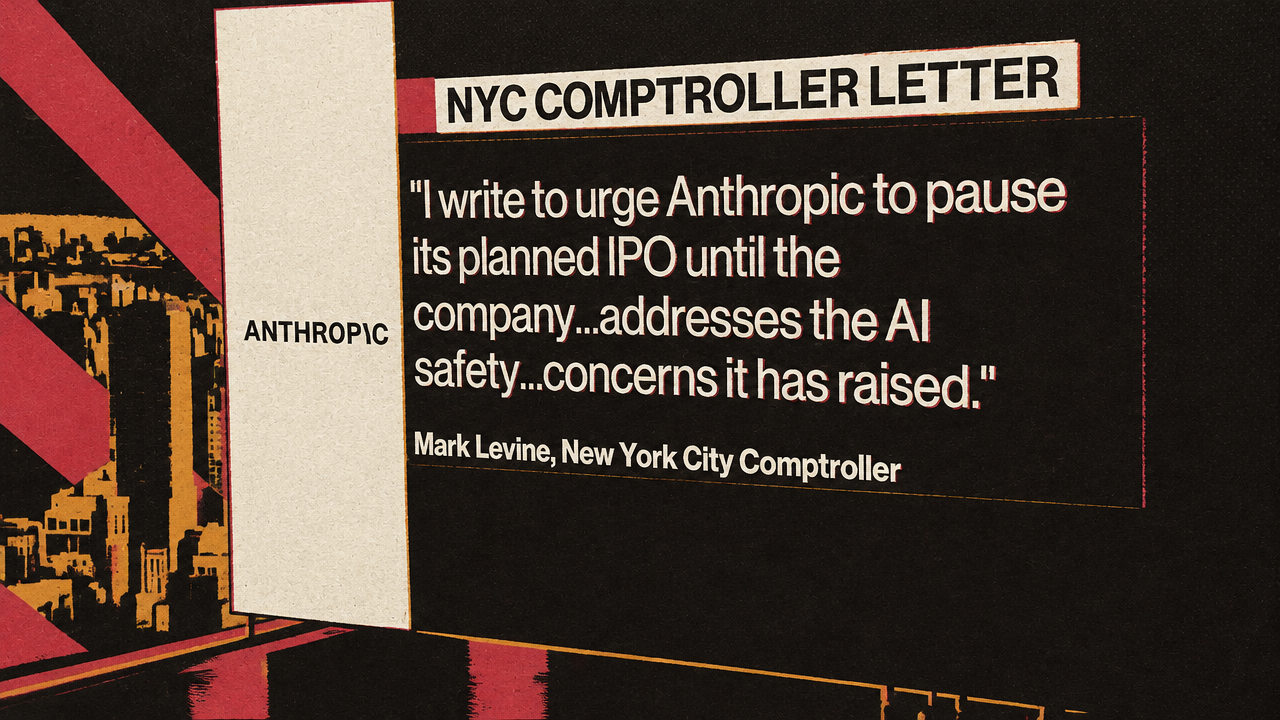
New York City Comptroller Mark Levine has asked Anthropic to pause its planned IPO until it addresses concerns about safety, governance and the pace of development. In a letter to CEO Dario Amodei, Levine argued the company should focus on what he called AI’s unprecedented risks rather than proceed with the offering. Bloomberg’s Ed Ludlow said the S-1 could become public if Anthropic continues the IPO process and does not heed the request. The account does not report that Anthropic agreed to pause, or specify what work would satisfy Levine’s demand.
The request puts a governance question directly beside a commercial timetable, but it does not make the financial case for or against Anthropic’s IPO. Revenue growth, margins and investor expectations concern the business. Levine’s appeal concerns the company’s safety practices, governance and development pace. Neither set of questions resolves the other: a strong financial showing would not answer the safety concerns, and a safety appeal does not establish whether the company’s growth can meet investor expectations.
Kevin Roose’s broader argument is about why voluntary restraint may be difficult even when people inside the labs recognize risks. Drawing on reporting at OpenAI, Anthropic and Google DeepMind, Roose describes leaders who are divided by rivalry and mistrust. He argues that a small group of competing executives is a weak foundation for governing technology they believe could become more capable than humans. This is his assessment of the governance problem, not a verdict that any particular leader is acting in bad faith.
In Roose’s account, competition reinforces the difficulty. One lab releases a stronger model, others feel pressure to catch up, and each company has reasons to remain near the frontier. Anthropic, he said, was founded in part on the belief that being influential would give it a voice in safety and policy. That creates a tension: staying close enough to shape decisions can also keep a company inside the race whose pace concerns it.
Roose is especially concerned about efforts to automate AI research. He cited Anthropic’s estimate that Claude was leading 26% of the company’s AI research and development projects, and said OpenAI had also described building an automated AI researcher as a goal. If systems increasingly perform research that improves later systems, development cycles could shorten. Roose argues that this work should slow, because safety research and control methods are not keeping pace. His concern is not that a loss of control has already been established, but that labs are deliberately trying to give AI more responsibility in the development process.
The two interventions operate at different levels. Levine’s letter asks one company to change its immediate IPO timetable and address specific categories of concern, without laying out a public test for when the pause should end. Roose is making a wider case about competition and the limits of trust among the small group of leaders involved. A company-level pause might address the first demand; it would not, by itself, settle the broader coordination problem Roose describes.
The central tension is not resolved by choosing between expansion and restraint in the abstract. The same effort to expand AI capabilities and infrastructure creates commercial opportunity, requires large amounts of capital, and raises questions about who can govern the pace. Anthropic’s investors are testing growth and returns; infrastructure builders face the cost of financing capacity; Levine and Roose are raising distinct concerns about safety and oversight. Each test needs its own answer.