Anthropic’s $67 Billion Run Rate Fell Short of Investor Expectations
Anthropic’s third-quarter revenue annualized to a $67.2 billion run rate, up sharply from a year earlier, but John Coogan said some investors had expected it to reach $90 billion. He said a shift by customers such as Meta toward in-house models could weigh on the company’s growth, as could enforcement that curbs model distillation, an activity he described as worth billions of dollars.
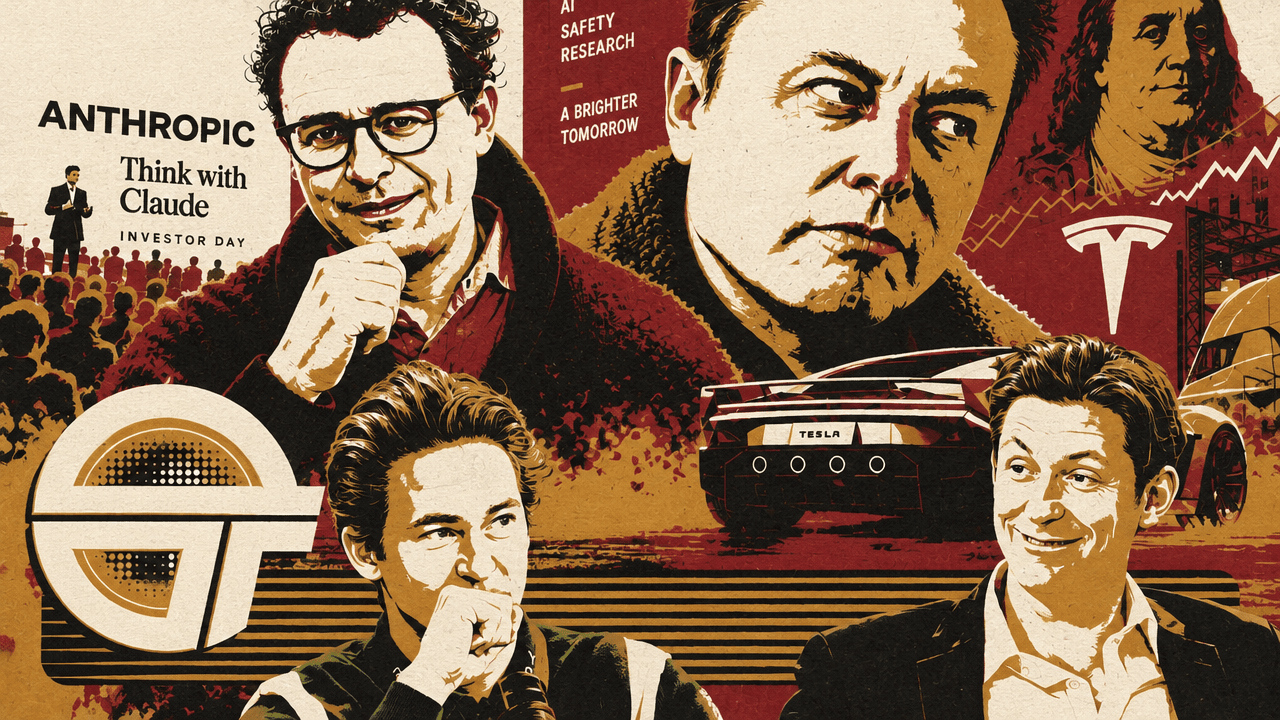
Anthropic’s growth is exceptional; the market expected more
Anthropic said its third-quarter revenue was $16.8 billion, which annualizes to a $67.2 billion run rate. John Coogan called the scale remarkable: the company had been doing roughly a tenth as much a year earlier. But the figure still disappointed investors who had expected a larger upside surprise. Coogan said some had expected the run rate to reach $90 billion.
The pressure on AI stocks had been building for weeks. Coogan initially said CoreWeave was down about 50% over the past month; Jordi Hays corrected him: it was down about 16%. Coogan described the broader AI trade as struggling, but said the overall market had not collapsed. He put the Nasdaq’s decline at roughly 0.3% to 0.4%, while the Dow was up nearly 1%. His interpretation was that investors were rotating away from some technology stocks, not selling everything.
Anthropic’s growth is exposed to changes in its customer mix and to efforts to restrict model distillation. Coogan pointed to Meta’s possible shift toward its own models and to a reported comment from a Meta executive suggesting that stopping purchases from Anthropic could hurt the company’s prospects ahead of an IPO. He characterized the remark as a veiled threat.
The hosts cited a figure of 5% to 7% for distillation. Coogan described the activity as worth billions of dollars, interpreting it as users extracting value from Anthropic’s models by generating outputs that could help train or emulate other models, in violation of the service’s terms. He argued that cutting off the activity could weigh on near-term growth; allowing it to continue might produce more revenue in the short run but create more competition at the frontier.
The hosts differed on what restrictions could mean for open-weight models. Hays asked whether the gap between frontier systems and open weights might widen. He offered a blunt test for being at the frontier: other groups must be willing to spend heavily to reproduce your model. Coogan called that a useful reality check, while saying it remained to be seen how effective restrictions would be. He distinguished distillation from open-source releases such as Meta’s, which he viewed as a different practice.
Enforcement is complicated by the layers between a model provider and the end user. Coogan described “wrapper” companies—services that integrate models into products such as document editors and pass users’ requests to frontier labs. A distiller could potentially create many accounts through such services and send a high volume of queries. The wrapper may see unusual activity without being able to inspect the documents, while the model provider sees traffic coming from a legitimate-looking business. Coogan suggested that some wrapper companies may have appeared to grow quickly even though distillers, rather than ordinary customers, were driving usage.
Coogan also described a “tall poppy” dynamic among frontier AI companies. When one firm appears to be pulling ahead, he said, customers and partners have reason to work with competitors rather than let one company run away with the market. He compared this to alliances forming against a company that has become too dominant. The investor-day numbers, in his view, were not the IPO itself but a chance to air difficult details ahead of it; he joked that after the market’s reaction, “only way to go is up now.”
Inflation is showing up differently for luxury buyers
The day’s inflation news gave the hosts a counterpoint to the AI-stock pullback. Coogan cited Joe Weisenthal’s comment that the producer-price index reading was the hottest in four years. He said people who owned real assets might be pleased. Hays joked about selling everything and preparing for a barter economy, sending up the “blackpill” mood rather than offering a literal investment prescription.
The discussion turned from the standard consumer-price basket to CPI Reserve, a site that tracks prices for goods and services purchased by wealthy consumers. Its figures framed the difference as “richflation”: the Chanel Classic Flap rose from $4,900 in 2016 to $11,700 in 2026, while the site put headline CPI-U inflation over that period at 40%. Had the bag tracked CPI, the site calculated, it would cost $6,839. Hays called buying the bag “bozo” behavior at that price; Coogan agreed that its inflation looked out of control.
Other luxury prices rose sharply, but the hosts did not treat every increase as evidence of overpricing. A Met Gala ticket went from $30,000 to $100,000, a 233% increase. Hays still considered it worth the price; Coogan said the event’s charitable giving was part of the value, and the two agreed that more money raised could be better. A Virgin Galactic seat rose from $250,000 to $750,000, a 200% increase. Coogan called that a steal and said he would go to space; Hays said he would try to stop him, joking that he would be the one improvising repairs if the flight went wrong.
The Porsche 911 Carrera base model rose from $84,300 to $135,500, or 61%—about one and a half times the CPI increase, according to the on-screen figures. Hays said the car remained undervalued relative to the enjoyment it offered, though he wished the base model could stay near $99,000. The site also showed the hourly rate for a BigLaw partner rising from $1,500 to $2,935, a 96% increase since 2016. The hosts used the price to joke that at the old rate a client could call a lawyer simply to talk; at nearly $3,000 an hour, that kind of conversation would be harder to justify.
Not every high-end category had risen. Hays noted that Manhattan luxury real estate prices per square foot were down relative to the chart’s 2016 baseline. He speculated that a pied-à-terre tax and people moving out might be factors; Coogan replied, “It’s working,” without developing that explanation. CPI Reserve’s broader purpose was to offer a different view of inflation from the basket built around what an average consumer buys.
AI investment could raise rates before it raises growth
A post by Blake Byers, read aloud by Coogan, sketched a longer-term possibility for the AI investment boom. Byers’s “modal prediction” was that interest rates would rise as capital moved out of savings and Treasuries and into AI-related investment, which promised higher returns. That shift could initially cause panic: higher rates would increase debt-service costs for governments and other borrowers.
In Byers’s scenario, the panic lasts about three years, until investors see that the investment is paying off. Borrowing costs stay high, but faster growth more than offsets them; the mood shifts from panic to euphoria. The developed world then treats 5% growth as normal and expects 10% to feel satisfied. Coogan presented this as a possible account of how AI could affect capital markets, not as a settled forecast. The same investment boom that might eventually raise productivity could first put pressure on borrowers.
AI is changing the hiring contest before the job market itself
Coogan’s claim was that AI was disrupting job applications faster than employment itself. He pointed to a Wall Street Journal report shared by Derek Thompson about McKinsey using an AI avatar in some consulting interviews. As Thompson described it, candidates would have roughly ten-minute conversations with an AI acting as a client, while partners or interview assessors watched.
The setup turns an interview into a performance for both a system and its human observers. Coogan joked that candidates might try to jailbreak the avatar—prompt it into treating the candidate as the interviewer instead. Hays called the format wild; Coogan likened it to a gladiatorial arena in which a candidate must face a challenge while partners watch.
The exchange also complicated the idea that AI adoption necessarily means immediate job destruction. Coogan cited a report that Bank of America had hired 1,000 contractors to patch software flaws exposed by Anthropic’s Mythos. Hays welcomed the jobs but questioned why the system that found the vulnerabilities could not also help fix them. Coogan wondered whether AI had created make-work by opening a new class of problems. Neither offered a firm resolution; Hays raised the possibility that there might simply be a large backlog of vulnerabilities for the contractors to address.
New interpretability tools could make alignment a normal science
Researcher Nick Cammarata’s account of mechanistic interpretability offered a more optimistic view of AI safety. Cammarata said early work had made neural networks look like tangled knots. In an earlier large-scale automated project at OpenAI, he said, researchers found only about 2% of neurons legible with the tools then available. With newer agentic tools and closer analysis, he now believed that the vast majority of neurons in models up to trillions of parameters could be understood, and that many apparent examples of tangled circuitry had been misunderstood.
The hosts explained the shift through the idea of superposition. A neuron may activate for apparently unrelated inputs—say, text about cats and text about dogs—making it unclear what feature it represents. One earlier approach used sparse autoencoders to expand a model into a larger representation in which each neuron could correspond to a more specific feature. As the hosts explained Cammarata’s claim, researchers may be able to inspect the model’s own neurons and circuits more directly instead.
That could matter for both safety and capability development. If researchers can identify how a model handles a particular feature or task, they may be better able to understand its behavior and improve a specific capability. Cammarata framed interpretability as a prerequisite for solving alignment: researchers need to know what they are building. Roon, reacting to the post, said Cammarata had been underselling the breakthrough and suggested that alignment could become a “normal science.”
The Valar Atomics dispute is about more than pro rata
Valar Atomics founder Isaiah Taylor said publicly that most of the company’s investors had agreed to waive their pro rata rights, while Day One Ventures had not. Coogan said Taylor described a worsening dispute, including a law firm and the threat of litigation, and had taken it to X. Day One co-founder Masha Bucher replied that she was surprised Taylor had made the disagreement public and wanted her side heard.
The financing issue is whether an investor with pro rata rights can keep investing in later rounds to preserve its ownership stake. Coogan said those rights are deliberately difficult to take away: if an investor continues to provide capital, the agreement may allow it to maintain a particular share of the company. He relayed a concern voiced by other venture investors: supporting Taylor in this case should not imply that pro rata rights are generally optional or “squishy.”
Hays argued that the dispute was not really about pro rata rights so much as whether Taylor wanted to continue working with Day One. He questioned how much the investor’s continued involvement might harm Valar, including whether it could cost the company contracts or give competitors a way to attack it. He also said that, based on Taylor’s account, Day One did not have technical information rights that would expose sensitive details, leaving open the possibility of keeping the investor at arm’s length.
Coogan cautioned that financial information rights can matter too, including internationally. The hosts left the central tension unresolved: a company may want to limit an investor’s role, but rights already written into its financing documents can make that difficult. They also noted that the public dispute had an additional layer of complexity because of Day One’s controversial connections and Valar’s government work.
Tesla’s Roadster promise meets a one-year test
Coogan said he had placed a $5,000 credit-card deposit on the new Tesla Roadster, with another $45,000 due by wire within ten days. He planned to wait for the reveal before deciding whether to stay in line. Elon Musk had described the car as “beyond movies, beyond imagination, beyond human,” and Coogan said he was willing to reserve a place before demand surged if the demonstration delivered.
The hosts disagreed over what the car might do. Hays predicted ramps; Coogan expected some form of lift from rocket engines, thrusters, or fans. They made a bet: if the car jumped from flat ground, Coogan would win; if it used a ramp, Hays would. The speculation pointed to a broader question raised by the original Roadster: what counts as “falling for it again” when the first car was announced years before it shipped? Coogan said buyers who had put down money on the original Roadster waited a decade without receiving a car. Tesla has shipped other vehicles, he argued, but that history did not erase the Roadster delay.
Coogan’s proposed limit was one year: if the new Roadster took longer than that to ship after its reveal, he would consider himself fooled. Hays offered a different possibility: a spectacular demonstration could be followed by regulators preventing the car from being sold as shown, giving Tesla a reason to retreat to more conventional production. The joke captured the gap between an extraordinary product demo and a deliverable vehicle.
The discussion ended with a leaked video of a white Porsche Mission S. Hays said the car looked far more aggressive than he had expected and called it immediately desirable in the $500,000-to-$1 million range. The roof scoop, rear design, and overall shape made him think it could challenge established supercar makers. Coogan said the look evoked a successor to the Porsche 918 or Carrera GT, while reserving judgment on performance, positioning, and production volume. Hays saw it as a car a journalist could drive hard around San Francisco; Coogan noted that its rear tires might throw rocks at anyone following close behind.