Investors Debate Whether Anthropic’s Growth Can Match IPO Expectations


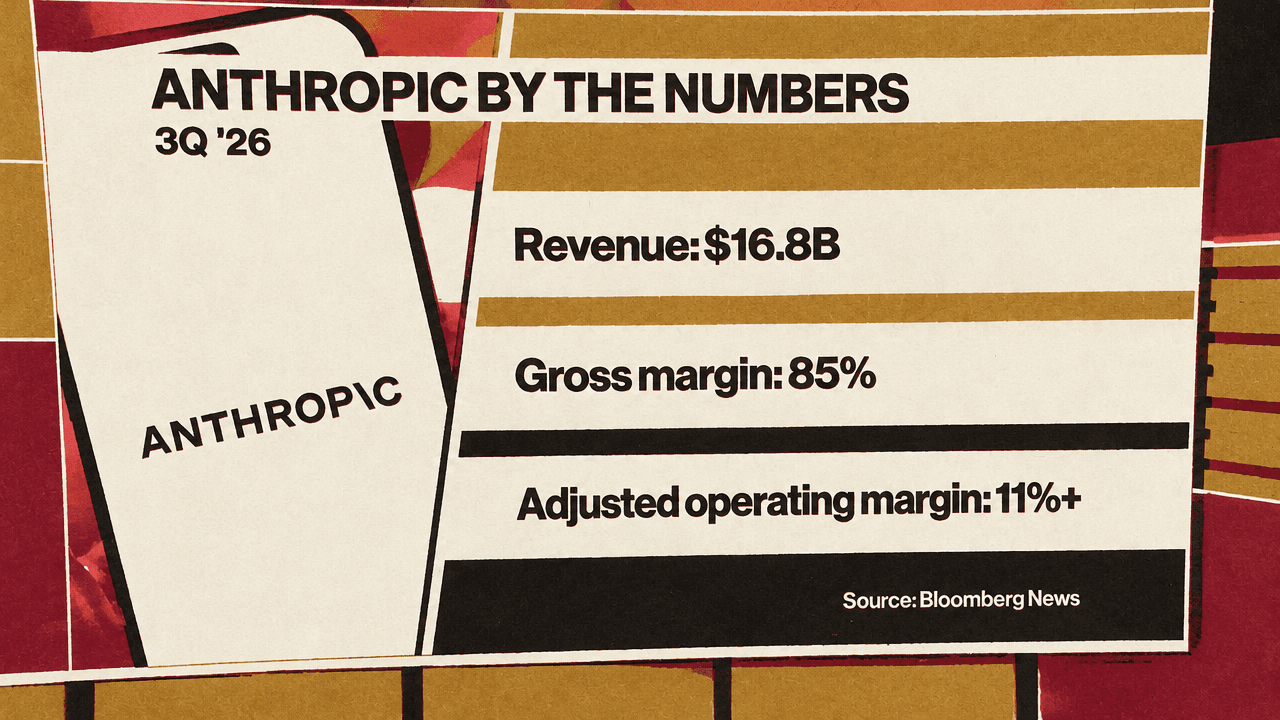
Anthropic told prospective investors its third-quarter revenue was $16.8 billion, but Bloomberg reporter Bailey Lipschultz said the figure has not resolved a central question ahead of the company’s planned IPO: whether its growth is fast enough to meet investor expectations. Some investors see growth below 50% quarter over quarter as a sharp slowdown, while others question whether a company at Anthropic’s scale can be expected to double revenue every quarter; investors are also looking for evidence that growth can produce returns.
The growth dispute is about the right benchmark
Anthropic’s third-quarter revenue reached $16.8 billion, but the figure did not settle the question investors were asking: how quickly the company is still growing. Ed Ludlow pointed to the first- and second-quarter numbers and said the market appeared disappointed by deceleration.
Bailey Lipschultz said some investors read the third-quarter result as quarter-over-quarter growth of less than 50%, against expectations closer to 100%. That gap matters to investors trying to judge whether the company’s pace is matching the expectations built into its valuation. But Lipschultz also described a different view: fundamental investors questioned whether a company already at Anthropic’s scale could realistically be expected to double revenue every quarter.


The disagreement, then, is not simply whether growth slowed. It is also about what rate of growth is a reasonable benchmark for a company of this size. An expectation of near-doubling quarter after quarter can make a still-large increase look disappointing; a slower pace may be more plausible at scale, but may also fall short of what some investors had anticipated.
One investor who attended Anthropic’s meeting pointed to a major third-quarter ramp for OpenAI’s Codex as a possible headwind for Anthropic. That investor expected growth to reaccelerate in the fourth quarter, Lipschultz said, while stressing that the eventual impact remained uncertain. She described the offering as a record-setting IPO.
Margins put the focus on returns from growth
The figures shown included an 85% gross margin and an adjusted operating margin above 11%. Ludlow said his understanding from calls was that the gross-margin figure was on a GAAP basis.
Lipschultz said Anthropic had been reported as free-cash-flow positive. Investors, she said, want to see a company generating real returns on its investment, not only growing what it can sell. She also pointed to compute margin: the question is whether Anthropic makes money as its products go out the door, alongside its ability to sell more to customers.
The adjusted operating margin carries a qualification. Lipschultz said investors do not know what Anthropic is stripping out to arrive at that adjusted figure. For Anthropic, OpenAI and other companies in the ecosystem, the broader question is whether investors will see a real return on invested capital, what that return will look like, and whether it can help justify the companies’ ambitions.
A 900% retention figure tracks spending by an existing customer group
Ludlow highlighted net revenue retention of 900% and illustrated it with a hypothetical: a group of customers spending $100 a year earlier would, as a group, be spending $900 now. The example describes how much spending from that same customer group has changed over the period. It is not a claim that every customer increased spending ninefold.
For investors, the figure offers a way to consider growth within an existing cohort, alongside revenue from customers acquired over time. It puts a striking number on how much more the earlier group of customers is spending, though Ludlow’s illustration does not specify how that increase is distributed among them.
The investor meetings are routine; the attention around them is not
Anthropic held about five hours of programming at its headquarters for investors, including a question-and-answer session. Lipschultz said such meetings are normal ahead of a public filing: companies typically bring analysts to headquarters and give investors time to hear the company’s story.
What she described as abnormal was the volume of reporting around Anthropic’s meetings and its still-confidential S-1 filing. Lipschultz said a public filing was expected soon. Bloomberg’s reporting pointed to possible formal IPO marketing beginning the week of November 9. Given that potential schedule, she said, the filing would need to arrive by early to midweek the week after the interview; she did not describe that as a confirmed filing date.