Manna Bets Low-Cost Airline Economics Will Win Drone Delivery
 Alex Wilhelm
 Jason Calacanis
 Ian Laffey
 Bobby HealyThis Week in StartupsWednesday, May 27, 202619 min read
Manna founder Bobby Healy tells This Week in Startups that drone delivery is becoming a low-cost operations business, not a novelty market, and argues his Dublin-based company can win by applying airline-style discipline to delivery networks. Healy says Manna’s 300,000 completed deliveries, claimed 97% Irish-weather availability and new $50 million Series B position it to expand in the U.S. as regulation opens up. Theseus co-founder Ian Laffey adds a defense-side version of the same argument from Kyiv: drone scale depends less on exotic aircraft than on cheap, reliable systems that can keep working when GPS and supply chains fail.
Drone scale is becoming an operations problem
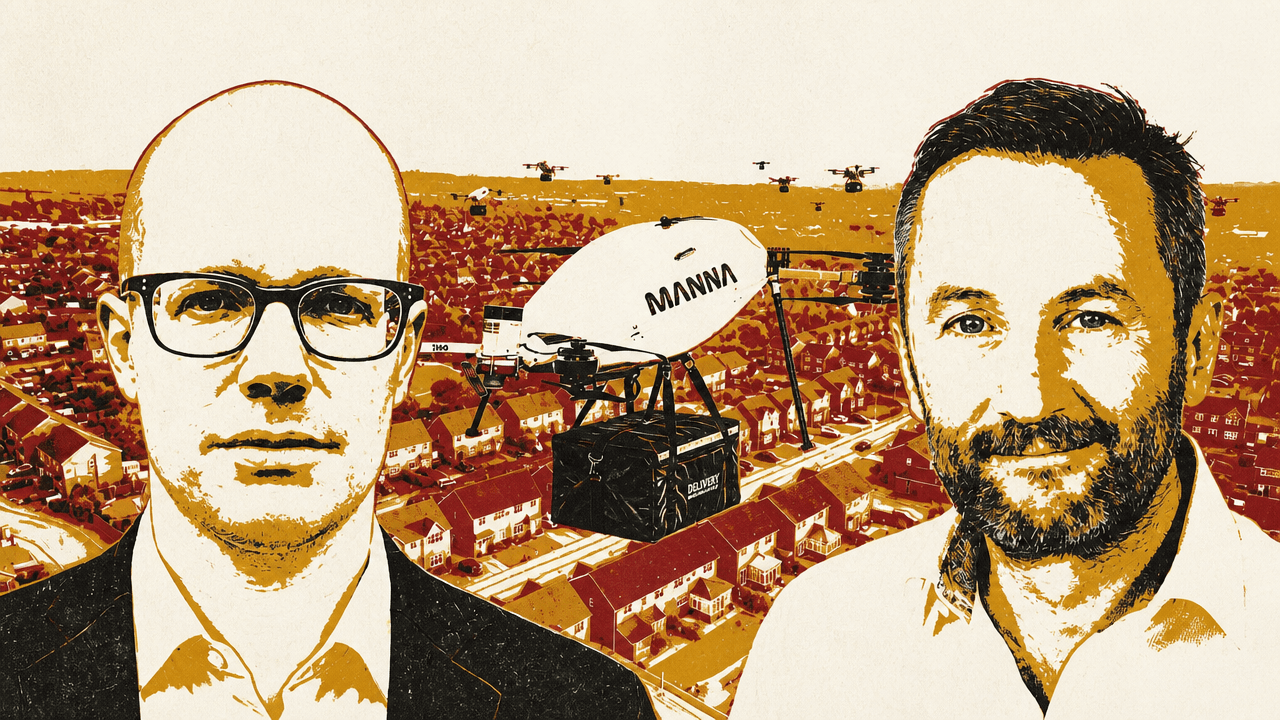
Bobby Healy describes Manna as “the Ryanair of this industry”: Irish, operationally quiet until recently, and built around the premise that drone delivery will be won by unit economics rather than novelty. The company, founded in Ireland, says it has completed more than 300,000 deliveries and is now shifting its attention to the United States after raising a $50 million Series B.


Healy’s explanation for why the company has not been more visible in the U.S. is simple: Manna had not been trying to be found there. The company spent years in Europe getting the technical and operational stack “clean and ready to launch,” and only now sees the U.S. regulatory environment as ready for scale. In his argument, the important question is no longer whether drone delivery can work, but whether it can work cheaply enough to undercut road-based delivery at scale.
That question also links Manna’s consumer delivery business to the later discussion of Theseus’s battlefield navigation system. The two companies operate in different domains, but both describe drone markets moving past demonstrations and into a harder phase: cheap hardware, reliable autonomy, permissive or workable regulation, field maintenance, supply chains, and unit costs. In both cases, the drone itself is less interesting than the system that lets many drones operate repeatedly.
Manna’s operating model is closer to an airline network than to a collection of static drone depots. In a dense city such as Dublin, Healy said, aircraft live at a central depot overnight, return there for inspection and maintenance, and then fly out each morning to pads distributed across the city. They “migrate dynamically” between those pads depending on demand, which Healy compared to Waymo vehicles repositioning around a city.
The useful operational fact, he said, is that food delivery gives Manna advance notice. A hamburger and fries may take about 20 minutes to prepare. When the restaurant receives the order, Manna receives the order through an API and can move a drone toward the pickup point before the food is ready. The aircraft does not need to wait at every restaurant all day; it can reposition during the prep window.
Manna has contracted with major delivery platforms, Healy said, including DoorDash, Uber Eats, Just Eat Takeaway, and Deliveroo. The aggregator sends the order to the restaurant and to Manna; Manna replies whether it can fly that order from that location at that time. In European markets where Manna operates, Healy said Just Eat now defaults to drone delivery when Manna’s API says yes, rather than treating drone delivery as a secondary option.
That detail matters because Healy insists consumers are not buying “drone delivery.” They are buying a burrito, a hamburger, coffee, ice cream, or another ordinary item. If the delivery mode is better, cheaper, or faster, it becomes the default. If it is merely futuristic, it remains a demo.
It's a commodity product, Alex. People aren't buying drone delivery, they're buying a hamburger or a burrito.
Manna’s delivery requirements are narrower than a casual observer might assume. Healy said the company needs roughly a two-meter-wide flat, inanimate area to put a package down. It can deliver to trampolines and “frequently” does; he added that 15% of suburban gardens have trampolines. Dublin and Helsinki, he said, have been difficult proving grounds because they are dense — Helsinki is “90% apartments,” in his description — and Ireland adds wind and rain.
The company does not land the drone to hand off the food. It delivers from above and lowers the bag. Healy distinguished GPS positioning from the harder practical problem: knowing where the bag should go and then getting it there through flight dynamics in real weather. Ireland, he argued, is an unusually punishing place to build this business: windy, rainy, and capable of “four seasons a day.” Manna claims 97% availability in Irish weather.
The delivery count is accelerating as Manna adds bases. Healy said one base represents roughly 100,000 annual deliveries. The company had added another 10 bases in Ireland and had about 40 bases contracted in the United States. Its rough target is about 2 million annualized deliveries by the end of 2026. He said the company does not yet know its target for the end of 2027 because that depends on how 2026 goes.
Healy framed the sector’s leading players as entering a simultaneous scale-up phase. Manna, Zipline, Google, and Amazon are all “throttling up at the same time,” he said, because the regulatory environment has changed. In his view, the constraints that previously mattered — regulatory uncertainty, technical readiness, and product-market fit — are giving way to capital and execution.
But he also argued that Manna’s capital needs are structurally lower than those of rivals. The company raised $50 million, while some U.S. competitors have raised rounds in the hundreds of millions. Healy’s answer was that capital has “never been a bottleneck” for Manna because the company had not previously been ready to scale. Now that it is, he said, individual locations are contribution-positive from day one when opened with, for example, 10 aircraft and aggregator demand. He claimed such a location pays itself off in roughly seven to 12 months, depending on utilization, and said Manna expects to use debt as well as equity for growth.
The cost target is aggressive. Healy said Manna’s marginal cost is already a fraction of road-based delivery, and that by the end of the year he expects it to be in the $1 to $2 range. Longer term, he said, Manna wants to drive the marginal cost of drone delivery down to about 20 cents per delivery. That cost difference, he said, could be split among consumers, restaurants, and aggregators.
Healy also argued that price is not the only source of demand. Manna’s net promoter score over five years of flying, he said, has been in the high 80s to low 90s. He did not attribute that to managerial brilliance. He attributed it to the consumer experience: hot fries, hot coffee, and unmelted ice cream arriving in a back garden in minutes by flying robot. In his account, the novelty reinforces a practical advantage: faster delivery produces a better version of the product.
The aircraft are designed to make capital cost almost disappear
The economics Healy describes depend on aircraft that last a long time, require little maintenance, and do not force the company to build an expensive service organization around them. He said one Manna drone completed 75,000 deliveries over its lifetime. Aircraft maintenance downtime, he claimed, is less than half a percent.
That maintenance figure is central to his argument. The aircraft purchase price matters, but Healy said maintenance is what adds cost because it forces the company to scale people, process, and spare capacity. Manna has used the same aircraft design for more than five years, which Healy described as “simple as hell” and low cost to own. If a drone can fly 75,000 deliveries, he said, the capital cost becomes “inconsequential” relative to the revenue it generates.
Manna’s mental model is therefore not Tesla or SpaceX. Healy repeatedly returned to airlines: Ryanair and Southwest, particularly their low-cost operating logic. The business is not about dazzling hardware. It is about relentless cost discipline, utilization, maintenance, safety, and operational simplicity.
We think like a low cost airline. We do not think like Tesla or SpaceX or any of those guys.
That worldview also explains Healy’s view of competition. Drone delivery, he said, will become a commodity service. Once multiple providers can perform the basic delivery function, the winner will be the operator with the lowest cost base and the densest, most efficient network. He invoked logistics scale effects: small operators can exist, but large networks reinforce themselves through coverage, density, and utilization.
Setting up a new location, in Healy’s description, is intentionally lightweight. Asked what preparation is required to enter a city such as Tulsa — mapping homes, trees, yards, and safe delivery zones — he answered: “Big fat zero.” Manna signs real estate at a restaurant roof or car park, places aircraft on the ground, plugs in charging equipment, and can begin accepting orders through DoorDash, Uber Eats, or its own app.
The consumer-side setup happens at first order. Manna shows the customer a picture of the house and asks them to verify the address. The system then automatically selects a delivery location, flies there, and the aircraft decides whether the area is safe. If it detects children, obstacles, or anything in the way, the aircraft brings the product home rather than delivering.
Manna’s immediate U.S. focus is Oklahoma and Texas. Healy said the company had four new U.S. locations approved in 30 days, which he contrasted with prior timelines that could have taken years. The broader regulatory backdrop, as he described it, is a reversal in U.S. drone readiness. More than a year earlier, he said, he would have put the U.S. nearly last, behind China and Europe. Now, he said, the U.S. is the world leader in readiness to scale drone delivery.
Healy credited an executive order aimed at American “drone dominance,” a new FAA administrator, and the movement from existing Part 107 and Part 135 frameworks toward Part 108. He did not give a technical explainer of those regimes, but he drew a clear business distinction: Part 107 and Part 135, in his view, were not fit for purpose at large scale because of their overhead. Part 108, he said, looks like “the perfect set of regulations to scale the industry” and part of a progression toward “unlimited scale.”
Manna’s expansion is also changing the company’s labor profile. Healy said the company is moving from being a pure technology company with roughly 200 people in Dublin to being “an operational airline, essentially.” That means maintenance, operations, manufacturing, and unglamorous physical work. He gave the example of cleaning bird droppings off motors: work that still requires people.
The company had discussed growing from 170 people to more than 570. Healy said most of the new hires would be operations people, and that Manna is also moving manufacturing to the United States. As much as possible, he said, the company wants a U.S.-only supply chain for aircraft used in the U.S. Of the roughly 400 people budgeted for this phase, he estimated about 300 would be in Oklahoma. The hardest U.S. role to fill, he said, is Head of Manufacturing; the company is also hiring across mechanical engineering, electrical engineering, and software.
The delivery network could become infrastructure for hyperlocal commerce
Alex Wilhelm pressed Healy on a use case beyond restaurant and aggregator delivery: calling a drone to one home, loading it with something personal, and sending it to a friend. Healy said peer-to-peer delivery was in his original business plan eight years ago, but not the first wave.
His imagined version is broader than favors between neighbors. Once automated delivery becomes cheap enough, a person baking cakes or cookies at home could suddenly reach hundreds of thousands of nearby customers. Manna’s near-term commercial target is much larger and more basic: Healy cited 92 million suburban homes in the U.S. that the company wants to reach and build a meaningful commercial relationship with over the next five years.
The infrastructure could support a different kind of local marketplace. If a million people in a city can connect to one another with a five-minute flight, Healy said, they can deliver goods directly to each other in a way that strengthens the local economy. He contrasted that with the current model of “gigantic Amazon fulfillment centers” whose logistics scale serves centralized commerce. Cheap robotic delivery, in his view, could make hyperlocal commerce competitive with large fulfillment networks for some categories.
Manna already has a limited version of this in operation. Healy described a small independent popsicle maker — a family business with a factory in its back garden — selling thousands of ice pops a day in summer through Manna’s system, delivered directly to households. It is not peer-to-peer in the strict sense; it is small-business-to-consumer. But Healy treated it as evidence that the network can let small local suppliers reach far more buyers than they could through conventional delivery.
There are obvious control problems. Wilhelm raised the possibility that a future peer-to-peer drone system could be used to send drugs. Healy acknowledged the concern: “That’s the thing with robots is robots don’t ask questions.” It is not, however, the problem Manna is focused on now. The sequencing is deliberate: first restaurant and aggregator delivery, then broader network uses.
In Ukraine, drone navigation is being rebuilt for a jammed battlefield
Ian Laffey joined from Kyiv, where he said he had been for several weeks flying Theseus’s system with different partners and drone companies. Theseus builds a drone guidance system intended to work without GPS. The basic ingredients are deliberately ordinary: a camera, satellite maps, and software that tells a drone where it is.


Laffey described Ukraine’s drone industry as unusually competitive and unusually fast. Unlike the U.S. defense procurement environment, Ukraine has an active front line where thousands of people are fighting every day and where technology can be tested in days rather than months or years. That creates faster iteration cycles under terrible conditions. A system either works where it matters or it does not.
He said the drone contest between Ukraine and Russia is constantly changing and does not look like one side decisively breaking away. Ukraine’s advantage, in his view, includes Starlink access and more AI drones. Russia, he said, has an advantage in Shahed-type loitering drones, producing hundreds a day. But the larger condition is a battlefield saturated with drones and countermeasures.
The problem Theseus addresses starts with radio physics. GPS satellites are low-power, old, and broadcast on known frequencies. That makes them easy to overpower with another radio signal. Laffey said GPS jamming is essentially universal in Ukraine because, if left unjammed, GPS enables devastating precision-guided munitions, intelligence, surveillance, reconnaissance, and navigation.
Communications links are also jammed, though different links are affected in different places at different times. Theseus tries to circumvent radio dependence by using onboard vision instead. The system compares camera imagery to satellite maps stored onboard and estimates location without needing GPS.
The hard part, Laffey said, is not the concept. Similar approaches have existed for decades. He cited Tomahawk missiles using laser range finders and high-quality topographical maps. The difference is cost and input quality. Theseus is trying to move that class of capability from government-grade maps and expensive sensors to a cheap camera and bad satellite imagery.
We've spent a lot of time training an algorithm that's able to look at very old, very out of date, very bad satellite maps and very bad camera imagery and still figure out where it is.
The resulting accuracy is not comparable to consumer GPS in a city. Laffey said Theseus advertises 30-meter median accuracy. That is enough to get a drone from point A to point B, but not enough to identify which street corner a person is standing on. He was explicit that higher precision is not the current priority and brings additional considerations.
Theseus is not focused on terminal strike guidance. Laffey pushed back when the discussion moved toward drones “going boom” near a target. The company’s focus, he said, is getting drones over long ranges and complicated environments while maintaining enough location awareness to complete a mission. If a drone needs to fly 600 kilometers over fields and still know where it is, Theseus wants to solve that problem. Last-mile targeting and strike capability are not its focus.
That distinction matters because communications and positioning are different problems. Laffey used the phone analogy: LTE lets a phone communicate, GPS lets it know where it is, and applications combine the two. Starlink can help with communications, and it is much harder to jam than GPS because of its directional antenna and phased array. But satellite internet does not automatically replace positioning.
He also said some operators had begun using Starlink panels for positioning because satellites have known locations and the receiver can infer position. According to Laffey, Starlink has moved to block or degrade that capability unless users pay for a military Starlink contract. He framed that as outside Theseus’s preferred domain. For him, the value of drones is that they can be cheap and numerous; relying on expensive special connectivity can undermine that logic.
The Theseus box is meant to become boring
The early Theseus product was a physical box mounted to the bottom of a drone. In the source video, Laffey held up a small black unit with a camera lens and ports, labeled on screen as part of the Theseus drone guidance system. The form factor supported his point: the visible hardware is not meant to look exotic. It plugs into a drone and “pretends to be GPS,” giving the aircraft location information as if it came from a conventional GPS source while deriving that position from vision and maps.
But Laffey said that approach “kind of sucks” for technical reasons he did not unpack in detail. Theseus has since moved toward separating the software from the dedicated box. The system can run on commodity compute — he cited a $65 Raspberry Pi — and can support different cameras, including thermal and ordinary electro-optical cameras. The company still sells hardware, but it also offers the system to customers who already have onboard compute, cameras, and supply chains.
The hardware, in Laffey’s view, should become a commodity. He summarized the bill of materials almost provocatively: a camera, a Raspberry Pi, and an SD card. “There’s no secret sauce,” he said, at least not in the visible hardware. The point is not to build a differentiated positioning box; it is to deliver reliable positioning at lower cost and higher scale.
That is the same industrial pressure Healy described from the commercial side: drone systems that win by becoming cheaper, plainer, easier to maintain, and easier to deploy. Manna wants the drone delivery customer to stop caring about the drone; Theseus wants the guidance hardware to become ordinary enough to put on large numbers of aircraft. Both arguments treat commodity hardware not as a weakness but as a requirement for scale.
Laffey defines Theseus less as a hardware or software company than as a reliability company. The goal, he said, is to “keep good guys from getting killed.” In his view, that means reducing the need for people to be physically present in dangerous places. Systems can do that either by becoming more autonomous or by allowing human pilots to operate from farther away. Both require reliability.
Humans on a battlefield often serve as the reliability layer. They solve unexpected problems, apply common sense, and compensate for the gaps in “janky or hacky” systems. Theseus wants to fill some of those gaps mechanically and algorithmically. Delivering position to the drone is foundational because autonomy collapses when the system no longer knows where it is.
Laffey argued that the GPS-jammed battlefield has forced drones backward. A drone from 2003, before jamming, could have a higher autonomy level than many drones flying in Ukraine until recently because GPS made basic navigation dependable. In a post-GPS environment, autonomy has to be rebuilt from lower-level capabilities, starting with location.
Progress at Theseus, therefore, is not mainly about making the system more accurate. Laffey said accuracy has regulatory considerations and is not a current priority; he said the company does not want to make the system more accurate right now. The priorities are reliability and cost. The first half of the company’s life, he said, was spent making the product work well enough that someone would use it. The past year has been about scaling: if the system works, what roadblocks must be removed to reach very large volumes?
Ukraine’s drone scale exposes the supply-chain problem behind autonomy
Laffey put the scale gap bluntly. Ukraine, he said, is at roughly 6 million to 8 million drones a year. The U.S. “drone dominance” program, as he understood it, is aiming for about 300,000 drones over two years.
The U.S. program’s value, in Laffey’s account, is not only the drones themselves. He said the program is also intended to shock the supply chain and incentivize American companies to move components out of China. That challenge is deeper than final assembly. Laffey said it is “really, really surprising” how much of the stack is made in China, and he gave the example of a camera.
A sensor may be available from Japan or Korea. A lens made outside China is harder. A small business trying to source the PCB behind that sensor outside Shenzhen may face four-, five-, or six-times higher costs, with far fewer options. The problem recurs “across every level of the stack,” he said. Pull out one component, go two levels down the supply chain, and another niche part turns out to be made only in China.
Laffey said he has been impressed by top American drone companies and their creativity in trying to reconstitute supply lines. Individually, he argued, many of the problems are not technically hard. A PCB can be made in many places if demand is large enough and buyers coordinate. In aggregate, however, the dependency becomes almost impossible because cheap small electronic components require a dense commercial ecosystem.
He contrasted older American industrial strengths with the current need. The U.S. has a culture and industrial history around heavy industry — cars, large systems — and information technology. China, by making much of the world’s physical goods for so long, has dense networks of small component manufacturers serving a large domestic market. Modern war, in his account, has shifted battlefield importance toward cheap, small electronic components, and the U.S. now has to ask how to create domestic demand at scale for those parts.
Alex Wilhelm suggested a Cost Plus Drugs-style model for critical manufacturing: a wealthy backer funding at-cost domestic production of PCBs, springs, screws, and other inputs. Laffey agreed that the problem is not impossible, but said he is worried because the current U.S. commercial system has weak incentives to move back toward manufacturing without significant protectionism. Labor costs are high, regulations are extensive, and automation is only one possible path. He did not claim to have an answer.
The policy tension was left unresolved. Wilhelm said even people skeptical of industrial policy are beginning to ask whether a “dusting” might be necessary because capitalism does not always anticipate national security needs. Laffey responded that the U.S. is already highly regulated and suggested some problems might be solved by fewer laws rather than more. He also doubted that broad public concern over drone component supply chains would be enough to drive major changes on its own.
The contrast with Manna is useful here. Healy said Manna wants a U.S.-only supply chain for aircraft operating in the U.S. and expects hundreds of new Oklahoma-based roles as it moves manufacturing into the country. Laffey described why that kind of move is difficult at the component level: domestic assembly does not by itself solve dependence on the small, cheap parts that make drone scale possible.
More defense startups help, but Laffey says the need is broader than defense
Theseus went through Y Combinator, and Ian Laffey described the accelerator as an unusually dense concentration of talented, intelligent, kind, motivated people. He said YC has started investing much more in defense, though he also described accelerators as generally following founder interest. Theseus itself started out of a hackathon rather than a long-standing plan to found a defense company.
The lesson Laffey drew was practical rather than institutional. People can look at global problems and conclude there is nothing they can do, or they can pick one issue and work intensely on it. He said more companies are now coming out of the U.S. and Silicon Valley focused on national-interest problems.
But he cautioned against making the response purely defense-focused. The U.S. is not Ukraine, he said, and has a different problem set because it is not actively being invaded. The same underlying constraints he described — component supply, autonomy, cheap electronics, reliability, domestic manufacturing — may need commercial as well as defense companies to create the demand and ecosystems required for scale.