China’s Communists Won Through Foreign Backing and Attritional War
 Joseph Ledford
 Larry Diamond
 Philip Zelikow
 Frank DikötterHoover InstitutionMonday, June 15, 202620 min read
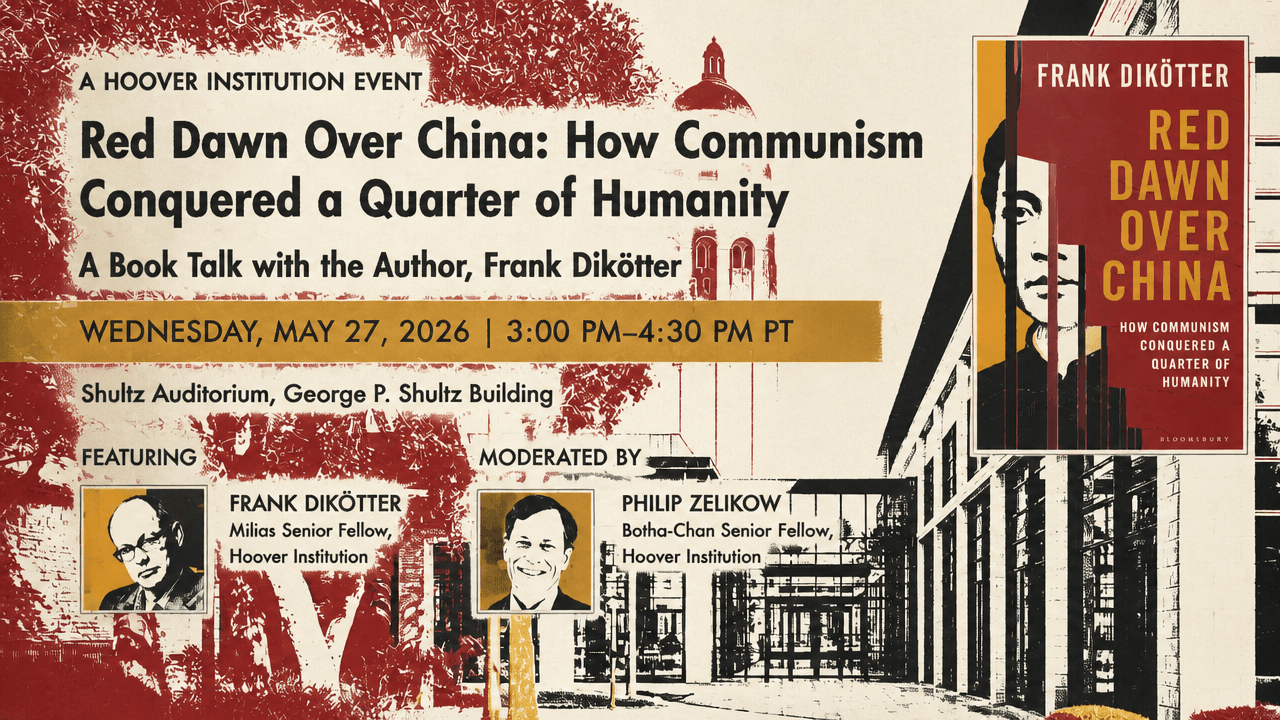
At a Hoover Institution book talk, historian Frank Dikötter argued that the Chinese Communist Party’s victory in 1949 was neither inevitable nor chiefly the result of mass peasant support. Drawing on archival research behind Red Dawn Over China, Dikötter presented the conquest as a contingent outcome shaped by Soviet sponsorship, Japan’s destruction of the Chinese Republic’s position, American pressure for truce and coalition in 1946, and the party’s use of coercion, forced conscription and attritional warfare.
A tiny party won because larger forces kept reopening the path
Philip Zelikow framed the problem as one of the most unusual in world history: a very small political movement took absolute power over an enormous share of humanity. The Bolshevik Revolution, he said, had once seemed to him the archetypal case of a small revolutionary party seizing an empire. But the Russian Social Democratic movement from which Bolshevism grew had been substantial, factional, and long established. By comparison, the Chinese Communist Party was “quite small, narrowly based,” yet came to rule an even larger population.
Frank Dikötter answered that problem by rejecting the familiar image of a popular agrarian movement steadily rising against a doomed Nationalist state. His argument was that the Communist victory was not inevitable, not primarily ideological, and not well described as a simple victory of land reform. It depended on a sequence of contingencies: Soviet sponsorship from the beginning, Japanese destruction of the Republic’s strategic position after 1937, Soviet creation of a Manchurian sanctuary in 1945, American insistence on coalition and truce in 1946, and the Communist Party’s willingness to use coercion, forced conscription, starvation, and attritional war.


The scale of the party is central to that argument. In 1921, Dikötter said, the first Communist gathering in Shanghai involved about 12 men representing roughly 50 people. In 1929, in Wuxi, a city where about 100,000 workers were alerted to shifts by steam whistles and electric sirens, there were 25 Communist Party members. Before Chiang Kai-shek’s 1927 break with the Communists, Zhejiang province, “the size of France,” had no more than 2,800 Communists — about one in 7,700 people. By 1936, after 15 years, the party had roughly 40,000 followers in a country of about half a billion.
Dikötter compared the Chinese Communists not with a mass national party, but with marginal organizations. In the 1930s, he said, they were “about the same size as some local religious sect, a secret society, a local gang of bandits.” The standard historiography, in his view, exaggerates their stature by treating the period as a fight between two roughly equivalent national forces: Communists and Nationalists. That equivalence, he argued, did not exist in the 1920s or most of the 1930s.
The international comparisons were meant to sharpen the point. In Portugal under Salazar in 1934, he said, roughly one in 250 or 280 people belonged to the Communist Party. In Gansu province in 1940, the Chinese ratio was one in 25,000. Even using what he called inflated Comintern figures for China in 1940, the ratio was about one in 1,700, roughly comparable to Communist Party support in the United States. His summary was blunt: few countries were “so unattuned to the ideology of communism” as China.
That is why he treated Edgar Snow’s Red Star Over China as such an important distortion. Snow visited the Communists in 1936, when Dikötter said their “red star” was at its lowest, and presented them as agrarian reformers fighting for freedom in the hills. The book was translated into 20 languages, made Mao a household name, and helped create the romantic account Dikötter believes still shapes much of the historiography. His own title, Red Dawn Over China, deliberately echoes Snow’s.
Asked about method, Dikötter said he had read Snow as a student and found the account “a bit too pretty” and implausible, especially for anyone familiar with Bolshevik precedent. After years working on Republican-era China and then on the Mao period, he said he rarely encountered evidence that corroborated Snow’s version. If historians cannot access proper primary sources, he concluded, “better withhold judgment.”
Soviet sponsorship made the party before China did
The Communist Party’s early history, as Dikötter presented it, began less as an indigenous mass awakening than as a Moscow-directed project. In 1919, the Communist International began sending Soviet envoys to China. They spoke to small circles of intellectuals in Shanghai and Beijing and, by 1921, had converted roughly 50 people. Those recruits argued among themselves, prompting Moscow to send another organizer: the Dutch Comintern agent Henk Sneevliet, whom Dikötter described as able to gather a dozen of them in a room.
The source base for this reconstruction came from an archival accident of timing. Dikötter moved to Hong Kong in 2006 and spent about 15 years crossing into mainland China to work in archives — Beijing, provincial archives, Guangzhou, Lanzhou, Wenzhou, and elsewhere — while writing his trilogy on life under Mao from 1949 to 1976 and a sequel extending toward the present. His last mainland research trip before this book was in December 2019, shortly before Covid closed the border and cut him off from the archives he had relied on.
That closure pushed him toward a prequel: how the party founded in 1921 conquered China by 1949. The question was what sources could sustain the project without continued mainland access. He found a series of roughly 300 volumes published between 1981 and 1989 by China’s central archives in collaboration with provincial archives. Dikötter described them as collections of “every scrap” on the Communist Party of China found in the archives. At the time, they were published as neibu — internal-circulation material for party members, not for sale in bookshops or general library use. In Hong Kong, he said, the volumes had been smuggled across the border during the 1980s and 1990s.
He supplemented those materials with five large Russian-language volumes on the Comintern and with British and French records. Britain and France mattered, he said, because as great powers they often knew a great deal about events even in remote parts of China.
What came out of that material was not the image of a disciplined revolutionary machine. Dikötter found reports about party branches that did not exist, members who failed to pay dues, and young men and women more interested in dating than in reading Marxism-Leninism. His summary was that it was “an organization which was rather disorganized.”
Moscow’s strategic interest was not confined to this weak Communist Party. It was also interested in the Nationalist Party, founded after the collapse of the Qing empire. The Nationalists wanted to unify China through a military expedition launched from Guangzhou. Moscow was willing to provide men, money, and munitions, Dikötter said, but with a condition: the Nationalists had to accept Communists inside their ranks.
He called this a “beautiful illustration of the Trojan Horse.” By 1926, about 600 Soviet military advisers were in Guangzhou helping organize an army of roughly 100,000 soldiers. When the Nationalists launched their northern expedition, Communist members inside the ranks incited mobs against people with wealth — landlords, shopkeepers, and foreigners identified as agents of imperialism. The disorder, in Dikötter’s account, helped push Chiang Kai-shek, by then head of the Nationalist Party, to break with the Communists and end the alliance imposed by Moscow. Soviet advisers were expelled by the end of 1927.
After that break, the Communists followed what Dikötter called a policy of Red Terror — Hongse kongbu, their own term. The premise was that class enemies and obstacles to revolution had to be eliminated. Mao’s January 1930 slogan captured the theory: “A single spark can set the prairie alight.” Revolutionary violence was supposed to ignite the masses.
It did not work that way. Dikötter described a pattern of attacks on towns: government buildings burned, class enemies executed, wealth confiscated, hostages ransomed. When government troops arrived, the Communists moved on.
Land reform became coercion when there was too little land to redistribute
The rural program’s deepest weakness, according to Dikötter, was that its Russian model did not fit much of China. Stalin intervened in 1930 and instructed the Chinese Communists to stop roaming through the countryside and seize and hold territory. They established revolutionary bases, or soviets, in remote mountainous regions. There they faced a practical problem: how do you take land from the rich and give it to the poor when, in Dikötter’s phrase, “everybody is poor”?
The Bolshevik model came from Russia, where emancipation had left many peasants poor while large aristocratic estates survived. But in the regions where the Chinese Communists built bases, he said, there were no barons, no squires, no landed aristocracy whose estates could be broken up and distributed. Villagers worked hard to survive on very little.
Unable to find enough “landlords,” the party turned against “rich peasants.” Once those had been attacked, it turned against “middle peasants.” At that point, he argued, villagers understood that the Communists were after their grain and their men.
Dikötter cited Communist reports describing peasants as becoming lazy and no longer working. His interpretation was direct: villagers knew that anything produced beyond the minimum needed to feed themselves and their families would be taken by the party. Communist rule therefore reduced incentives to produce and impoverished the region.
The soviets were also marked by paranoia and purges. The Futian incident of 1930, he said, led to somewhere between 2,000 and 10,000 followers being massacred as alleged spies. Other purges targeted ordinary people; speaking against party exactions could bring severe punishment.
The Jiangxi Soviet, the most famous base area from 1931 to 1934, did not collapse only because of Nationalist encirclement. Dikötter argued that it also imploded because people fled. Its population fell by about 1.3 million from a base of 5.6 million — roughly one-fifth of the population leaving. Zhang Guotao, leader of another soviet in Hubei, gave the most compressed version of the dynamic: “We squeezed the region like a lemon.”
The Long March followed in 1934. Dikötter described it not as the heroic founding ordeal of later myth but as a chaotic retreat — in fact, three long marches by different groups seeking refuge in the loess plateau of Shaanxi. Government troops cut off Communist access to supplies and pushed them into inhospitable terrain, practicing a form of guerrilla war against the guerrillas. Attrition did much of the work. Of the 70,000 to 80,000 who left the Jiangxi Soviet, he later said, only about 6,000 reached Shaanxi a year later; by 1936, the separate Communist groups that reached Shaanxi numbered about 40,000.
Yan’an later acquired a very different reputation because the party wrapped itself in the language of coalition and democracy. Mao’s 1940 text On New Democracy promised a multi-party system, freedom of speech, respect for private property, and unity with anyone willing to fight Japan. Dikötter called those promises a fiction, but an effective one. Tens of thousands of idealistic students and teachers went to Yan’an believing they were joining a movement of liberation and national resistance.
At the same time, Mao remained suspicious of newcomers. From 1942 to 1944, a rectification campaign interrogated tens of thousands, sometimes tortured them, and physically eliminated thousands. Yet Yan’an was also staged as a showcase for foreign visitors. American journalists arriving in 1944 described it, in Dikötter’s account, as “a small paradise on earth” and believed the Communists represented the future.
Japan inflicted the damage the Communists could not
By 1936, Dikötter argued, the Communists were near their lowest point. The rescue came from a larger strategic collision: Japan, the Soviet Union, and Chiang Kai-shek’s central government.
Stalin had reason to want China united against Japan. Japan had occupied Manchuria in 1931, creating a common frontier with the Soviet Union and generating repeated border incidents. Moscow pressed the Chinese Communists to collaborate with Chiang Kai-shek against Japan. Mao resisted, but Stalin kept pressing.
Zelikow focused on the Xi’an Incident of December 1936 as a pivotal moment. Japan had moved out of Manchuria into North China but had not yet fully occupied Beijing. Tokyo wanted China to accept its losses and make a deal. The full Sino-Japanese War was still in the future and, in Zelikow’s judgment, might not yet have happened.
Chiang Kai-shek was trying to buy time. He had been purchasing weapons from Germany, had 750 airplanes, and had a plan to fight Japan, Dikötter said. But first he wanted to finish off the Communists and further unify the country. In Shaanxi, he pressed two generals — Yang Hucheng and Zhang Xueliang — to fight the Communists. Zhang had been driven out of Manchuria by the Japanese along with 160,000 soldiers, and his troops wanted to fight Japan, not other Chinese.
The generals kidnapped Chiang when he came to Xi’an to lecture them. Dikötter described Chiang as stubborn and unpleasant, someone who often alienated his generals by lecturing them. The kidnappers seized him and held him until he agreed to fight Japan rather than the Communists.
The Communists initially celebrated. They thought their mortal enemy could be hanged. Stalin thought otherwise. He feared the kidnapping might be a Japanese-engineered provocation or at least a gift to Japan, because it could force the central government into a position that would bring war with Japan and possibly the Soviet Union. Stalin ordered the Communists to make sure Chiang was released.
Dikötter added that Mao received Stalin’s telegram but withheld it for several days. Mao also instructed Zhou Enlai to spread the claim that the central government, especially General He Yingqin, was preparing to bomb Xi’an even at the risk of killing Chiang. Dikötter presented this as evidence of Mao’s manipulation during the crisis.
The result, in his account, was to accelerate Japan’s decision for war. Chiang returned to Nanjing, and newspapers across China cheered him; Dikötter said there was no popular sympathy for the Communists or for the two kidnapping generals. But Japan did not believe the situation had stabilized. In January 1937, Japanese troop movements in Manchuria indicated preparation for war. Tokyo feared that the Nanjing government would lean toward the Soviet Union — precisely the result of the kidnapping.
The full war began in the summer of 1937. Zelikow described it as the war that delivered “the mortal wound to the Chinese Republic,” gutting it to a degree from which it could not recover. Dikötter agreed that Japan did what the Communists could never have done: remove the central government from China’s main coastal cities. The war included the Rape of Nanjing, flattened cities, and chemical warfare in the Japanese drive to Wuhan.
Dikötter did not credit the Communists with defeating Japan. One could argue, he said, that they fought only one major battle against the Japanese, in September 1937, though he called that slightly unfair. They did fight, but chiefly against the central government, competing for territory behind Japanese lines. They thrived in distressed terrain, dislodging Nationalist authority and expanding their reach from 1940 onward.
Manchuria gave the party arms, sanctuary, and a state-building base
For Dikötter, the decisive external intervention after Japan’s defeat was the Soviet occupation of Manchuria. He asked whether one would explain North Korea’s communization or East Germany’s communization by culture. The obvious explanation, in his view, was that the Red Army arrived. The same logic applied to Manchuria.
In August 1945, one million Soviet troops invaded Manchuria, the vast region north of Beijing. Dikötter said they prevented Allied forces and Chiang Kai-shek’s central government from entering, while welcoming the Chinese Communists. They also armed them heavily, with wagonloads of material arriving by rail and sea. Manchuria gradually became a fortress: countryside in Communist hands, cities along the railways weakly held.
The mechanism was deliberately disguised. Stalin declared that the Communist Party was not allowed in Manchuria, but “local partisans” were. Communist commanders such as Lin Biao and Chen Yi were instructed to enter Manchuria, change names, and present themselves as local partisans. Manchurian partisans who had fled under Japanese occupation had been recruited and trained by the Soviet Union and also entered the region. From August 1945 onward, Communist forces moved into Manchuria in large numbers. By 1946, Dikötter said, the countryside was already in Communist hands.
Zelikow pressed him on whether the Soviet withdrawal in 1946 meant Stalin had already accomplished his mission. Dikötter agreed: by the time the Soviets withdrew, the Communists controlled the countryside.
The importance of Manchuria was not only military. Once protected by sanctuary and then by truce, the Communists began land reform. Dikötter described it less as voluntary peasant mobilization than as a method for destroying local power holders and replacing them with party authority. Poor villagers were compelled to participate in the physical elimination of local figures — sometimes neighbors whose supposed wealth might be signaled by something as small as a pane of glass. Party members could then say everyone had blood on their hands: if the central government returned, they would be in trouble.
That violence bound villagers to the party through shared culpability and fear. It also allowed the party to extract grain and impose compulsory conscription. When asked why people joined, Dikötter described a spectrum: idealistic students drawn to Yan’an, fellow travelers, thugs, and villagers facing the choice of joining the army or being shot.
| Claim | Number or example Dikötter used |
|---|---|
| Communist weakness before the war | About 40,000 followers in China by 1936 |
| Communist military expansion after Manchuria | 750,000 troops recruited through forced conscription by the end of 1947 |
| Changchun siege | 160,000 deaths from hunger or disease |
| Postwar aid comparison | $25 billion for Europe from 1945 to 1948, versus at most $330 million for the Republic of China |
By the end of 1947, Dikötter said, the Communists had recruited 750,000 troops through merciless forced conscription. This was not just a question of arms. It was how the party used arms, coercion, and territory together.
The 1946 American truce is the hinge in Dikötter’s argument
The sharpest exchange concerned George Marshall’s mission to China. Zelikow described the postwar situation: Japan defeated, China devastated, Soviet forces occupying Manchuria, Japanese civilians and soldiers awaiting repatriation, and the Chinese Communists being armed and built up in a Soviet-protected sanctuary. The United States then sent Marshall to broker a coalition between Chiang Kai-shek and Mao, using American prestige and remaining advisers and troops to try to halt the civil war.
Dikötter argued that Marshall’s mission cannot be understood apart from Stalin’s strategy. By 1943, as the tide of World War II turned, Stalin had abolished the Comintern so Communist parties would appear national and independent when the Red Army moved into Eastern Europe. He told the American ambassador that the Chinese Communists were “margarine communists,” agrarian reformers rather than agents of international communism.
Henry Wallace, then U.S. vice president, visited Siberia, including Magadan, which Dikötter identified as part of the gulag system, and came away impressed. Wallace then urged Chiang Kai-shek to get closer to the Communists and adopt Soviet-style economic approaches. Dikötter argued that the United States, even before Marshall arrived, was effectively trying to do what Stalin had twice engineered: a coalition between Communists and the Nationalist central government.
Marshall arrived in January 1946 and imposed a truce. Dikötter said that on the very day of the truce, five Communist regiments attacked Yingkou, a coastal Manchurian city where Nationalist forces were trying to disembark. In April 1946, when Soviet forces withdrew from Manchuria after plundering it, the central government sent troops under Du Yuming in pursuit of Lin Biao. The Nationalists pushed the Communists back toward Harbin and, in Dikötter’s view, probably could have driven them across the Soviet border into Siberia.
Marshall intervened again and imposed another truce.
Zelikow asked why Marshall would do that. Dikötter’s answer was that Marshall was ideologically committed to a coalition. Marshall had an aide, Alvan Gillem, who, according to Dikötter, clearly reported that the Communists were the aggressors. Marshall nevertheless wrote to President Truman describing the Communists as disorganized bands. Dikötter said Marshall “had no clue” what he was talking about.
The April 1946 truce was crucial in Dikötter’s account because it gave the Communists time to consolidate Manchuria through land reform, grain extraction, and conscription. The September 1946 American arms embargo compounded the effect by hampering the central government while the Communists continued to draw on Soviet-supplied resources and captured arms.
Zelikow summarized the argument back to him: despite Soviet success in building up the Communists in Manchuria, the central government still had a reasonable shot at driving them out; the American-imposed truce prevented that victory; the Communists retained strength, began turning the tide, and the United States then abandoned the mission while cutting aid to Chiang Kai-shek. Dikötter accepted the summary, then sharpened it: “In 1946 Moscow and Washington intervene on behalf of the Communist Party.”
The turning point, he said, was 1947, when the balance of power became frail. All was not yet lost for the central government in 1946. By the end of 1947, however, Chiang recognized the danger of returning deeply into Manchuria. He did not want to go back in, Dikötter said, but his general Wei Lihuang countermanded him and tried to reconquer it, leading to defeat.
Attrition, not mass enthusiasm, finished the war
Zelikow distilled one of the book’s major themes as the denial that Communist victory was a mass movement or a mass ideological triumph. Instead, he suggested, it was a power struggle determined by who was willing and able to use maximum violence. Dikötter agreed, adding: “Who uses fortune and misfortune best and who is more determined.”
That determination culminated in what he called unrestricted warfare — war without regard for moral principle. He cited telegrams in the Taipei archives reporting soldiers exhausted by firing into unarmed villagers who were sent toward them in waves. Above all, he emphasized the willingness to starve cities into surrender.
The central example was Changchun. From May to October 1948, Lin Biao surrounded the city under the instruction, as Dikötter translated it, to “turn Changchun into a city of death.” Soldiers stood 40 meters apart, trenches were dug four meters deep, and nobody was allowed to escape. When the city fell, he said, 160,000 people had died of hunger or disease.
Dikötter quoted Zhang Zhenglong, later a lieutenant in the People’s Liberation Army who studied the siege, as saying that Hiroshima took about nine seconds and Changchun took five months, but the result was the same: 160,000 casualties. Once Changchun fell, other cities were unwilling to suffer the same fate. Beijing surrendered, he said, because commanders did not want the seat of Chinese culture destroyed as Changchun had been. Major battles still followed, including Huaihai, but by late 1949 cities were falling “like dominoes.” In October 1949, the red flag rose over the Forbidden City.
The lesson Dikötter later drew for Taiwan was also about attrition and unrestricted warfare. Asked what lessons American and Taiwanese policymakers should take if China were to invade Taiwan, he said he did not think an invasion was likely. He pointed to Russia’s struggles in Ukraine as evidence of the difficulty of modern ground war and noted that the Taiwan Strait is about 100 miles of rough sea. But what worried him was not technology. It was the willingness to throw huge numbers at an enemy and overwhelm it. The practical lesson, he said, was to “arm Taiwan to the teeth,” just as he said Ukraine should have been armed to the teeth.
The “who lost China” question becomes an aid and judgment question
Larry Diamond asked whether the old American debate over “who lost China” was properly framed and how much responsibility the United States bore for naivete or miscalculation. Dikötter did not answer with a simple indictment. He noted that the United States had enormous burdens in World War II, including the liberation of large parts of the world. Truman’s desire for Soviet help against Japan in 1945 was understandable, he said, especially because Truman did not yet know he would have the atomic bomb available later that summer.


Lend-lease material supplied to the Red Army in Siberia helped enable a million Soviet soldiers to move through Manchuria and onward toward the 38th parallel in Korea. That decision, in context, was not inexplicable.
But Dikötter also emphasized the irony that the United States did not want to fight Communists in China and then ended up fighting them in Korea. He cited a 1951 exchange from Taipei archives in which an American general, after seeing United Nations forces in Korea face wave after wave of Chinese troops, remarked on the difficulty. Chiang Kai-shek’s answer, as Dikötter paraphrased it, was: if the United Nations found it so hard in Korea, what should he have done in 1948?
The financial comparison mattered. Europe received the Marshall Plan — $13 billion — plus another $12 billion in assistance before 1948, Dikötter said. The Republic of China, one of the four great allies represented at Cairo, received at most about $330 million. Even Japan received more. Truman’s phrase, Dikötter said, was that helping the central government was like “pouring sand down a rat’s hole.”
Zelikow underscored the irony: the United States went to war with Japan in significant part because it would not accept a deal that abandoned China, then failed to commit the money after the war that might have completed China’s salvation. Dikötter agreed.
He also resisted the common American explanation that Chiang’s regime was so corrupt and incompetent that it could not have been saved. Asked about Chiang Kai-shek’s shortcomings, Dikötter said he had once believed the standard story too. Reading Chiang’s diary and following his decisions changed his view. Chiang was “a lot smarter than meets the eye.”
As an example, he described Chiang’s handling of the Long March. Rather than simply chase lightly equipped Communist troops through hostile terrain, Chiang sought to steer them into Guizhou and other provinces where central control was weak. Those provinces then asked for help, allowing him to extend national authority. He also cut off Communist access to supplies and forced them into increasingly inhospitable terrain, relying on attrition to reduce their numbers.
Dikötter cited Joseph Stilwell — no admirer of Chiang — as saying in the summer of 1936 that China had never before been united to such an extent without violence. Zelikow noted that Stilwell’s praise mattered because Stilwell was famously critical of Chiang.
On the later period, Dikötter acknowledged inflation and corruption in Nationalist-controlled areas. What could buy a pig in 1938, he said, bought only a small bag of peanuts by 1945. But he argued that inflation was worse in Communist Yan’an, a fact he said is rarely mentioned. The central government funded Communist troops under the United Front until about 1940 or 1941. After that, Yan’an relied on higher taxes, war bonds, round-the-clock labor, and eventually opium cultivation and sales.
His point was not that Chiang’s government was virtuous. He said it was violent, had a secret service, and was corrupt. But he rejected the claim that corruption alone explains defeat. The central government was trying to rebuild a continent-sized country devastated by war while being sabotaged and denied adequate help. In 1946, Chiang authorized an offensive in Manchuria that, in Dikötter’s view, was near success until the Americans stopped it. In 1947, the disastrous overextension in Manchuria came from a general disobeying Chiang’s restraint, not from Chiang’s own order.