Older-Adult Nutrition Needs Medical Evidence and Community Infrastructure
 Corby KummerKathleen Graim
 Patrick Stover
 Robert BlancatoThe Aspen InstituteWednesday, June 3, 202620 min read
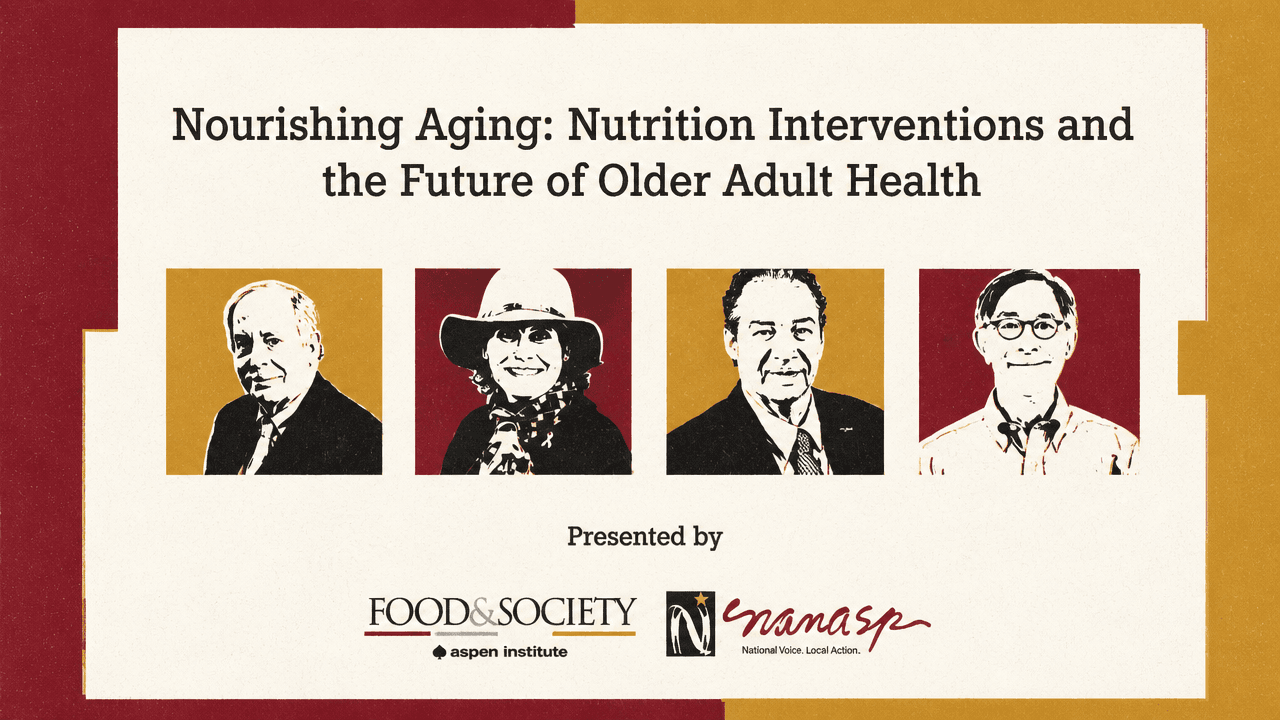
Food & Society at the Aspen Institute and the National Association of Nutrition and Aging Services Programs convened Robert Blancato, Kathleen Graim and Patrick Stover to argue that older-adult nutrition should be treated as health infrastructure, not just emergency food aid. Their case is that effective interventions must account for changing physiology, chronic disease, isolation, mobility, mental health and home conditions, while producing the evidence and reimbursement pathways policymakers require. The discussion places the Older Americans Act, medically tailored meals, dietitians and community-based delivery at the center of that agenda.
Older-adult nutrition is being asked to prove medical value while delivering more than medicine
The central tension is not whether food matters for older adults. It is that nutrition programs are being asked to show health-care outcomes and return on investment while delivering an intervention that is clinical, social, logistical, and often dependent on human contact. Corby Kummer framed the issue as part of health care itself: not simply personal choice, and not only supplemental social support, but a set of interventions that can affect independence, hospitalization, functional ability, costs, and quality of life.
Kummer said Food & Society’s food-is-medicine work has helped bring attention to medically tailored meals, produce prescriptions, and nutrition counseling as evidence-based tools that can improve outcomes, reduce costs, and help people live healthier lives. The older-adult question is more specific: how nutrition becomes part of the infrastructure of aging, rather than an add-on service that is funded episodically, measured inconsistently, and separated from health care until a crisis occurs.
Robert Blancato put protein at the top of the practical list. Older adults face multiple nutrition-related risks, he said: inadequate protein, dehydration, oral-health barriers, medication-food interactions from polypharmacy, and mobility constraints that make access itself difficult. When asked to rank the priorities, Blancato chose protein intake because of its relationship to sarcopenia, muscle-mass loss, and malnutrition.
Protein was not treated as a wellness preference. Blancato connected inadequate intake to sarcopenia and malnutrition. Patrick Stover expanded the biological account: lean muscle mass is not only structurally important for preventing falls; it also plays a signaling role across organ systems and is a key determinant of cardiometabolic health.
Stover described aging as a series of physiological declines that can alter nutrient needs. Lean muscle mass builds from an early baseline and then decays in midlife and later adulthood. Vitamin B12 absorption declines with the loss of stomach parietal cells, which produce the acid needed to liberate nutrients and help transport B12. In his account, an older adult can eat what appears to be a healthful diet and still fail to absorb or use nutrients in the same way as a younger person.
That distinction shifts the target from “better food” in the abstract to nutrition interventions suited to changing physiology. Stover said there is knowledge that can be implemented now, but also a need for research into how nutrition can counter physiological and mental decline. His caution was that interventions must remain evidence-based. Nutrition, he said, has overpromised in the past.
We have to implement the knowledge we have now and get maximal coverage and do that critical research to understand how nutrition can be a countermeasure to decay and aging.
The research agenda he described is not simply more dietary advice. It includes understanding nutrient requirements as systems age, the impact of declining absorption, the relation between diet quality and brain function, and how to reduce the complexity of nutrition research enough to produce evidence that can be translated into practice. Stover pointed to work in aging biology on DNA mutations, epigenetic signatures, and biomarkers, but said there remains controversy about what those biomarkers mean functionally, much less how nutrition interacts with them.
He was encouraged that NIH had elevated the Office of Nutrition Research into the director’s office and was pushing nutrition as a cross-cutting theme, including in aging. But he described the current knowledge base as insufficiently integrated, especially around prevention and maximizing health through nutrition.
Older adults cannot be treated as one nutrition category
Individualization was the practical counterpart to the physiology. Kathleen Graim described the work at Feedmore New York as grounded in dignity and in the need to address the whole person rather than symptoms alone. Older adults, in her account, cannot be treated as a homogeneous group. Nutrition programs have to account for medical condition, ability to eat, mental health, household safety, cultural needs, allergies, and the social context in which meals arrive.
Some of that work begins with basic nutrition education. Graim spoke about helping seniors understand “eating the rainbow” and the importance of different fruits and vegetables. But the examples moved quickly from general advice into targeted interventions. Feedmore had received grant funding to provide Boost and Ensure for additional protein, as well as protein bars for clients on renal diets. The organization works with DaVita, a dialysis provider, and checks albumin levels for some clients. Meals are designed to be heart healthy, with attention to sodium intake, and medically tailored diets are used to help ensure that people consume the right nutrients for their condition.
The examples were concrete. For clients with cancer, including ear, nose, and throat cancers, Graim said Feedmore works with medical providers and the American Cancer Society to understand when people cannot eat normally and whether a pureed, ground, or bland diet is appropriate. For people on dialysis, the organization tries to eliminate foods that could cause harm. For someone with celiac disease, avoiding gluten is not a preference but a safety requirement. Across these diets, Graim said the meals still need to meet relevant nutritional requirements for clients to sustain their nutrition.
The organization does not outsource menu design to a culinary partner. Graim said its registered dietitians write the menus and perform nutritional analysis in-house, using “food processor” in the process she described, and the meals are produced in Feedmore’s own commissary. Kummer referred to Feedmore’s “army of seven dietitians” when asking how the organization funds that capacity. Graim treated the staff as essential infrastructure: Feedmore budgets for dietitian salaries, covers professional dues and continuing education credits, sends dietitians to conferences, and works with local universities and dietetic programs to host interns.
That staffing model was presented as essential but financially difficult. Graim agreed with Blancato that reimbursement rates for dietitian services are too low. Even under New York’s 1115 waiver, she said, nutrition counseling and education do not pay enough to fully reflect the work involved.
The 1115 waiver came up as one of the main mechanisms through which states can fund a broader set of health-related social services. Graim described it as an opportunity to provide additional nutrition, transportation, housing, medically tailored meals, prescription food boxes, and other holistic supports. But she also said New York’s implementation had been challenging. Feedmore initially tried to be “the all to everybody,” then concluded it lacked the infrastructure to do that. Its strength, she said, is nutrition, delivery, and nutrition counseling—not housing or transportation.
Kummer pressed on the vulnerability of medically tailored meals if waiver funding is not renewed. Graim said Feedmore is collecting outcomes data through both registered dietitians and social workers. The organization tracks clients at intake, 30 days, 90 days, and afterward, using measures such as blood pressure, weight, BMI, albumin levels for renal clients, allergies, cholesterol, nutritional analysis, weight management, underlying medical conditions, and early signs of Alzheimer’s or dementia. Home visits also allow staff to assess fall hazards and involve social work when needed.
| Area tracked | Examples Graim said Feedmore monitors |
|---|---|
| Clinical measures | Blood pressure, weight, BMI, cholesterol, albumin levels for renal clients |
| Dietary fit | Food allergies, gluten avoidance for celiac disease, renal restrictions, sodium intake, texture needs such as pureed or ground meals |
| Nutrition trajectory | Nutritional analysis at start of service, 30 days, 90 days, and continuing follow-up |
| Home and functional risks | Slip-and-fall hazards observed during home visits, need for social-work involvement |
| Medical context | Underlying conditions, dialysis, cancer-related eating limitations, early Alzheimer’s or dementia concerns |
For Graim, the financial case is linked to keeping people at home. Meals on Wheels and related prepared-meal services provide food, nutrition, and companionship with the goal of keeping individuals “home and safe.” She argued that keeping someone out of a hospital, rehabilitation facility, or other institutional setting creates a financial benefit. Her emphasis was practical: people want to be home, and home is often where they feel safest.
A meal without contact misses part of the intervention
Nutrition delivery can fail if the surrounding conditions make eating, shopping, cooking, or accessing care impossible. Robert Blancato said nutrition interventions for people who cannot cook or go grocery shopping may require homemaker services, chore services, transportation to medical appointments, and other supports. This was not an argument that food is secondary. It was an argument that nutrition depends on the conditions that allow food to become nourishment.
Congregate nutrition programs were his clearest example. Program operators may be proud of the food they serve, but when Blancato asks older adults why they come, he said 90% say they come for socialization and camaraderie. In an environment of isolation and loneliness, he argued, that makes the program’s social function part of the health intervention.
Kummer asked directly whether social isolation may be worse than lack of protein. The answer was not a single ranking. Isolation, malnutrition, mobility, falls, mental health, and chronic disease were treated as linked conditions that aging programs need to address together.
Graim made the mental-health point most sharply. She said food insecurity is often discussed in terms of physical health, but it also affects mental health. Over recent months, beginning in the aftermath of COVID and continuing through concerns about the government shutdown and SNAP, she said Feedmore learned about high suicide risk among seniors. She said the organization responded by working with crisis services and helping promote gun locks. After mentioning gun locks, Graim said suicide by “that type of weapon” was on the rise.
Her phrase for the work was “healing through food.” In her account, that included crisis awareness, household safety, social work, and the recognition that food insecurity can coincide with mental-health risk as well as physical-health risk. Graim described food work as part of a broader crisis-response system.
Patrick Stover reinforced the need to measure mental-health outcomes. The usual metrics—blood pressure, BMI, weight, albumin, cholesterol—are easier to measure and sensitive to intervention, he said. But mental-health measures should be incorporated because they are critical, sensitive to nutrition, and predictive of long-term health.
He gave a biological account for why aging and nutrition matter for brain health. As people age, he said, they lose the ability to move nutrients across the blood-brain barrier because they lose energetic potential across that barrier. The brain needs higher concentrations of a small group of nutrients, which are enriched in healthy dietary patterns. Stover identified folate, vitamin B12, vitamin E, and vitamin C as nutrients concentrated up to tenfold from blood to cerebrospinal fluid. As those concentrations decrease with age, certain mental-health markers can appear.
Kummer asked whether protein has a direct effect on mental health. Stover said he did not know of a “smoking gun” linking protein directly to the brain in that way, though there are interactions. His stronger claim was about diet quality, specific micronutrients, aging-related nutrient transport, and mental-health outcomes such as depression.
Nutrition programs for older adults are not simply calorie-delivery systems. If a meal is dropped on a porch without contact, Blancato said, it may technically provide food while missing the larger intervention. He warned that as budgets shrink, governments may choose for-profit entities that deliver meals without connecting with older adults. That, in his view, loses the “more than a meal” function: nutrition intervention, social contact, risk observation, and linkage to other supports.
The policy case depends on evidence the field often lacks
The evidence gap that matters most to policymakers is not whether nutrition is intuitively important. It is whether specific interventions can show effectiveness, economic impact, and return on investment. Patrick Stover said the field lacks enough good analyses of program impact and effectiveness. In his view, that evidence is essential because policymakers face competing funding requests across the medical arena.
At the end of the day, that’s what’s really going to persuade policymakers who have everybody requesting funding for all sorts of things in the medical arena, and we have to be able to make that case both for effectiveness and for return on investment.
Prevention is widely valued in principle, but Kummer noted that funders often resist it because the return on investment may take too long. Falls prevention emerged as a possible exception because falls are expensive and may be more directly tied to measurable savings. Robert Blancato said nutrition interventions can prevent falls, and described the Older Americans Act reauthorization as an ideal place to require a study quantifying how much the act—especially its nutrition programs—saves Medicare and Medicaid. He said the answer is “quite a bit,” but the field needs the number so it can argue for reinvestment in the act.
Blancato gave the policy maxim behind the data push: “data drives dollars.” In the federal environment, he said, programs competing for funds need current, persuasive data. But he identified a contradiction. Studies need to run long enough and be well designed enough to detect meaningful change; at the same time, policymakers do not want to hear that the most recent data are three years old. They want current trends and evidence of what is happening now.
Kathleen Graim’s organization is trying to collect that kind of evidence in practice. Some of it is funder-driven; some of it is self-initiated because Feedmore wants to show grantors the health outcomes associated with medically tailored meals. Asked whether the organization is collecting data only when funders pay for it or “stealing money from different budget lines” because the data matter, Graim answered: “A little bit of both.”
The work involves grant writers, registered dietitians, social workers, and case managers. The data are used in funder conversations, but funders do not always ask for the same things. Sometimes, Graim said, they want “the new thing” or “the shiny thing” rather than improving and enhancing existing work.
The field is trying to demonstrate effectiveness, return on investment, and outcomes while preserving forms of value that are harder to quantify than blood pressure or BMI. Home safety, socialization, depression, dignity, avoidance of institutionalization, and the ability to remain at home are part of the case. They are also harder to package into the type of evidence funders and policymakers routinely demand.
The Older Americans Act is the platform, but the surrounding systems are not aligned
The existing platform for older-adult nutrition is the Older Americans Act. Robert Blancato described it as a Great Society program passed in 1965, before Medicare and Medicaid, in recognition of the need for community-based social services for older adults. The largest program in the act is nutrition, and Blancato said it has four objectives: providing a meal, providing nutrition education, providing a socialization opportunity, and helping prevent malnutrition.
Those objectives, he said, are achievable if the program is properly funded. The act was up for reauthorization. A Senate version had passed in 2024, he said, and the House was close before the congressional clock ran out, forcing the process to restart. Blancato described the Senate approach as bipartisan and named Senators Casey and Sanders as co-authors of the main reauthorization bill. The difficulty, in his account, was getting the House to address the issue, mostly because of disagreement over authorization and funding levels in the Senate bill. He did not describe a fundamental dispute over the structure or purpose of the act.
Nutrition has been part of the Older Americans Act since the beginning, but Blancato said the emphasis on targeted nutrition interventions has increased. One reason is demographic: people 85 and older are among the fastest-growing components of the older population, and their needs differ from those of people near the act’s eligibility threshold of 60. The act serves people from their 60s into their 90s, which means nutrition programs must address a wide range of functional and medical circumstances.
Another reason is that malnutrition has become more visible in the policy language. Blancato said malnutrition was not mentioned in the act until 2020, when language was inserted. Rising rates have made it harder to ignore.
The relationship between the Older Americans Act and food-is-medicine interventions remains underdeveloped. Blancato said nutrition programs have spent too long in silos. The Department of Agriculture and HHS both run significant nutrition programs for older adults, but, in his view, they do not communicate enough. Food as medicine may help bring systems closer together because it offers another way to address older-adult needs.
He proposed an inventory of what programs are already doing: which aging-services organizations are providing food-is-medicine interventions, what models exist, and what can be learned from them. He cited a NANASP grant to a Tennessee program with a waiting-list problem. That program is dedicating 50% of its waiting-list reduction to food-as-medicine services for higher-risk individuals.
Blancato also highlighted the Medically Tailored Meal Pilot Act. He said “a law was written talking about” CMMI, the Center for Medicare and Medicaid Innovation, partnering with the Older Americans Act as the pilot progressed. He viewed that as a promising experiment because it could connect Medicare and Medicaid innovation with the existing community-based infrastructure of aging programs.
Kummer and Blancato both returned to the Administration for Community Living. Blancato credited Mary Lazare, ACL’s top official, with bringing “nutrition intervention” into the vocabulary of aging programs. Kummer emphasized ACL’s importance and said it has an outsized role that is not always recognized.
The policy direction Blancato wanted was practical: reauthorize the Older Americans Act, connect CMMI to community-based nutrition programs, and push CMS to go further on Medicare reimbursement codes for social care, including community-based nutrition.
They were dangling this idea of potentially having Medicare reimbursement codes for social care, including community-based nutrition. That would be a game changer. Let’s move on that.
Food insecurity is politically fraught, but hunger is not the same outcome as health
A major tension inside the food-is-medicine field is whether to describe food is medicine as a way to address food insecurity. Corby Kummer said it plainly can give people more food, but that framing may make the political sale harder. He asked whether older-adult nutrition advocates face pressure to downplay food insecurity.
Robert Blancato called it a dangerous question and gave a Washington answer: it depends who you are talking to. Some elected officials, he said, including some on the Agriculture Committee, do not even think food insecurity exists. He pointed to changes in SNAP as evidence of a lack of understanding about the extent of food insecurity. Data, he said, show food insecurity is increasing among older adults. But linking food insecurity and food is medicine can be risky because officials who do not believe in food insecurity may not accept food is medicine as a solution.
Patrick Stover approached the issue through outcomes. He said both “food insecurity” and “food as medicine” are somewhat flawed constructs. Food insecurity, in his account, began as a construct to address hunger. Hunger was unacceptable, and food is accepted as a human right. But he raised a separate question: whether nutrition, understood as a healthy human right, is accepted in the same way. Hunger prevention is not identical to nutrition, and hunger does not necessarily relate to health.
That distinction has consequences for policy design. If the intended outcome is preventing hunger, programs and incentives may be built around food volume and access. If the intended outcome is health, the system must define and measure nutritional adequacy, diet quality, chronic-disease outcomes, function, mental health, and cost. Stover argued that the field needs to decide what outcome it is trying to achieve and then align programs, policies, and economic incentives to that goal.
Kathleen Graim’s organization operates on both sides of the distinction. Feedmore is both a prepared-meals program, including Meals on Wheels, and a food bank serving children, families, and programs such as backpacks. It is directly on the front line of food insecurity. At the same time, its prepared-meal program is increasingly oriented toward medically tailored meals, culturally sensitive meals, allergens, and close work with physicians and medical teams.
That dual role makes the debate less theoretical. A food bank has to get food out. A medically tailored meal program has to ensure that food does not harm a client on dialysis, conflict with celiac disease, ignore sodium restrictions, or fail to match chewing and swallowing needs. The food-insecurity frame captures the absence of food; it does not by itself capture whether the food is clinically appropriate.
“Food is medicine” helps only if it does not shrink the work
The phrase “food is medicine” was treated as both useful and risky. Robert Blancato said he both embraces and avoids it. His concern was definitional. Policy depends on definitions, he said, and many policy efforts get stuck when no one can agree on what the words mean. Is it food is medicine? Food as medicine? Medically tailored meals? Are they the same, overlapping, or separate? He compared the problem to long-term care policy, where people may understand the concept but struggle to define it cleanly enough for law.
He worried that terminology could slow progress. But he also warned against allowing the phrase to be narrowed to meal delivery alone. For older adults, he argued, the intervention includes wraparound services and human connection. A meal left on a porch without contact is not the same as a nutrition intervention that includes assessment, education, socialization, and linkage to health and social supports.
Patrick Stover took a different but compatible position. He said “food is medicine” has been extremely successful as a marketing tool. It elevates nutrition among policymakers and the public. But it can also make nutrition sound like a pill: take it and get better. Nutrition, he argued, is more complex than medicine in that sense. It involves many nutrients, lifestyle factors, social variables, education, and medical care. A phrase that galvanizes attention can also create a false simplicity.
It’s great to have the spotlight on it, it’s great to have a phrase that really galvanizes people, but we can’t think of nutrition as simplistic as medicine is, if you will.
Kummer pushed back in favor of pragmatism. If food is medicine is the umbrella term that releases funding, he suggested, then it may be worth configuring the term to include mobility, transportation, social isolation, and other wraparound needs. Blancato agreed that the broader discussion should expand, especially around linkages: nutrition and falls prevention, nutrition and elder abuse prevention, nutrition and other aging-policy priorities. From an advocacy standpoint, he said, making those linkages broadens the base.
The phrase must not obscure what older-adult nutrition requires. For Graim, that means targeted nutrition and treating each person with dignity and respect. For Stover, it means evidence, measurable outcomes, and research into changing nutrient needs. For Blancato, it means using existing community-based structures while securing better funding and reimbursement.
Reimbursement determines whether nutrition reaches the front line
Nutrition has to be cross-cutting not only in federal policy but also in universities, state systems, and health care delivery. Patrick Stover said nutrition research needs engineering for devices that support personalization and individualization, economics for impact analysis, and humanities for questions such as whether nutrition is a human right. At the state level, nutrition has to cut across health care, agriculture, and other systems.
One of his most concrete workforce concerns was dietitian reimbursement. People listen to trusted health care providers, he said, and dietitians are one route for getting nutrition onto the front lines. But many rural medical centers cannot afford both a nurse and a dietitian. That creates a need to examine scope of practice and how to get more nutrition capacity into frontline health care, especially in rural settings where older-adult needs can be acute.
He supported efforts to put more nutrition into medical education and said Florida had been a leader in that area. But medical education alone is not enough. The field needs to decide how nutrition counseling, screening, and intervention will be delivered in the places older adults actually receive care.
Kathleen Graim’s account of Feedmore’s dietitian staffing showed the operational version of the same problem. The organization budgets for dietitians because it sees them as essential, but low reimbursement rates make retention difficult. Feedmore pays for professional costs and creates training pipelines with local universities partly because community nutrition must compete with clinical dietetics as a career path.
Robert Blancato identified reimbursement coverage for registered dietitians as one of the major gaps in current nutrition-support systems. He also called for health insurance funding to give more credit to dietitians’ work. Without that, the field is left relying on grants, internal budget choices, and uneven waiver funding.
The workforce issue connects directly to the outcomes problem. If funders want data, organizations need staff who can assess patients, conduct nutrition counseling, coordinate with physicians, document case notes, and track clinical and social outcomes over time. If the reimbursement system pays only for food or pays too little for counseling, much of that work has to be supported by grants, cross-subsidies, or discretionary organizational commitment.
The near-term agenda is legislation, reimbursement, and better evidence
The practical advocacy agenda had three parts. First, Robert Blancato said Congress should reauthorize the Older Americans Act. His Hill Day message was direct: the act’s largest program is nutrition, it is widely known, and it should be reauthorized. He also wanted the act used to produce better evidence on savings to Medicare and Medicaid, especially from nutrition programs.
Second, he said CMS and CMMI should move toward reimbursement for community-based nutrition and related social care. Blancato described potential Medicare reimbursement codes for social care, including community-based nutrition, as a game changer. He also argued that the Medically Tailored Meal Pilot Act should connect CMMI with the Older Americans Act’s community-based infrastructure.
Third, Patrick Stover called for a stronger research base that does not flatten nutrition into a single metric. He said the research priorities should include understanding how nutrient needs change with age and physiological decline. Nutrition has too many variables—many nutrients, many health outcomes, and many social variables—so he argued for methods that reduce complexity, similar to high-throughput preclinical approaches in drug development, while translating rapidly into clinical insight. The goal is to understand how nutrition can restore function or slow decline.
Kathleen Graim’s closing emphasis was targeted nutrition: looking at the individual and treating that person as one person, not as a category. Her operational model included medically tailored meals, dietitians, social workers, home visits, clinical data, cultural sensitivity, allergen attention, and collaboration with medical providers.
The claim was not that nutrition can solve aging. Stover explicitly warned against overpromising. The stronger claim was narrower and more demanding: older adults’ nutrition needs change with physiology, disease, function, isolation, income, mobility, and mental health; existing programs already reach people in community settings; and policy has not yet caught up with the clinical and social complexity of the intervention.