Celebrity Reach Can Open Doors, but Venture Returns Still Depend on Picking Winners
 Chamath Palihapitiya
 Jason CalacanisAlex Pall
 Jake PaulDrew Taggart
 David SacksAll-In PodcastWednesday, September 30, 202616 min read
Jake Paul argues that a large audience can help founders reach customers, but cannot replace a good product—and that chasing attention can reward spectacle over substance. Alex Pall describes Mantis, the venture firm he co-founded with The Chainsmokers, as a supporting investor whose visibility and relationships can help companies, though that profile can also put off institutional investors. The discussion ties access to a broader test of value: whether an investor’s contribution or a company’s rising valuation reflects stronger business performance.
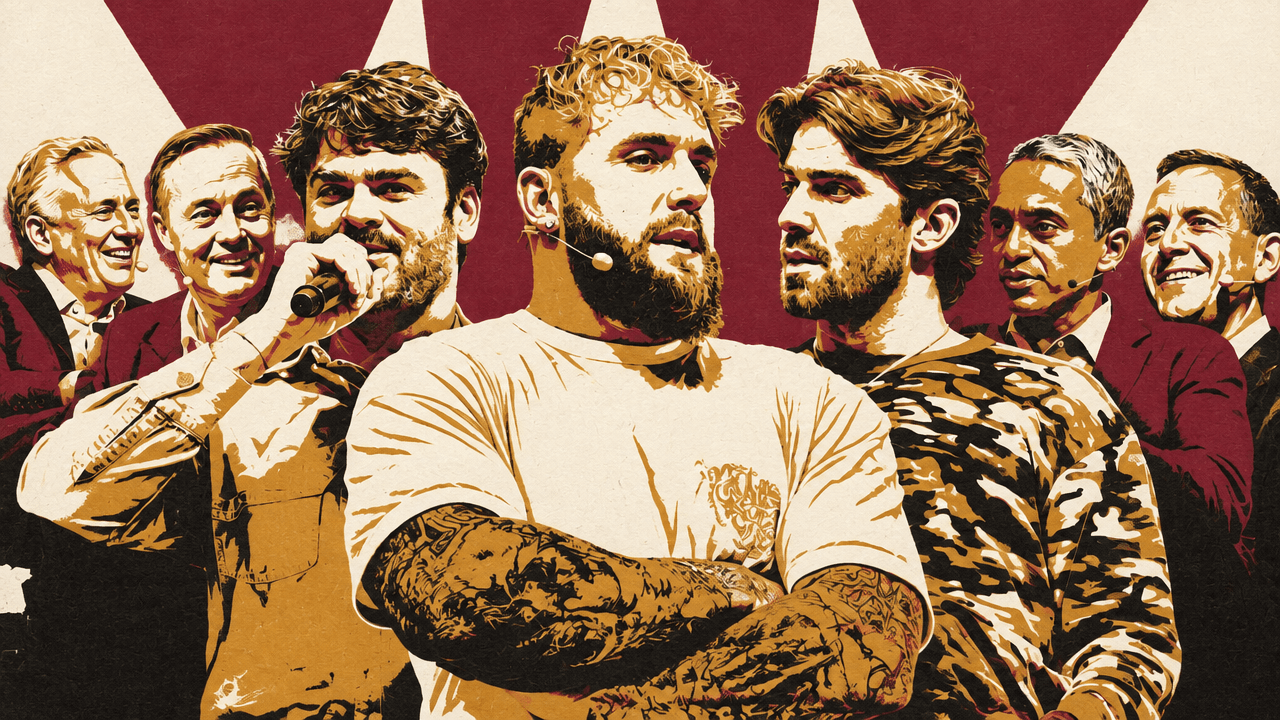
Attention creates distribution, but it cannot substitute for the thing being distributed
Jake Paul treats attention as an economic resource: it can help a company reach people, but it does not make the company’s product good. He and his partner Jeff Woo believe capital is becoming a commodity while attention remains valuable. Founders, in Paul’s account, need ways to make people notice what they are building. His own audience can provide some of that reach; his experience in marketing and branding can help turn it into a more deliberate contribution.


The world has shifted to attention being one of the most valuable currencies.
Paul’s business interests grew out of that premise, but he described them as more than a collection of ways to monetize a following. Content can lead people to his fights, fighting can draw attention to his other businesses, and investing gives him a role beyond his own career as a creator or boxer. He called the arrangement a flywheel: each activity can feed the others. He also connected it to a philanthropic effort, saying his foundation had opened 40 gyms where children could box for free and sponsored young boxers to attend events and tournaments.
The premise has a limit that Paul acknowledged directly. If people focus on getting views rather than building something good, he said, they may create products that merely appear important or content designed only to attract attention. He called the impulse to say increasingly absurd things for clicks “the YouTuber disease,” and said he had fallen into it when he was younger and trying to build a following. He sees a related incentive in journalism and online reporting, where provocative claims can draw views and generate money. Attention can help a business find an audience; it can also reward performance in place of substance.
That tension also shapes his view of platform responsibility. Asked whether YouTube should take greater responsibility for what it supports, Paul argued that one company would be reluctant to restrict content if competing platforms continued to host it. He named Twitch, Kick, X, Instagram and TikTok as alternatives viewers or creators could move to, and compared the competition to the race among the United States, Russia and China in artificial intelligence. In his view, platforms would need to act together for the problem to be addressed. The same competition that makes it possible for creators to find new audiences can make restraint costly for an individual platform.
Paul’s own experience with Vine gave him an early lesson in the bargaining power creators can have when a platform depends on their work. He said the top 20 Viners told the company that they needed to be paid or would stop posting. They asked for $1 million each per year, he said; Vine returned with an offer of $1 million to divide among all 20. The creators rejected it, moved to Facebook, YouTube and Snapchat, and stopped posting on Vine. Paul said the platform died within a couple of months. His account presents the dispute as a business lesson in negotiating over the value creators bring, while leaving the platform’s decline as a sequence he recalled rather than a claim that the creators’ departure alone caused it.
He said he started creating because he enjoyed taking an idea and making it real, making people laugh, or helping someone through a difficult day. In his vlogs, he said, he would remind viewers to work hard, smile and chase their dreams. He believes those messages helped him build an audience. His distinction is between people who have a genuine entertainment idea or occupy a particular niche and those who try to become influencers because it looks like a promising career.
That distinction runs through his account of turning an audience into a business. Paul said he visited technology companies and startup communities in the Bay Area as a teenager, began angel investing at 18, and started a social-media talent company called Team 10. He found people he believed had potential, signed them and helped them build followings. He described Team 10 as his first startup. The model was not simply to use his own popularity to sell something; it was to develop other people’s reach and build a business around that work.
Boxing offered a related way to use an existing audience, but Paul said it began with a challenge rather than a plan to enter the sport. Two brothers from the UK were talking trash about him and his brother, he recalled, so they agreed to fight. Paul went to a professional boxing gym the next day and trained for three months before fighting in Manchester. He said he won by knockout, found the experience satisfying, and was struck by the pay-per-view numbers. He then decided to pursue professional boxing seriously and moved to Puerto Rico to train away from distractions.
His business case was that an audience could follow fighters before they had built the long record that usually draws attention. Paul said many boxers are not widely known until they are 20–0, whereas he already had an audience of about 100 million followers who could follow his fights. He saw another opportunity in building a group of fighters around a central operation, as he had with Team 10. Paul said Most Valuable Promotions had 400 fighters across boxing and MMA and said it had merged with the Professional Fighters League.
Paul’s critique of the UFC rests on fighter pay and control over careers. He said the UFC pays fighters roughly 15% of its total revenue, compared with about 50% in other professional sports leagues. He also cited Sean O’Malley receiving $600,000 for the White House card. Paul argued that fighters who feel underpaid are less willing to risk certain matchups, making it harder to put on the big fights fans want to see. He said his company would compete by giving fighters a larger share of the gate and revenue, allowing sponsorships and avoiding shelving fighters. When Chamath Palihapitiya described the opportunity as “your margin, my opportunity,” Paul agreed.
Those figures and comparisons are Paul’s explanation of the opportunity, not independently established measurements in the discussion. His broader argument is that a promotion can attract fighters by offering them more money and flexibility than the incumbent. He said the company was going after Dana White, Zuffa Boxing and the UFC, and described the PFL merger as part of its chance to compete. He also said that supporting women’s boxing and younger fighters gives him particular satisfaction. He said women’s boxers had been underpaid, underserved and rarely included on fight cards, and described his work as giving them a platform and what he called the biggest paydays of their careers.
For Paul, that work helps explain why he sees a possible future in politics. He said he might enter politics around age 40, describing it as one of the best ways to make change. He linked the ambition to his satisfaction in helping people through boxing and said he expects future politicians to have a built-in following they can address directly. When Palihapitiya brought up Donald Trump, Paul distinguished him as a traditional celebrity rather than someone who had built a social-media-native audience by making content. Paul pointed to Spencer Pratt and online creators such as Nick Shirley as examples of people who might translate an audience into political influence. He described a possible direction, not a specific campaign plan.
Mantis aims to contribute access without taking the lead
For Drew Taggart and Alex Pall, The Chainsmokers’ early business problem was distribution: how to get music heard. Taggart said he and Pall met through a mutual friend around 2012, after Pall’s original partner in the group had left. Taggart had been making music while finishing school at Syracuse, and the two decided to start a band. Fourteen years later, Taggart said, they remained best friends.
Their first growth method relied on a specific feature of the online music world at the time. The pair made remixes of indie electronic tracks already circulating on Hype Machine, a chart that Taggart said tracked how often blogs posted about music and how many likes a track received on the site. Pall searched the site’s back end to find the college students writing for those blogs, then contacted them with personalized emails. Instead of sending the generic promotional notes labels were using, he joked with the writers and referred to where they had gone to school. Taggart said the group went from obscurity to roughly 30 number-one positions on the site in its first year.
The method joined a piece of music to an existing route to discovery. They chose songs that blogs were already covering, made remixes those blogs might post, and contacted the writers directly. Palihapitiya compared the approach to content marketing. Taggart said it was their hustle while they were learning to produce and write songs and finding an artistic identity, not a formula they could simply repeat now.
The market has changed since then. Taggart said 300,000 songs were being uploaded to Spotify every day, and that the music business was not like that when The Chainsmokers started. He did not know how they would break through if they were starting today. TikTok might be part of an equivalent path, he suggested, but he did not claim to know what the current version of their early strategy would be.
Pall described the broader music business as unsettled. Artists have more ways to distribute music and build communities directly, but a conventional label deal still has obvious appeal. A new artist may be offered their first substantial sum after years of work, and many of the artists they admire have signed with labels. The choice is between betting on direct distribution and accepting the resources a label can provide, sometimes in exchange for a share of future work. Pall said labels still provide value, but that no one knows how the balance will change as AI, streaming, YouTube and shorter attention spans reshape the market.
The group’s own income depends in part on which kind of performance it is doing. Taggart said arena tours with a full band carry substantial overhead. The Chainsmokers also came up as DJs, and he said DJ touring has much better economics for them. They have performed in Las Vegas for ten years and held a Wynn residency for eight. The difference illustrates that an audience alone does not determine the economics of a creative business: format and operating costs matter too.
The same tension between audience expectation and creative choice appears in the group’s music. Pall said they sometimes hear that they make the same song repeatedly, but do not want one online critic to dictate their direction. They follow their creativity rather than fixing a label on the kind of music they make. At the same time, he said, renewed interest in nostalgia around 2016—a significant year for the group—has made them consider how to balance what they want to make with the feeling listeners associate with that period. Taggart suggested that people remember the past more favorably than the present. Pall offered a simpler possibility: perhaps the music was just better back then.
Their move into venture began, Pall said, with the distribution and marketing platform they had built as artists. That made them attractive to consumer brands, but he said what caught their interest was working with founders and contributing to businesses. They did not want investing to be a passive revenue opportunity. Pall recalled investing in a late round of Uber and making about $25 on that investment so far; what appealed to him was the chance to be involved with ambitious companies. He named founders including Brian Chesky, Drew Houston, Michael Seibel and the Collison brothers as people whose work drew him further into venture.
Pall said Mantis focuses on cybersecurity, AI infrastructure, deep tech and health tech, with investments at seed and Series A. He named himself, Taggart, Jeff and Milan as founders, and said the firm also had other partners. Mantis does not take lead positions. Pall described its intended role as a useful “sixth man” alongside a company and its other investors.
We like being this sixth man of the year on these teams.
Pall compared the role to basketball player Robert Horry, who won championships without being the central star on every team. The analogy describes Mantis’s intended place in a financing: the firm wants to add value alongside founders and lead investors, rather than claim that it can replace established firms such as Sequoia or Craft. Its contribution, Pall said, often comes through relationships, introductions and brand-building.
The experience behind that contribution is not primarily about building technology. Pall said The Chainsmokers may make music much as they did 15 years ago, but the surrounding business has changed: distribution, community-building, sales and touring work differently. He said that experience has helped the partners understand the changing inputs involved in building a company. A founder still cares about revenue, customer retention, acquisition costs and production costs, but the ways of achieving those outcomes have shifted.
Pall offered a practical example of how access might help. A founder once asked him to arrange a call with someone; Pall could help because The Chainsmokers had played that person’s company party a few days earlier. He said the firm had been useful with go-to-market relationships and brand-building. David Sacks argued that the duo’s experience making a business work in music gives them credibility, and that a strong network can help founders with specific needs. Sacks also emphasized knowing when to get out of the way.
Pall said the firm’s position is collaborative rather than a substitute for established lead investors. That choice can make sense when a founder needs a particular introduction or help reaching customers, but it does not mean every company needs the same kind of support. Pall said the partners want to show up for the businesses they back, not perform a “song and dance” to win access and then disappear. He also said that their experience speaking with founders helped them recognize that many of the challenges involved in building modern businesses—distribution, community and sales—were familiar from their own work.
The partners’ public profile is both an advantage and a liability. Pall said he uses LinkedIn and his name to reach people he wants to speak with. But he also said some institutional investors have told him that, although they like what Mantis is doing, they do not want to invest in “The Chainsmokers fund” because they expect to be blamed if something goes wrong. He said he understands that concern. His answer is to return with results that make skeptics reconsider.
That standard matters because Pall described venture as long-duration and illiquid. He advised famous people interested in investing to pay off their mortgage first, and said the field is hard enough that it should be treated with the same seriousness as music or sports. He cited a chart discussed by the partners suggesting that the top 5% of investments generate 90% of returns. His point was not that a famous investor can gain access and expect success; the work is to identify a small number of strong companies and stay involved.
A paper mark is not the same as cash returned to investors
Venture firms have to decide not only which companies to back, but when to keep holding, sell shares or return cash to their investors. Pall said Mantis had recently experienced one of its first proper liquidity events: Underdog Fantasy sold to HG IG International. He called it a good outcome and said sending a check to limited partners felt important. His account of the transaction was brief; the point he drew from it was that a venture firm may have done much of its work, but cash still has to get back to investors.
That obligation sits beside the attraction of continuing to hold a company that is growing. Pall said some of Mantis’s early investors were not looking for a cautious strategy, giving the firm room to ride winners. He cited Dandy, which he said continued to double each year and had begun expanding internationally, as a company he wanted to hold. Concentrating in winners, he said, takes time and the confidence to commit more capital. The decision is not simply whether a company has performed well; it is whether the next dollar should stay invested or be returned as liquidity.
Pall also watches what happens to demand around a financing round. He described looking at interest before a round, the price at which it is set, and whether demand builds or holds after that price is established. A change in sentiment can be informative, as can the secondary-market offers he receives. A higher valuation by itself does not demonstrate that a company’s business has improved.
That distinction becomes sharper when a financing is split into tranches at different prices. Pall said a later investor can sometimes pay two or three times the company’s earlier valuation without a corresponding change in underlying performance. He said he understood why large firms might participate, given differences in their cost of capital, but the later buyer is still paying a significant markup. A new paper price may raise the value assigned to existing shares without showing that the company has become more capable of generating revenue or growth.
The trade-off between holding and selling is therefore practical as well as theoretical. A secondary sale or a later round can provide liquidity, but selling too early may mean missing further growth. Holding can preserve the chance of more upside, but leaves the fund dependent on a later sale or exit. Pall said managers need to underwrite the company’s potential rather than treat its latest price as proof. He also said Mantis was still learning how to concentrate follow-on capital in its strongest companies.
The panel’s examples of missed opportunities showed how difficult that judgment can be. Jason Calacanis said he introduced 21 angel investors to Travis Kalanick; 19 declined to invest in Uber. He recalled objections to the complications of operating in the physical world, including the prospect of accidents and liability. One prominent venture capitalist, he said, would have backed Kalanick if he had sold software to taxi companies instead. Calacanis said he and two others invested.
Palihapitiya described passing on Robinhood because its sign-up numbers conflicted with his experience building Facebook’s growth mechanisms. He said one of his principals had argued strongly for the investment, but he could not get past his own prior assumptions. He called the decision a billion-dollar mistake. Pall said he recognized a related bias in himself: Mantis does not invest in music apps or entertainment because his experience makes him pessimistic about those opportunities. Familiarity can help an investor see operational challenges; it can also make a different model harder to imagine.
Palihapitiya suggested that some successful investors entered their fields without established assumptions, bringing curiosity and the ability to think critically instead. Calacanis said the useful question is what the world would look like if the founder’s idea worked. In Robinhood’s case, he said, the founders’ plan to let millennials invest for free seemed implausible to some people. What caught his attention was their capability and drive. The exchange leaves a tension for experienced investors: domain knowledge can sharpen judgment, but accumulated experience can also become a set of priors that filters out unfamiliar businesses.
Follow-on investing is another test of judgment. Pall said Mantis was still developing its approach to concentrating capital in winners. Palihapitiya described a model in which a firm requires each partner to identify one portfolio company for a large allocation. That turns a broad belief in a company into a specific decision about how much of the fund to put behind it, while forcing partners to accept that other investments will receive less.
Pall said making that sort of commitment might mean working closely with a founder for months to earn the chance to invest at that scale. Looking back, he said, the signs about which companies deserved more backing had often been present. The harder part was building enough experience and confidence to act on them. He credited Brian Singerman with spending two hours explaining the importance of follow-on investments, and said Mantis had become better at concentrating in winners.
The partners were also debating whether to create a growth fund. Calacanis proposed special-purpose vehicles as another way to participate in later-stage investments and serve investors with different preferences. He described early investors seeking liquidity while later-stage funds wanted to buy shares. As companies stay private longer, he argued, a firm may be able to combine early-stage investing with a later-stage business. These structures can give a fund ways to buy or sell shares; they do not resolve the underlying question of what a company is worth or when cash should be returned.
The discussion ended with a distinction between valuation and operating performance. Calacanis said he now thinks of a unicorn as a company with $1 billion in revenue, rather than one valued at $1 billion. Pall agreed that business performance matters when judging whether a higher financing price or a secondary sale is warranted. A later tranche demanding a large markup without a corresponding change in performance may simply pass shares between investors at a higher price. Calacanis called that “bubble market behavior”—a signal to pay attention to, not evidence by itself that the business has improved.