AI Moves From Model Capability To System Design
Apple, OpenAI, Balyasny, Cloudflare, Brilliant, and mental-health researchers are all pointing to the same applied-AI test: whether models can be embedded into trusted systems that preserve context, control, and safety. The work is shifting from producing fluent answers to building the operating layers, workflow harnesses, context systems, runtimes, and guardrails that let AI act in real settings.

1. The operating system is becoming the AI battlefield
Apple’s reported Siri overhaul is the most consumer-facing version of a broader applied-AI shift: the market is no longer asking only whether a model can produce a good answer. The harder question is whether AI can be installed into the places where people already work, communicate, plan, and move between devices.
Bloomberg’s Mark Gurman frames Apple’s position as lagging on both Apple Intelligence and Siri, but he also describes the expected WWDC test as an integration problem rather than a frontier-model contest. The reported Siri upgrade would move the assistant from a weak single-prompt voice interface toward a system layer that can use personal context, see what is on screen, work across first- and third-party apps, search user data and the web, and complete multi-step tasks. His example is not “ask Siri a trivia question.” It is asking Siri to draft an email from the user’s schedule, meeting notes, web research, and other personal context.
That is a different product category. Siri’s strategic value would come less from being a better chatbot destination than from becoming operating-system glue: present across iOS, macOS, and other Apple environments, able to interpret intent and connect the user to app capabilities without requiring every interaction to start in a separate AI app.
Operating-system layer is also where Apple’s strength and its risk meet. Apple has distribution, device integration, privacy positioning, and control over APIs. But Gurman’s reporting does not say Apple has shipped the finished version of that vision. It describes a strategic test: whether Apple can make nondeterministic AI feel polished enough, private enough, and predictable enough to belong inside a tightly controlled consumer ecosystem.
Carolina Milanesi sharpens the same point from the consumer side. She does not treat the question as whether Siri beats ChatGPT or Claude in a head-to-head chatbot comparison. She says Apple’s advantage is the multi-device experience. The user should not feel that the AI experience changes arbitrarily between iPhone, Mac, or another Apple product. In that view, the winning consumer implementation is not the model with this week’s best benchmark, but the layer that carries context and continuity across devices.
Paul Hudson turns the same idea into a developer requirement. Developers do not want to hand-code the 50 ways a user might ask for the same thing. They want Apple Intelligence to handle natural-language intent and give apps a reliable way to expose data and actions. For developers, Siri becomes valuable if it becomes an API surface, not another prompt box.
Privacy is not a side issue in that architecture. Gurman reports that the new Siri uses underlying Gemini models, while Hudson says developers will be watching whether the intelligence runs through Apple’s private cloud compute, Google infrastructure, or some hybrid such as Gemini hosted by Apple. Hudson’s preferred version is clear: Google’s model capability under Apple’s privacy model. His reasoning is not simply brand loyalty. Developers have bought into Apple’s privacy promise as part of the platform bargain.
| Apple AI question | Why it matters |
|---|---|
| Model quality | Siri cannot feel materially behind daily AI tools users already choose. |
| OS integration | The value comes from acting across apps, screens, devices, personal data, and web information. |
| Developer APIs | Apps need a way to expose intent, data, and actions without rebuilding natural-language understanding themselves. |
| Privacy architecture | Personal context is useful only if users and developers trust where it is processed. |
| Consumer continuity | Apple’s advantage depends on a consistent cross-device experience, not a separate chatbot race. |
Ed Ludlow adds a useful constraint: even a better Siri may not rescue the smartphone market this year, given memory constraints and component costs. That keeps the Apple story from becoming a simple launch narrative. Apple’s AI credibility matters because users are forming habits around other assistants and agents. But the near-term business effect is not guaranteed. The deeper test is whether Apple can turn model capability into a trusted, cross-device consumer infrastructure layer.




2. Enterprise AI is shifting from answers to work
The enterprise version of the same deployment problem is workflow consolidation. OpenAI used its Intelligence at Work event to argue that workplace AI is moving away from separate tools and toward one operating workflow across ChatGPT, Codex, agents, annotations, and deployment. Sam Altman described the roadmap as a response to customers asking OpenAI to bring its offerings together into “a single workflow in the enterprise.”
Altman’s distinction matters: raw intelligence on one side, and the “harnesses and system around it” on the other. That is the applied-AI market in one sentence. Companies may care about model capability, but they buy systems that retrieve context, complete tasks, produce artifacts, fit into governance, and work where employees already are.
OpenAI’s product framing follows that logic. ChatGPT and Codex are being presented as “one unified experience.” Agent Plugins are role-specific agents for marketing, finance, customer support, data science, operations, and sales. Annotations bring model collaboration into existing tools. Sites is described as a path from idea to deployment. The common claim is not that every employee should open a chatbot more often. It is that AI should sit inside the operating flow of the company.
Balyasny Asset Management’s Charlie Flanagan supplies the customer-side version of the argument. He says Balyasny’s internal AI platform is now used daily by 97% of employees across investment research, coding, and back-office operations. His most concrete metric is time compression: economic analysis that used to take two days reportedly now takes 30 minutes.
The Balyasny example is important because it does not present AI as a search tool with better prose. Flanagan says 2026 is the year systems move “from systems that can do search to systems that can do work,” enabled by the Codex harness. He describes Codex as beginning from coding and then expanding into investment research, finance operations, and other structured workflows.
OpenAI’s own Codex metrics give the company’s side of the adoption story. Denise Dresser says Codex has more than five million weekly active users, up 400% since the beginning of the year, and that OpenAI has two million business customers, double in the last year. Those numbers are not proof that every enterprise workflow has been transformed. They do show why OpenAI is folding Codex into ChatGPT rather than keeping coding assistance as a separate developer silo.
The useful comparison is between product direction and institutional use. OpenAI is selling a unified workflow across agents, coding, collaboration, and deployment. Balyasny is describing a firmwide platform that compresses analysis and turns Codex from a coding tool into a work-execution layer. Both point to the same enterprise requirement: the model is not the product by itself. The product is the harness around the model.
That shift also changes what success means. A system that summarizes an earnings report is useful. A system that moves earnings-report analysis closer to real time inside an investment workflow is a different proposition. A code assistant that suggests a function is useful. A Codex-like agent that takes a backlog item, scopes the change, touches the right files, writes a regression test, and avoids unrelated local changes is closer to work.
OpenAI and Balyasny are both describing AI as an institutional operating layer. Neither resolves the full governance problem: who approves outputs, how work is audited, which tasks are safe to delegate, and where human judgment enters. But the center of gravity has moved from impressive answers to bounded execution inside governed workflows.






3. Coding is the first breakout market, but it exposes the next bottleneck: context
Coding is the clearest market where AI has moved from novelty to pull. Benedict Evans says agentic coding has crossed from “kind of useful” to genuinely changing software development. His larger point is deliberately cautious: AI may become transformative across many fields, but coding is the one use case where demand is unmistakable now.
That makes coding both a success case and a diagnostic tool. It shows that models can do useful work. It also shows why model capability alone is not enough.
Evans’s market-level argument is that the long-term economics remain unsettled. Foundation models may become infrastructure, like cloud providers or mobile networks, while applications and workflows capture much of the value. He does not say that is certain. He asks where durable differentiation and leverage will come from if multiple model providers sell similar capabilities, if customers switch providers, and if the application layer abstracts the model away.
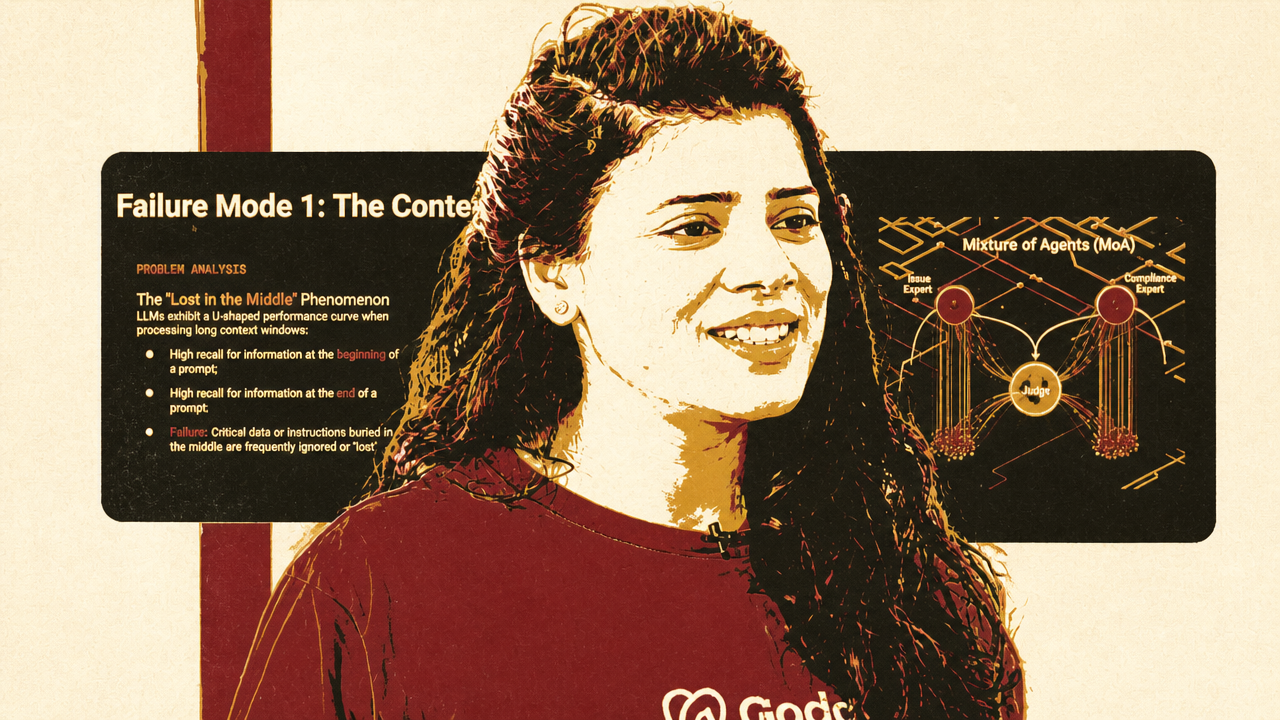
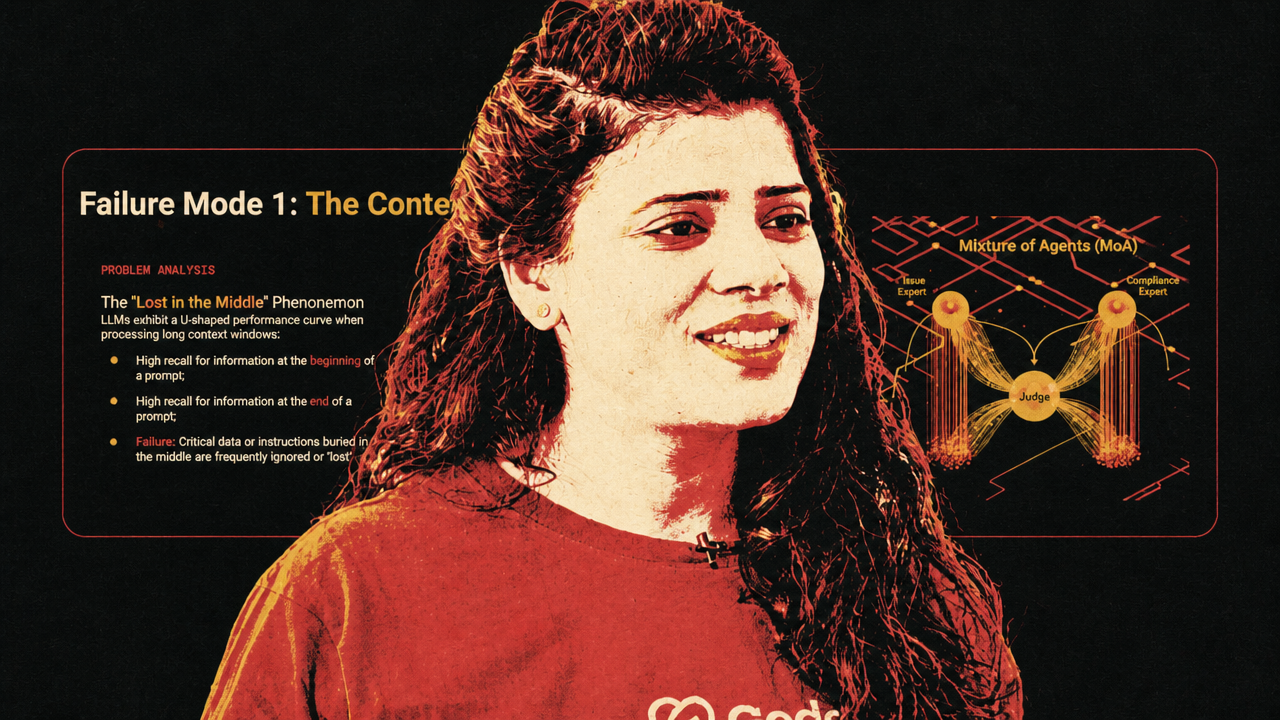
Nupur Sharma’s engineering-level argument explains why the application layer may matter so much. She says larger context windows have not solved a core agent problem: models may use the beginning and end of an input while losing critical information in the middle. Qodo sees this pattern in agentic code review, where teams are tempted to give an agent the pull request, repository, Jira ticket, tooling outputs, conventions, and historical decisions all at once. The agent may appear to reason and still miss the material that matters.
Lost in the middle is not just a benchmark curiosity. In code work, the buried middle may contain the relevant ticket, security requirement, organizational convention, or dependency relationship. Sharma’s conclusion is that agent quality depends on context engineering: retrieving, ranking, constraining, and checking what the model sees, rather than stuffing more into the prompt.
That connects directly to Evans’s value-capture question. If coding is the first breakout market, and if reliable coding agents require retrieval, ranking, specialist agents, judge nodes, bounded loops, organizational rules, and validation, then the practical value may sit in the harness around the model as much as in the model itself.
| Problem exposed by coding agents | Engineering response described by Sharma | Market implication in Evans’s frame |
|---|---|---|
| Long prompts bury key facts | Retrieve and rank context instead of dumping everything into the window | Application systems may differentiate through workflow and context control. |
| Agents loop while deciding how to work | Use counters, timeouts, and rigid validation gates | Raw reasoning needs orchestration before it becomes reliable work. |
| One generalist agent drops subtasks | Use specialist agents with isolated context and a judge layer | The product is a system of roles, not one prompt. |
| History can encode bad habits | Let explicit organizational rules override inferred preferences | Enterprise value depends on governance and domain fit. |
| Outputs can be plausible but wrong | Add critic or judge nodes to compare results against the original goal | Evaluation becomes part of the product layer. |
Sharma’s architecture is not anti-model. It assigns different jobs to different parts of the system. High-reasoning models are useful for discovery, planning, and deciding what to inspect. Stricter, lighter steps can handle validation, summarization, formatting, and checks. Specialist agents can examine security, code differences, Jira context, or architecture separately. A judge can reconcile conflicts and filter noise.
Evans’s broader analogy is that AI resembles the internet in the late 1990s: obviously important, already useful in places, but too early to know which layer captures the economics. Coding narrows that uncertainty without ending it. It proves that agents can change a real workflow. It also reveals that the next bottleneck is not simply bigger models or longer windows. It is the engineering of what the model should know, when it should act, and how its work should be checked.






4. Agents need new runtime primitives, not just better prompts
If Sharma’s code-agent argument explains the context layer, Cloudflare’s Durable Objects and Dynamic Workers discussion explains the compute layer. Agents that act over time, coordinate across tools, stream results, sync across clients, and run generated code need infrastructure that looks different from ordinary stateless request-response functions.
Sunil Pai describes Durable Objects as the execution unit behind Cloudflare’s Agents SDK. The key property is not merely that they include storage. It is that a given identifier maps to an addressable, persistent coordination point. Future requests and WebSocket connections can land in the same place. The object can hold state, hibernate, wake, run background work, schedule tasks, connect outward, and coordinate clients.
That matters because agent workflows are not always one request and one response. Pai’s resumable-stream example is simple: a user asks an LLM for a long answer and refreshes the page midway. Without the right primitive, the developer now has to manage databases, replication, sticky sessions, and stream recovery. With a durable coordination point, the client can reconnect to the same object and resume.
Matt Carey ties the same model to MCP, where production deployment often requires long-lived stateful connections between client and server. Pai extends the point to collaborative AI: multi-tab sync, phone-plus-laptop sync, and shared conversations. His line that “AI should be a multiplayer game” is less a consumer feature request than an infrastructure claim. If agents are going to become part of work, they need coordination and continuity.
Dynamic Workers address a different constraint: safely running generated or user-supplied code. Carey describes a model in which a Worker can take a string of code from a customer, user, or LLM and run it in an isolated Worker. Pai’s security framing starts with no ambient authority. The generated code has no default access to fetch, APIs, environment variables, or broad privileges. The host grants only explicit capabilities, such as a narrow API or an outgoing request to a specific domain or path.
That is why Pai calls Dynamic Workers “eval++.” Developers have long been told not to run arbitrary generated code because it is dangerous. Cloudflare’s claim is that a sandboxed, capability-based runtime can reopen that design space. Generated code can become an agent interface, but only under explicit constraints.
MCP makes this concrete because agents need to call tools without turning every tool surface into a giant prompt. Carey previews Code Mode as a way to access thousands of Cloudflare API endpoints in roughly a thousand tokens by letting generated code act inside a Dynamic Worker. The general principle is larger than Cloudflare: code can be a compact action representation if the runtime can safely restrict what that code can do.
| Runtime need | Cloudflare primitive | Broader agent requirement |
|---|---|---|
| Persistent state | Durable Objects | Agents need memory and coordination beyond one request. |
| Resumable streams | Durable Objects and Agents SDK | Users should reconnect without losing long-running work. |
| Multi-client sync | Durable Objects | Agent state may need to follow users across tabs, devices, and collaborators. |
| Generated code execution | Dynamic Workers | Agents need expressive action while staying sandboxed. |
| Explicit permissions | Capability grants | Safety depends on no ambient authority and narrow powers. |
The connection back to OpenAI, Balyasny, and Sharma is direct. Enterprise agents need workflow harnesses. Code agents need context engineering. Long-running agents need runtime primitives that can remember, schedule, synchronize, resume, and restrict. The model may reason, but the surrounding system has to provide the operational guarantees that make action tolerable.


5. In high-stakes domains, usefulness depends on constraint and trust
Education and mental health show the same applied-AI pattern in domains where “AI that does more” can be harmful if the deployment is not carefully bounded.
The contrast is useful because the desired human outcome differs by domain. Brilliant wants an AI tutor that makes the learner think harder. Mental-health researchers and platform teams want AI systems that do not abandon, misdirect, or quietly replace human support. In both cases, fluent output is not the measure of success. The question is whether the system changes the human situation in the intended direction.
Brilliant founder Sue Khim describes Koji, the company’s new AI tutor, as a response to the education use case parents fear most: software that gives students answers while eroding their ability to think. Her argument is not that AI belongs everywhere in learning. It is that an AI tutor must be constrained by pedagogy, lesson design, assessment, and the goal of making the student do more of the thinking.
Koji is not presented as a generic chatbot attached to a learning app. It appears inside Brilliant’s structured lessons, beside interactive visual problems. It can see the problem state, respond to confusion, ask Socratic questions, annotate, and guide the student toward the relevant structure. Khim emphasizes that the tutor should eventually disappear: present while the concept is being learned, absent when the student must prove mastery in a test-like environment.
That design makes Koji a positive case for applied AI under constraint. Brilliant is not trusting a frontier model to invent pedagogy from scratch. Khim says the large language model has a constrained role, while Brilliant’s lesson infrastructure supplies the deterministic mathematical structure, the visual scaffolding, and the learning loop. She says frontier models have improved at conversation and tool use, but that the “core job of tutoring” — diagnosing and fixing student misunderstandings — requires reward signals tied to real learning.
Mental-health AI is the cautionary version of the same principle. At Stanford’s AI for Mental Health symposium, Russ Altman, Jina Suh, and OpenAI’s Sara Johansen treat mental-health AI as a deployment problem already underway. People are using general-purpose AI systems for distress and support because human care is expensive, inaccessible, or emotionally costly to seek. The question is not whether AI will enter mental-health contexts. It already has.
Suh’s most important contribution is the evaluation frame. She argues that mental-health AI should not be judged one conversation at a time. A person’s journey begins before the prompt, continues through the interaction, and extends into what they do afterward. A safety redirect can pass a benchmark and still fail the person if it withdraws care abruptly, misreads context, points to unusable resources, or leaves the user more frightened and alone.
Johansen describes OpenAI’s approach as layered: model policy governing how ChatGPT responds in conversation, and product policy adding interventions such as parental controls, crisis helplines, and Trusted Contact. OpenAI’s stated premise is that ChatGPT should not replace human connection or human care. The interventions are meant to route people toward trusted people, professionals, emergency services, or localized support.
The unresolved tension is that personalization and safety both require context, and mental-health context is unusually sensitive. Johansen says broader context can help time a crisis intervention or personalize a recommendation. Suh asks when a general-purpose system should use what it knows about a person, whether it should “peek” at intimate data, and whether asking follow-up questions can increase disclosure in ways that deepen dependence.
| Domain | Wrong success measure | More relevant measure |
|---|---|---|
| Education | The tutor gives a fast correct answer | The student solves the problem and can demonstrate mastery without help. |
| Mental health | The model offers a standard safety redirect | The person reaches usable support and is not abandoned by the interaction. |
| Enterprise work | The model produces a plausible response | The system completes bounded work inside governance and existing workflows. |
| Coding | The agent sees a very long prompt | The agent uses the right context, acts under bounds, and passes validation. |
The day’s common pattern is constraint. Apple needs an OS layer that preserves privacy and product trust. Enterprises need workflows that turn intelligence into governed work. Coding agents need engineered context and validation. Agent platforms need stateful and sandboxed runtime primitives. Education and mental health need domain-specific guardrails and measures of human outcome.