A Propofol Emergence Protocol Pairs Trauma Rehearsal With Dream Recall

Tim Ferriss describes two distinct approaches to using dreams in trauma treatment: dream engineering, which he says Dust is exploring for conditions such as PTSD, and a propofol protocol that pairs rehearsal of a traumatic event with a quiet emergence from anesthesia. He recounts cases in which patients with complex PTSD reported lasting relief after the protocol, while Kevin Rose raises the possibility that deliberately shaped dreams could offer another route for people who cannot use psychedelics.
Dream shaping and anesthesia dreams are separate approaches
Tim Ferriss described two different lines of work that had brought him back to questions about dreams and therapy. One is dream engineering: deliberately modifying dream content. The other is a protocol involving dreams during emergence from anesthesia. Ferriss connected both to the possibility that the experience surrounding treatment may matter, but clarified that Dust, the dream-engineering startup in which he is an investor, is not doing anything with propofol.

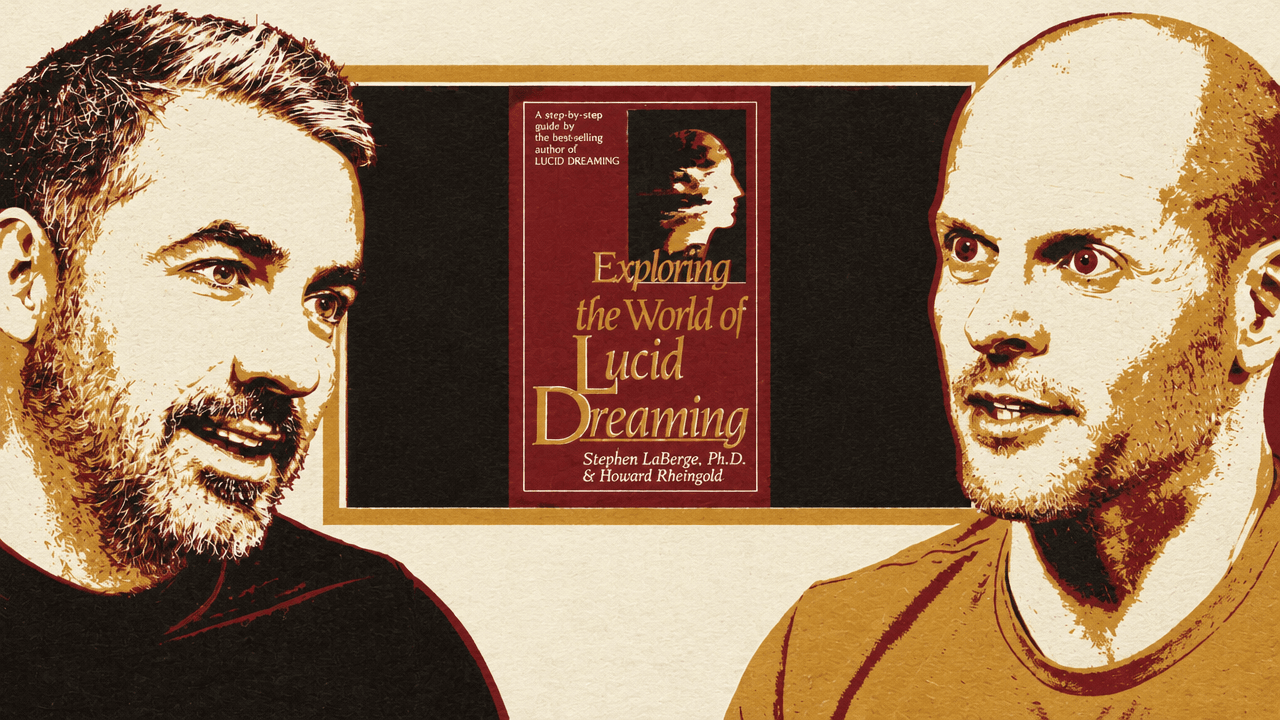
Ferriss traced his interest in lucid dreaming to reading Stephen LaBerge’s Exploring the World of Lucid Dreaming in high school. Lucid dreaming, he explained, is recognizing that you are dreaming while the dream is happening. With practice, a person may also learn to change the dream’s content. When he competed in wrestling, Ferriss said, he used to add training sessions in his dreams and felt that they translated into better performance.
His current questions are whether dream content can be modified deliberately and whether researchers can communicate with people while they are dreaming. Ferriss said he was introduced to Adam Haar Horowitz, who took research from MIT and Harvard into work on dream engineering. He described Dust’s potential work as helping people modify dream content to address conditions such as PTSD.
Kevin Rose connected dream shaping to a possible alternative for people for whom psychedelics are not appropriate. If researchers can engineer dreams to reduce nightmares, Rose asked, might people have a recurring opportunity during sleep to work with processes that resemble some psychedelic outcomes? He also raised the practical question of who would develop the science and preparation needed to shape those experiences.
Rose pointed to lucid dreamers’ ability to communicate with researchers while in a verified REM state. As he described it, dreamers memorize an eye-movement pattern in advance and use it to signal that they know they are dreaming—“like Morse code.” Ferriss called the demonstration extraordinary. Rose’s example concerns communication from within a dream; the discussion of therapeutic dream shaping was a separate question.
The propofol protocol uses rehearsal before emergence
The anesthesia-dream approach Ferriss described is distinct from Dust’s work. He cited Stanford Medicine headlines asking whether anesthesia-induced dreams could wipe away trauma and whether anesthesia dreams could be a more palatable psychedelic therapy. When Rose asked what the protocol involved, Ferriss called it a five-step procedure and described the steps this way: tell the patient they might dream under anesthesia; use propofol; monitor brain activity, including with EEG; ensure at least ten minutes of quiet, undisturbed emergence; and ask the patient about dream recall afterward.
Ferriss’s description focused on propofol as the patient emerges from anesthesia, not on changing the anesthetic used during surgery. He likened the process to tapering the patient out and tuning the dose to a particular “radio station,” with the aim of pleasant dreams. He stressed that the quiet emergence period matters for recall: “If you don't do that, then dream recall is shot.” He also warned against trying propofol outside medical care.
The preparation he described is separate from those emergence steps. Beforeward, patients rehearse an imagined version of the traumatic event that ends differently, with some kind of resolution. Ferriss recounted cases he had encountered in which people with longstanding, complex PTSD had a dream during propofol emergence after this preparation. He said some people who had severe symptoms reported zero symptoms ten months later.
The claim that the dream experience might contribute to treatment led Ferriss to question a common framing of psychedelic medicine. He described a development strategy in which a drug targets serotonin type 2A receptors while the subjective trip is treated as dispensable—a side effect to remove from a new compound. Ferriss argued that the trip might matter, particularly for the emotional release associated with the experience. He also made a distinction: an LSD variant can act on the same receptor without producing a trip and, he said, can be effective for cluster headaches.
Rose added that psychedelics may work through more than one pathway. Some, he said, have potent anti-inflammatory effects at doses below the threshold of perception, which could also contribute to antidepressant effects. That possibility did not settle the question of what the subjective experience contributes. Rose returned to the prospect of shaping dreams: if dream engineering can reduce nightmares, he wondered whether sleep might offer a way to work with experiences that some people cannot pursue through psychedelics.
Ferriss asked whether Dust was a coaching service and whether the anesthesia approach might be possible through hypnotherapy. Rose clarified that Dust was not working with propofol and said he did not know the answer about hypnotherapy. He also said he did not know what Dust was disclosing publicly, and directed people to the company’s own materials. For Rose, the anesthesia discussion was a way into a broader interest in dream shaping, not a description of Dust’s method.
Brain stimulation is Ferriss’s other route beyond psychedelics
Dream-based approaches sit alongside Ferriss’s continuing interest in neuromodulation and brain stimulation. He said he remains “super, super bullish” on the field and expects to undergo treatment again, usually every three to four months. He has become involved with Ampa Health, which he described as offering small, modular equipment, and said the company was working on one-day protocols rather than courses that might require five days away from work.
Ferriss described one protocol involving a small dose of the antibiotic D-cycloserine, which he said induces plasticity in the brain in a way he compared with certain psychedelics. In his account, it dissolves in the mouth before treatment. He said his OCD and generalized anxiety had been at an eight or nine out of ten and that treatment had brought them to zero or one.
He contrasted Ampa Health’s equipment with devices he said can be refrigerator-sized and require leases of around a quarter-million dollars. He put the provider cost for Ampa Health’s product at about $3,000 a month, with the ability to cancel, and said it could fit in a car trunk. He hoped providers already offering ketamine or CBT might add brain stimulation to their services.
Ferriss also described a recent session while traveling: brief stimulations about every 30 minutes over roughly two hours, for sleep. The target was the same throughout, though he said the company was not discussing it publicly yet. He said the targeting drew on overlapping networks identified through deep-brain-stimulation data and lesion research. The aim, as he explained it, was to find targets that are more uniform from person to person and less vulnerable to clinician error. With earlier targets and equipment, he said, a placement error of half a centimeter could mean no effect after a week of treatment. He reported a mild headache lasting about a day.
When Rose asked whether stimulation made him uneasy, Ferriss compared it with drugs Rose had mentioned experimenting with before recording. Ferriss said he was no stranger to pharmacology, but found the risk-benefit ratio of brain stimulation more attractive for the general population than psychedelics, in part because some people cannot take psychedelics.
Anesthesia remains puzzling to Rose
Rose widened the discussion to the workings of anesthesia itself. He said that researchers do not know how many anesthetics work. Referring to Michael Pollan’s new book, he mentioned the claim that anesthesia is effective on plants despite their very different anatomy. Rose briefly raised possible quantum effects, then said he was not credible enough to discuss them at length.
His more tentative suggestion was that some anesthetics appear inert and may not fit a simple explanation based on a chemical binding to a receptor. Rose wondered whether physics or bioelectrical fields might be involved, while describing that as the limit of his cursory understanding. The mechanism, in his account, remains an open question even as anesthesia is used in the dream protocol Ferriss described.