Software-Defined Factories Are Moving From Hypercars to Cruise Missiles
 Jason Calacanis
 Lukas Czinger
 Mark Horowitz
 Brandon Goode
 Lon HarrisThis Week in StartupsSaturday, May 23, 202625 min read
Lukas Czinger, chief executive of Divergent Technologies, argues on This Week in Startups that U.S. defense manufacturing can move faster and at lower cost if factories are treated as software-defined infrastructure rather than product-specific plants. The article also follows Brandon Goode and Mark Horowitz’s case for Outro Health: that antidepressant prescribing has scaled without an equally developed system for helping patients stop safely. Across the defense, healthcare and AI segments, the source frames the central problem as incentives — what existing systems pay companies to build, maintain or automate, and what they leave underbuilt.
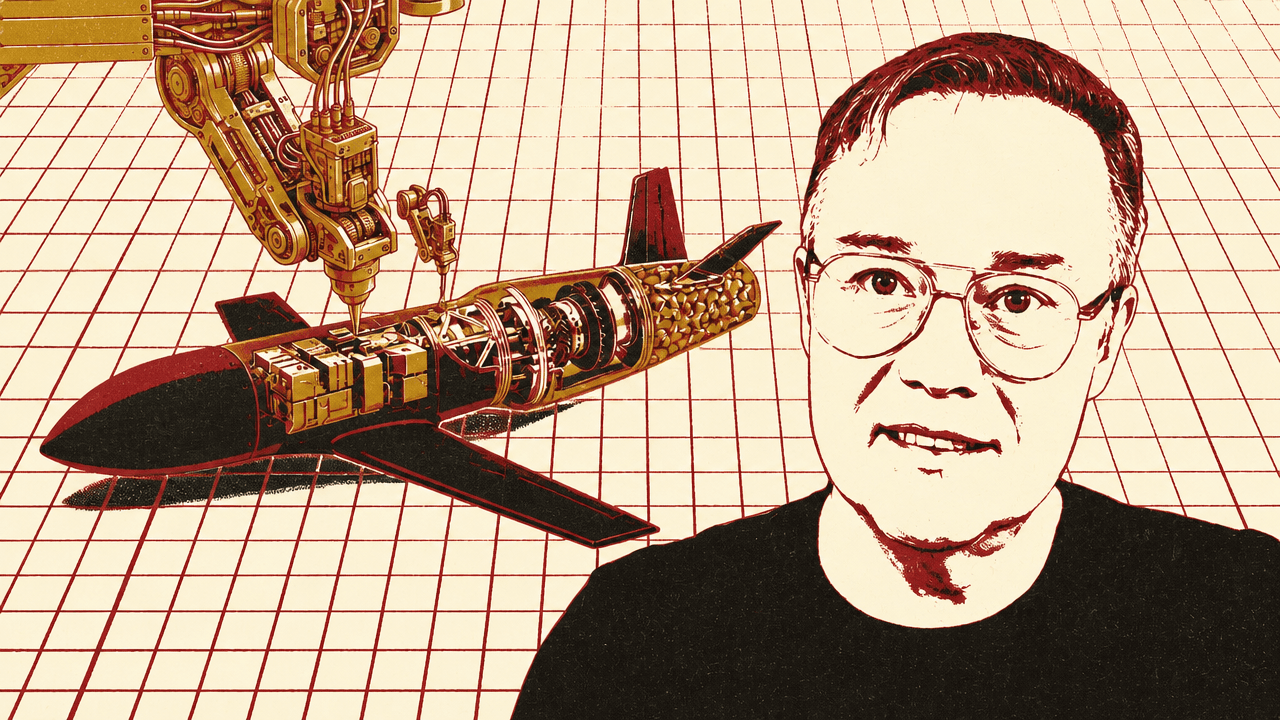
Divergent wants factories that can switch from hypercars to cruise missiles without changing the hardware
Lukas Czinger described Divergent Technologies as a manufacturing and engineering company built around a product-agnostic factory, not as a hypercar company that later found a defense market. The early vehicle work, including Czinger Vehicles, was a way to bring vehicle development in-house and prove the platform. The larger ambition, he said, was to own and operate factories that can reach low unit cost while switching among very different products: a city-vehicle chassis, a performance-car chassis, and a cruise-missile airframe, all produced on the same factory hardware.


That distinction mattered because Jason Calacanis initially framed the company as something like “Kinkos for 3D printing stuff,” a distributed service layer for industrial additive manufacturing. Czinger pushed back. Divergent is not just a layer on top of other companies’ printers, he said. It is vertically integrated through the engineering application, printer, assembly system, post-processing, and materials.


The analogies Czinger chose were AWS, TSMC, and Cadence: not simply a printer manufacturer, and not simply a contract manufacturer, but an infrastructure layer that can take functional requirements for an airframe, engineer it quickly to a higher-performance point, prototype it, and then manufacture high-volume production runs. Divergent builds its own 3D printers, but does not sell them. It also develops its own material chemistries and material cards.
We want to make tens of thousands, hundreds of thousands of parts, and we actually build our own 3D printers as well.
The company started in automotive and supplied structures to large OEMs including McLaren, Aston Martin, and Bugatti, shipping from Los Angeles to Europe as a tier-one supplier. About three years ago, Czinger said, Divergent began defense work, applying the same AI-driven engineering and manufacturing practice to airframes, piece parts, and complex assemblies for the U.S. military.
The manufacturing system was presented as three linked capabilities. The design layer was shown over a heat-mapped aircraft or missile fuselage model with the text: “DESIGN OPTIMIZED WITH DIVERGENT’S IN-HOUSE SOLVER 3-5X FASTER THAN COMMERCIAL SOLVERS.” The print layer was shown over a 3D-printing process with the text: “PRINT MATERIALIZE STRUCTURES WITH DIVERGENT’S APPLICATION-SPECIFIC ALLOYS” for “INDUSTRIAL SCALE, HIGH-RATE OPERATIONS.” The assembly layer was shown with robotic arms assembling metal structures and described as “UNIVERSAL ROBOTIC ASSEMBLY,” “FULLY SOFTWARE DEFINED,” with “ZERO CHANGEOVER TIME BETWEEN DESIGNS.”
DESIGN OPTIMIZED WITH DIVERGENT’S IN-HOUSE SOLVER 3-5X FASTER THAN COMMERCIAL SOLVERS
The claim was not that additive manufacturing is universally better. Czinger’s argument was narrower: the economics have changed enough that, for certain metal aerospace and defense geometries, additive manufacturing can now beat conventional methods, provided the parts are designed for additive manufacturing and supported by the necessary downstream processes.
Ten years ago, Czinger said, Divergent was printing at about 10 cubic centimeters per hour. Today, it prints in the high hundreds of cubic centimeters per hour. That improvement in cost productivity changed the range of use cases where metal 3D printing can compete.
In defense, Czinger said, metal structures often top out around 10,000 units per year outside of class-one drones, which are usually plastic and not Divergent’s specialty. At that level, for defense-type geometries, additive manufacturing can win. In auto, where geometries are simpler and volumes can reach millions of units per year, casting can still be cheaper. Czinger put the crossover differently by sector: in automotive, additive makes more sense in the high single-digit thousands of units; above roughly 30,000 units per year, he said, companies probably will not look to additive manufacturing today.
| Sector or product type | Czinger’s stated fit for additive manufacturing |
|---|---|
| Defense metal structures | Can win around 10,000 units per year and above for defense-type geometries, if designed for additive manufacturing |
| Class-one drones | Likely to use forward-deployed plastic printing; not Divergent’s specialization |
| Automotive | Crossover in the high single-digit thousands; above about 30,000 units per year, additive is unlikely today |
Quality, Czinger said, has also changed. Calacanis asked whether fidelity and repeatability were still issues. Czinger said those issues had been “put to bed,” especially for defense applications where certification and repeatability are critical. His example was a cruise missile mounted on an aircraft: the supplier has to be able to assure the Air Force, Army, Navy, prime contractors, and “neo-primes” that the system is safe and certifiable. Divergent’s claim is that its years of data and performance history demonstrate better controls than traditional manufacturing alone.
The defense use case Czinger emphasized was not the small plastic drone assembled near the battlefield. He agreed those will be forward-deployed, likely in CONEX boxes, with high-volume production in the field. Divergent’s core domain is heavier, faster, longer-range metal structures: munitions and autonomous airframes that can carry more than 100 pounds of payload, fly hundreds of miles per hour, and travel around 1,000 miles.
A single Divergent printer, he said, can produce about 200 typical cruise-missile airframes per year. A factory with 100 printers could therefore produce about 20,000 typical airframes annually. That factory, in his description, is “copy and paste” infrastructure, comparable to a server farm: deployable across the United States, with shared capacity, surge capacity, and the ability to rotate between commercial and military work based on demand.
Pentagon access was explained as impact first, technology second
Lon Harris asked how Divergent got in front of senior defense officials when so many startups are trying to secure attention from the Pentagon. He cited Divergent’s Venom prototype with Mach Industries. A displayed article page described Divergent and Mach as partners on Venom, a flight-demonstration prototype aircraft, and said the aircraft “moved from concept to flight-ready prototype in 71 days,” according to Alex Lavoie, Principal Deputy Assistant Secretary of War for Mission Capabilities in the Office of the Under Secretary of War for Research and Engineering.
Czinger’s answer was blunt: “It comes down to performance.” He said the government sees where the hardware is ending up, hears about it from the services, and knows Divergent is already shipping thousands of units per year from its Los Angeles factory. He said Divergent hardware is on more than 20 programs the government cares about. That existing footprint, in his telling, drew officials to inspect the factory and understand the technology.
He also broadened Divergent’s positioning beyond additive manufacturing. The company is known for 3D printing, but he said it also engineers multi-material systems and uses multiple manufacturing methods. In some cases, it combines off-the-shelf composites with additively manufactured structures to make hybrid systems for large airframes, including autonomous airframes around 30 feet long.
Jason Calacanis pressed on whether Divergent is a “neo-prime,” a “micro-prime,” or something else. Czinger said it is not a prime at all. It is an infrastructure layer that primes and neo-primes use. Lockheed can be a customer; Mach can be a customer. Divergent’s role, as he described it, is to force-multiply the ecosystem by helping defense products reach market faster, cost less per unit, and scale into thousands per year.
That supplier position is central to Czinger’s argument. Divergent is not trying to replace the large defense primes or the new defense startups. It is trying to make their programs move faster and cost less by supplying the manufacturing and engineering infrastructure under them. Czinger said that is part of why the U.S. government looks at the company differently: it can help legacy primes and neo-primes reach a lower cost point while inviting more competition and more volume into defense.
The pitch is not merely lower cost. Czinger said a typical cruise-missile airframe Divergent supports might go from around 200 parts to fewer than 10. Fuel volume might increase 20% to 30%. Mass might decrease 20% to 30%. The result, in his framing, is not only cheaper production but higher performance and fewer failure modes.
| Metric | Czinger’s stated typical impact for a supported cruise-missile airframe |
|---|---|
| Parts count | Around 200 parts reduced to under 10 |
| Fuel volume | Likely increase of 20% to 30% |
| Mass | Likely decrease of 20% to 30% |
| Program speed | Mature CAD typically in about 1.5 to 2 months; first hardware a couple weeks later |
| Cost | Some programs have been 50% cheaper per unit |
The prototype-to-production gap is another part of the claim. Czinger said the same system that delivers prototypes is used to deliver production hardware, so the first unit is essentially production grade. He contrasted that with conventional timelines and said Divergent is typically able to deliver mature CAD within a month and a half to two months, with first hardware within a couple of weeks thereafter, and then ramp continuously.
He gave one named example: CoAspire’s RAACM system, which he described as an adaptable affordable cruise missile platform. Czinger said Divergent has helped engineer products like RAACM at a low-hundreds-of-thousands cost point rather than the low single-digit millions. He also said RAACM is flying through an FMS contract and going into the U.S. Air Force in the future.
Czinger tied the defense work to deterrence. Asked by Calacanis about conflicts including Iran and Ukraine, he said the issue is what hardware the United States has and whether preparedness can deter or end conflict. He described himself as a proponent of deterrence and said the team is motivated by the idea that being prepared can stop unnecessary conflicts or prevent adversaries from starting them.
We can stop something here if we’re prepared.
Calacanis’s interpretation after Czinger left was that defense has been “infected by entrepreneurship” and venture capital. He called that positive because defense had been a noncompetitive space where startups were not expected to play a major role. Now, in his view, startups are injecting competition and competing in the standard startup way: better, cheaper, faster.
The field itself has also changed, Calacanis argued. Military production is moving toward commoditized, small munitions, drones built to order, and battlefield-adjacent manufacturing rather than decade-long contracts. Harris compared the shift to preparedness before World War II, when the U.S. Navy had already been working on aircraft carriers before Pearl Harbor. The difference now, he said, is that ramping capacity can happen more quickly.
Calacanis then focused on incentives. In his telling, the old defense model was cost-plus: the contractor makes a fixed percentage above cost. If a missile costs $1 million and the contractor earns 10%, it makes $100,000. If the missile can be made for $250,000, the contractor earns less under that model. He argued that cost-plus does not reward faster and cheaper production, and suggested that contractors should instead share in savings if they reduce cost.
Harris added that old defense timelines also excluded startups. If Boeing works on a new plane for 15 years, a startup cannot compete because it needs to sell today. Shortening development timelines, he said, has shifted the landscape.
The broader geopolitical context was treated as live uncertainty rather than settled analysis. Calacanis briefly pulled up a Polymarket market showing “Russia x Ukraine ceasefire agreement by...?” with December 31 at 43%. He said the market implied a majority chance the war would continue into its fifth year, which he found hard to believe given earlier expectations that Russia would reach Kyiv in days. Harris said the war had become a pivot point for geopolitics and that conventional wisdom about Russian military potency had been wrong. He argued that some militaries that looked potent from a late-1990s or early-2000s perspective may be vulnerable in 2026 to swarms of small drones and battlefield systems their defenses were not designed to handle.
Outro Health’s premise is that stopping antidepressants is an underbuilt market
Brandon Goode described Outro Health as a virtual care platform built around helping patients taper off antidepressants and, eventually, other medications. The shorthand raised by the hosts was “the inverse Hims”: instead of scaling a prescription business, Outro is building a business around getting people off medications safely.


Goode’s background shaped the argument. He said he moved from Canada to the United States, learned what a copay was, and later worked on launching GLP-1 drugs at Novo Nordisk. That experience led him to conclude that pharma had no interest in helping people stop medications or funding research into stopping them unless there was a business case.
Pharma had no interest in getting people off or doing any research to get people off medications unless you had a business case for it.
Outro’s model, as Goode described it, turns Mark Horowitz’s work on hyperbolic tapering into a virtual care platform. Clinicians help people reduce antidepressants safely, monitor symptoms, supply compounded medications so that doses can be reduced accurately, and add non-drug supports intended to help patients maintain mental health without the medication. Goode said the company is expanding to other psychiatric medications that follow the same tapering principle and argued the approach can extend beyond psychiatry to proton pump inhibitors, opioids, and GLP-1s.
Mark Horowitz offered the clinical and scientific critique behind the business. His starting point was the chemical-imbalance story. He said campaigns, mostly run by drug companies, convinced much of the public that sadness or anxiety means something has gone wrong in the brain. The story began as a hypothesis in the 1960s, he said, but has not panned out.


Horowitz said 60 years of research looking in blood, cerebrospinal fluid, and brains has not found that depressed people have lower serotonin than healthy volunteers. He added that by age 45, around 70% of people will experience clinical depression or anxiety. It is not plausible, in his view, that 70% of people have something wrong with their brains. He instead emphasized stressful life events: divorce, job loss, moving across the country, death of a parent. “When life is tough, you feel bad,” he said, summarizing the point.
Calacanis restated the implication: pharma companies advanced a thesis that SSRIs correct a chemical imbalance by inhibiting serotonin reuptake, thereby increasing serotonin in the brain, but no blood test, scan, or research has proven the chemical-imbalance theory. Horowitz agreed.
He compared the antidepressant messaging problem to opioid messaging, while noting that opioids are more dangerous in many ways because they can stop breathing. The similarity, he said, is that company messaging made doctors comfortable prescribing widely. In opioids, the message was that the drugs were not addictive if prescribed by a doctor. In antidepressants, he said, the messages were that depression is caused by a chemical imbalance, that stopping causes only “mild and brief discontinuation symptoms,” and that the drugs are highly effective and life-saving. Horowitz said all of those messages have major scientific flaws.
Harris added his own experience: when he took Zoloft and went back to a doctor saying he did not like it and did not think it was working, the response was to try another SSRI — Lexapro, Celexa, Prozac — rather than to explore other approaches. He said the chemical-imbalance explanation was explicit: depression was framed as a brain misfire, not connected to life context, habits, thoughts, or circumstances. Often, he said, there was no talk-therapy component, just medication and a follow-up.
Horowitz did not respond by saying patients are at fault. He said the data show that people have breaking points under enough stressors, and that normalizing that matters. But he argued that the chemical-imbalance explanation reduces agency. Research, he said, shows that people told they have a chemical imbalance feel less in charge of recovery, are more likely to want medication, and are more pessimistic because they believe they have a major medical problem. If people are told more accurately that they are in a rough life period and need help, including holistic support, they feel more optimistic, are less likely to want medication, and do better over the long run.
Calacanis used the word “agency.” Horowitz agreed.
The scale of the issue was central. Horowitz said 50 million Americans are on antidepressants, or about one in six. Goode noted that this is larger than the population of Canada. Horowitz also said there are 20 million people in America who have been on these drugs for five years or more, while many studies on withdrawal run only eight weeks. That, he argued, creates a large disconnect between the evidence doctors were taught and the experience of long-term users.
Asked what antidepressants do to people’s brains after 10 or 20 years, Horowitz was careful. “We don’t know,” he said. He quoted psychiatrist Allen Frances, who led the DSM-4 committee, as saying society is running “the biggest open-air experiment on the public ever conducted.”
We are running the biggest open-air experiment on the public ever ever conducted.
That uncertainty did not lead Horowitz to say no one should take antidepressants. His critique was about scale, duration, messaging, and exit. The drugs have become long-term treatments for a very large population, he argued, without enough evidence about long-term effects and without a sufficiently practical clinical pathway for people who want to stop.
Hyperbolic tapering is a dose problem disguised as a relapse problem
Mark Horowitz’s most concrete contribution was a demonstration of why standard antidepressant tapering can fail. He showed a chart from The Lancet Psychiatry titled “Management of the antidepressant withdrawal syndrome,” with dose of citalopram on the x-axis and striatal serotonin transporter occupancy on the y-axis. He described the curve as steep at low doses and flat at higher doses, “like the left-hand side of an archway.”
The key point: dose and brain effect do not move in a straight line. In the United States, he said, common citalopram doses are 20 milligrams and 40 milligrams. That sounds like doubling the dose. But because those doses are near the plateau of the curve, the increase in brain effect is small. By contrast, tiny doses can still have large effects. Horowitz said even a two-milligram dose has about half the effect of 60 milligrams.
He explained the mechanism using the law of mass action. When little drug is in the system, many receptors are open; every milligram has a large effect. As the drug saturates receptors, each additional milligram has less effect. The result is diminishing returns at higher doses and disproportionate effects at lower doses.
This is why a linear taper can become punishing. Doctors often recommend going from 20 milligrams to 10 milligrams, then to half a tablet every second day, or effectively 5 milligrams, and then to zero. That sounds gradual because each step appears similar in tablet terms. But in brain-effect terms, the steps grow dramatically larger as the dose gets lower.
A chart titled “What happens when you taper linearly?” made the point numerically:
| Dose reduction | Change in brain effect shown in Horowitz’s chart |
|---|---|
| 20mg to 15mg | 3% change |
| 15mg to 10mg | 6% change |
| 10mg to 5mg | 13% change |
| 5mg to 0mg | 58% change |
Horowitz said the 5mg-to-zero step is like “jumping off a cliff.” It has about 20 times the effect of going from 20mg to 15mg. Patients then experience headaches, dizziness, “brain zaps,” panic attacks, insomnia, low mood, crying spells, and sometimes suicidality. The emotional symptoms create the main clinical confusion.
When patients tell their doctors they stopped the drug and now cannot sleep or are having panic attacks, Horowitz said, doctors often do not let them finish before concluding the underlying depression or anxiety has returned. In his view, that mistake has trapped many people in a revolving door: off the drug, into withdrawal, told they have relapsed, back on the drug.
The doctor doesn’t even let them finish the sentence and says, you must be relapsing.
Horowitz distinguished physical dependence from addiction. People are not craving antidepressants or seeking them on the street. But withdrawal can occur without addiction. He used caffeine as the everyday analogy: many people are physically dependent on caffeine and would get headaches or feel bad if they stopped, without being addicted in the way people use the term for compulsive drug-seeking.
Calacanis offered his own caffeine example: he tapered down by mixing decaf and regular beans, effectively lowering caffeine per cup. Horowitz said that was “getting into our territory.”
The solution, Horowitz argued, is not to reduce by equal milligram amounts. It is to reduce by equal effect on the brain. That produces smaller and smaller dose reductions as the dose falls, down to very tiny final doses below commonly available tablets. Because the dose-response curve is a hyperbola, this is called hyperbolic tapering.
A second tapering chart, titled “Tapering according to equal change in effects at the serotonin transporter? Hyperbolic dose decrease,” showed final doses such as 5.4mg, 2.3mg, and 0.8mg, with the note that the final dose before stopping must be very small. The visual logic was the reverse of the usual tablet logic: large apparent cuts can be tolerable at higher doses, while the final reductions must be tiny because the biological effect of each milligram is much larger.
Going from 5mg to 0mg was shown as a 58% change in brain effect; going from 20mg to 15mg was shown as 3%.
Calacanis compared the difference to skiing: a gentle 3.4-mile route down the mountain versus a 1.4-mile double black diamond straight down. Horowitz accepted the metaphor, saying whatever that does to the knees, a rapid taper does to people’s nervous systems. His recommendation to patients is to take the “kiddies snow patrol” route rather than the double black diamond.
Outro’s business model follows from that dosing problem. Brandon Goode said medication management is already reimbursed; Outro is managing the medication down rather than up. The company is working to get in-network with insurers. Longer term, it wants to enter bundled payment models, similar to some opioid-use-disorder companies, and collect data with universities to show that supported tapering is cheaper than unsupported tapering.
The cost argument is that coming off the wrong way can lead to missed work, lower productivity, hospital visits, new prescriptions, and prescribing cascades. Goode also said many common antidepressants — Lexapro, Zoloft, Prozac — are now generics costing perhaps $20 to $30, so ongoing prescribing is less about active pharma sales pressure for those drugs and more about clinical inertia. He added that some newer mental-health drugs inspired by psychedelic molecules may not work well in people taking antidepressants because antidepressants blunt the serotonin response.
Horowitz closed the clinical portion by emphasizing side effects that patients may not attribute to medications after years or decades on them: daytime tiredness, disrupted sleep, impaired concentration, impaired memory, weight gain, and sexual dysfunction. He said sexual side effects affect most people taking the drugs, including reduced desire, reduced ability to get an erection, and reduced ability to orgasm in both sexes. In some people, he said, sexual dysfunction persists after stopping, a condition called PSSD.
He did not claim antidepressants explain population decline or declining marriage rates. When Calacanis asked, Horowitz said many factors are likely involved, but that if 10% to 15% of some demographics are taking drugs that profoundly affect sexuality, the relationship should be explored. He said he is planning a study on the relationship between asexuality and antidepressant use and called it an obvious hypothesis worth examining.
The other side effect he emphasized was emotional numbing. He said that when people on antidepressants are asked how they feel, three quarters say they feel emotionally numbed: the range from very positive to very negative is compressed into the middle. That can be a relief when someone is intensely panicked, but he said it can also reduce interest in life, intimacy with a partner, and relationships with children. For Horowitz, that is why short-term use may make sense, while long-term use deserves much more scrutiny.
Incentives explain why the missing product often stays missing
The defense and healthcare segments returned to the same operational question: what does the system pay people to do?
In defense, Jason Calacanis argued that cost-plus contracting weakens the incentive to make systems cheaper. If profit is a percentage markup on cost, reducing the cost base can reduce the contractor’s dollars. That is why he focused less on patriotism or technology and more on changing how savings are rewarded. Divergent’s claim fits that frame: if production can be made faster, cheaper, and more flexible, the customer needs a procurement model that lets those gains matter.
In antidepressants, Brandon Goode made the business-model gap explicit. Drug companies had a reason to develop, market, and sell medications, but not to fund the infrastructure for getting people off them. Mark Horowitz supplied the clinical argument for an exit product: standard tapering can create withdrawal symptoms that look like relapse because clinicians and patients are measuring the wrong thing.
The AI discussion later applied the same incentives logic to labor. Companies have a strong reason to substitute software for work if output holds or improves. The question Calacanis and Harris kept circling was whether that substitution creates more productive work, cheaper goods, and new products, or whether it concentrates gains while displaced workers absorb the cost.
Calacanis argued AI job loss is no longer a future debate
Jason Calacanis treated AI-driven job loss as already underway, especially inside big technology companies. The immediate reference was leaked Meta layoff audio and reports, as Calacanis described them, that Meta had pushed AI-first hackathons while monitoring employee desktops. His framing was not that every layoff can be cleanly attributed to AI, but that the evidence is shifting from ambiguity to pattern.
He said early stages of profound change produce mixed signals. Over time, the question becomes whether leaders’ words and actions match observable workforce changes. In his view, AI is now producing “a massive amount of job loss for certain jobs” at Big Tech, and that outcome appeals to leadership because doing more with less increases earnings and frees investment for other priorities.
Calacanis described Mark Zuckerberg as the most cutthroat modern businessperson he has covered or commented on. He said it is a bad look for Zuckerberg to combine layoffs, AI-first hackathons, and desktop monitoring, but also called it honest if the company is effectively studying employees to train internal and public systems, eliminate chores, and identify roles that become unnecessary.
Lon Harris asked whether Meta is likely the only company doing this. He suspected Google, Amazon, OpenAI, Anthropic, and others would also have incentives to train better coding models and internal AI systems from employee work. Calacanis said the answer will become visible in the next year or two by looking at employment numbers and hiring demand for roles such as product managers, designers, and middle managers.
The anchor example was Matthew Prince’s opinion article, shown on screen under the headline “How I Choose Which Cloudflare Employees to Replace With AI.” The visible text said Cloudflare had laid off more than 20% of its workforce despite record revenue growth, strong free cash flow, and unprecedented customer additions. Prince’s framework, as displayed and discussed, divided roles into builders, sellers, and “measurers,” with less need for middle managers, operations jobs, and other measuring positions.
Calacanis agreed with the basic framework: in the new environment, a worker should make the product or sell the product. People supporting those two groups will become less necessary because agents will do that work better. He compared the shift to the disappearance of typing pools, mailrooms, and typing rooms once everyone had email and became their own typist.
You’re going to either sell the product or make the product.
For workers, his advice was direct: embrace AI tools, get good at building products, or get good at selling products. He argued the debate should move past whether AI job loss is happening. The real debate is whether companies will use productivity gains to tackle more problems and hire more AI-enabled builders. His own answer was yes: if products can be built better, cheaper, and faster, then things that were previously uneconomic become viable.
Harris added that, for their own media operations, the point is not necessarily fewer people but more projects. If AI allows a team to launch 10 times as many newsletters or podcasts with the same or more people, the productivity gain becomes expansion rather than pure headcount reduction.
There was a secondary disagreement over tone. Harris objected to the label “measurers,” saying it sounded pejorative and could stigmatize laid-off workers seeking their next job. Calacanis acknowledged that candid labels can unintentionally hit people, but he also argued that middle management has long been seen as bloated and unproductive. Harris used the phrase “emails and meeting jobs” for roles where people mostly comment, meet, and coordinate rather than produce.
The shared conclusion was not that every non-builder or non-seller role is useless. It was that AI makes many coordination, reporting, measuring, and middle-management functions easier to automate, and large companies are beginning to act on that.
A canceled Trump AI order became a proxy fight over safety, jobs, and power
Lon Harris summarized press reports, as he understood them, that President Trump had planned to sign an executive order giving the federal government power to evaluate AI models before public release, especially from defense and national-security perspectives. Harris said the order was canceled hours before signing and quoted Trump saying he did not want to do anything that would get in the way of the U.S. lead over China.
Harris laid out two theories from the reporting he had read. One, which he associated with the New York Times, was that Trump wanted major tech CEOs behind him for the signing and canceled after many declined or sent surrogates. The other, which Harris attributed to Axios, was that David Sacks and other tech industry figures talked Trump out of it by arguing that excessive regulation would violate Trump’s anti-regulatory philosophy. Harris framed it as a contest between AI skeptics in the intelligence community and MAGA populist wing, and accelerationist tech figures such as Marc Andreessen, Elon Musk, David Sacks, and Peter Thiel.
Jason Calacanis said he had no inside information and would not share it if he did. He then asked what the executive order was trying to achieve. If the goal was simply to preview frontier models before public release, he argued that the industry could self-regulate.
His analogy was the Motion Picture Association rating system and similar music-industry labeling. Rather than have government pre-clear every model, frontier labs could create a shared operating group that stress-tests models through a changing set of tests: hacking personal accounts, building bioweapons, running misinformation campaigns, generating deepfakes or explicit material, and other harmful behaviors. Models could then carry ratings indicating what they are and are not appropriate for, including age limits.
Calacanis called the executive order political theater, because AI is increasingly unpopular and is becoming entangled with job loss and wealth polarization. In his view, several fears are collapsing into one issue: trillion-dollar AI companies, jobs being automated, truck drivers and delivery drivers facing replacement, and public concern that a permanent underclass will be created while tech oligarchs win.
Harris agreed that the canceled order looked like a victory for the accelerationist side and that Trump did not appear to have a large appetite for regulating AI. But he did not take a pure anti-regulation position. Asked for concrete regulations, he said chatbots should face tighter rules around conversations involving psychological dependency, violence, and therapy-like use. Harris referred to a case, as he described it, where a shooter had talked to ChatGPT and the model discussed infamy and increased news coverage. In Harris’s view, chatbots should not be having those conversations, and “chatbots as therapist” is probably a poor use of the technology.
Calacanis organized the possible responses into three categories: lawsuits after harm occurs, industry self-regulation, and state or federal regulation. All three, he said, will be pursued. Litigation is slow, but it is already one route for harms that have occurred. Self-regulation could move faster if labs agree on testing and ratings. Statute or executive action would be the most formal route, but also the most politically contested.
Harris added copyright as another area where regulation or legal constraint is reasonable. He said companies should not train models on bootlegged books and movies without compensating artists. Calacanis noted that issue is already being adjudicated in the courts.
The most concrete labor-regulation idea came from Calacanis’s discussion of robotics and autonomous vehicles: count each eight-hour robot shift as equivalent to one human job, whether in a warehouse, a robotaxi fleet, trucking, or delivery. Society should then discuss the pace of deployment and the “soft landing” for affected workers. If every Uber driver, truck driver, and DoorDasher loses work without a transition plan, he warned, the result could be unrest. He tied that concern to high unemployment among young men in other countries and said the basic idea of licenses or medallions limiting robotaxi or autonomous-driver deployment has been floated by figures ranging from Bernie Sanders to the Chinese government.
Harris’s critique was that “AI regulation” is too broad a phrase to be useful. NotebookLM-generated podcasts, Palantir and Flock Safety-style surveillance, chatbots, copyright, data centers, and autonomous vehicles are different categories. Some may not need regulation; others may need privacy, safety, labor, or intellectual-property rules. The mistake, he said, is arguing at the level of “AI” rather than specific applications.
Calacanis’s final point was that public acceptance will depend heavily on job outcomes. If AI reduces inflation, food costs, construction costs, and education costs, and if people get higher-paying jobs, they will feel better about it. If the next five to ten years bring visible job loss without gains people can feel, regulation will come state by state whether the industry wants it or not.