China Uses Robot Sports to Normalize Humanoids Before Mass Deployment

Jason Calacanis argues that China’s World Humanoid Robot Games are not simply a technical showcase but a campaign to make people cheer for machines before those machines enter workplaces and daily life. On This Week in Startups, he contrasts Beijing’s use of sport and spectacle with what he sees as a more anxious American debate about AI displacement, while Lon Harris says the games’ anthropomorphic framing is plainly intended to make humanoids seem familiar and relatable.
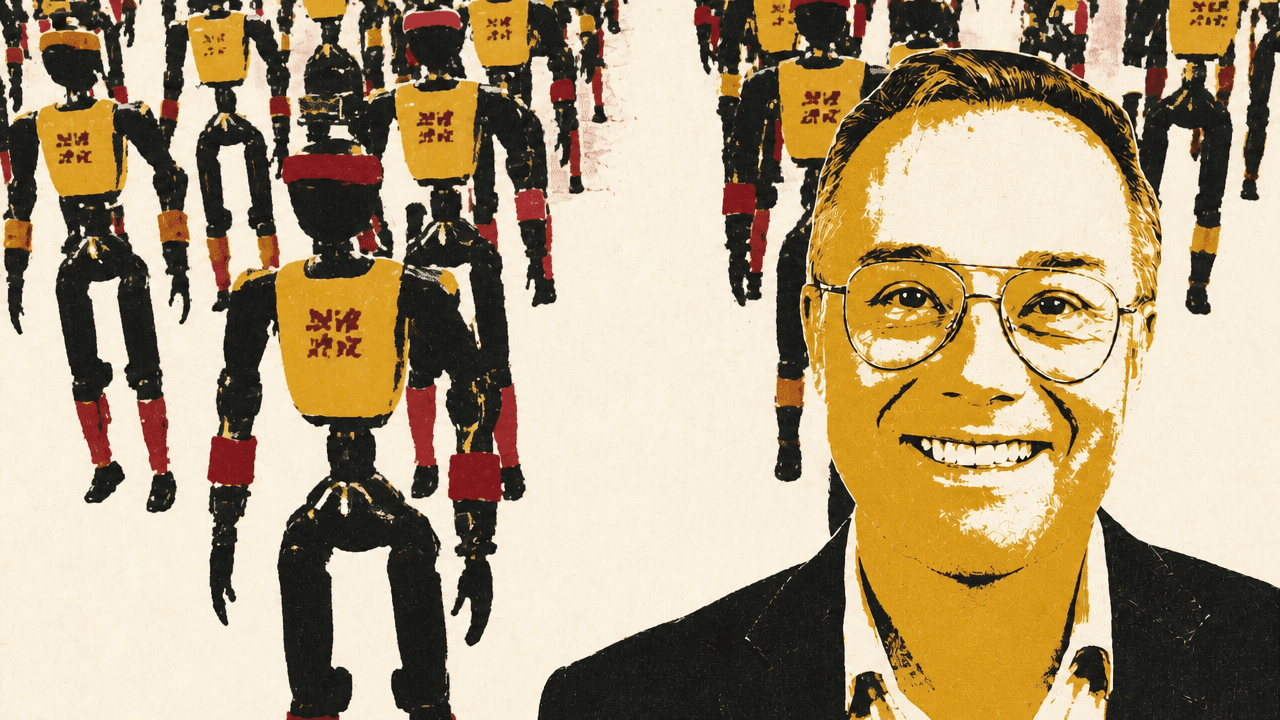
Humanoid robotics needs a public story before it becomes an economic fact
China’s World Humanoid Robot Games were presented as sport, but Jason Calacanis saw a more consequential purpose: making people comfortable with machines before those machines become common in workplaces and daily life. His reading was that China is using entertainment, spectacle, and national pride to make humanoid robots feel less like a threat and more like contestants people can cheer for.


The games ran alongside China’s annual government-backed World Robot Conference, which Lon Harris said has operated since 2015. The humanoid competition involved 51 events and more than 1,000 contests at Beijing’s National Speed Skating Oval. The machines boxed, played tennis and table tennis, ran track events, performed jumps, and competed in other sports.
Two results discussed during the show were reported as exceeding human athletic benchmarks. Harris said an X-Humanoid robot ran the 100 meters in 9.39 seconds, faster than Usain Bolt’s world-record time, while another humanoid cleared 2.88 meters in a standing high jump. Harris compared that result with the 2.45-meter human mark associated with Javier Sotomayor.
The high-jump footage made the claim legible without much technical explanation: a full-sized humanoid cleared the bar with a split-like motion as a crowd applauded. A social post displayed during the discussion described the robot as “full-sized” and put the jump at 2.8843 meters. Other clips made the machines look distinctly less superhuman. One sprinter ran into a padded barrier, collapsed, and was carried away on a stretcher by staff.
That mixture of competence and failure was central to Harris’s interpretation. A machine that falls, gets damaged, waves to spectators, or needs help from people can be framed as a physical actor with setbacks rather than as an impersonal system arriving to replace workers.
There is definitely an overt effort to make them feel relatable. They’re anthropomorphizing them. They’re giving them human qualities. They’re making them feel like, “Oh, this is comfortable, this is familiar, I’m rooting for this robot.”
Calacanis’s language was deliberately more extreme. He called the event a “psyops” campaign and repeatedly joked that the robots were “murder bots,” including speculation about their military use against Taiwan. Harris did not endorse that reading. His narrower point was that the presentation is visibly designed to soften an audience’s response to capable humanoids. The cheering crowd, not simply the technical performance, was the meaningful image.
That is a different public posture from one built around warnings of job losses, energy-hungry data centers, and economic displacement. Calacanis argued that China’s approach is to say: look at what these machines can do; enjoy them; root for them. In his view, American culture has become more anxious about AI and less receptive to robot entertainment, even though it has its own traditions of robot spectacle in BattleBots, Real Steel, and science fiction.
The contrast was sharpened through a scene from Steven Spielberg’s A.I. Artificial Intelligence. The film’s “Flesh Fair” depicts humanoid robots being publicly destroyed for entertainment. Calacanis and Harris used it as a joke about a more hostile version of robot spectacle: China gives audiences a robot athlete to cheer, while an American fantasy imagines a cage, a cannon, and a crowd taking pleasure in destroying machines.
A humanoid robot shown walking and waving on an indoor field captured the alternative framing. It was not presented as a production system or a military unit, but as a figure meant to be watched and responded to.
Harris nevertheless identified an entertainment constraint. Human sports work partly because viewers understand the discipline behind performance: athletes train, endure failure, make sacrifices, and develop competitive drive. A robot may execute an impressive move, but it has been built and programmed for the task. Its achievement does not automatically contain the same narrative of effort. Robot sports may therefore be useful as public relations even if they never produce the emotional depth of human competition.
Tesla’s Optimus raises the same question of acceptance, though the hosts did not establish a direct connection between Tesla’s strategy and Beijing’s. Calacanis said he had privately seen a recent Optimus demonstration that he could not describe. He claimed that what he saw was better than anything on display in Beijing, estimating Tesla’s hardware at roughly one and a half generations ahead and its “brain” much further ahead.
He predicted that Optimus would win 35 of the games’ 51 contests if entered. More significantly, he predicted that there would be one billion Optimus robots in the world by 2036, calling it a future product with greater utility and reach than the iPhone.
Harris’s contribution was less about capability than identity. “Optimus,” he said, is an unusually strong name because it invokes a fictional robot associated with benevolence and leadership. If humanoids are to move from demonstrations into homes, factories, and service work, emotional framing will matter alongside performance. Beijing’s robot athletes and Tesla’s reassuring name are different tactics, but both bear on whether a human-shaped machine becomes something people can live with.
The real AI prize is sovereignty over context and distribution
A potential sale of Hugging Face at a valuation above $13 billion prompted a broader argument from Jason Calacanis: the important fight is not only over who builds the best model. It is over who owns the layer through which users discover models, direct workloads, deploy systems, and generate valuable usage data.
Lon Harris described Hugging Face as an open-source platform where developers and researchers share, find, test, and deploy models and datasets. He contrasted it with OpenRouter, which routes requests across model providers. The distinction matters: Hugging Face has a repository and community function, while OpenRouter is more directly a utility for directing a workload. Harris also saw substantial overlap, since both can host models and help users put them to work.
Calacanis’s own experience with Claude usage supplied the cost argument. After his company enabled Claude through Slack, he said, $2,500 in credits was consumed in six weeks. That was enough to make him question whether every task should be run through a premium frontier model. Routing platforms matter, he argued, because they can direct a user to the newest, cheapest, or otherwise most suitable model rather than locking that user into one provider.
But his central concern was control. He has argued for years that open-source models could command a large share of token usage even if frontier providers retain more revenue, because businesses and developers do not want a single outside company controlling their AI infrastructure. He compared the impulse to the adoption of open databases: users want control over their technical destiny.
Harvey’s use of Kimi K3 for legal AI was his chief example. Calacanis said Harvey had forked Kimi K3 to create a system it controls on its own servers. In that arrangement, the provider does not automatically receive the legal documents, user feedback, output data, or operational signals generated inside the system.
He called this a “castles and keeps” model. Harvey operates the castle: the core system under its control. Each customer law firm has a keep: its own protected environment containing confidential documents, case law, work product, and other sensitive context. The point of the metaphor is that valuable material should not necessarily move up from the firm to Harvey, or from Harvey to a frontier-model company, and then back down again.
That concern is not merely about privacy. It is about who accumulates the information that makes an AI product better and who can use that information to enter an adjacent market. Calacanis argued that a buyer of Hugging Face could see which models customers use, where demand is growing, and which workloads appear valuable. A frontier-model company could then offer its own model into that workflow at a lower price. A cloud provider could steer the underlying traffic toward its own infrastructure.
He framed this as a thesis, not an established outcome: a frontier-model company buying Hugging Face would be a “master stroke” because it would have two ways to compete. It could sell its own model directly while also observing and participating in the open-model ecosystem that threatens it.
Calacanis named AWS, Google Cloud, Azure, CoreWeave, Nvidia, Microsoft, Salesforce, Stripe, Anthropic, and OpenAI as conceivable buyers. He thought infrastructure providers were more obvious candidates, because their incentive is to direct workloads to their clouds. His spiciest proposal was that Stripe should combine OpenRouter and Hugging Face: routing on one side, and a repository, deployment environment, datasets, and developer community on the other.
The operating rule behind this was “buy the threat.” Facebook’s acquisitions of Instagram and WhatsApp were his examples of incumbents buying rapidly growing adjacent products before those products became more dangerous. He applied the same rule to OpenAI’s hiring of OpenClaw founder Peter Steinberger.
Calacanis argued that OpenClaw’s momentum faded after Steinberger joined OpenAI because a founder carries the project’s vision and “soul.” Harris offered a more qualified explanation. OpenClaw had been an early demonstration of an agent that could plug into many systems and use broad context, but competitors arrived that were easier to configure, faster, and more intuitive. Still, Harris agreed that OpenClaw did not visibly deliver the next update that would keep it central to the market’s attention.
The same anxiety shaped the hosts’ reading of Sam Altman’s stated vision for OpenAI. Altman said OpenAI should provide abundant, low-cost, fast, context-aware AI and a primary interface that could evolve from chatbot to persistent agent. But it should not try to build every product category or compete directly with all its customers.
All human beings have access to all intelligence for all time.
Calacanis called Altman’s vision “the AWS of intelligence.” He also read it as a response to application companies that fear being built on top of a supplier that can see their market, duplicate their features, and distribute a competing product. He named Harvey, ElevenLabs, Lovable, Legora, and Figma as examples around which this concern is emerging.
The platform promise is cheaper intelligence and easier access. The conflict Calacanis identifies is whether the platform owner becomes the indispensable intermediary between users, models, cloud infrastructure, and the proprietary context generated by real work.
A political bargain cannot rest on promised income alone
The hardest political problem raised here is not whether AI can make expertise more widely available. It is whether the benefits of that access can arrive faster than the insecurity created by automation. Jason Calacanis believed Sam Altman had begun to recognize the industry’s messaging failure when Altman acknowledged that AI companies had not done a good job explaining benefits, mitigating harms, or showing people how they would gain more personal power rather than less.
Calacanis thought Altman’s acknowledgment sounded sincere, but said the industry should stop leading with job losses and universal basic income. The better public promise, in his formulation, is universal access to high-quality intelligence: a child without money for private tutors can learn skills; a patient can better understand medical options before a short doctor’s appointment; people without elite networks can gain information and guidance that wealthier people already buy.
His preferred message would commit to a free, unlimited tier of AI for everyone. That would make AI’s social case one of expanded access rather than compensation for displacement.
Lon Harris agreed that this is more persuasive rhetoric than leading with UBI. But he did not share Calacanis’s certainty that unconditional income would be socially corrosive. If a baseline covered rent, food, and health care, Harris argued, many people could use the time freed from survival work to create, start businesses, or pursue more fulfilling activity. Some people might not work, he conceded, but he regarded that as potentially better than crime, dependency on family, or more destructive forms of deprivation.
Their disagreement was partly practical and partly political. Harris doubted that the United States would ever enact UBI because Americans distrust handouts and free lunches, while economic and political elites show little appetite for it. Calacanis rejected UBI as a path toward idleness and argued instead for a coordinated increase in the federal minimum wage.
His proposal was to move low wages toward $20 an hour over a decade, roughly one dollar per year rather than a sudden change. He said modest minimum-wage increases in places including Australia, New Zealand, Seattle, and New York had produced limited job losses and limited price increases.
Calacanis’s case was explicitly capitalist. Workers at the bottom of the wage distribution, he argued, would spend almost all of an increase: on food, subscriptions, services, and ordinary consumption. The money would move through the economy rather than sit idle. If all employers rose together, he argued, no individual company would be uniquely disadvantaged.
He also argued that low pay can shift business costs onto taxpayers. Workers who need food stamps, housing assistance, or other benefits may be effectively subsidizing an employer’s labor costs through public programs. Calacanis used Amazon delivery workers as an example while stressing that he is a major Amazon shareholder and considers it one of the best-run companies in the world.
For Harris, the political obstacle applies to both proposals. Even a higher federal minimum wage remains difficult to enact, he said, given how long the country has debated a federal floor around $7.50. Calacanis’s answer was that raising the wage would not be socialism or charity but a way to expand consumption, reduce dependence on public benefits, and give capitalism a more sustainable social footing.
Distributed capacity is Calacanis’s answer to concentrated risk
Calacanis’s proposed response to cyberattacks, supply disruption, and autonomous weapons begins with a simple preference: essential capacity should not sit in one vulnerable place. Lon Harris cited reports of an Iran-linked cyberattack that shut down a small UK power generator for four days in July, while noting the UK government’s statement that the wider system was never at risk. He also referenced warnings about attacks targeting U.S. water facilities.
Jason Calacanis answered with redundancy. Centralized systems optimize for cost, he argued, but create points of failure. At the household level, he wants more batteries, solar panels, water tanks, food supplies, and backup capacity. At the national level, he wants more diverse supply chains for necessities such as medicine and protective equipment.
IKEA’s on-screen product page presented plug-in solar panels and storage batteries for balconies, gardens, and terraces. Calacanis’s interest was not aesthetic. Small systems, he argued, can keep a refrigerator, internet connection, phone, or computer running during a disruption without requiring a full rooftop installation. They can also reduce demand on the central grid in ordinary conditions.
That is the model he favors: not complete self-sufficiency, but many smaller sources of capacity so that one attack or outage cannot disable everything at once. He extended the idea to stored water collected from gutters, backup generators, small-scale solar, household food supplies, and even keeping chickens. The point was that resilience becomes more available when it is distributed across homes and communities instead of supplied only by a centralized provider.
The military discussion turned that same principle into a more immediate contest. Harris described a reported incident in Zaporizhzhia in which a small Russian drone crashed near a gas station, killed three people, and was subsequently assessed by Ukrainian personnel and experts as potentially autonomous. In Harris’s account, the drone may have received a broad target and then navigated toward propane tanks by itself, missing the apparent target.
Calacanis said weapon restrictions exist but treated drone proliferation as unavoidable. Ukraine’s technical workforce and wartime demands, he argued, have turned it into a major center of drone and counter-drone capability. The countermeasures discussed ranged from overhead nets stretched above streets to handheld devices that fire nets at drones.
A video shown on screen depicted a person aiming a net-firing device at a small drone. Calacanis also described a more automated response: AI systems detect hostile drones, then dispatch tiny interceptor drones to collide with them.
The result is an increasingly layered contest of sensors, drones, nets, software, backup power, and human operators. Calacanis speculated that a future Taiwan conflict could involve people directing AI drones and robots from container ships against other machine networks. That was speculation, but it expressed his broader view: exposure falls when no single grid, supply chain, weapon, or control point determines whether a system survives.