AI’s Bottlenecks Shift From Model Demos to Compute, Rights, and Institutions
 John Coogan
 Jordi Hays
 Tyler Cosgrove
 Alex Tabarrok
 Bill Clerico
 Christina Storm
 Erik Bernhardsson
 Alex Norström
 Jordan SchneiderTBPNThursday, May 21, 202627 min read
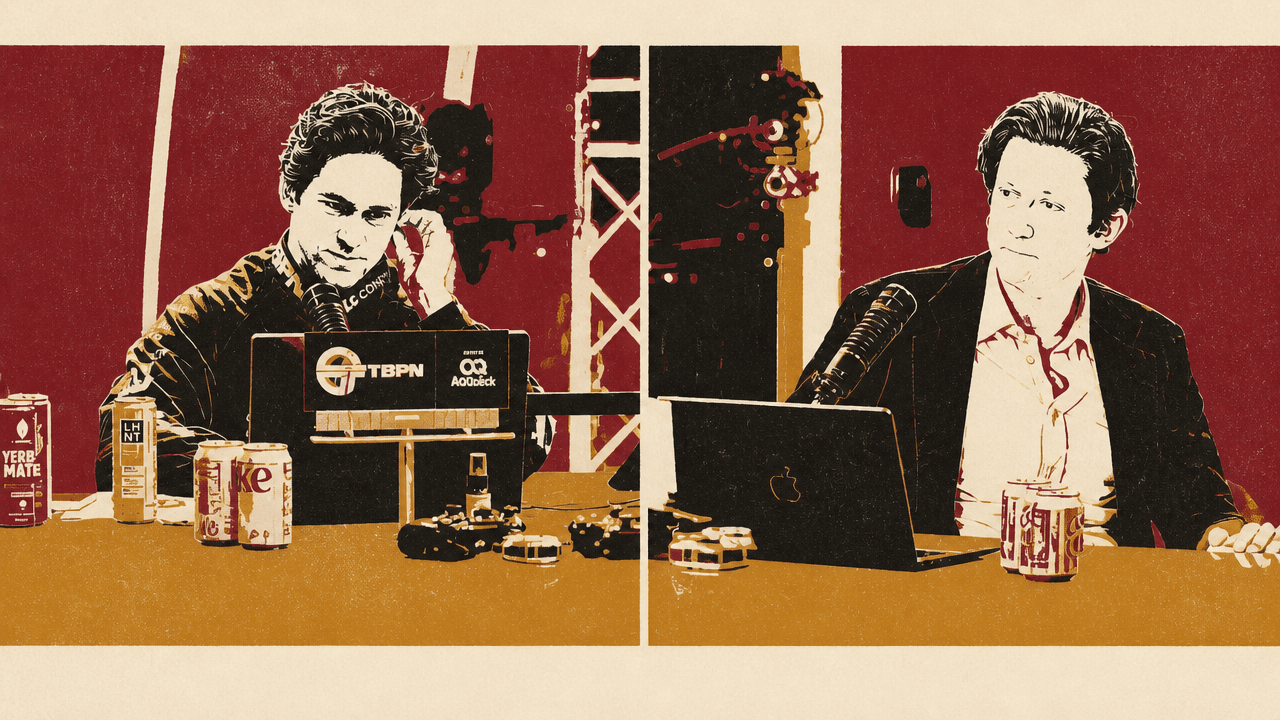
AI, in TBPN’s latest discussion, is no longer treated mainly as a product demo but as a question of infrastructure, financing and institutional adoption. The strongest evidence came from SpaceX’s AI-heavy IPO framing, Anthropic’s reported move toward operating profit, and OpenAI’s claimed Erdős breakthrough, which the speakers used to challenge the “AI is a scam” critique. The unresolved issue is not whether the technology matters, but how quickly compute capacity, rights regimes, regulation and existing institutions can absorb it.
AI has moved from demo layer to infrastructure layer
The most consequential material treated AI less as a product feature than as an infrastructure, financing, and institutional adoption problem. SpaceX’s IPO narrative, as discussed through Coogan’s reading of the filing and visible social posts, was built partly around AI compute. Anthropic’s reported growth and expected first operating profit challenged the “AI will never be profitable” critique. OpenAI’s reported Erdős breakthrough supplied a concrete claim about novel reasoning. Spotify described AI as both a recommendation layer and a new rights-and-creation product surface. Modal’s financing showed how quickly compute demand is being abstracted into a new cloud-like layer.
The sharpest example was SpaceX. John Coogan read the company’s IPO filing as positioning SpaceX to potentially raise “$80 billion or more” from a stock sale as soon as the following month. He said the company reported $18.67 billion in revenue for the prior year, had more than 22,000 workers as of March 31, and now spans launch, satellite operations, and a nascent AI unit. In Coogan’s framing, the prospective offering could exceed Saudi Aramco’s 2019 IPO, which raised $26 billion.

The filing’s market-sizing exercise made the reframing explicit. A post from Sawyer Merritt quoted SpaceX as saying it had identified “the largest actionable total addressable market in human history,” with a quantifiable TAM of $28.5 trillion. The striking part was not merely the size. It was the composition: $26.5 trillion of the estimate was AI.
| Segment | Estimated TAM described in the filing excerpt |
|---|---|
| Space-enabled solutions | $370B |
| Connectivity | $1.6T, including $870B Starlink Broadband and $740B Starlink Mobile |
| AI | $26.5T, including AI infrastructure, consumer subscriptions, digital advertising, and enterprise applications |
| Total quantifiable TAM | $28.5T |
Jordi Hays found the space and connectivity portions easier to believe than the idea that X would take meaningful digital-advertising share. Coogan’s response was that the time horizon mattered: some of the markets may not be that large today, but a long-enough horizon, inflation assumptions, and geopolitical change could alter the picture. SpaceX said the estimate excluded China and Russia; Coogan joked that adding them back in would create “an economic incentive for world peace.”
The filing’s tone became part of the debate because it read less like a conventional industrial prospectus than a sci-fi-scale company narrative. Kevin Kwok’s visible post called it the “most enjoyable S1 read in a long time” and said it read “so easy like sci-fi or fiction.” Hays called that the perfect double-edged reaction: pro-tech readers could hear grandeur; bears could hear science fiction.
The banker and early-investor material mattered mainly as evidence of the size and complexity of the moment. Coogan noted Dan Primack’s observation that Goldman Sachs beat Morgan Stanley for the left-lead role, even though Michael Grimes had returned to Morgan Stanley “in part” for this deal. He pointed to the workload implied by the assignment: the largest IPO ever in his framing, a complicated multi-business structure, and Elon Musk as the client. He also identified Luke Nosek and Gigafund, along with Antonio Gracias and Valor’s many SpaceX vehicles, as examples of long-duration conviction being rewarded after repeated primary rounds and employee tender offers.
The sharper valuation implication came from Peter Hague’s observation, shown in a visible post, that SpaceX’s capital spend on AI was three times its capital spend on space: “Its an AI company with some rockets.” Coogan called that “a wild, wild pivot at the eleventh hour.” Starlink had been a natural extension of launch capacity: build rockets, launch satellites, sell internet. AI compute felt different because xAI’s Colossus infrastructure had seemed like a separate initiative before becoming enormous very quickly.
The Anthropic partnership supplied the near-term revenue bridge in the hosts’ discussion. Coogan said he thought Anthropic was spending more than $1 billion a month, and Hays translated the scale as about $15 billion per year. Against SpaceX’s $18.67 billion in prior-year revenue, Coogan treated that as a step-change: SpaceX could become, in his words, “one of the biggest neo clouds like overnight” if the arrangement scaled as described.
Hays’s interpretation was that xAI and Grok may not yet have grown fast enough on the product-distribution side to require all that infrastructure internally. But if a company “shoots for the stars” and misses, it can still end up with “a pretty great neo cloud business” if Anthropic pays above traditional neo-cloud pricing for the compute.
Shoot for the stars, and if you miss, you have a pretty great neo cloud business.
Hays framed the broader pivot as a sequence of plays by Musk and his investors: public discussion of space data centers, a valuation narrative late the prior year, a play for Cursor, and a partnership with Anthropic after a more combative period. His conclusion was not that the strategy was tidy. It was that Musk is unusually good at “making plays.”
Anthropic’s reported profit and OpenAI’s math result challenged the “AI is a scam” frame
The AI news was not only about infrastructure spending. Anthropic’s reported financials, as discussed through Coogan’s reading of a Wall Street Journal report and Ray Wang’s visible post, pushed directly against the argument that frontier AI demand is impressive but structurally unprofitable. Coogan pointed to the report saying Anthropic revenue was set to reach $10.9 billion in the second quarter and that the company was expected to post its first operating profit. Wang’s post said Anthropic’s second-quarter revenue was set to increase by more than 200% and that operating profit would reach $559 million.
Coogan’s read was blunt: “The AI will never be profitable group is in absolute shambles right now.” He tied the report to a broader pricing argument, citing Dylan Patel’s view that leading models may eventually raise prices because they create so much economic value. He also referred to examples from Constellation in which AI workflows could produce results comparable to much more expensive human labor, sometimes at a tenth or a hundredth of the cost, and sometimes with more modest savings.
The report was contrasted with a Gary Marcus post quoted in a visible social post: “Turns out Generative AI was a scam,” or at least much less than advertised. Hays said that if the post had been written in 2024, he could have understood the skepticism: maybe usage was limited, maybe a data wall existed, maybe a new paradigm was needed. But making that claim in 2026, during what he described as the fastest period of acceleration in actual model value, was “pretty remarkable.”
Hays argued that crypto, NFTs, and the metaverse had damaged many people’s ability to recognize a real technology wave. Coogan added VR and the Apple Vision Pro to the list of overhyped moments. Hays drew the distinction around product experience: the metaverse never had a broadly accessible moment where anyone could use a product and have a mind-blowing experience. AI, by contrast, could give many users a striking experience across many services.
OpenAI’s reported solution to a long-standing Erdős problem gave the capability debate a technical anchor. Coogan introduced the news through Noam Brown’s statement that a general-purpose internal OpenAI model had achieved a breakthrough on a well-known combinatorial geometry problem, less than a year after frontier AI models reached IMO gold-level performance. He also mentioned a joking-sounding post from Sidhar Ramesh saying he had lost a $30,000 bet that AI would never solve the planar unit distance problem; Hays believed the post was a joke.
Tyler Cosgrove explained the problem at the whiteboard. Paul Erdős, he said, proposed a little over 1,200 problems across the 20th century, and these have become recurring targets for AI systems. This one was problem 90. In plain terms, it asks: given n distinct points in the real plane, how many pairs of points can be exactly one unit apart? The function u(n) represents the largest number of such unit-distance pairs among n points.


Cosgrove started with simple constructions. Put n points in a line, each one unit apart, and the number of unit-distance pairs is n minus 1. Put them in a square grid and the count still scales linearly, roughly 2n, because diagonal neighbors do not count. The known lattice construction, shown as a dense geometric pattern, does better: it scales as n^(1 + O(1) / log log n). That construction was the lower bound — a known achievable arrangement — but not necessarily the upper bound.
| Construction or claim | Unit-distance pair count described |
|---|---|
| Points in a line | Scales as n − 1 |
| Square grid | Scales roughly as 2n |
| Known lattice construction | Scales as n^(1 + O(1) / log log n) |
| Previously discussed upper bound | O(n^(4/3)) |
| Erdős conjecture | u(n) ≤ n^(1 + o(1)) |
| OpenAI result as described | For infinitely many n, u(n) ≥ n^(1 + d), d > 0 |
The upper-bound landscape was the key. Cosgrove said researchers had discussed an upper bound scaling like O(n^(4/3)), while Erdős conjectured a much tighter form, effectively that u(n) would be no more than n^(1 + o(1)). OpenAI’s result, as Cosgrove described it, showed that the Erdős conjecture is false: for infinitely many values of n, u(n) is greater than n^(1 + d) for some constant d greater than zero.
Cosgrove emphasized that the importance was not merely that a system found an answer already latent in the literature. He said this appeared to be a new solution using novel ideas, and that mathematicians were treating it as potentially useful beyond the single problem. He described the proof as 18 pages and complex enough that he did not personally understand all of it, but said the mathematical reaction was that it could introduce a new way of doing things.
Two details mattered for the AI-capability debate. First, the model was not a specialized math model but a general-purpose internal OpenAI model. Second, Cosgrove said public perception suggested it may not have required millions of dollars of inference; he guessed something more like hundreds to thousands of dollars of compute. That made it different from brute-force schemes that try many known templates across many problems until one fits.
Coogan tied the result back to the Gary Marcus critique: if models can make novel improvements outside their training distribution, then they are not merely stochastic parrots or retrieval engines. Cosgrove put it similarly.
They can actually make novel ideas, novel improvements, outside of the distribution, outside of the training data. It’s not just knowledge retrieval.
Alex Tabarrok argued that expensive services are often a sign of rising wealth, not just regulatory failure
Alex Tabarrok used Baumol’s cost disease to explain why hospital services, college tuition, childcare, and medical care services rise in price while manufactured goods such as TVs, toys, software, clothing, and cars become more affordable on a quality-adjusted basis. His core example was teaching. Pythagoras could gather students around a triangle drawn in the sand; thousands of years later, a professor may use chalk or PowerPoint, but the labor structure has not changed much.

Because productivity has not risen much in that service, prices rise relative to sectors where productivity has increased. A professor still must be paid enough not to leave for other work. If other industries become more productive and can pay more, then education must compete for labor even if classroom productivity remains flat.
| More expensive categories shown | More affordable categories shown |
|---|---|
| Hospital services | TVs |
| College tuition | Toys |
| Medical care services | Computer software |
| Childcare | Cellphone or cellular services |
| Educational books | Clothing |
Coogan asked whether regulation should be discounted in this explanation. Tabarrok did not dismiss regulation — he called himself a free-market, anti-regulation, anti-bureaucracy economist — but argued the trend is deeper. People complained about rising medical costs in 1920 and 1930, before Medicare, Medicaid, and much of the current regulatory state. Education has been rising in price for a very long time too.
His cobbler example made the point concrete. People do not repair shoes less because younger generations lack virtue; they repair shoes less because repair labor has become expensive relative to buying new shoes. Hays put it as a consumer choice: why spend $70 to fix a $60 pair of shoes? Tabarrok said the same logic applied when a surface repair on his car cost roughly one-third of the car’s value.
AI matters in this framework if it lets services replace labor with capital. Tabarrok said the big question is robots. If labor can be replaced by capital, then much of the Baumol effect goes away. He welcomed that because productivity improvements are good.
But he also cautioned against treating the Baumol effect as simply bad news. Services get more expensive because manufactured goods get cheaper and because society gets richer. People can afford more health care and more education, so they buy more of them. That, for Tabarrok, is one reason the pure regulation story fails: if rising health-care prices were mainly artificial scarcity, people would buy less. Instead, they buy more.
Why are services getting more expensive? It’s because manufactured goods are getting cheaper.
On American economic pessimism, Tabarrok said he had changed his mind about how large psychological factors can be. The United States, in his view, has benefited more from globalization than any other country, helped keep sea lanes open, globalized the world to its benefit, and remains the richest country in history. It has also assimilated immigrants unusually well. Yet it is angry about free trade and immigrants.
He described the United States as caught in “grievance culture.” Initially, he thought grievance politics was concentrated on the left, with complaints about treatment of African-Americans, women, and the poor. With Trump, he said, the grievances changed target: foreigners are ripping America off; crime is terrible. He rejected the crime premise and argued that the grievance set had shifted without changing the underlying habit.
Hays pressed on downward mobility and American progress culture. If a society defines itself around each generation doing better than the last, then frustration may intensify when people believe they will not out-earn or out-achieve their parents. Tabarrok agreed there is frustration but said comparisons with the past are often wrong. Americans are better off than in the past, though housing is an important exception.
Housing, for Tabarrok, is not primarily a Baumol story. The construction of housing has not become the main source of cost inflation; land has. That makes zoning and permitting central. He pointed to San Francisco and San Jose as places that should have become dense, “glorious” future cities but remain, in much of Silicon Valley, “a land of strip malls” sitting on extremely valuable land where people are not allowed to build.
He said California Forever and similar new-city attempts gave him some hope, but his main point was political: housing scarcity is under human control. It is not a tornado that made people poorer; it is a choice to say no to building.
On remote work and new cities, Tabarrok said he was surprised that no city had really taken off in the Covid aftermath. Miami briefly looked like it might jump, Las Vegas tried with Zappos, and Trump had briefly talked about “Freedom Cities,” which Tabarrok considered a good idea. But agglomeration effects remain powerful: people become more productive near other productive people. Starting a new city requires a large coordinated push.
AI’s broader economic impact divided into two time scales in Tabarrok’s mind. He trusted technologists who say the technology will continue to get better quickly. But he thought technologists underestimate how long it takes for a general-purpose technology to work through jobs and production structures. Electricity was transformative, but firms needed time to reorganize around it. He expected a similar lag with AI.
On labor-market anxiety, Tabarrok was comparatively sanguine. If AI does all the jobs, he said, that means society becomes fabulously wealthy. That is the kind of problem one wants to have. It is not a tsunami that destroys wealth; it is a tsunami that creates wealth, like “Santa Claus coming and leaving us goods” under the tree. Distribution will still matter, but he argued problems are easier to solve when the pie is getting bigger, not smaller.
His strongest enthusiasm was for AI in medicine. A 5% reduction in cancer mortality, he said, would be worth trillions. The OpenAI math result suggested that frontier systems can make inroads into high-level knowledge work; if similar capabilities produce one new drug or improve drug discovery, the welfare gains could be enormous.
On value capture, Tabarrok expected AI’s benefits to be widespread. Frontier models from OpenAI and Anthropic may be ahead, but he described them as roughly six months ahead of open-source models, while yesterday’s frontier becomes tomorrow’s cheaper second-rate model. The underlying technology, in his view, does not seem magical; it is built on linear algebra and a few powerful ideas. The people who got in early may become very wealthy, but the technology itself looks increasingly accessible.
His final position on AI risk was deliberately middle. He is not convinced by sudden “foom” scenarios in which one day everything is normal and the next day there is a “God in the laboratory,” but he does not consider them insane. Nor does he dismiss boomers or doomers entirely. For the first time in his life, he said, “the window of what is possible” feels extremely wide.
Spotify is turning taste data into ticketing, AI creation, and internal productivity gains
Alex Norström came from Spotify’s 2026 Investor Day with three linked claims: Spotify has compounded user and financial growth over the prior four years, it has four large future ideas, and it sees more room to monetize Premium. The most concrete consumer-facing change was Reserve Ticket Access.

Norström described Reserve Ticket Access as one of the most meaningful improvements to Spotify Premium since the company’s founding. The product holds concert tickets for users for a limited time window through partners. The key is matching participating artists and tours to the users Spotify believes are true fans.
The matching is not just raw stream count, Norström said, because users should not be able to “grind” their way into access. Spotify looks at broader catalog engagement: whether a user listens daily, listens deeply across an artist’s catalog, and spends meaningful time with the music. The same logic already underpins 150 to 200 Spotify-run events per year, where the magic comes from putting artists in rooms with listeners who are truly engaged.
AI at Spotify is not new. About a decade earlier, Daniel Ek, Gustav Söderström, and Norström began investing in what was then called machine learning. The early versions were essentially lookalike and collaborative-filtering systems: one listener engaged with something, another listener looked similar, therefore the second listener may like it too. Coogan noted that those systems likely relied on tags and collaborative signals more than waveform understanding.
What changed recently is that Spotify can use general-purpose language models to reason over its own proprietary data. Norström said Spotify logs between three and four trillion events per day, producing billions of relevant signals for its recommendation systems. The company’s Large Taste Model is built on that proprietary taste graph, with additional proprietary data coming from Spotify for Artists.
On build-versus-buy, Spotify expects to buy general reasoning capabilities as the cost curve falls and the industry commoditizes. The defensible work, in Norström’s telling, is applying those capabilities to Spotify’s own taste data. But acquisitions can accelerate either capability or data. Sonantic helped create AI DJ. WhoSampled supplied data that made Song DNA possible, letting users trace samples, original tracks, participants, technicians, artists, and composers through a song’s lineage.
Inside the company, AI coding tools have become broadly adopted. Norström said Spotify had close to 99% adoption across the company, beyond engineering into marketing and other functions. Employees are using tools for prototypes, design, insight generation, storytelling, and software development. He said Spotify’s chief architect had recently presented at Anthropic, and that Anthropic viewed Spotify as one of the leading developers in adopting AI for productivity gains.
The more structural change is cross-functional. Employees first experiment individually, then share use cases in Slack and internal communities, and then product developers, engineers, and marketers sit together to build more holistic experiences — product, feature, and narrative — in a more leveraged way.
The UMG AI music deal was the most culturally sensitive Spotify topic. Norström called it a landmark agreement because it creates, for the first time, a legal product for users and fans to create AI remixes and covers in a controlled, licensed medium. It also lets artists participate in the AI economy rather than merely being exposed to it.
The product will be a paid add-on for Spotify Premium users. Premium users will get limited usage to try it and form habits, then can buy into the add-on. Norström summarized the business model as: creation is paid for, consumption is included. If Hays makes a Gunna remix, Norström said, everyone else can listen to it.
Asked whether a fan-made remix might become the number one track globally and create a new category of artist, Norström did not address revenue-share specifics. He answered at the level of catalog and personalization. Spotify had roughly 2 million tracks when he joined about 16 years earlier; now it has on the order of 200 million. A larger catalog is good if recommendations work. The opportunity and responsibility are the same: get the best song to the right listener.
The much-discussed Spotify disco-ball app icon became a case study in brand behavior. Norström said the company changed the app icon about 10 days earlier to a glittery disco-ball version, sparking broad conversation across major social platforms. Users and brands joined in; OpenAI and KitKat were among the brands he mentioned. The internet even coined “discomorphism.”
Coogan and Hays liked the icon because it broke through a flat-design environment and made the app jump out on the home screen. Norström’s reflection was that Spotify sits at the intersection of humanities and technology, and when hundreds of millions or potentially billions of people talk about a logo change, the company has done something culturally interesting. Music should be fun, he said, and building a company around music should be fun.
Modal is selling relief from GPU capacity planning
Modal’s financing made the compute bottleneck concrete. Erik Bernhardsson said Modal had raised a $355 million Series C at a $4.65 billion post-money valuation, led by General Catalyst with Redpoint. The immediate growth catalyst was sandboxes: a product that lets users execute LLM-generated code in a safe environment. Bernhardsson said sandboxes had grown almost 2x every month for the prior six months, powering reinforcement learning, vibe-coding apps, and background agents.
Modal began five years earlier with a general-purpose infrastructure thesis: existing infrastructure was not built for AI. AI application companies need varied compute primitives — sandboxes, inference, training, batch jobs, and other workloads — and Modal aims to provide them as a new cloud-like layer.
Infrastructure companies, Bernhardsson argued, can reason more from first principles than application companies. Sandboxes launched three years earlier and only started taking off in summer of the prior year. Inference similarly launched almost four years earlier. The strategy is to build the compute building blocks customers will need, then let customers discover the use cases.
Demand planning is brutal. Modal looks at the last few months, sees 30% to 40% monthly growth, compounds that forward, and buys the GPUs it will need in three to six months. GPUs can often be secured roughly three months in advance. The new capital gives Modal more room to make those commitments.
On chips, Bernhardsson was intellectually bullish on TPUs, AMD, Trainium, and alternative accelerators over a two- to three-year horizon. But he was clear that Modal sees “zero demand” from customers for them today. The fixed cost of rewriting software stacks is too high unless a customer operates at enormous scale. Big labs may be able to amortize that work; ordinary AI application companies generally cannot. Over time, he expects software to make CUDA-compatible workloads easier to run on other accelerators, but today customers want Nvidia.
Compute markets will remain tight, in Bernhardsson’s view. Modal’s product abstracts away capacity: a customer can ask for a thousand GPUs and often get them within minutes because Modal aggregates demand across thousands of companies and manages a large shared pool. The company watches GPU prices and talks to neo-clouds constantly; Bernhardsson expects tightness to continue for the next year or two before eventually normalizing.
Modal’s customer base illustrates how broad the demand has become. Bernhardsson mentioned Suno for AI music generation, Cognition for reinforcement-learning-based coding models, Ramp for background agents, Lovable and other vibe-coding platforms, Chai for molecular dynamics in drug discovery, weather forecasting companies, and robotics companies. LLM inference remains the largest recent application, but diffusion models and scientific workloads are also growing.
Asked what comes next, Bernhardsson’s personal candidate was speech-to-speech interaction: talking to a computer with low enough latency that it feels natural. That requires reducing latency across speech recognition, model reasoning, and text-to-speech. He also named curing cancer as an obviously compelling use of compute-intensive AI.
Modal does not want to become a data-center operator unless it must. Bernhardsson described the company’s value as the software layer above underlying compute providers — almost a cloud one layer up from existing clouds. If Modal cannot get enough capacity, it might build more itself, but racking computers, plugging in cables, and dealing with fires is not the appealing part of the business.
Convective’s disaster thesis depends on who pays for resilience
Bill Clerico announced Convective Capital’s new $85 million second fund, roughly double its prior fund, with a thesis focused on disaster resilience. His formulation was simple: the world is getting warmer, infrastructure is getting older, and that is “literally a recipe for disaster.” As disasters rise and volatility increases, he expects private markets to build services, technologies, and systems that reduce risk.


Wildfire was the practical center of the discussion. Clerico focused less on fire as a single market and more on who pays: utilities, insurance companies, government agencies, housing, real estate, forestry, and emergency response. Venture investors historically avoided many of those buyers, but Clerico said behavior is changing as costs rise.
Utilities were the first leverage point. Clerico said utilities cause about 11% of fire ignitions but about 60% of acres burned. Convective has backed Overstory, which uses satellite imagery to help utilities trim trees around power lines, and Volt Air, which performs autonomous drone power-line inspections. If startups can reduce utility-caused ignitions, he argued, they can have an outsized impact.
Insurance is the consumer unlock. Hays described Malibu homes with fire shutters, roof-mounted autonomous sprinklers, and other hardening features, but noted that homeowners’ attention fades after a fire season passes. Clerico agreed that consumer demand is seasonal and volatile. The durable behavior change, in his view, will come when insurers create financial incentives. He described Stand, a Convective portfolio company, which models homes using computational fluid dynamics to simulate wildfire moving through a property, recommends hardening changes, remodels the risk, and can provide insurance discounts.
Clerico pointed to the California Fair Plan, the state-backed insurer of last resort, as evidence that the economics are forcing change. He said it had announced a 30% rate increase after the LA fires. If the probability of homes burning is not reduced, he argued, housing and insurance become unaffordable.
Government sales and firefighter culture were more delicate. Hays raised Anduril’s firefighting tank, which faced resistance around job displacement despite offering a capability no human firefighter could safely perform. Clerico separated actual job displacement from cultural resistance. In reality, he said, firefighting is under-resourced relative to the scale of disasters. CAL FIRE, in his telling, is the largest and best-resourced firefighting agency in the world, but even that does not eliminate the need for leverage.
The cultural problem is that outsiders from Palo Alto cannot credibly walk onto a fire line and tell firefighters how to do their jobs. Clerico described Convective’s Red Sky Summit as an attempt to bridge that gap: 600 fire chiefs and emergency managers gather in San Francisco with builders and technologists in an off-the-record venue. The goal is not only demonstration but translation — changing the tenor between people building tools and people expected to use them in dangerous conditions.
The firefighter-equipment discussion showed why Clerico sees the market as broader than wildfire alone. He called it a “travesty” that wildland firefighters are sent into smoke and heat with limited respiratory protection, sleeping in smoke for days, carrying packs, and working with chainsaws and axes. Convective has not yet invested in firefighter wearables or protective equipment, but he sees the category as a path into field-service work and worker safety more broadly.
Clerico’s own path into the thesis came from fintech and fire exposure. He founded WePay in 2008, moved through Y Combinator, built the company over roughly 12 years, and sold it to JPMorgan. Leaving JPMorgan, he wanted an early market with skepticism similar to fintech in 2008, where a focused investor could become a market leader and where the mission mattered. A fire that nearly reached his and his wife’s ranch in Mendocino County helped connect the dots.
Jordan Schneider sees a China stalemate, not a grand bargain
The recent China summit, in Jordan Schneider’s view, produced atmospherics rather than substance. His broader read was that the United States and China have entered a stalemate. For years, successive U.S. administrations assumed they could keep turning up pressure through tariffs, export controls, and investment restrictions. Then in April 2025, Schneider said, China “punched back with rare earths” and discovered that it had real leverage over the United States.


The summit gave China “prestige on the cheap.” Cabinet members and CEOs flew to Beijing, received a highly produced 36-hour experience, and generated face for Chinese leadership. Schneider did not dismiss atmospherics entirely; there is an argument that giving face can reduce grievance and lower the risk of conflict. But substantively, he saw little.
The absence of major AI lab leaders from the delegation stood out to Coogan. Jensen Huang and Elon Musk matter to AI, but Sam Altman, Dario Amodei, Demis Hassabis, and Sundar Pichai were not there. Schneider’s explanation was that the trip looked more like a trade delegation than an AI governance summit. The asks were inchoate. If the U.S. government had not figured out its domestic AI regulatory strategy, he doubted it was ready for a serious grand bargain with China on catastrophic risks.
On U.S.-China AI safety cooperation, Schneider was skeptical but not dismissive. The logic exists: both the United States and China would have reasons to prevent non-state actors from using AI-enabled bioweapons against them. But he said Chinese leadership remains “hardware-pilled” and skeptical of arguments that sound like science fiction. The Cold War’s arms-control conversations emerged after crises such as Berlin and Cuba, when leaders viscerally understood apocalypse. An Anthropic paper about scary models is not the same kind of societal shock.
He called the theory that China is funding U.S. data-center opposition “cope by the labs.” His practical view was that data-center resistance can be solved with money and local benefits: pay people near the site, build parks or golf courses, make the facilities attractive. Coogan doubted that American industrial construction would become beautiful before financial compensation was offered; Schneider joked that the beautiful industrial examples always seem to be in the Nordics or sometimes China.
On Taiwan, Schneider rejected the idea that its geopolitical importance could disappear as chip production diversifies. Even if the share of advanced chips made in Taiwan falls from a previous peak, he said, it would still be around 85% or 90% in 18 months under the analysis he referenced. Losing Taiwan would still be a global economic catastrophe. Beyond chips, he emphasized Taiwan’s democratic self-determination and the strategic importance of the first island chain. If Taiwan became a PLA base, the broader U.S. security architecture linking Southeast Asia and North Asia would become far more tenuous.
Rare earths exposed a larger structural problem. Schneider said some reports suggest China’s leverage may still exist five years from now. Fully decoupling from the world’s second-largest country and largest economy, in a way that removes its ability to coerce the U.S. economy, is a generational challenge. The United States can spend money to make leverage less acute or protect specific critical inputs, but deterrence also requires credible willingness to absorb and impose pain.
Chinese EVs and humanoid robots led Schneider to a related point about hardware scale. He had ridden in a BYD in Norway and described the sector as impressive enough that American automakers deserved to be yelled at. Waymo’s use of a Zeekr body, he explained, works because the chassis and battery are Chinese but the connected electronics are not.
On humanoids, he said there is not yet a real market beyond toys and research units. But if Western companies have smarter software and China can apply similar capabilities at far greater manufacturing scale, the result could be dramatic once economic utility turns on.
The software-hardware split is what makes embodied AI different from frontier model training. In AI, Schneider said, America has more chips and compute as long as Taiwan exists. But in humanoid robots, the physical devices needed to use the models will likely be manufactured in China at much larger scale than in the West. Coogan countered that the United States can still win capital-intensive industrial races, pointing to rockets; Schneider agreed it is not impossible, but warned that America often lets leads languish, as in cars.
AI film tools lower production barriers, but story remains the constraint
Christina Storm framed AI in film as an extension of a long technological story rather than a clean rupture. She pointed to Jurassic Park and the documentary Jurassic Punk, about Steve “Spaz” Williams and the first computer-graphics T-Rex walk cycle. Williams believed the dinosaur could be done with computer graphics when the film was still oriented toward animatronics and traditional on-set techniques. When Steven Spielberg and Kathleen Kennedy saw the walk cycle, she said, it changed everything.

That history matters because entertainment has always absorbed technology. Storm resisted treating AI only as a disruptive headline. Producers who once could “offline” technical specialties to other departments now need to lean in. The emerging convergence is between technology and storytelling, not technology replacing storytelling.
Coogan tested a specific theory: because dinosaurs are not protected IP in the way Superman is, and because AI makes dinosaur imagery easier to generate without actor likeness issues, perhaps there will be a surge of dinosaur films. Storm said the premise was directionally interesting but “half-baked” unless the story is undeniable. A dinosaur is not a movie. The specific character, world, and reason to watch still matter.
On low-budget AI films, Hays raised Helgrind, described in a Wall Street Journal article as premiering at Cannes with a $500,000 budget, including roughly $400,000 of compute. Storm cautioned against obsessing over headline budget figures. At Secret Level, she said, the company has a proprietary workflow pipeline that helps it scale, but total costs include process, guild alignment, and other production realities. If people focus only on the budget, she said, they miss the larger frame.
Her view of the winning formula preserved a role for independent film. AI tools may let independent voices bring more creativity forward, as earlier eras of independent filmmaking did through Sundance and similar institutions. But AI-native filmmaking may require a different approach than a traditional studio pipeline. She compared the moment to George Lucas creating technology that did not yet exist because the story demanded it.
Asked for favorite films, Storm named Inception, It’s a Wonderful Life, When Harry Met Sally, and The Godfather, a range she used to resist being boxed into a single genre taste. Asked for her favorite fully AI-generated content, she pointed to Secret Level’s The Heist. When founder Jason Zada first showed her 30 seconds, she said, she felt they were approaching something interesting. Even there, her emphasis stayed on process and story rather than the novelty of generation itself.