Sowell Treated American Racial History as Part of a Global Record


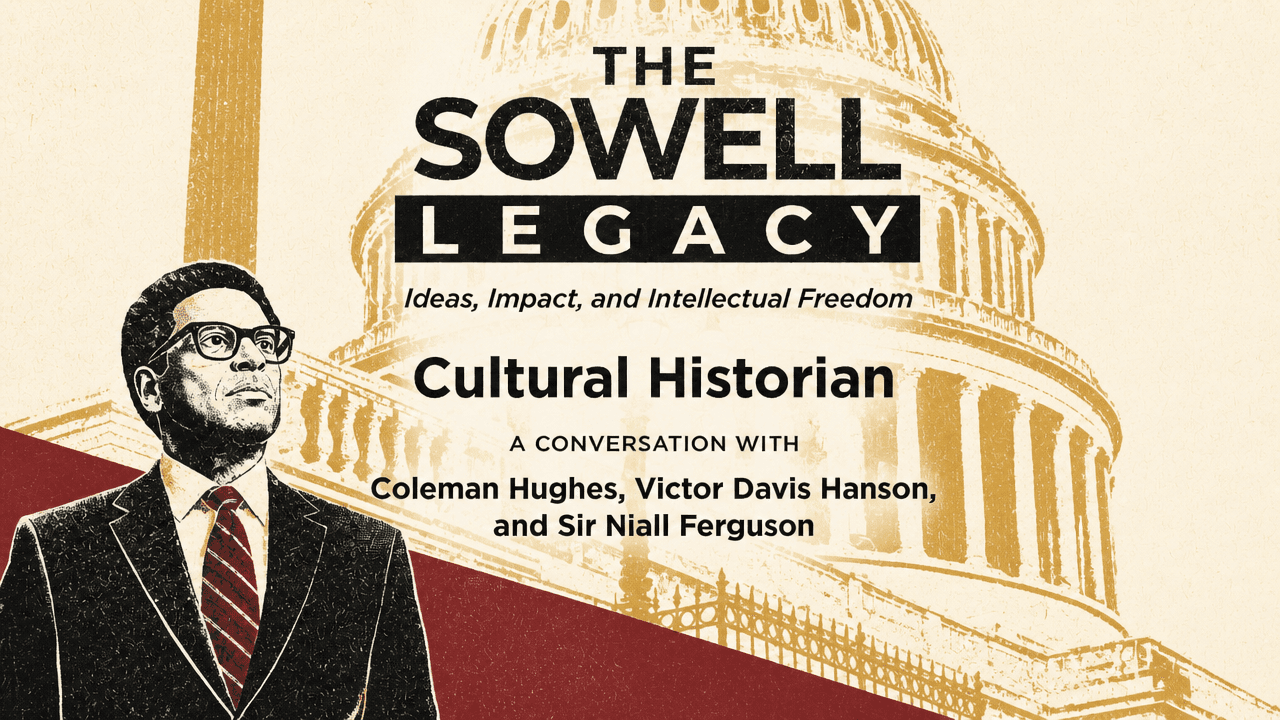
Niall Ferguson, Victor Davis Hanson, and Coleman Hughes argue that Thomas Sowell’s central contribution was a comparative historical method that treated American questions of race, slavery, migration, inequality, and political order as part of wider human patterns. They focus on Sowell’s culture trilogy and later work to contend that cultural practices, human capital, and institutions—not racial essence or American exceptionalism—better explain how groups rise, stagnate, or come into conflict. They also credit his plain prose with carrying those arguments beyond academic institutions they say largely excluded him.
Sowell’s historical method begins by refusing American exceptionalism
Niall Ferguson describes Thomas Sowell as an economist by training whose work also belongs to history: an attempt to place race, inequality, migration, conquest, and political conflict in a perspective extending across countries and centuries. The major expression of that ambition was a three-volume project that began as one book and grew into Race and Culture, Migrations and Cultures, and Conquests and Cultures.


Victor Hanson says Sowell began researching and drafting the project at 65 and completed the roughly 1,600 pages in four years. The work was published over the 1990s as three books rather than the intended single volume.
- 1982Sowell begins research and manuscript drafting for what becomes the culture trilogy.
- 1995*Race and Culture* is published as the first volume.
- 1997*Migrations and Cultures* is published.
- 1999*Conquests and Cultures* is published.
The trilogy’s governing question, as Ferguson and Hanson describe it, is what becomes visible once American racial history is treated as one instance of broader human patterns rather than as a self-contained story. Hanson says Race and Culture was meant to “globalize” the American racial situation. Slavery, ethnic hierarchy, migration, inequality, and resentment of successful minorities were not uniquely American phenomena, even if American institutions and history gave them a distinct form.
Coleman Hughes identifies that reversal of starting points as central to Sowell’s approach to race. In Hughes’s account, many American writers start with the United States, conduct research within its particular history, and then make wider assumptions. Sowell starts with a broader premise: Americans are human beings, so the social and economic patterns visible elsewhere may help explain American outcomes too.

I'm going to posit that Americans are human beings and that we have something to learn from the entire history of the rest of the world as well.
The method has practical consequences. If affirmative action is intended to address ethnic inequality, Hughes says Sowell’s question is not only what happens under American programs but what happened in India, China, and other countries with policies directed at group disparities. If slavery is invoked to explain present conditions, the inquiry should include slavery across many societies, races, and eras. And if lowering standards or distributing material assistance is proposed as a route out of poverty, the relevant test is whether comparable approaches have produced the promised results elsewhere.
Ferguson highlights a Sowell statement he sees as the trilogy’s underlying challenge: “I haven't been able to find a single country in the world where the policies that are being advocated for Blacks in the United States have lifted any people out of poverty.” Hughes calls this the crux of Sowell’s position on race. He says Sowell found many instances of ethnic groups beginning with little and rising through particular cultural attitudes, but did not find cases supporting what Hughes calls the progressive prescription of lowering standards and giving handouts.
Hanson says Sowell did not regard inequality itself as the decisive measure of harm. The question was what happened to people at the lower end of the distribution: whether they were secure, prosperous, and able to raise their standard of living. In Hanson’s rendering, unequal outcomes could coexist with broad material improvement, while social conflict could be intensified by envy even when those with less were becoming better off.
Migration made culture portable rather than fixed
Victor Hanson describes Migrations and Cultures as Sowell’s account of what groups carry with them when they leave one social setting for another. The book considers Germans, Italians, Jews, Japanese, Indians, Chinese, Scots, and others. Its focus, as Hanson explains it, is not racial essence but the movement of human capital, commercial experience, learned habits, and cultural practices across different institutional environments.
A displayed world map traces Indian migration to Africa, Jewish migration across Europe, Japanese migration to the United States, and Chinese migration across the Pacific. Hanson’s account is that groups could be poorly regarded in their societies of origin, own little land, and lack political power while still possessing capabilities that became valuable elsewhere. He names punctuality, discipline, education, commercial knowledge, and willingness to act as middlemen.
In societies that valued landholding, aristocratic status, or birth, these capacities might not confer much prestige. When migrants entered commercial settings where such skills could be used more freely, however, they could prosper. Hanson says that success was frequently accompanied by resentment, especially where a minority became economically conspicuous within a larger population. Jews in Europe, Indians in parts of Africa, Japanese Americans, and Chinese communities in the Pacific are among the examples he gives.
The point is not simply that migrants relocate. In Hanson’s description of Sowell’s framework, groups transfer knowledge and practices whose value changes with the receiving society. A population’s economic position may therefore shift dramatically without any change in its underlying racial identity. The relevant interaction is between acquired human capital and the institutions that reward, restrict, or resent it.
Niall Ferguson says he tested Sowell’s reach against Scotland, a subject he thought he knew. He expected the treatment of Scottish history to be superficial or mistaken; instead, he says, he learned things about his own people. Ferguson describes the Scots as once occupying a violent and comparatively peripheral position in relation to Rome, a population the Romans could not fully conquer, before becoming important to later intellectual, commercial, and imperial history.
Hanson similarly says Sowell did not make geography destiny. Geography mattered, culture mattered, and human capital mattered. Mediterranean proximity gave societies around Europe, Africa, and Asia opportunities for contact that distant populations lacked. But geographic advantage alone did not settle outcomes in Hanson’s account. Migration, accumulated knowledge, institutional settings, and cultural development could change a group’s trajectory.
This same framework informs Hanson’s description of Conquests and Cultures. Hanson says Sowell distinguished between conquest that transmitted a more advanced culture and conquest that replaced a society’s existing capacities with a less sophisticated paradigm. Roman Britain appears, in Hanson’s summary of Sowell, as a case in which a conquered population absorbed Roman culture. The late Roman world, displaced by Germanic invaders, appears as a case where the reverse movement was damaging.
Hanson calls the argument controversial, especially in its treatment of European conquest of indigenous peoples. He says Sowell treated conquest as tragic and sometimes genocidal while arguing that it could also transmit institutions and capacities to conquered populations. In Hanson’s account, the direction of transmission was decisive: conquest could produce cultural gains, or it could destroy existing social and political capacities.
A comparative history of slavery challenged the American frame
Coleman Hughes says Sowell’s global approach to slavery was especially resonant with students in his course, The Legacy of Slavery. The reading that drew the strongest response, he says, was Sowell’s essay “The Real History of Slavery,” beginning with the proposition that if slavery “had been confined to two races within one country for three centuries, it would not be one tenth as great a moral evil as it actually was.”
Hughes takes the line as a refusal to reduce a worldwide institution to the American case. His question is why anyone would understate the scope of slavery unless the narrower story served a contemporary political purpose. The claim is not that American slavery was insignificant; it is that treating it as the whole of slavery’s history omits the breadth of the institution Sowell wanted to explain.
Victor Hanson attributes a related argument to Sowell about the racialization of slavery. Hanson says that in Greek and Roman antiquity, people could become enslaved through conquest, birth, or bad luck, but slavery was not predicated on race. In his telling, ancient slavery did not generally rest on the proposition that one racial group was naturally incapable.
Hanson says European colonial systems developed a different rationalization. Europeans encountered populations whose technologies, literature, architecture, and social arrangements differed from their own, enslaved them, and developed post hoc claims of racial inferiority. He adds that Islam had used related religious and other rationales earlier, while describing the sixteenth-century European formulation as a consequential development.
For Hanson, that racial claim made slavery more vulnerable rather than more secure. Once enslavement rested on the assertion that Africans were inherently less capable, evidence of Black intellectual achievement challenged the institution’s stated justification. He names Frederick Douglass as an example: when Black people received education and opportunity and demonstrated equal or greater capability, the premise of racial incapacity became harder to sustain.
Hughes gives a political explanation for why the comparative account can meet resistance. Drawing on Shelby Steele, he says Americans developed a political identity around shame in the 1960s: the idea that the United States is uniquely evil. The worldwide facts of slavery threaten that identity, Hughes argues, because they situate American slavery within a broader human record.
Hanson offers another explanation. He says Sowell would have regarded Americans as innately American-centric: inclined to think the world revolves around their own unique experience. The country’s history as a largely biracial society, together with its geographic distance from Europe and Africa, made Americans parochial about race and slavery in Hanson’s account.
Black Rednecks and White Liberals located culture in contact and inheritance
Coleman Hughes presents Black Rednecks and White Liberals as Sowell’s most controversial application of cultural history to the United States. Its argument begins by suspending the usual Black-white comparison and examining differences among white Americans. Hughes says that Northern and Southern white populations showed major differences in crime, income, out-of-wedlock births, and other measures associated with community conditions.
A displayed North–South comparison graphic charts crime, income, and out-of-wedlock births without giving numerical values. Another graphic maps migration from different regions of the British Isles into distinct parts of the United States. Hughes says Sowell’s question was where the populations of the North and South had come from, and what cultural histories those populations brought with them.
The North, in this account, drew more heavily from areas associated with industrial development and university life. The South drew more heavily from borderland populations including Ulster, Scotland, Wales, and northern England. Hanson says those regions had not achieved parity with the British core in income and education, and that migration patterns transmitted their distinctive social histories to the American South.
Sowell then extended the inquiry to African American culture. Hughes says that before 1900, roughly 90 percent of Black Americans lived in the South. People brought from Africa came from many ethnic groups and languages; in the American South, they became a new ethnicity and culture. The question is how that culture was formed and from whom it acquired language and social patterns.
Hughes says Sowell identified the Scotch-Irish and related British borderland populations as an important cultural source. African Americans learned English from the people around them, and Hughes cites features of African American Vernacular English, including “he be going there” and “he ain’t doing that,” as deriving from Scots speech. He describes the argument as controversial because it treats culture as historically transmitted rather than naturally attached to race.
Victor Hanson says Sowell regarded the book as “lose-lose” in its likely reception. The argument, Hanson says, was that there were pathologies in parts of the Black community and that these had roots in pathologies within white culture. He names an exalted sense of personal honor, machismo, dueling, fighting, and readiness to answer insult with violence.
The displayed maps and charts present the sequence Hughes and Hanson attribute to Sowell: British borderlands shown as lower in income and education relative to the British core; migration from those regions to the American South; regional differences among white Americans; and the transmission of cultural patterns to Black Southerners through contact, language, and local institutions.
Hanson sees a related personal code in Sowell himself. He recalls a lunch with a prominent visitor who told Sowell what he was expected to do because the visitor would bring money to an organization. Sowell asked whether he had ever told the visitor what column to write, speech to give, or lecture to deliver. If not, Sowell asked, why was the visitor telling him what he had to do?
Hanson presents that response as evidence of Sowell’s insistence on decorum and reciprocal respect. He says Sowell treated waitstaff and people doing ordinary work around him with particular dignity, while reacting sharply to presumption and command. Hanson calls it a “tragic code”: treat others as they treat you, and do not expect compliance when you violate that standard.
The constrained vision asks what makes order possible
Coleman Hughes describes A Conflict of Visions as Sowell’s account of two enduring orientations toward human nature and politics: the constrained and unconstrained visions. Hughes notes that Steven Pinker renamed them the tragic and utopian visions.
Sowell’s formulation, displayed during the discussion, makes the contrast direct: believers in the unconstrained vision seek special causes for war, poverty, and crime; believers in the constrained vision seek special causes for peace, wealth, or a law-abiding society.
Hughes says the utopian vision assumes that people are generally good, so destructive conduct calls for a particular explanation. When someone commits a crime, loots a store, or behaves violently, the question becomes what happened to that person: what failure of upbringing, deprivation, trauma, or social environment made the behavior occur.
The tragic vision begins with a different assumption. Hughes says self-interest is ineradicable even among decent people. People do not voluntarily donate all surplus income to strangers; they conserve resources and direct them toward themselves, their families, and their kin. The political task is therefore to organize society so that ordinary self-interest can generate socially useful results.
Market capitalism is Hughes’s central example. It permits people to pursue wealth, but requires them to create products or services that other people will exchange money for. The motive may be self-regarding, but Hughes says the result can include greater efficiency, cheaper and healthier food, innovation, and technology.
People in the tragic vision try to create societies that allow for human self-interest and usher it towards pro-social outcomes.
Hughes contrasts this with the family, which he calls a small communist unit. A three-year-old may contribute only what he can, but that does not determine how much he eats; provision is according to need. The utopian vision, Hughes says, imagines that a similar arrangement can be extended to strangers throughout society if people are educated or morally transformed in the right way.
His conclusion is that the moral attractiveness of that vision does not demonstrate its feasibility. The twentieth century, Hughes says, testifies to its failure. Sowell’s irony, in his account, is that utopianism leads to tragedy, while a tragic view of human nature creates the best outcomes people can realistically hope for.
Niall Ferguson places Rousseau, Marx, and their heirs on the utopian side of the divide, and Adam Smith, Burke, and Hayek on the constrained side. Ferguson argues that the utopian vision has been dominant in universities and among public intellectuals.
Hughes applies the distinction to the disorder of 2020. He says many commentators treated rioting, theft, and violence as behavior requiring a special social explanation. His own view was that teenage boys may destroy things because it is exciting and because social permission has appeared. The deeper puzzle, in the tragic framework, is not why people sometimes behave badly but why they cooperate, follow rules, and refrain from violence for long periods.
Hanson connects this outlook to Sowell’s intellectual temperament. Sowell believed, Hanson says, that people had the capacity to reason empirically: to examine examples, use induction, and reach sound conclusions. But human beings also seek approval, conform to orthodoxy, and champion claims they know are false when doing so is rewarded. Independence, in this view, is not contrarianism for its own sake. It is the willingness to follow evidence even when the result is socially costly.
Plain prose created an audience outside the institutions that excluded him
Coleman Hughes first encountered Sowell through his father’s bookshelf. His father had written an undergraduate economics thesis on Sowell’s work, while Hughes had absorbed the idea that Sowell was someone one was not supposed to agree with. Reading The Economics and Politics of Race at 19, he says, gave form to questions that had existed in his mind only incompletely. He then decided to read the rest of Sowell’s work.
Ferguson says this route of discovery matters because Sowell’s books are not commonly assigned in graduate economics or history programs. He describes Sowell as tacitly excommunicated by a dominant intellectual class, leaving readers to find him through family libraries, friends, short clips, and quotation accounts rather than formal curricula.
A screenshot displayed during the discussion shows the X fan account Thomas Sowell Quotes, which identifies itself as not operated by Sowell and reports 1.3 million followers. The account posts quotations and points followers to Sowell clips on YouTube.
Hughes says he recognized its reach when his fiancée repeated a point about the British Empire’s role in stamping out slavery that she had encountered on the account. The popularity is paradoxical, he says. Sowell avoided old media and wrote what Hughes calls “door-stopping tomes,” yet an account posting his quotations can reach more than a million followers.
Hughes attributes that fit partly to Sowell’s style. He says Sowell reaches the crux of a question in the first paragraph: no fluff, no padding, and no detour around the argument. In a digital environment saturated with repeated talking points, Hughes argues, an actual insight stands out.
He also connects the style to Sowell’s distrust of experts. Experts, Hughes says, can use big words to create an appearance of authority while making it difficult for ordinary readers to judge whether an argument makes sense. Sowell’s response was to write so that any intelligent person could understand the claim and decide whether it held up.
Victor Hanson describes the style more technically. Sowell preferred the exact word even when repetition would offend conventional stylistic advice. He favored noun, verb, predicate; avoided unnecessary dependent clauses; and used accessible Anglo-Saxon words over Latinate alternatives when possible. Hanson calls the style Tacitean: direct by choice, not because of limited intellectual range.
Hanson says Sowell was hurt by what he regarded as unfair treatment from parts of the intellectual world, including negative and condescending reviews of the culture trilogy. But he did not primarily respond with rebuttals about mistreatment. His answer, Hanson says, was to keep writing and to overwhelm caricature through the range and accumulated force of his work.
The short quotation works, Hughes and Hanson suggest, because it points toward a larger argument built elsewhere: a demand for comparison, a suspicion of conventional explanations, and prose that asks readers to judge the claim for themselves.