The Case That Government Intervention, Not Markets, Threatens Economic Freedom
 Phil Gramm
 John Cochrane
 David HendersonDonald BoudreauxHoover InstitutionTuesday, October 6, 202628 min read
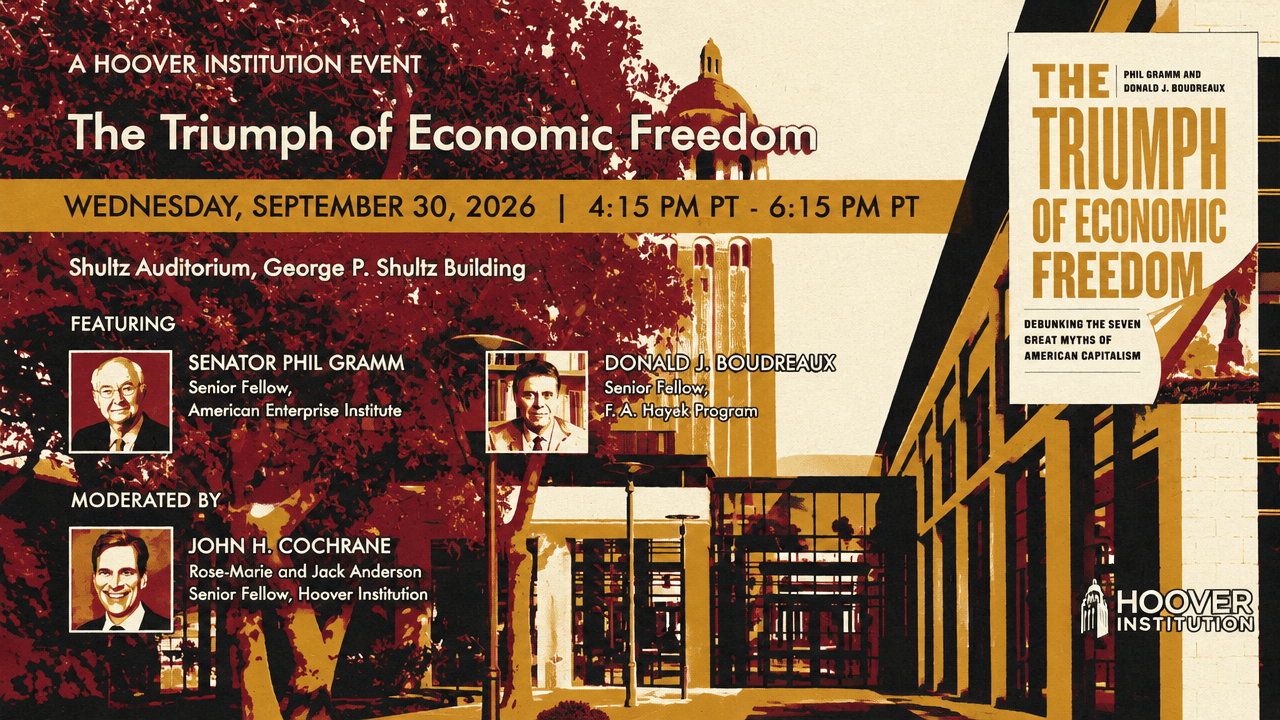
In *The Triumph of Economic Freedom*, Senator Phil Gramm and economist Donald J. Boudreaux argue that familiar accounts of industrialization, the Great Depression, trade and inequality misread the evidence in favor of expanding government. They contend that economic change often improved living standards and widened individual choice, while government interventions and failed policies posed a greater threat to economic freedom. At a Hoover Institution book talk, John Cochrane joined the authors in presenting their case for judging economic outcomes against the alternatives people actually faced.
Economic freedom changes the comparison
Phil Gramm and Donald Boudreaux argue that familiar accounts of American capitalism mistake visible disruption for evidence of failure. Their alternative is to compare conditions before and after economic change, ask what choices people actually had, and count the costs of policies presented as remedies.


For the authors, economic freedom means more than higher output. It includes owning one’s labor and its proceeds, moving, starting a business, and choosing how to spend. Their historical argument is that people often gained those freedoms through economic change, while government interventions intended to correct hardship could restrict them.
John Cochrane frames the book around “founding myths”: accounts of capitalism that, he says, become received wisdom even when they conflict with the evidence. He argues that the stories societies tell about their economies help sustain their political opinions, and that people can become attached to an account of the facts because it supports a preferred conclusion. Gramm, Boudreaux, and Cochrane’s alternative is not a claim that the past was comfortable. It is a demand to compare hardships with the conditions people actually left behind—and to examine what economic change made possible.


The difference in emphasis matters. The authors do not claim that every person benefited immediately from every change, or that economic growth made hardship disappear. They ask readers to distinguish the costs of change from the conditions that preceded it, and to distinguish the effects of private enterprise from the effects of government rules. That method underlies their accounts of industrialization, monopoly, the Depression, trade, poverty, and inequality.
Industrialization made hardship more visible—and offered an alternative
Gramm describes the Industrial Revolution as a wave of “creative destruction.” The creative part, he argues, shows up in economic data that conventional accounts often subordinate to descriptions of factory life. He says that in Britain, after roughly a thousand years of virtually no economic growth, per-capita income began rising around 1830. He describes the period from 1830 to 1900 in Britain, and from 1865 to 1900 in America, as an unprecedented improvement in human well-being. These are the historical comparisons he uses to challenge accounts that treat industrialization chiefly as a story of exploitation.
That does not mean factories looked benign by modern standards. Cochrane acknowledges that mills could be grim. Boudreaux’s point is that they were being compared, in retrospect, with an idealized rural life rather than with the actual alternatives. Subsistence farms could mean injury, disease, and poor housing. Those conditions were familiar enough to go unnoticed; factories, by contrast, were new and conspicuous. Workers voluntarily left the countryside for mill jobs, Boudreaux says, where wages were higher and living standards were beginning to rise.
Gramm adds two measures of change: average lifespan grew by 22 percent over 70 years, he says, and contemporary complaints included the difficulty of keeping household servants when textile mills offered them work. Cochrane’s formulation is that industrial employment created competition with servitude. The relevant comparison, he argues, is not between a nineteenth-century mill and a modern workplace, but between the options available to a landless laborer at the time.
The authors’ account turns in part on what observers could see. Cochrane suggests that rural poverty was less visible to city dwellers than factory poverty, and that landlords had reason to resent workers leaving the countryside for paid employment. Gramm makes a similar argument: people who had lived in poverty in the country became conspicuous when they moved to cities, while their departure reduced the wealth available to landed interests. In his view, visibility and self-interest helped shape the literature and political response to industrialization. This is an explanation the speakers offer for why accounts of the period emphasized the factory’s conditions without giving equal attention to the rural conditions workers left.
Boudreaux cites historian Emma Griffin’s research on diaries written by ordinary British workers in the early and middle nineteenth century. The diarists recognized that their lives were hard, he says, but also described them as better than those of the previous generation. Gramm argues that later observers often missed that change. Poverty in the countryside could appear picturesque from a manor house, while poverty in the city was visible on the streets.
He uses Charles Dickens’s A Christmas Carol as an example of the limits of contemporary understanding. Dickens, Gramm says, could imagine charity as a response to poverty but not the income growth already underway as a solution. The claim is not that charity was useless or that hardship had vanished; it is that the economic process that could raise living standards was harder to see than the deprivation it might eventually ease. Gramm argues that people looking back at poverty often recoil from it, while the people living through the beginning of industrial growth could understand their own lives as improving.
The authors also discuss ideas and institutions as causes of industrial growth. Boudreaux draws on Deirdre McCloskey’s argument that commercial activity became more honorable in northwestern Europe, first in Holland and then Britain. A change in social esteem, he says, made more people willing to engage in business and innovation. He adds that ideas alone were not enough: institutions, including a state that was not predatory, also mattered. In this account, growth depended both on the ability to conduct ordinary business and on a change in how society regarded those who did so.
Gramm focuses on the right to own one’s labor and its proceeds. In the medieval order, he says, workers owed obligations to rulers, guilds, churches, and villages, each of which could claim part of their earnings. The Enlightenment’s recognition that people owned their own labor was, in his view, a fundamental change in property rights. He argues that when people could own the fruits of their work, they had incentives that earlier systems had denied them.
The Gilded Age’s “monopolies” expanded output and cut prices
The familiar account of the Gilded Age depicts robber barons amassing power by restricting output and raising prices, until progressive reformers intervened on behalf of consumers. Boudreaux argues that the large firms commonly described as monopolies—including Standard Oil and the Chicago meatpackers—used economies of scale made possible by railroads, telegraphs, and telephones. In his account, their growth displaced older businesses, but that did not make them monopolies in the sense of firms that reduced output and raised prices.
Boudreaux says the available data show these firms increasing output faster than the economy overall and cutting inflation-adjusted prices faster than the general price level was falling. Gramm makes a related comparison: he says that in the 20 years before the Sherman Act, production grew faster and prices fell further in the industries labeled trusts than they did in the 20 years afterward. Their argument is that the label “monopoly” is not enough to establish consumer harm; one must examine what firms did to output and prices.
Their test is consumer impact, not the fortunes of competitors. Boudreaux says Standard Oil innovated, cut prices, increased output, and was losing market share when it was broken up. He also notes that Ida Tarbell, whose 1904 account helped popularize the charge of predatory pricing, was the daughter of an oil refiner put out of business by Standard Oil. For Boudreaux, that background helps explain the origin of a claim; it does not substitute for examining what the firm did.
Gramm makes a similar case about Upton Sinclair’s The Jungle. He says the federal agencies created in response to the book investigated the Chicago meatpackers and found no evidence for its most lurid allegations. In Gramm’s telling, dangerous practices were more common among small packers and in the back rooms of shops; large Chicago firms had eliminated some of those hazards. Boudreaux says he was struck, while researching history textbooks, by how often they treated Sinclair’s fictional account as factual evidence about the plants. The speakers’ objection is not to investigating food safety, but to treating a work of fiction as if it were itself evidence about the conditions in the plants.
Cochrane draws a broader lesson about how historical stories persist: textbooks and later writers can repeat claims without returning to the underlying sources. He suggests that tracing citations may reveal writers citing one another rather than checking the original evidence. He and Gramm point to the vividness of accounts of the Industrial Revolution as one reason they can be treated as factual even when their evidentiary basis is disputed.
That concern carries into the case for antitrust. Gramm argues that without a consumer-welfare standard—requiring a case that intervention benefits consumers and that the existing system is harming them—antitrust becomes a license for regulators to act on whatever grounds they choose. The exchange turns to the political use of regulatory power, including the possibility that merger approvals can be influenced by political favor. Boudreaux characterizes coercive threats to regulated businesses as “the language of the mafia.” Their criticism is that antitrust can be used to serve political purposes if it is detached from a requirement to show consumer harm.
Gramm also credits deregulation under Jimmy Carter, followed by Reagan, with helping lay the foundation for modern communications and transportation. He presents those reforms as a response to progressive-era rules that had become constraints on industries. In his account, deregulation was not simply a retreat from government: it helped make possible later changes in communications and transportation. The broader question for the speakers is what regulation and deregulation do, rather than whether regulation is automatically a remedy for market power.
The Depression story turns on policy—and on the recovery that did not arrive
Gramm rejects the account in which unrestrained capitalism caused the Depression, Hoover did nothing, and the New Deal restored prosperity. He points instead to the Federal Reserve’s failure to inject liquidity as banks collapsed. One-third of the country’s banks went out of business, he says, while the money supply fell faster than prices. Gramm also rejects the idea that Hoover was simply a non-interventionist, calling that a fiction.
Boudreaux draws on economist Robert Higgs’s concept of “regime uncertainty”: the idea that changing policies and hostility toward private investment can make businesses uncertain about what rules they will face. Boudreaux says net investment remained below zero throughout the 1930s, and argues that an economy cannot recover while that persists. His interpretation is that Roosevelt administration interventions and hostility toward investors kept private investment on the sidelines. This is the speakers’ explanation for the weakness of the recovery; they present it as a counter to the account that New Deal intervention restored prosperity.
Cochrane separates the New Deal’s monetary changes from its other interventions. He credits Roosevelt with taking the country off the gold standard, which he says helped address monetary problems. But Cochrane argues that policies aimed at raising prices by organizing industries into monopolies, higher marginal tax rates, and what he calls a “war on capital” damaged economic activity. He says these policies are often crowded out of the familiar story by the simpler claim that government action restored prosperity.
The wartime recovery is another point of dispute. Gramm notes that drafting millions into the military increased employment, but argues that this does not mean civilian production and consumption had recovered. As victory approached, he says, there was a major debate over whether the government would have to resume New Deal spending to prevent a return to depression. Truman did not restart that spending, Gramm says, and the economy took off. Boudreaux adds that economist Paul Samuelson predicted a postwar downturn when wartime spending ended. Cochrane argues that the prediction is often forgotten while the overlap between spending and recovery is remembered as proof that stimulus ended the Depression.
The speakers’ point is partly about how predictions are remembered. Cochrane says those who argued that ending wartime spending would bring back the Depression were not vindicated by the postwar outcome he describes. Boudreaux underscores that Samuelson made such a prediction. Their argument is that the chronology alone—government spending followed by recovery—does not settle whether spending caused the recovery.
Cochrane connects that argument to economic rhetoric he sees as fixed in the language of the 1930s: the insistence that the country needs more jobs even when unemployment is low. His objection is to describing the economy as though mass unemployment or widespread material deprivation were its defining conditions when, in his view, they are not. The speakers do not argue that no one is in hardship; they challenge the use of Depression-era language as a general description of current conditions.
Income and wealth comparisons depend on what they count
Gramm argues that standard comparisons of low incomes omit government benefits delivered in kind, including food stamps, Medicaid, and housing subsidies. The Census Bureau, he says, does not count those benefits as income. He contrasts that treatment with the fact that an average middle-class family spends about half its income on those three items. Gramm says that in 2025 the government benefits received by the average household in the bottom 20 percent of the income distribution totaled more than $55,000 a year.
That figure is Gramm’s calculation of benefits to an average household in the bottom quintile, not a cash-income measure. He also says that since 1967 the income of the bottom quintile has risen faster than the income of the top quintile when government transfers are included. Alongside that comparison, he cites a decline in the employment level from 78 percent to 36 percent. He characterizes the result as reduced poverty alongside increased idleness, because fewer people are connected to the market that, in his view, generates continuing economic progress. Gramm says that poverty has been eliminated “by any real definition” for most people receiving welfare benefits, while allowing that some people remain poor and have fallen through the cracks. These are his claims and definitions, not a neutral finding established by the discussion.
Gramm’s criticism of inequality studies is that they can compare unlike things. He says some analyses exclude transfers received by low-income households and taxes paid by higher-income ones, while estimating income for the very wealthy as if they had sold assets and paid taxes on the proceeds. He objects in particular to using the top one-tenth of one percent as if it represented the condition of the population as a whole. His broader objection is that a statistic can magnify inequality if it leaves out redistribution in one part of the comparison and uses a different income concept in another.
Cochrane makes a related, but distinct, argument about wealth. He says much measured wealth inequality reflects the market value of stock portfolios, not consumption inequality. Wealth invested in factories and businesses, he argues, is not necessarily evidence that other people are worse off. He also points to changes in household composition: a family structure that once counted as one household may now be divided into different households, complicating comparisons over time. Cochrane cites research by Gerald Auten and David Splinter as work that addresses these measurement issues.
Gramm and Cochrane challenge particular comparisons; they do not offer a single replacement measure in the exchange. Their contention is that claims about the poor getting poorer or the middle class disappearing should be tested against how taxes, transfers, household differences, and assets are counted, rather than inferred from a headline statistic.
The same distinction between a measured share and people’s living standards arises in a question about labor’s share of GDP. An audience member cites a series in which labor’s share was above 60 percent from the 1950s to the 1970s, reached roughly 66 percent in the mid-1970s, and stood at 53 percent in 2025. Boudreaux says a fall in labor’s share does not, by itself, mean workers’ absolute income is falling. He adds that a larger capital stock can be beneficial, while acknowledging that investors need a return for capital to be attractive.
Gramm says he has not studied the measure closely, but suggests that a more capital-intensive economy would be expected to rely less on labor in production. He also notes that the comparison is often made with the postwar period, when American firms had little foreign competition in heavy manufacturing and unions negotiated industry-wide wages. He describes that period as one in which American firms could share what he calls monopoly rents with unions, because foreign competitors had not yet returned to the market.
Cochrane questions how consistently the statistic classifies income. Stock options may be counted as capital returns, he says, as may income received through incorporation or partnership. He also points out that much capital is held through retirement accounts and pension funds, so workers may own part of the capital whose returns are being distinguished from labor income. Gramm says that corporate ownership through 401(k)s, IRAs, pension funds, and insurers is substantial, while cautioning that he does not claim expertise in the issue. The exchange does not resolve how the labor-share measure should be interpreted; it identifies reasons the speakers think the figure alone is not decisive.
Manufacturing employment is not industrial capacity
Boudreaux argues that claims of a hollowed-out American industrial base do not fit measures of production and capacity. He says industrial capacity reached an all-time high around 2020, and that real median family income was also at an all-time high. In response to research identifying local labor markets affected by competition from China, he cites economist Jeremy Horpedahl’s analysis that real incomes in those places later exceeded their previous highs.
Boudreaux acknowledges that economic change can lower wages for some people and weaken some regions. His claim is that the places identified as especially exposed to Chinese imports recovered, and that regions with lower taxes and less regulation recovered more strongly than some Rust Belt areas, according to research by Gary Winslett. He also says manufacturing output and industrial capacity did not decline or slow after NAFTA or China’s entry into the World Trade Organization. These are the speakers’ arguments about the measures and regions they discuss; they do not deny that workers and communities experienced disruption.
Gramm separates manufacturing employment from manufacturing production. Manufacturing employment, he says, peaked around 1979 and has declined since. He compares that trend with agriculture: 39 percent of Americans worked on farms in 1900, compared with roughly 1.5 percent today, without agriculture having been “hollowed out.” His explanation is that productivity and machinery allow fewer people to produce more.
He cautions that employment statistics also depend on definitions. Around 2000, he says, the Labor Department classified programming as a service rather than manufacturing. In a modern car, Gramm says, many high-value electronic components are provided by contractors whose workers may not be counted as manufacturing employees. The decline in manufacturing employment is real in his account, but the measure does not by itself describe the volume or value of industrial production.
The speakers challenge nostalgia for the 1950s on similar grounds. Gramm describes the postwar period as an unusual moment when the United States faced little competition in heavy manufacturing because the war had destroyed industrial capacity elsewhere and killed millions of skilled workers. As Europe and Japan rebuilt, American firms faced competition. Gramm says consumers benefited from that competition, using the Toyota Corolla as a symbol of the pressure that changed the auto industry. Cochrane adds that the factory jobs now recalled with nostalgia could be difficult work; the decline of a particular kind of employment is not necessarily the decline of living standards.
The China-trade argument does not deny local costs or the need for mobility. Gramm says workers and communities competing directly with cheaper or better imports could lose, while consumers and domestic producers using cheaper components could gain. He also says China substantially reduced its tariffs on American goods when it joined the WTO, while the United States did not lower tariffs on Chinese goods in response.
Boudreaux supports making employer-provided health benefits portable, but as a general response to economic disruption—not as a special remedy for trade. Workers may need to move when industries change for any reason, including new technology. Cochrane points to other barriers: social services tied to location, mortgage arrangements that can make moving difficult, and local governments that may deter new businesses. The question, for Cochrane, is not only why a factory closed, but also why people and businesses could not readily move to places where work was growing.
National security is an exception with a price tag
Gramm accepts that national defense can justify limits on free trade, but calls it one of the most abused arguments in American government. He recalls government stockpiles of materials accumulated to prepare for another world war, including coal and minerals, that proved inefficient to retrieve and use. His example shows how a defense rationale can preserve costly arrangements long after the original need has passed.
He also objects to paying substantially more for goods on the grounds that they must be produced domestically, citing cotton underwear as an example. Money spent protecting one product, he argues, is unavailable for other purchases, including goods that may matter more for defense. Gramm says there is a legitimate national-defense case for some restrictions, but that it is easily invoked to defend policies that do not serve that purpose. He specifically objects to restrictions on steel and aluminum imports from Mexico and Canada.
Boudreaux says protection for a strategically important industry is not free. If the government stimulates domestic production in one sector, resources have to come from somewhere else. Protection may also make an industry less innovative and less responsive to competition—an especially serious cost if the industry is supposed to be essential to defense. He wants advocates to name both the trade-off and the possibility that the protected supplier becomes less capable over time.
The Jones Act becomes an example in the exchange. Cochrane argues that restrictions intended to support American shipping have instead damaged shipbuilding. He prefers stockpiles to permanent protection where they can meet the security need more efficiently. Gramm notes that oil has been shipped from Saudi Arabia to New York because it was cheaper than shipping it from Houston—even using Jones Act ships, which he says effectively do not exist for the purpose.
Cochrane proposes putting the cost of national-security industrial policy visibly in the defense budget. If policymakers want to spend $100 billion on a chip factory, he suggests, they should have to weigh that against spending the same amount on military equipment. The proposal is not a claim that chips or other industries are irrelevant to defense; it is a way to force the cost and competing priorities into the open. Boudreaux agrees that making the choice explicit would make the policy more honest.
The freedom argument is broader than efficiency
Cochrane asks whether phase-outs in means-tested programs create steep effective marginal tax rates for people moving from no earnings to modest incomes. He estimates that the combined rate from zero to $60,000 may be about 100 percent. Gramm responds that, for people without valuable skills or strong incentives to work, welfare benefits can leave them nearly as well off as employment. He argues that the system is poorly suited to people facing drug or alcohol addiction and other serious difficulties, and says that most recipients of welfare benefits are not poor by the definition he is using. The speakers’ concern is that programs intended to help can make it less attractive to enter or remain in work, while failing to address some of the problems that keep people out of work.
The argument about artificial intelligence follows the same historical logic as the argument about industrialization. Boudreaux sees no reason to conclude that AI will destroy jobs. A job, he says, is a way of satisfying a human want; if technology could truly eliminate all jobs, it would amount to “heaven on earth.” Gramm points to how much less labor would be needed to produce the goods available in 1830 using later productivity, and argues that new wants and products absorbed workers who were no longer needed for old tasks. He also notes that people now work far fewer hours than they did in the nineteenth century. Cochrane’s formulation is that lower production costs can expand output and create new industries as well as displace existing work. Their claim is not that every worker will move easily into a new job, but that technological change has historically created new work as well as replacing old tasks.
For Gramm, the central defense of markets is ultimately political as well as economic. He argues that economists place too much emphasis on efficiency and productivity and too little on freedom:
People don't die for efficiency. People don't storm the barricades because of productivity.
Socialism appeals to ideals of shared prosperity, Gramm says, but in his account it fails to produce prosperity and, when government directs economic life, destroys freedom. He says the desire for a world in which everyone is better off is understandable; his objection is that systems aimed at equality of outcome have not produced it, and that government supervision comes at the cost of freedom.
Boudreaux acknowledges that economic freedom does not always lead to political freedom, citing China and Russia as cases that complicate the claim. But he says he knows no case in which socialism has produced more political freedom. His comparison is between the likelihood of political freedom under economically free and economically unfree systems, not a claim that markets guarantee democratic government.
Gramm also presents Reagan’s support for free trade as grounded in freedom of choice. Absent a threat to national security, he asks, what gives government the right to tell people what to spend their money on? In this framing, the case for trade is not only that specialization can increase output. It is also that consumers should be free to make choices without government directing their purchases.
The speakers disagree on how open immigration can be
That freedom argument informs the speakers’ disagreement over immigration. Gramm supports legal immigration, particularly for talented people and international students who have studied in the United States, but opposes illegal immigration because it is illegal. He argues that the current welfare system makes fully open immigration difficult to sustain. He wants an aggressive program for talented people, including a route to a green card and citizenship for international students who have done well.
Boudreaux is more optimistic about the economy’s ability to absorb immigrants. He notes that immigration restrictions came after a period when people could come to the United States without the later limits, and invokes Julian Simon’s phrase that immigrants arrive “with one mouth and two hands.” The contrast is not over whether immigrants can contribute; it is over whether the welfare system changes the case for an open policy.
Gramm describes immigration as integral to the American story, while arguing that the rules for legal entry need to work better. He points to his own family and colleagues’ varied immigration histories, and says that the country would be acting against its interests if talented people came to study and then returned home because they could not stay. At the same time, he argues that the current level of welfare support makes unrestricted immigration a different proposition from earlier periods.
The speakers also push back on the claim that immigrants are a burden or a source of crime. Gramm says immigrants, including those who entered illegally, are less likely to commit crimes than people born in the United States. He describes a foundation that funds college scholarships for talented Texas students: in the year he cites, 72 percent of its selected students were foreign-born or children of foreign-born parents. He interprets that as evidence of the importance immigrant families place on education.
A brief story from Gramm makes the disagreement about opportunity more concrete. He says he offered a Spanish-speaking worker doing stonework on his house twice his current pay to become his ranch manager, with training provided. The worker declined because he wanted to work for himself. Gramm treats the exchange as an example of the freedom to choose a form of work, rather than simply accept the highest available wage. He concludes that America cannot be America without immigrants, while Cochrane adds that the legal system for immigration needs fixing.
Political division makes reform harder, but not unimaginable
Cochrane asks whether American institutions can still support bipartisan reform. He points to the period when Gramm served in the Senate, when lawmakers made major changes to Social Security and the tax system, and asks whether that kind of cooperation can happen again. Gramm says the parties have moved further apart and that each increasingly regards the other’s policies as a threat to the country. In his account, that makes it harder to find middle ground than it was when he worked with senators who disagreed with him about government but were not regarded as existential threats.
Gramm recalls working with Senator Robert Byrd, who wanted more government while Gramm wanted more freedom. Their disagreement did not prevent them from cooperating on other matters, Gramm says. He describes the Social Security changes as a response to an immediate crisis, not as a reform undertaken because lawmakers wanted to revisit the system. The system was eight months from a large benefit cut, he says, and that pressure forced decisions. He says the Reagan budget eliminated three Social Security benefits outright and that the cuts did not become a campaign issue because, in his telling, the system was made secure for 50 years.
Gramm expects the current political period to get worse before it gets better, but says he remains confident in the long run. He bases that confidence on his belief that American voters do not tolerate a bad economy and will eventually reject policies he considers unworkable. He predicts that the country will ultimately correct course, while acknowledging that an election could move policy in the wrong direction in the near term. That is a political judgment, not a prediction shared or tested in the exchange.
Cochrane’s question about institutions follows from the book’s account of economic freedom: if prosperity depends on rules that allow people to work, invest, and trade, then the endurance of those rules matters. Gramm’s answer is cautious about the immediate future and more optimistic about the long run. He invokes Jefferson’s warning that liberty requires eternal vigilance, and says that anything threatening the economy also threatens a basis of American exceptionalism. His confidence rests less on the present political climate than on voters’ eventual response to economic outcomes.
The audience questions test the argument against specific policies
The question-and-answer session returns to the China trade argument in a more specific form. An audience member challenges the claim that trade-exposed local labor markets have recovered and asks whether the China shock’s localized displacement supports policies such as making health benefits portable. Gramm answers that areas producing goods that became more expensive or less competitive did lose, but says consumers benefited from cheaper imports and domestic producers gained from cheaper component parts. He also says China reduced its tariffs on American goods when it joined the WTO, while the United States did not reduce tariffs on Chinese goods in response.
Boudreaux agrees that employer-provided health benefits should be portable, but separates that proposal from trade policy. Workers may need to move after any economic disruption, he says, whether caused by imports, AI, or another labor-saving technology. He maintains that the regions identified as especially affected by Chinese imports have recovered, citing Horpedahl’s comparison of real incomes before and after the shock. He adds that Gary Winslett’s comparison finds stronger recoveries in Southern regions with less regulation and lower taxes than in some Northern Rust Belt areas. Those are the authors’ cited arguments about the data; the audience member’s concern about localized losses remains part of the exchange.
Cochrane widens the question from trade to mobility. He points to social services tied to place and housing arrangements that can make moving difficult, and asks why other businesses did not move into areas where factories closed. He suggests that local-government dysfunction can be part of the answer. The exchange therefore does not treat recovery as simply a matter of whether national output rises: it also asks whether workers can move and whether a region can attract replacement activity.
Another audience question asks Gramm to name the three Social Security benefits he said had been eliminated in a day. Gramm calls them unearned benefits. One was the adult student benefit, which he says provided benefits to students in households of retirees even after a federal student-loan program had been established. Another was a minimum benefit for people who had spent time in government or abroad without paying Social Security, then worked a small number of hours in covered employment and qualified for payments that Gramm considered disproportionate to their contributions. He also names a death benefit, a cash payment at death that he says was not part of the system’s core purpose. Gramm adds that part of the minimum-benefit change was later reversed. His answer illustrates the kind of program rules he regards as additions that can strain a system, though the exchange does not provide a fuller account of the legislative history.
The labor-share question is also a test of how the speakers handle a statistic whose interpretation they do not claim to have settled. An audience member cites a decline in labor’s share of GDP from around 66 percent in the mid-1970s to 53 percent in 2025 and asks whether that is a problem. Boudreaux says not on its face: a falling share does not establish that workers’ absolute incomes are falling. Gramm says he has not examined the figures closely and offers capital intensity and the return of foreign competitors as possible context. Cochrane questions whether the categories are stable as more workers receive stock options or work through incorporated businesses, and notes that workers also own capital through retirement and pension funds. Gramm agrees that this is an area requiring more knowledge rather than claiming the question is resolved.
These exchanges sharpen a recurring distinction in the book’s argument: a measure can describe a real change without determining whether that change is harmful, what caused it, or what response would improve matters. The speakers use that distinction to resist moving directly from a statistic—employment, income share, or regional exposure—to a policy conclusion.
Mobility, wealth taxes, and what investment is used for
The state exit-tax exchange concerns the ability of people to move between jurisdictions. Gramm hopes such a tax would be found unconstitutional. More broadly, he argues that the ability to leave is a check on state government: people can “vote with their feet.” He describes disputes with states over whether former residents have truly moved, including friends who left New York for Florida and spent years in court establishing their residency elsewhere. He sees the possibility of an exit tax as an especially serious constraint on that choice.
Boudreaux considers the hypothetical that such a tax might be legal, while saying he believes otherwise. His argument is that a state might gain in the short run by making it harder to leave, but that people unable to move as readily would have less reason to invest, start businesses, or innovate there. The discussion is about the cost of restricting people’s ability to leave a state; it is not the same policy question as a tax on wealth.
A separate audience question concerns a proposed California wealth tax. Boudreaux’s answer is about what the wealth represents: he argues that it is largely invested in companies rather than sitting in a storehouse. In his account, taking some of that wealth would reduce investment and could hurt workers. Gramm adds that people can become wealthy by creating ideas and products that make others better off. He uses Elon Musk’s satellite internet service as an example, saying it replaced his older system at a lower price and with better service. Gramm asks why consumers should resent the wealth of someone whose innovation benefits them.
Cochrane adds a fiscal argument about the proposed tax, citing work by Hoover economist Josh Rauh. He says that if wealthy residents leave, California could lose not only one-time wealth-tax revenue but also future income-tax revenue, including taxes on capital gains. That is Cochrane’s prediction about the policy’s effects, not an outcome established in the event. He also argues that redirecting invested wealth toward consumption would reduce the capital available for future production. Gramm adds that consumption has value but comes out of the capital stock.
The wealth-tax exchange is therefore distinct from the exit-tax question. One concerns a proposed levy on accumulated wealth and the speakers’ claims about investment, tax revenue, and production; the other concerns a penalty for leaving a state and the speakers’ concern about mobility as a limit on government power. Their shared subject is the relationship between individual choice and government policy, but the mechanisms and claims are different.