Gulf States Still Anchor Security in the U.S. Despite China’s Rise


Jonathan Fulton tells Elizabeth Economy that China’s Middle East role is substantial but narrower than the recent hype suggests: Beijing is a major economic actor in the Gulf, yet remains a limited security and diplomatic player. In his account, the Iran crisis and reopening of the Strait of Hormuz underscored that regional governments may be frustrated with Washington but still rely on the U.S. security architecture because no other power can replace it. Fulton argues China is useful to Gulf states in trade, infrastructure, digital systems and energy, while its capacity to convert that influence into geopolitical power remains constrained.
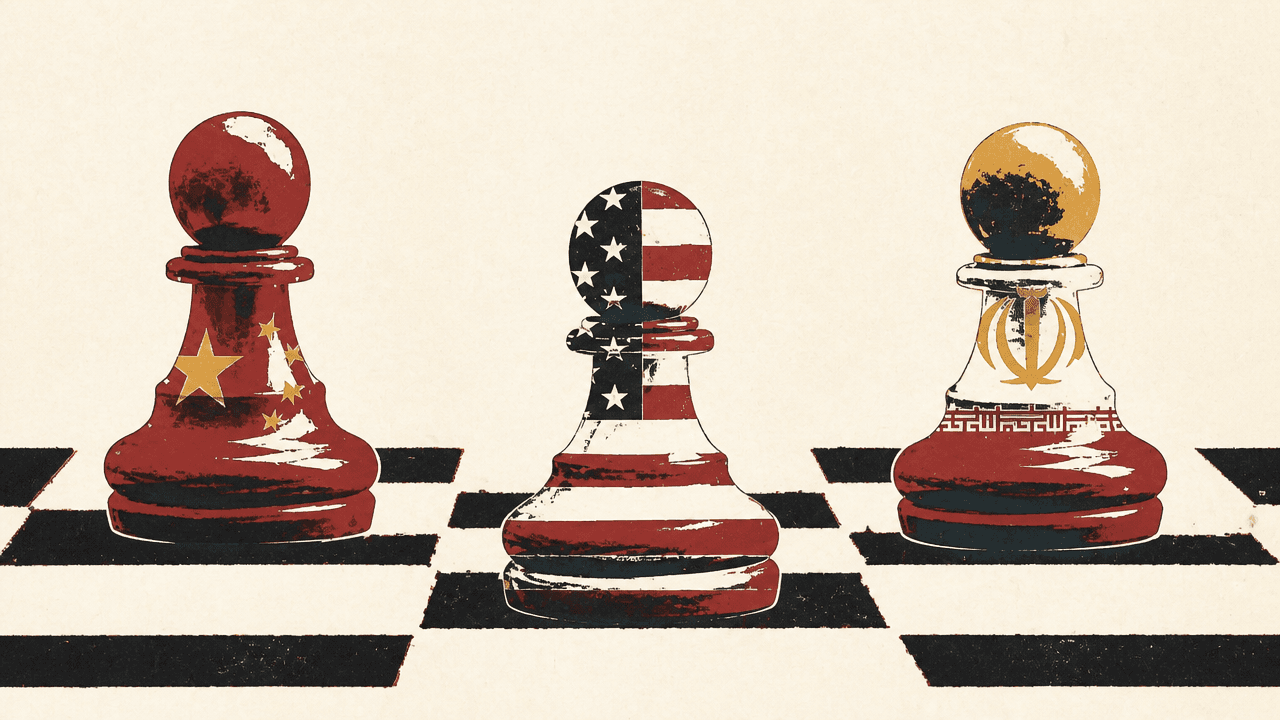
After the Iran crisis, Gulf governments still look first to the U.S. security architecture
Jonathan Fulton describes the U.S.-Iran ceasefire and reopening of the Strait of Hormuz as a relief, not a strategic reset. From Abu Dhabi, he says the immediate regional mood is “cautious optimism,” with the emphasis on cautious. The agreement depends partly on Israel and Lebanon holding steady, which he calls uncertain. The larger reaction is exhaustion: local economies have been disrupted, businesses have been hurt, and wealth has been destroyed.

Fulton’s first thought on seeing the ceasefire terms was that the region had returned to where it had been months earlier: the strait open, the blockade over, and no obvious new political order. In his words, it looked like “a terrible detour” to arrive back at the February baseline. Elizabeth Economy notes that the Trump administration would likely argue the United States inflicted serious damage on Iranian military capabilities. Fulton answers that many people in the region would say Iranian capabilities were not the only thing degraded. American bases, the idea of deterrence, small and medium-sized enterprises, real estate markets, and accumulated wealth all took damage.


That framing matters for his broader argument about China. The war did not, in Fulton’s view, make China look like a substitute security provider. Publics may be frustrated, and local economies may have suffered, but governments have largely concluded that no other great power is willing or able to provide security in the region at comparable scale. Fulton lists the practical requirements: munitions stockpiles, training, personnel, and military infrastructure. Europeans have helped on a smaller scale; Koreans have helped the UAE in limited ways; Ukraine has provided drones and drone technicians. But no other power can do what the United States does.
China has also made clear that it does not want to be that kind of partner. Fulton argues that the U.S. security architecture has long provided a low-cost entry into a risky environment not only for China, but also for U.S. allies and partners such as India, Japan, and Korea. They can do business in the Gulf without assuming the burden of regional security. China has benefited from that arrangement too.
The common shorthand, Fulton says, is that “the US does security and China does the economy.” He understands why the phrase persists: China is one of the top trading partners for every country in the Arab world. But much of that is trade in goods, often highly imbalanced in China’s favor. In non-oil-exporting countries, he argues, the relationship can hurt local producers and markets. China is an important economic partner, but its economic role is not necessarily balanced, comprehensive, or deep in the same way as the U.S. relationship.
The United States remains embedded across a wider range of ties: investment, education, training, security, diplomacy, defense cooperation agreements, and facility access agreements. When Xi Jinping visited Riyadh in December 2022, the outcome list looked dramatic and received extensive attention. But compared with the full range of Saudi-U.S. ties, Fulton says, the China-Saudi list was a handful of bullet points next to “a phone book.”
China gets the headlines — it’s flashy, it’s sexy, it seems disruptive — but it’s really much shallower.
The UAE’s AI choices illustrate the same logic. Huawei had made significant inroads into Emirati 5G and AI networks, and U.S. officials worried the UAE might be playing both sides. But Fulton reads the Microsoft-G42 deal as a clear public bet. G42 is the UAE’s national champion AI company, and Fulton says that for AI cooperation linked to security networks or strategic applications, the Emiratis have excluded Chinese companies and are exceptionally strict about the separation.
Commercial AI is different. In Dubai, Chinese-linked technologies remain present in digital commerce, electric vehicles, robotaxis, and smart-city systems. Fulton describes the UAE as trying to silo “critical” from “commercial”: use China where it is useful, while keeping sensitive strategic systems aligned with traditional partners. The calculation is not a binary alignment choice. It is a distinction between what is a “must-have” and what is a “nice-to-have.”
China’s Middle East role is large economically and limited strategically
Fulton describes China’s Middle East presence as real, fast-growing, and still primarily economic. The most important distinction, in his account, is regional: China’s footprint is “pretty broad and relatively deep” in the Gulf, modest in the Levant, and increasingly active in North Africa. Across those subregions, however, the basic driver is consistent. China comes to the region “to make money” and “to get energy.” Security, diplomacy, and politics exist around that core, but remain second-order.
He traces the shift to the mid-2000s and early 2010s. When he arrived in the Gulf in 2006, during the Iraq war, China was already becoming more active. Oil prices, China’s status as a major oil importer, and high-profile engagement with Saudi Arabia were pushing Beijing toward a larger regional presence. The more dramatic expansion came after Xi launched the Belt and Road Initiative. From that point, Fulton says, there was “a tremendous surge” in Chinese activity across the region.
The framework Beijing itself used was not initially framed around security or military power. Fulton points to Xi’s 2014 remarks at the China-Arab States Cooperation Forum, where Beijing introduced the “1+2+3 cooperation framework” for engagement with Arab countries. In Fulton’s summary, “one” meant hydrocarbons; “two” meant trade, investment, infrastructure, and construction; “three” meant nuclear energy, renewable energy, space, and satellites. The striking point, for him, is what was absent: no politics, no security, no military cooperation.
| Element | Priority areas | Fulton’s assessment |
|---|---|---|
| 1 | Hydrocarbons | Central to China’s regional engagement and energy needs |
| 2 | Trade, investment, infrastructure, construction | Expanded sharply under the Belt and Road Initiative |
| 3 | Nuclear energy, renewable energy, space, satellites | Renewables expanded; nuclear and space-satellite cooperation largely did not |
That agenda has produced uneven results. Energy, infrastructure, and trade have “shot through the roof.” Renewable energy has expanded substantially. Nuclear energy, space, and satellites have “kind of gone nowhere.” The pattern supports Fulton’s broader point: China’s visible rise in the Middle East is not imaginary, but its substance is narrower than many headlines suggest.
Economy presses the question of whether the economic footprint has begun to spill into security, especially through digital infrastructure, policing, and surveillance. Fulton’s answer is yes, but with an important caveat. If security cooperation means military-to-military ties, arms sales, or joint operations, China’s role remains modest. If it means surveillance technology, policing tools, smart-city systems, and the technological side of Beijing’s Global Security Initiative, he says China has made “pretty good inroads.”
That distinction matters because the region contains many governments that Fulton sees as receptive to the governance assumptions embedded in these systems. Many Middle Eastern governments, he says, are comfortable with the idea that technology can be used to surveil citizens, identify extremist organization membership, monitor politicized religious groups, or track online chats. In Western countries, he notes, such practices would raise serious reservations; in much of the region, governments tend to see them as a benefit.
China can pitch the same technologies in sharply different ways. In places like Dubai, the framing is developmental: smart cities, better emergency services, digital modernization, and economic diversification away from hydrocarbons. In Saudi Arabia, Chinese smart-city technology can be presented as a way to manage massive flows of hajj pilgrims, where crowd movement, emergency response, and care for elderly pilgrims are real operational challenges. The same toolkit can be described as a development instrument or a state-control instrument, and in both cases, Fulton says, China finds receptive audiences.
Beijing has preferences, even when it avoids saying so
China’s perceived advantage in the Middle East is that it appears able to maintain relations with everyone. Beijing supports Iran, engages the Gulf monarchies, speaks for the Palestinians, trades with Israel, and avoids public choices among regional rivals. Jonathan Fulton disputes the idea that China does not choose sides. His formulation is sharper: China “absolutely” chooses a side; it just does not “go out around blabbing about it.”
The evidence, for him, is material rather than rhetorical. China’s relationship with Iran attracts attention because it looks consequential, disruptive, and connected to the China-Russia-Iran-North Korea grouping that has become more salient since Russia’s invasion of Ukraine. But China’s ties with the Gulf Cooperation Council are deeper and broader. Fulton says roughly 500,000 to 600,000 Chinese citizens live in the GCC, compared with the 2,000 to 3,000 citizens China said it evacuated from Iran during the 12-day war. China has done hundreds of billions of dollars of contracting in the GCC over roughly two decades, compared with about $20 billion in Iran.
China’s method is to preserve rhetorical flexibility while letting economic weight reveal priorities. It says it is friends with both Israelis and Palestinians. Fulton’s assessment is that China is rhetorically friendly with the Palestinians while doing enormous trade with Israel. Those relationships are “not comparable,” even though Beijing has not stood with Israel in U.N. Security Council votes.
This logic also shapes Fulton’s skepticism about reports of a possible Chinese military facility in the UAE. He places the issue in the context of China’s port and industrial-park strategy. In 2018, Wang Yi introduced what Fulton calls the “ridiculously named” Industrial Park Port Connectivity Two-Wing Two-Wheel Approach. The wording was unwieldy, but the underlying map was coherent: Chinese commercial nodes across the Persian Gulf, Arabian Sea, Red Sea, and Eastern Mediterranean.
Fulton names several: Khalifa Port in Abu Dhabi, where COSCO established port operations and a Chinese industrial park; Duqm in Oman, with a port and industrial park; the Chinese base in Djibouti; an industrial park in Saudi Arabia north of the Yemeni border; activity in Suez in Egypt; and Haifa in Israel. Seen individually, the projects look disconnected. Zoomed out, they suggest supply chains and business clusters connecting the Gulf to the Mediterranean.
The reported Chinese facility at Khalifa Port would have represented something different. Fulton says the Emiratis resolutely denied any military application, and he is inclined to believe them because a Chinese base or military facility in Abu Dhabi would have been a clear break with the UAE’s U.S. relationship, the central pillar of its defense and security policy. Whatever China was building, he says, appears to have stopped.
His skepticism also rests on military logic. China has a base in Djibouti, which he says is often overstated in military utility. Beyond that, from the Gulf to Hainan Island, China has commercial ports but not the connective tissue of bases that would support a significant military posture. A facility in the Gulf, “in the heart of Pax Americana,” would be exposed: surrounded by American facilities and roughly 35,000 American troops. Fulton does not see the strategic payoff, especially since China had already been receiving the benefits of the U.S. security umbrella without bearing the costs.
The Saudi-Iran deal was peak China-MENA hype, not proof of a new security order
The Saudi-Iran rapprochement is central to the dispute over China’s diplomatic rise. Elizabeth Economy notes that Beijing capitalized extraordinarily on the agreement and that it appeared to embody the logic of the Global Security Initiative: no alliances, no war, negotiation and discussion as alternatives to coercion. Jonathan Fulton agrees that it became a powerful symbol, but he sharply limits what China actually did.
He situates the deal in what he calls “peak China-MENA hype,” a roughly 11-month period beginning with Xi’s December 2022 visit to Riyadh and ending with the Hamas attack on Israel in October 2023. Xi’s visit contrasted strongly with Joe Biden’s July 2022 trip: Biden got a fist bump; Xi got a purple carpet, large memoranda of understanding, multiple summits, and the presence of numerous heads of state. Soon after, Iran’s then-president Ebrahim Raisi visited Beijing; Iran was moving into the Shanghai Cooperation Organization as a full member; BRICS expansion into the Middle East was underway; Mahmoud Abbas visited Beijing; and Chinese officials even floated engagement with Benjamin Netanyahu as part of an Israel-Palestine effort.
- July 2022Joe Biden visits Saudi Arabia, a trip Fulton contrasts with Xi Jinping’s later reception.
- December 2022Xi visits Riyadh, receiving what Fulton describes as a purple-carpet welcome, major MOUs, and multiple summits.
- After December 2022Iran’s President Raisi visits Beijing; Iran’s SCO membership and BRICS expansion into the Middle East add to the sense of Chinese diplomatic momentum.
- During the same hype periodSaudi Arabia and Iran announce their rapprochement in Beijing, allowing China to present itself as a diplomatic convenor.
- October 2023The Hamas attack on Israel marks, in Fulton’s account, the end of the peak China-MENA hype period as China’s peace-through-development narrative comes under stress.
In that context, the announcement that China had brokered Saudi-Iran peace in Beijing landed perfectly. Fulton’s view is that the deal had already been “baked almost to completion” by local actors, especially Oman and Iraq, with Saudi involvement. By December 2022, the parties needed a great-power guarantor or stamp of approval. The United States could not provide it because it had no diplomatic relations with Iran. Russia was preoccupied by the war in Ukraine. India had relations with both but was not seen as a significant diplomatic actor in the region. China was the available option.
The result, Fulton says, was “like a gift” that fell into Xi Jinping’s lap. China’s contribution was convening power and political endorsement. It could host the final step, frame the outcome as the Global Security Initiative in practice, and tell the world it had done something no one else could do. But the local motivations mattered more. Saudi Arabia needed security stability to attract foreign investment and prevent Iranian-backed Houthi attacks from making the kingdom look like an unsafe place to do business. Iran needed stability after internal unrest following the death of a young woman killed by Iranian police. Oman and Iraq had done much of the diplomatic cooking.
That distinction became clearer after October 7, in Fulton’s view. China’s “peace through development” narrative did not hold under the stress of the Israel-Hamas war and the wider regional escalation. Local actors did not see China as willing or able to play a meaningful role in the region’s most pressing security issues.
Economy sees more ambition in Beijing’s behavior than Fulton’s snapshot might suggest. She argues that Xi has released several global initiatives and that China has shown interest in overseas bases and diplomatic conflict resolution. Her view is not that China wants to replace the United States everywhere, all the time, but that it selectively wants to assume roles that signal great-power status when circumstances are favorable.
Fulton agrees with that longer-term assessment. His point is about current capacity, not the absence of ambition. Since the Belt and Road Initiative, China has been investing more in Middle East expertise. Before BRI, he says, Chinese Middle East specialists were often anthropologists studying subjects far removed from contemporary policy. A few universities had modest Middle East programs. Since then, area studies in Chinese universities and think tanks have expanded. A small but capable group of China-Middle East experts now has language skills, regional knowledge, and fieldwork experience, and they are training the next generation.
The region is also slowly becoming more China-aware. Fulton teaches at a local university in the UAE where instruction is in English because of U.S. and British influence. Few students learn Chinese, and the Confucius Institute below his office is rarely used. Students see Chinese as hard, foreign, and distant. Yet the Chinese population in the UAE is large, Chinese language has entered the K-12 curriculum in the UAE and Saudi Arabia, and pilot programs have expanded rapidly. Fulton compares it to French education in Canada in the 1980s: mandatory, often disliked, and not always useful to students at the time, but capable of producing a subset that takes to it seriously.
His conclusion is temporal. In 20 years, Chinese knowledge of the region and regional knowledge of China may be far more mature. For now, he says, China’s presence remains “massively overblown” relative to the hype.
China’s crisis diplomacy has been visible, but its weight is hard to prove
China’s more recent role around Iran and the Strait of Hormuz is harder to measure than its economic presence. Elizabeth Economy says President Trump appeared to have some ambition to draw China into a more significant role, but she does not see evidence that Beijing played a major part in bringing the agreement to fruition.
Jonathan Fulton is cautious. He says local actors have offered China “some flowers” for its role. The Crown Prince of Abu Dhabi, the presumptive future president of the UAE, made his first state visit to China in April. Fulton says the trip had been planned for months as an economic and development-focused visit, but it acquired a significant diplomatic component because of the crisis. During that meeting, Xi announced another numbered plan for Middle East peace, and Emirati officials later said they were able to send messages to Iran through China about stabilizing the region.
Fulton does not turn that into a major claim. “To what extent that’s true or what role China played other than delivering a message, it’s hard to say,” he says. His own sense is that China’s role was not especially significant. He also notes that Pakistan’s foreign minister visited Wang Yi in March, after which China and Pakistan released a five-point plan, and that there was talk of Chinese-Pakistani liaison during meetings in Islamabad. Again, he does not present this as evidence of China becoming a central diplomatic actor.
His broader assessment since October 7 is that China has not been “a very meaningful diplomatic player” in the region. On Israel-Hamas, Israel-Hezbollah, and Israel-Iran, Fulton sees China’s posture as rhetorically active but substantively thin. Israel has what he calls the region’s most mature China-watching community, and among that small group there was disappointment in Beijing’s position. China’s public rhetoric was mostly supportive of Palestine and harshly critical of Israel, which made it look as though Beijing was using the moment to differentiate itself from Washington: America destabilizes the region; China does not.
The problem, as Fulton presents it, is that “not America” is not itself a regional policy. China had little to offer beyond rhetorical contrast. It has not been deeply engaged long enough to build the diplomatic networks held by Americans, French, Norwegians, or British actors, and the Middle East is not a core interest for Beijing in the way it is for Washington.
Fulton’s contrast is political as well as strategic. In the United States, Arab and Jewish populations, American Jewish organizations, Muslim associations, lobbying groups, elections, and pressure politics all make Middle East positions salient to domestic politics. In China, he says, the region is “a purely geographical expression” for politicians. Beijing does not have to engage in the same way.
BRICS gives Iran legitimacy, but not necessarily material support
BRICS expansion is another place where China-Middle East ties can look more institutionalized than Fulton believes they are. Jonathan Fulton notes that Saudi Arabia has not officially joined despite receiving an invitation. The UAE and Iran did join, but for different reasons, and he does not see BRICS as having obvious material utility for many members.
For Iran, BRICS and the Shanghai Cooperation Organization are about international legitimacy. Tehran can tell domestic and international audiences that it may be treated as a pariah in the Western world, but it has membership alongside Russia, China, India, Pakistan, and others in organizations representing large shares of global population and GDP. The practical support Iran has received from Russia, China, or India in moments of need has not been dramatic, at least visibly. But the memberships allow Iran to argue that it is not isolated.
Fulton adds a less common point: BRICS and SCO membership may create leverage for Iran over China and other members. If these organizations abandon an existing member in a crisis, they look flimsy to potential future members. Iran can therefore say, in effect, that the credibility of the organization depends partly on not leaving it “high and dry.”
He also leaves room for activity below the surface, but he frames it carefully as second-hand research he encountered after a conference. Fulton says an Iranian American scholar was examining what Russia and China were doing with Iran after the war began, and that scholar’s account sounded more significant than what was visible in media coverage. As Fulton recounts the research, it pointed to Chinese machinery and industrial goods going to Central Asia or Gwadar in Pakistan and then making their way to Iran to support industrial power during the war, along with grains from Russia. He does not present this as a fully established public picture; he uses it to suggest that some forms of support may be less visible than headline coverage implies.
For the UAE, the calculation is different. Fulton describes the Emirates as economically ambitious and deeply engaged with emerging markets. India is especially important: he says the Indian population is about 43% of the country, and the trade, investment, energy, family, religious, and cultural ties are extensive. The UAE also has significant relations with China. On Russia, Fulton’s point is more cautious: he frames energy-market coordination through OPEC and related partners as one venue where the UAE has worked with Russia and others to manage energy markets.
But broader membership also dilutes BRICS as an anti-American instrument. Fulton says Russia and China sometimes want BRICS to chastise the United States. The Emiratis, by contrast, have refused to sign onto some such moves because the United States remains their most important partner. In this sense, BRICS expansion does not simply tighten a China-led bloc in the Middle East. It also brings in states whose interests do not align neatly with Beijing’s or Moscow’s.
Saudi Arabia’s hesitation reinforces the point. Fulton suggests the timing overlapped with U.S.-Saudi discussions under the Biden administration about a deeper security relationship, potential movement toward the Abraham Accords, and support for Saudi AI and civilian nuclear ambitions. With those incentives on the table, Riyadh may have been reluctant to jump fully into BRICS and add tension with Washington.
China is not yet a peer competitor in the region, and local actors know it
China itself may see the Middle East less as a field of direct strategic competition with the United States than as a place where it is still catching up. Jonathan Fulton offers an anecdote from 2023, during the peak hype period. He told a Chinese Gulf specialist that he saw China as a second-tier actor in the region, far from peer status with the United States. The specialist replied that he would be happy if China were second tier, because that is where Britain and France are; China, he said, was more like third tier.
Fulton hears similar views from Chinese commercial actors, defense contractors, diplomats, and journalists. They do not understand why the United States sees China as a strategic competitor in a region where China is still far behind and “clawing” upward. He does not expect that to remain true forever, but he sees current U.S.-China comparisons as distorted by attention to the pace of China’s growth rather than its absolute position.
The competitive picture is also not just U.S. versus China. India, Japan, and Korea are major regional actors. China may often be the number-one trading partner, but India is often number two, Japan number three, and Korea in the top five. Many U.S. Indo-Pacific allies and partners have substantial Middle East interests and their own concerns about how China operates.
Local actors frame competition differently as well. Fulton recalls reading an Abu Dhabi think tank report on great-power competition and expecting another U.S.-China analysis. Instead, it examined China-India competition from a UAE perspective. Its logic was that India has mature defense cooperation with the United States, deep trade with the UAE, religious and family connections, historical and cultural familiarity, and partnerships with Australia and Japan, which the UAE likes. China, by contrast, is less well understood and appears to have fewer friends that the UAE likes or works well with.
That local perspective supports Fulton’s description of China as transactional. Regional governments see China as useful for railroads, digital economy projects, renewable energy, and net-zero goals. But he does not see “a whole lot of trust” or comfort. Middle East expertise in Washington and Beijing, he says, is still not comparable. Arabic-speaking China specialists in the Arab world remain rare. This will change, but slowly.
Xinjiang failed as a wedge issue because it did not resonate locally
Middle Eastern silence on the Uyghurs and Xinjiang has been striking given earlier U.S. and European efforts to mobilize pressure on China over labor and re-education camps. China was able to gather support from many countries, including in the Middle East, while Western governments assembled their own coalitions. Jonathan Fulton calls Xinjiang “the wedge issue that won’t wedge.”
Western officials have raised it repeatedly with regional governments, but it has not taken hold. Fulton offers several explanations.
The first is China’s core-interest politics. Xinjiang, Tibet, Taiwan, and Hong Kong fall into the category of issues Beijing treats as domestic and fundamental. Countries that challenge China on those questions can expect economic retaliation. Fulton cites Norway after Liu Xiaobo won the Nobel Peace Prize, when Norwegian salmon “rotted on the docks,” and South Korea after deploying the THAAD missile defense system, when tourism and other areas were hit by an unofficial boycott. Middle Eastern governments with dense economic ties to China understand the risk.
The second is media structure and public awareness. Much media in the region is state-owned, Fulton says, and Xinjiang is not an issue publics hear much about. When they do hear about it, some interpret it as the West trying to make China look bad in the same way, in their view, the West tried to make Arab and Muslim societies look bad after 9/11. Western narratives about another “other” are met with skepticism because of deep frustration with how Arabs and Muslims have been represented in Western media for decades.
The third is local geopolitics. Fulton points to the aftermath of Jamal Khashoggi’s killing in 2018 and the broader rivalry involving Turkey, Saudi Arabia, and the UAE over leadership in the Sunni Muslim world. Because Uyghurs are ethnically Turkic and President Recep Tayyip Erdoğan had spoken often about them, countries aligned against Turkey could deflect the issue back onto Ankara: if this is Erdoğan’s issue, why is he not doing more?
The result is not a single cause but a convergence of incentives. Governments do not want to antagonize China over a core issue. Publics are not mobilized around Xinjiang. Media does not emphasize it. Local rivalries blunt its force. Western messengers lack credibility with audiences skeptical of Western portrayals of Muslim suffering when those portrayals serve geopolitical purposes.
The United States and China may have room to coordinate, not cooperate
Fulton’s policy advice is not to treat every Chinese move in the Middle East as zero-sum. He notes that the Trump administration is not using the strategic-competition or great-power-competition framework in the same way previous administrations did, and he sees that as an opportunity. In much of the world, he says, Chinese and American interests are difficult to reconcile. In the Middle East, there is more overlap.
He identifies three core U.S. interests in the region: keeping maritime shipping lanes open, ensuring Israeli security, and getting energy to global markets. China does not concern itself much with Israeli security in the way the United States does. But on maritime shipping and energy flows, Fulton says the interests line up “pretty neatly.”
That creates space for coordination, even if “cooperation” is politically too loaded a word. Fulton recalls an effort before COVID to set up a recurring dialogue between American and Chinese Middle East experts, meeting every six months in different regional capitals to discuss shared interests. The project died during the pandemic. A State Department contact told him there was room for such work, but advised using “coordinate” rather than “cooperate.”
The distinction is useful. The United States and China have different approaches to regional development and infrastructure. But if the end goals include open sea lanes, stable energy flows, and functional supply chains, there may be areas where their agendas do not have to collide. Maritime security and support for local development plans are the examples Fulton names.
Local governments may benefit from great-power competition when they can play powers against each other, but Fulton argues they also want stability. The region has had enough competition, he says. Many actors want a functional region where supply chains move across borders rather than a fractured environment of competing interests and security crises. Great powers can contribute to that outcome without making every issue zero-sum.