Wilderness Is a Cultural Idea, Not Land Untouched by People
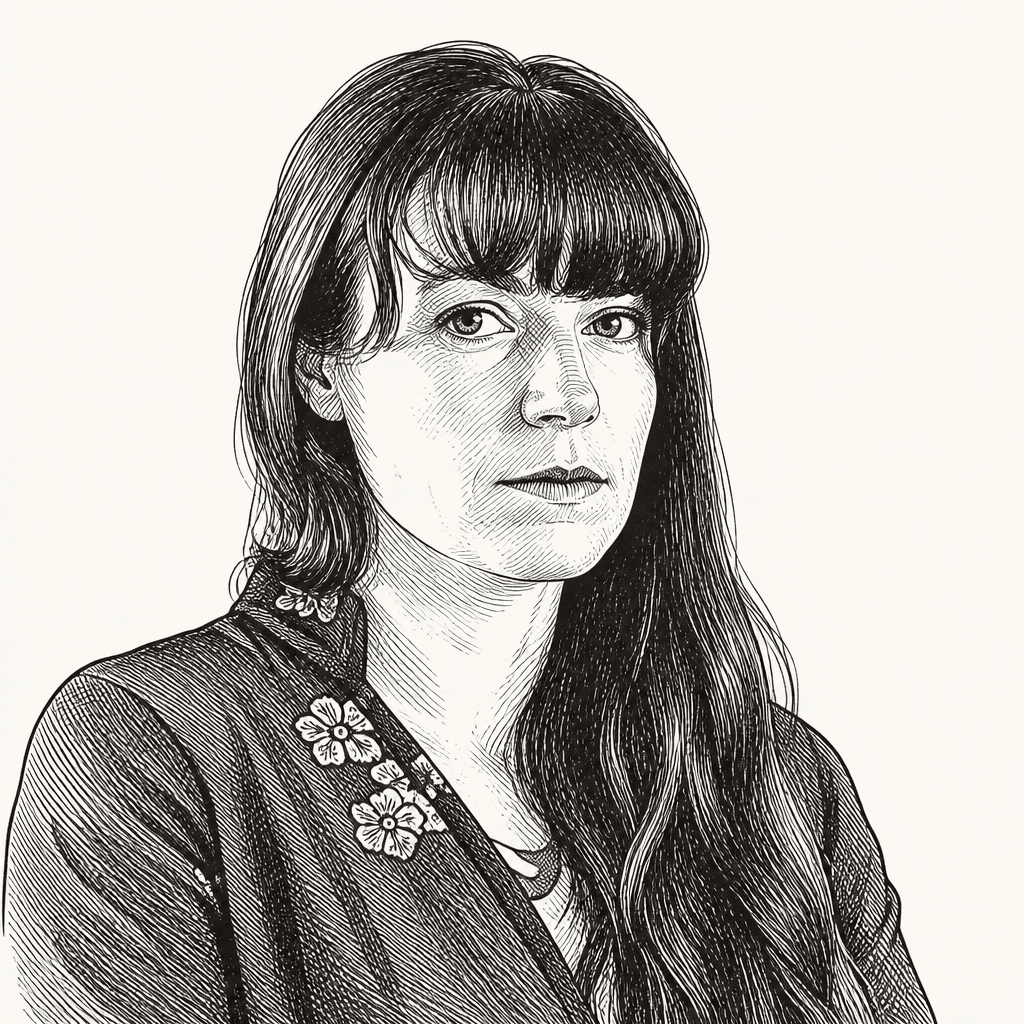
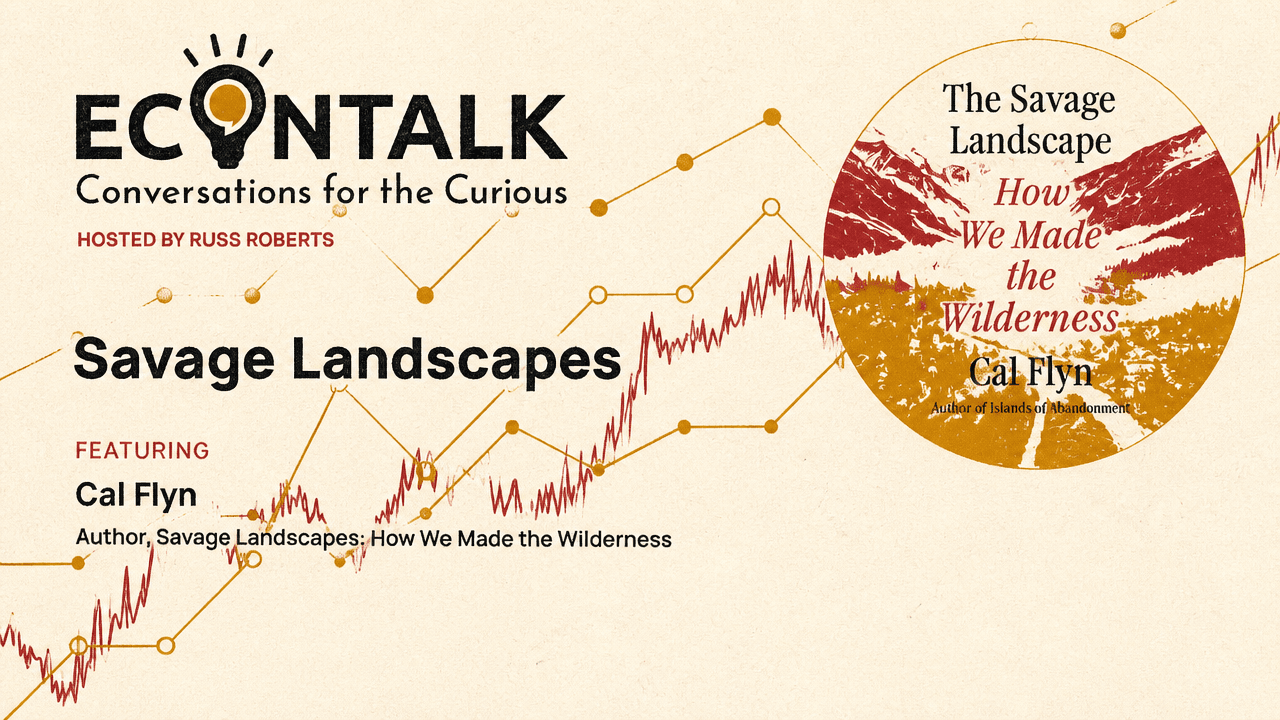
In *The Savage Landscape*, writer Cal Flyn argues that wilderness is not land untouched by people but a contested idea shaped by history, culture and power. Speaking with Russ Roberts, she examines how that idea influences conservation and predator reintroduction, including who gains from protected land and who bears its costs. Flyn also contends that the enduring appeal of wild places lies less in an escape from humanity than in encounters with fear, beauty and limits on human control.
Wilderness is not the absence of people
Wilderness is less a fixed category of land than a historically contingent idea: a place imagined as frightening, foreign, spiritually charged, or beyond ordinary human command. The word “savage” in The Savage Landscape is meant to retain that difficulty. It points to territory occupied by other species, sometimes by other people, and in religious traditions by forces or realms beyond the human.
But “savage” is also inseparable from a history in which Europeans applied the term to people elsewhere. No community calls itself savage; the savages are always presumed to live beyond one’s own boundary. That makes wilderness culturally relative as well as geographically slippery. A place can seem empty or untamed to an outsider while being the homeland, working landscape, or sacred terrain of the people who live there.
Cal Flyn argues that wilderness was traditionally understood as peopled. The modern ideal of a pristine landscape without people is comparatively recent, she says, and has created problems of its own. Her research repeatedly brought her to places described as among the planet’s last wildernesses, only for the category to dissolve on closer inspection. In the Yanomami Indigenous reserve in Amazonia, in the high mountains of Nepal’s Dolpo region, and in landscapes often treated by outsiders as remote and untouched, she found people with long-standing systems of habitation, belief, land use, and stewardship.
People are sewn up together with their landscape.
That discovery changed the terms in which Flyn thinks about nature. The opposition between “man” and “nature” does not hold up well, she argues, because people and landscapes are part of the same system. Cities are plainly human-made landscapes, but many supposedly wild places are cultural landscapes too.
Her earlier research in Australia made the point especially clear. When British and other European arrivals reached the coast of New South Wales, they described the landscape as resembling a country park: productive, open, generous, and apparently easy to inhabit. Flyn says that impression mistook the result of Aboriginal interaction with the terrain for untouched abundance. Firestick farming, the tending of fruit trees, and other purposeful practices had shaped what newcomers saw.
The larger pattern, in her view, extends well beyond Australia. What looks like wilderness to an outsider may have been shaped by people over centuries. It may be someone’s homeland, governed through concepts of ownership and responsibility that do not fit neatly into Western legal systems. Flyn says that when outside systems apply their own models of land ownership or stewardship to such places, they can override local practices at environmental cost.
This does not make wilderness meaningless. Flyn treats it as an emotional and spiritual concept, and sometimes as a legal or geographical designation. Maps can mark protected areas for practical reasons. But lived landscapes sit on a spectrum of human influence, from a tarmacked car park to a forest inhabited by mobile peoples. Human presence does not disprove wilderness. Flyn’s argument implies that decisions to designate and manage land must reckon with histories of human presence that an outsider’s idea of “empty” terrain can obscure.
That question carries directly into conservation. Once land is treated as vacant or available for a new purpose, someone must decide who can live alongside predators, gather resources, farm, hunt, or earn income from the reserve.
Predator recovery brings old conflicts back into daily life
A landscape does not become wild simply because large predators return or because authorities designate it a reserve. Predators change behavior, economies, land use, and political conflict—and force choices about who bears the risks and who benefits from protection.
Cal Flyn treats Europe’s recovering populations of bears and wolves as a living test of what people mean when they say they want a wilder landscape. In Romania, especially in Transylvania, brown bears have rebounded after a long period of protection that began under Ceausescu, who wanted bears available to hunt. At the same time, Romania has grown wealthier and expanded housing into areas that were relatively recently forest.
The result is conflict at what Flyn calls the “wildland urban interface”: bears entering towns, raiding school canteens, eating wax candles in churches, and consuming communion wine and wafers. Residents ask why they should bear risks that governments are meant to manage, particularly when children are involved. Fear of predators can exceed the danger they pose—Flyn says wolves are generally less dangerous to people than public imagination suggests—but that fear remains politically potent. Brown bears, she notes, are genuinely dangerous.
Elsewhere in Europe, wolves have returned to countries that had not seen them for a century or more. In parts of Iberia, livestock keepers have had to recover practices modern agriculture had allowed them to forget: specialist fencing, shepherd dogs, and methods for protecting herds. These are not abstract conservation outcomes. They impose costs on people whose animals are vulnerable and whose livelihoods may depend on open landscapes without hard borders.
Predators also matter because of what Flyn calls a “landscape of fear.” She acknowledges that the model can be simplified, but its basic proposition is that predators keep grazing animals moving and alert. That changes where herbivores feed, which vegetation survives, and how habitats develop. Bears, wolves, people, and prey species all exert effects that cascade through a landscape.
There is no uncomplicated return to a pristine baseline. Roberts notes that familiar landscapes in England and Scotland have been shaped by sheep farming over centuries. Flyn agrees that reintroducing major predators would involve economic and cultural decisions as much as ecological ones. The British case is especially revealing because, as an island, the United Kingdom would generally need to choose to bring predators back. Wolves are not likely simply to move in across a land border, as they have in parts of continental Europe.
Farmers tend to oppose reintroduction, while a vocal and increasingly mainstream constituency favors it. Flyn finds the impulse striking. In utilitarian terms, bringing predators back can look like self-sabotage: an invitation to economic inconvenience and psychological fear. Yet predators symbolize something beyond their own presence.
They don’t find it to be fearful enough, and so they’re trying to bring in fearful elements to kind of return that sense of the wild, however artificial that might be.
The same question of who lives with the consequences appears in trophy hunting, although the political arrangements are different. Flyn went to Mozambique’s Niassa Special Reserve to examine a proposition that can sound morally perverse but has practical force: revenue from killing a small number of animals can help finance the protection of a much larger population.
She shadowed professional hunter Paul Stones and two American trophy hunters in Niassa, near the Tanzanian border. The reserve is about the size of Switzerland and is divided into blocks, including hunting blocks. A lion hunt can cost more than $100,000. Flyn says much of that revenue can be absorbed by the practical expense of operating in such a remote region, but some is retained locally or used for conservation and anti-poaching patrols.
Flyn found the economic argument difficult to dismiss. Niassa is remote and unstable, making conventional high-volume photographic tourism difficult. After her visit, she says, a neighboring camp was raided and staff members were beheaded by Islamists hiding in the surrounding miombo woodland. In those conditions, Flyn reasoned, a small number of high-paying hunters may provide conservation revenue where photographic tourism is difficult to operate at scale.
But her reporting also distinguishes a community’s meaningful control over wildlife from a reserve model in which wealthy outsiders pay for access to land. In Niassa, villages exist on the edges of and within the reserve, while rights to use the land are negotiated with the land’s owners or managers. Local residents may be restricted from hunting themselves. What visitors rent is not only permission to kill an animal, but an experience of terrain whose everyday users may have limited rights within it.
| Place | Arrangement described by Flyn | Central tension |
|---|---|---|
| Niassa, Mozambique | Hunting blocks finance reserve operations and anti-poaching work; local residents may be restricted from hunting. | Outside clients pay for access to land used by nearby communities. |
| Namibia | Trophy hunting is more often run by communities themselves. | Community management can change who controls revenue and decision-making. |
| Kenya | Hunting has been banned since the 1970s. | Some former rangeland was converted to economically active farmland, and wildlife numbers fell. |
The racial and colonial dimension remains central to Flyn’s unease with the safari-hunting model. Trophy hunters today are often white and disproportionately American; historically they were often European and British. Flyn says that many Black Africans are uncomfortable with trophy hunting less because of the ethics of shooting animals themselves than because the model can preserve colonial ways of interacting between groups: affluent outsiders pay to exercise control over a landscape while local people retain constrained rights within it.
Community-run arrangements can change that political texture. Flyn points to Namibia, where trophy hunting is more often run by communities themselves. That does not erase internal disagreement: a village is not a single voice, and an economic model imported from elsewhere can create conflicts of its own. But it differs materially from a structure in which landowners, outside clients, and local residents bargain from unequal positions.
Her comparison with Kenya makes the land-use problem sharper. There, she says, hunting has been banned since the 1970s, but some former rangeland has been converted to economically active farmland. Wildlife numbers fell not necessarily because animals were hunted out, but because land acquired another profitable use.
The point is not that hunting resolves conservation’s moral conflicts. In Flyn’s account, ecological outcomes remain entangled with who has authority over a landscape, who receives its income, and who is expected to absorb the costs of keeping it wild.
Wilderness offers confrontation, not guaranteed revelation
The desire for wilderness persists even when people recognize that there is no untouched Eden waiting beyond civilization. What many seek, Flyn suggests, is not empty land but confrontation: an experience of fear, beauty, limitation, and otherness strong enough to interrupt ordinary habits of mind.
Cal Flyn distinguishes wilderness from the pastoral or merely picturesque. It is somewhere people move into territory occupied by others—by animals, by unfamiliar peoples, or by powers understood as transcendent. In such places, humans can feel less like proprietors than participants among species with agendas of their own.
That is one reason physical difficulty mattered to her fieldwork. Flyn describes herself as tenacious rather than naturally athletic: careful about preparation, able to persist through arduous travel, and determined to become capable. Yet she does not treat competence as mastery. Entering a difficult landscape can expose dependence, limitation, and the need to improvise.
Fear is not a stable measure of actual danger. Flyn says she has sometimes felt calm while genuinely at physical risk because she was with people who appeared confident. At other times, an objectively safe setting has produced a strong sense of threat. The gap between risk and perception interests her because it reveals where a person’s normal sense of control begins to weaken.
I’m really interested in where the edge of comfort is, and where we perceive that to be, and what we gain from pushing those boundaries.
For Flyn, writing The Savage Landscape became a wilderness trial in its own right. The familiar pattern of the wilderness quest is that a person leaves ordinary culture, encounters things they do not understand, wrestles with fear and difficulty, and returns changed. She found that physical discomfort and intellectual uncertainty often marked the point where she had reached a chapter’s real subject. When an encounter or argument made her feel unsettled, she took that instability as a sign that she was no longer resting on assumptions that had seemed solid.
The spiritual history of wilderness gives this pattern a long lineage. Flyn traces it through some of the earliest recorded literature: Gilgamesh’s search for immortality, the Buddha’s story, Prince Rama’s journey in the Ramayana, and traditions in which a departure from settled life becomes a precondition for insight. The seeker leaves culture, experiences strangeness, and returns more able to perceive something beneath ordinary appearances.
Mount Sinai provided a physical site from which to consider that history. The mountain associated with Moses, the burning bush, and Elijah’s revelation is also a geographically uncertain designation: no one can establish with certainty that the present pilgrimage site is the biblical mountain. It has a Christian monastery, steps carved into the mountainside, a newer camel route, guides, huts, and crowds of pilgrims climbing for sunrise.
The setting can be overwhelming: high, bald rock, desert darkness, and extraordinary color at sunset and dawn. But its infrastructure exposes a contradiction in wilderness-seeking. Famous sites of solitude and revelation become destinations for crowds, with prescribed routes and ready-made expectations of transformation. Hermits become famous enough to need secretaries; people seeking to escape society find themselves joining a social scene.
Flyn did not claim a revelation on Sinai. She felt amazement and aesthetic appreciation, but not the larger epiphany for which she had partly gone looking. Her more powerful moments arrived unexpectedly. In Antarctica, stepping onto the continent was remarkable but also organized and communal. A private moment—alone on a ship’s deck, seeing a particular alignment of icebergs or a shaft of sunlight—could carry greater force.
Planned journeys can still put someone in the path of experiences they cannot manufacture. But the experience itself cannot be scheduled, purchased, or guaranteed by an officially sacred location.
Flyn pursued the same question in Iceland, where she wanted to understand the sublime not as an art-historical label but as a lived sensation. The sublime, in the tradition she examines, is beauty mixed with horror: admiration fused with terror. Edmund Burke, writing in the eighteenth century, described it as the most powerful emotion known to man.
After finding waterfalls insufficient to summon that response, Flyn became obsessed with Icelandic eruptions. Her first attempt to see one failed when the eruption stopped before she arrived. On a later trip, she reached an active eruption that authorities had closed off as unsafe. Earlier eruptions had allowed visitors to approach on designated paths; this one had an exclusion zone.
She drove to its edge and walked across mossy heathland shaped by earlier lava flows. Hills concealed the crater until she was very close. The orange light, heat on her face, and scale of the eruption produced an experience she describes as aesthetically extraordinary but also terrifying. The fact that she had entered an area where she was not supposed to be intensified her fear: if anything happened, she believed, she had courted the danger herself.
I think I just blasted straight through sublime experience and came out the other side in just like a horror, terror for my life.
Flyn had gone looking for the mixture of attraction and dread that the sublime names, and found a version that overwhelmed the terms through which she had tried to understand it. She recorded raw impressions in her phone’s notes app and with voice memos because vivid sensations, strange images, and isolated words can be difficult to reconstruct after intensity fades.
This appetite for a more immediate reality, Flyn argues, is recurrent rather than uniquely contemporary. Comfort makes civilized life possible: it enables people to raise children, think, make art, and pursue intellectual work. Yet people also begin to worry that they have become too comfortable. Around the beginning of the twentieth century, anti-modernist writers worried that electricity, anesthetics, and other new conveniences had made life unreal or dulled experience. The anxiety resembles contemporary fears about phones and online life. The technology changes; the suspicion that mediation has distanced people from reality persists.
Her own account of wilderness makes the appeal concrete. Reducing possessions to two nested pots, a roll mat, tent, sleeping bag, and map; making fire, chopping wood, staying warm and dry, and navigating difficult terrain narrow life to fundamental questions of safety, survival, and supplies. For Flyn, that narrowing can bring calmness and clarity. A ridge, predator, storm, or route without an easy exit makes fear something to live with rather than merely avoid.
The forms of self-imposed confrontation vary across history. An early medieval Irish Catholic might set out alone on the sea in a coracle. An eighteenth-century Russian hermit might seek a lonely place in a forest. Others find the encounter in mountains, deserts, polar landscapes, or volcanic exclusion zones. What persists is a search for something solid enough to resist the self—something so real and natural, Flyn suggests, that it can begin to feel supernatural.