Remote Work Increased Court Output and Job Satisfaction, but Also Domestic-Violence Calls
 Steven Davis
 Cevat AksoyEnrico Miglino
 Francisco Perez-ArceHoover InstitutionWednesday, November 25, 202622 min read
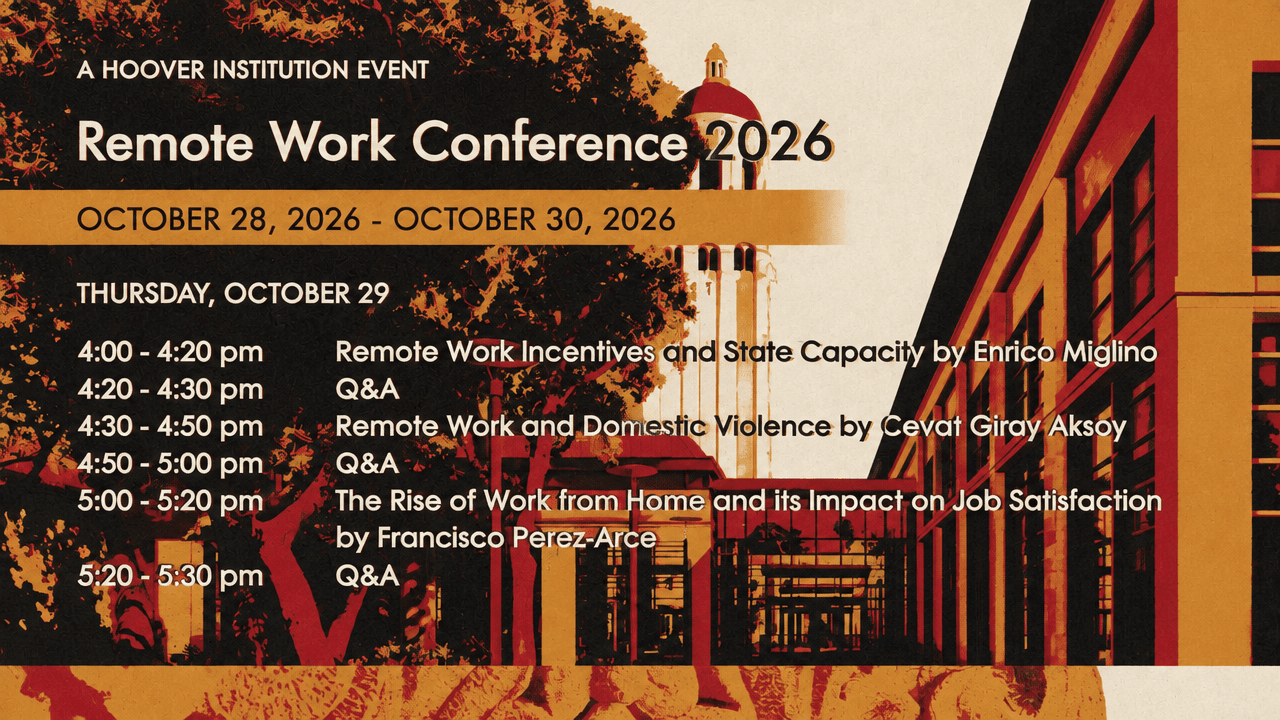
Remote work’s effects depend on the setting, and the evidence does not establish a single effect across workers and institutions. Enrico Miglino finds that an incentive scheme for judges handling cases remotely raised output in courts selected for difficulty meeting disposition-time targets, but cannot separate the effects of remote work and pay. Cevat Giray Aksoy links greater work-from-home feasibility to more domestic-violence calls on weekdays, while Francisco Perez-Arce finds an association between remote-work access and job satisfaction alongside qualified evidence that the pandemic-era shift raised satisfaction for workers whose jobs could be done remotely.
Remote work reallocates judicial capacity without moving judges
Enrico Miglino asks whether governments can shift public-sector capacity toward places that need it without physically moving the workers who provide it. His answer, based on Italian civil courts, is that remote work can help—but the evidence comes from a specific incentive scheme, and does not yet separate the effect of working remotely from the effect of being paid to take on additional cases.
Miglino defines state capacity as the ability to collect taxes, enforce law and order, and provide public services. In Europe, he shows, capacity varies substantially both between and within countries, and is strongly correlated with income: the displayed relationship between the EU Quality of Government Index and GDP per capita has a correlation of 0.7. Italy illustrates the distributional problem. The South is poorer than the North, and its courts are less efficient. The presentation reports that southern Italian GDP per capita is 43% lower; judgments take 3.9 years on average, compared with 2.8 in the North, and the backlog per judge is 83% higher.
That pattern matters, Miglino argues, because weak state capacity in poorer or marginal areas can reinforce economic inequality. It can also undermine civil rights and, in some settings, contribute to civil conflict. Yet shifting staff toward areas where they are needed is not straightforward. Moving workers can require compensation, overlapping staffing during transition, and investment in local infrastructure. Miglino’s estimates add a further cost: workers lose output while they transfer. Institutions may also restrict transfers. In Italian justice, judges cannot simply be assigned to another court; transfers are voluntary. And staffing needs change over time as judges retire or take leave and local demand shifts, making it difficult to predict where capacity will be needed.
The study asks whether the state can instead move the work. Miglino assembled data on about 10 million Italian civil proceedings from 2016 to 2026, drawing on the Ministry of Justice’s online platform. The records include first-instance cases across courts, with information on judges, courts, subject matter, filing and disposition dates, and some appeal outcomes from six courts of appeal. He uses the data to compare two approaches: transferring judges between courts and having judges work remotely on cases from other courts.
In the data, productivity varies more between judges than between courts
Miglino’s first step is to locate the source of variation in case output. Across judges, productivity is widely dispersed: a judge at the 25th percentile completes 14 cases per quarter, while one at the 75th percentile completes 72. He also constructs a measure that weights cases by complexity, using the average duration associated with a judgment’s subject-matter keywords relative to the average across judgments.
The differences between courts are smaller. In an adjusted variance decomposition that accounts for judges’ mobility across courts, judge effects explain 60% of productivity variation, compared with 11% explained by court effects. Adding court fixed effects raises the adjusted R-squared to 0.06; adding judge fixed effects brings it close to 0.5. In this setting, Miglino concludes, much of the relevant capacity resides in the judges themselves rather than in the court where they work.
That does not mean output is the only measure of performance. A judge’s decisions also need to be sound. Miglino measures quality using the probability that a first-instance judgment is overturned on appeal. He finds no evidence that greater productivity produces more reversals; if anything, his results suggest slightly lower accuracy among more productive judges. He also finds no correlation between productivity and compensation before the new scheme. Judges are evaluated every four years, and almost all receive a positive evaluation and the associated wage increase, so pay largely follows tenure rather than measured output.
Moving a judge physically appears costly in the short run. In an event study of transfers between courts, productivity begins to fall in the quarter before the move, reaches its lowest point in the quarter of transfer, and takes more than a year to recover. Miglino attributes this pattern to the work of handing over cases at the original court and learning the cases and procedures at the destination. He estimates a loss of about five months of output—roughly one month in the origin court and four in the destination court.
The alternative was a temporary remote-work scheme for judges. Italy had committed to reducing disposition time by 40% between 2019 and 2026 as part of its EU targets. In September 2025, the High Council of the Judiciary made it possible for up to 500 judges to apply to work remotely on cases from designated target courts while continuing their in-person work at their home courts. Judges who completed 50 remote proceedings between September 2025 and June 2026 received €9,515 net, or about €190 per case, plus seniority points. The heads of their home courts were meant to monitor whether their in-person output fell below the court average.
In practice, 212 judges participated, and Miglino identifies 139 of them in his first-instance data. He identifies judges who worked only in non-target courts before the scheme and then handled cases for both a non-target home court and a target court during the incentive period. Placebo checks in the prior year produce four false positives. The 139 are a subset of participants because the scheme also included judges in appeal and juvenile courts, which are outside this part of the analysis.
The program’s geography reflects the policy’s target: courts were selected for their difficulty meeting the disposition-time goal, not simply because they were in the South. Miglino separates target courts, judges’ home courts, and courts not involved in the scheme. Before the program, average judgment duration was almost a year longer in target courts than in home courts.
The scheme also attracted judges who were already relatively productive. Before the incentive, participating judges completed about 80 proceedings per quarter on average, compared with 51 for other judges. Miglino had expected that judges who were not otherwise doing much might be especially likely to participate. The observed pattern was the opposite: the participants were, on average, high-output judges who took on more work.
Output rose in target courts, but the intervention combines remote work and pay
Miglino’s event study finds an increase in participants’ productivity once the incentive period begins. The increase in remote proceedings was not fully offset by a decline in in-person proceedings. In his difference-in-differences estimates, participating judges completed four more unweighted proceedings per month, from a baseline average of 24—a 16% increase. When he weights for case complexity, the estimated increase is 30%. In-person output fell by about three proceedings per month in one specification, while remote output added about seven, leaving a net gain of around four.
At the court level, target courts’ completed proceedings rose by 9%, or 19% when weighted for complexity. Within the ten-month period, their backlog fell by about 5% and disposition time by 6%. The raw trends presented by Miglino show target courts catching up with home courts during the incentive period.
He also compares the scheme with two alternatives: transferring judges physically and hiring additional judges. The exercise holds constant the increase in target-court output achieved by the remote-work program—about 25,000 proceedings over ten months—and asks what each method would do to total output, not only output in the target courts. In his comparison, physical transfers perform poorly in the short run because gains at destination courts are offset by adjustment losses elsewhere. Hiring adds the most aggregate output, but is the most expensive option. The remote-work incentives fall between the two: aggregate output rises, though by less than the gain in target courts because home-court output declines somewhat, and the fiscal cost is lower than hiring or physical transfers.
Miglino describes remote work as a potentially useful, relatively low-cost instrument, not a substitute for staffing in every circumstance. He notes that the scheme was temporary and that remote proceedings could carry longer-run costs if they reduce interaction between judges and lawyers. He also reports that a separate paper finds lawyers do not like remote work in the justice system. The results, he suggests, may nevertheless have relevance to other public services where work can be reassigned across locations, including tax administration, public procurement, welfare processing, urban planning, and telemedicine.
Discussion sharpened the boundary of the finding. One question was whether procedures differ enough across courts to complicate comparisons. Miglino said the laws are broadly the same across Italy, though the mix of cases differs: the South has more cases per resident and, he thought, more family-related cases than business-related ones. Another question concerned decision quality after the incentive began. He could not yet answer it using appeals data: the scheme had just ended, and appeals take time to observe.
The most important identification question was whether the results show the effect of remote work or simply of performance pay. Miglino said he could not disentangle the two. He suggested they may be complementary: a judge asked to help another district has little reason to do so without an incentive. The program had not been renewed at the time of the presentation, and he said officials were waiting until after an election before deciding whether to act.
Participants also questioned how far the results could generalize beyond the unusually productive judges who selected into the program. Miglino argued that selection does not by itself explain the estimated increase: the analysis includes judge fixed effects and compares participating judges with their own prior performance. But he agreed that effects could be smaller if the program were extended to everyone. He had not yet estimated how the effect varies with baseline productivity, though he considered that a useful next step.
A discussant noted that the payment could be a substantial incentive per case, particularly for judges able to complete the target of 50 cases quickly. Miglino responded that Italian judges earn about €130,000 per year on average, so the marginal value of the payment might be limited for many, helping explain modest take-up. Pay also varies with seniority. He hoped to link his data to social-insurance records to measure compensation more accurately than his current estimates allow.
A final challenge concerned what it means to say that state capacity resides in individual workers. One participant asked how this fits with explanations of regional development based on long-run institutions, culture, or historical origins. Miglino did not claim to explain the origin of the North–South gap. He said it could reflect infrastructure, long-term investment, or personnel shortages and misallocation, rather than judges from one region being inherently less capable. Many participating judges were born in the South, even if they worked elsewhere. His narrower claim was that remote work could reduce a spatial mismatch in judicial capacity without requiring a theory that one group of judges is better than another.
Domestic-violence calls rose where remote work was most feasible
Cevat Aksoy and his co-authors study whether the shift toward working from home changed the risk of intimate partner violence by increasing the time household members spent together. The direction was not obvious in advance. Less commuting stress and less work–family conflict could ease tensions; employment and economic independence could also strengthen women’s outside options. But more time in close proximity could intensify conflict, increase controlling behavior, or remove time and space that had served as a refuge.


Aksoy’s main evidence comes from Los Angeles Police Department records covering 1,098 reporting districts across 21 policing areas. The study compares changes after the pandemic in neighborhoods with different levels of pre-pandemic work-from-home feasibility, including comparisons within the same policing area. Feasibility is constructed from the occupational composition of each district before the pandemic. Across the districts, it ranges from 9% to 78%; the average feasibility of the four quartiles is 22%, 32%, 46%, and 60%. Fifteen of the 21 policing areas contain both bottom- and top-quartile districts.
The LAPD data include calls for service, recorded crimes, and arrests. Calls can be distinguished by severity and have incident timestamps, allowing the researchers to compare weekdays and weekends and examine hours of the day. The baseline analysis excludes 2020 and 2021, though Aksoy also presents event studies that include the lockdown period. The study’s main estimates are intention-to-treat: they use whether a neighborhood’s pre-pandemic jobs could be done from home, not a direct measure of every resident’s actual remote-work hours.
The central result is concentrated in the districts with the greatest feasibility. Domestic-violence calls in the highest-feasibility quartile rose by 16% relative to the lowest; the weekday increase was 22%, while the weekend estimate was small and statistically insignificant. The presentation’s raw weekday trends show calls falling in the lower quartiles and rising in the top one. The pattern is not apparent in the middle quartiles. In a continuous-feasibility specification, a ten-percentage-point increase in feasibility is associated with 3.3% to 3.7% more calls across severity categories. For medium- to high-severity calls, Aksoy estimates this corresponds to about 810 additional calls per year across Los Angeles relative to 2019.
The distinction between weekdays and weekends is central to the proposed explanation. In the highest-feasibility districts, the weekday increase is especially pronounced; Aksoy reports an increase of about 17% in one comparison, while calls fell by 12% to 20% in the other quartiles. The event study shows no significant pre-trend for the top quartile. The difference grows during the lockdown period and remains elevated after 2022.
At the daily level, the increase begins on Monday, becomes significant on Tuesday, peaks on Wednesday, and remains elevated through Friday. At the hourly level, it appears during working hours: calls rise from around 8 a.m., are highest from 8 a.m. to 4 p.m., and then decline. Aksoy reports no detectable overnight increase.
The pattern extends beyond calls. Recorded domestic-violence assault reports rose by about 18% in the highest-feasibility districts, and arrests by about 23%. The presentation estimates roughly 320 additional assault reports per year in the top-quartile districts compared with their 2019 level, about 260 of them on weekdays. The researchers also report a similar high-feasibility pattern in nine other settings across the United States, Canada, the United Kingdom, and Australia. Those data do not provide the same detailed timestamps as the LAPD records, so they support the broader association but cannot reproduce the weekday and hourly analysis.
The timing fits co-presence, but it does not establish the mechanism
Aksoy treats the weekday and working-hours concentration as evidence consistent with a co-presence mechanism. If more people are working from home, partners who previously spent much of the working day apart may be at home together. Using American Time Use Survey diaries, the researchers find that people in occupations with high remote-work feasibility spent more time working at home on weekdays than they did in 2019. They report little change in other activities at home or away from home, and little change on weekends. Separate estimates from neighborhood data show workday co-presence among couples increasing by 11 percentage points in high-feasibility areas, compared with two points in low-feasibility areas.
A further test compares domestic-violence calls with non-domestic-violence calls for similar kinds of incidents, including battery and assault. The researchers calculate whether the weekday–weekend gap changed more for domestic-violence calls than for comparable calls without the domestic-violence flag. They find that it did. In the top quartile, the weekday shift for domestic-violence calls is significantly larger than for non-domestic-violence calls, and the triple-difference event study shows no significant pre-trend.
The researchers also find larger increases in neighborhoods with limited residential space. They do not find a similar pattern by population density or the share of renter-occupied homes. Aksoy presents this as suggestive evidence: limited space may make it harder for household members to avoid tensions when they spend more time together, but the neighborhood-level results do not directly observe what happens inside individual homes.
Several alternative channels receive little support in the analyses shown. The researchers do not find a larger deterioration in employment in high-feasibility neighborhoods; job separations and turnover were lower in more teleworkable occupations. Calls involving mental-health crises or attempted suicides did not increase more in high-feasibility districts. The effect was not significantly larger in areas with more households with young children, and the researchers find no variation by pre-pandemic commuting times.
The findings do not yet distinguish an increase in incidents from an increase in detection or reporting. In discussion, participants noted that a neighbor working from home might be more likely to hear an incident and call the police, even if the victim does not report it. Aksoy said the LAPD records identify who made the call, so the researchers could test whether the increased calls came from neighbors or other third parties. He also pointed to the consistency across calls, recorded crimes, and arrests as encouraging, while agreeing that the reporting channel needs more direct investigation. Emergency-department visits could provide another measure less dependent on a neighbor’s decision to call, and the team had applied for access to those data.
The study also leaves open whether the rise reflects new victims or repeated incidents involving the same people. The authors plan to examine victim and suspect characteristics in police records, and to use individual-level Add Health data to follow people before and after the pandemic. In response to a question about the pandemic period itself, Aksoy agreed that the timing deserves closer attention: if co-presence creates the risk, one might expect a particularly large increase during lockdown. He said reporting changes could complicate that interpretation.
Aksoy gave a preliminary estimate of about 390 additional incidents in the top-feasibility quartile, but said a more complete calculation was needed to estimate how many incidents across Los Angeles might be attributable to remote work. He acknowledged that the percentage change is large relative to a low base.
Job satisfaction rises with work-from-home access, while access remains unequal
Francisco Perez-Arce and co-authors Marco Angrisani and Arie Kapteyn ask how much workers value the option to work from home and whether the pandemic-era expansion improved job satisfaction. Their evidence comes from the Understanding America Study, a longitudinal panel recruited from U.S. postal addresses. It includes about 15,000 panel members, with tablets and internet access provided to those who need them. The researchers combine work-from-home surveys conducted in 2021, 2022, and 2023 with biennial measures of job satisfaction from 2015 through 2024.


The authors use three approaches. First, they ask workers who want more remote work how much pay they would give up for an additional day at home. Second, they relate employer-allowed remote-work days to job satisfaction, both across workers and within the same worker over time. Third, they use the pandemic-era shift as a natural experiment, comparing changes in satisfaction for workers whose jobs were remote-work-amenable at the start of the pandemic with changes for those whose jobs were not.
The approaches address different limitations. A direct willingness-to-pay question measures a stated preference, not a realized wage trade-off. Regressions relating satisfaction to allowed remote-work days may capture other features of the job or employer that change alongside remote-work policy. The pandemic comparison avoids relying only on workers who later switched jobs or employers, but depends on the assumption that satisfaction trends would otherwise have been similar for workers in amenable and non-amenable jobs.
Workers value another day at home, but preferences are not the same as causal effects
The survey asks whether a worker’s current job can be done from home at least part of the time. About half of workers say yes. Among workers with remote-work-amenable jobs, more than 40% would like to work from home more often than their employer allows. In the three survey waves, the share wanting more days was 37% in 2021, 47% in 2022, and 43% in 2023.
To measure willingness to pay, the researchers offer workers a hypothetical job like their current one, but with one additional day of remote work and lower pay. The first offer is a 5% pay cut; subsequent accept-or-reject questions vary the cut to locate the range at which the worker would switch preferences. The question is asked only of workers with amenable jobs who want at least as many remote days as their employer currently permits.
About 42% to 46% of respondents in those groups would not accept even a 1% pay cut for an additional day. Among those who would, the average stated willingness to pay is about 3.5% of current wages. The value is higher for people with longer commutes and for women, and lower for workers over 50. These estimates describe the subset of workers who both can work from home and want more of it; they should not be read as the average value for all workers.
The second approach relates job satisfaction on a five-point scale to the number of days per week an employer allows remote work. In pooled regressions, each additional day is associated with a 0.02- to 0.03-standard-deviation increase in job satisfaction, with little change after adding controls for demographics, earnings, commuting time, and job benefits. A fixed-effects analysis, which uses changes within the same worker, estimates a somewhat larger increase of about 0.035 to 0.037 standard deviations per additional allowed day. The result is similar when restricted to workers who did not change jobs or employers, and the researchers report similar estimates for changes associated with switching jobs and changes in an employer’s remote-work allowance.
These associations are consistent with workers valuing remote work, but they do not by themselves establish that the work arrangement caused the entire difference. A worker may change jobs or receive a new remote-work policy at the same time as other job conditions change. Even within-worker estimates can include changes in management, communication, or other amenities that accompany a remote-work arrangement.
The third approach uses the pandemic’s expansion of remote work. Workers whose jobs were remote-work-amenable at the start of the pandemic form the treatment group; workers in jobs that were not amenable form the comparison group. The authors track satisfaction with work and daily activities from 2015 to 2024. Before the pandemic, the two groups had similar satisfaction trends in the data shown. After the pandemic began, satisfaction rose relative to the comparison group for workers in amenable jobs. The estimated difference is about 0.06 to 0.07 standard deviations, equivalent to roughly 0.14 to 0.17 points on the original 0–10 scale. Adding controls for demographic characteristics, income, and occupation does not eliminate the estimate.
In the event study, the difference remains elevated through the later survey period rather than appearing only as a short-lived response to the pandemic’s onset. The authors report no significant pre-pandemic difference, while noting that the available pre-periods offer a limited test. Exploratory subgroup estimates suggest that women account for much of the observed effect, but the sample is too small for the authors to treat that pattern as conclusive.
To express the pandemic estimate per additional remote-work day, the researchers use an instrumental-variables calculation. The instrument is whether a worker’s job was amenable to remote work at the pandemic’s start, interacted with the post-pandemic period. The calculation requires a measure of how many days workers worked from home before the pandemic. The survey asks respondents to recall their typical 2019 schedule; amenable workers report about one day per week before the pandemic and about two afterward. The authors warn that retrospective reports may overstate pre-pandemic remote work because of telescoping bias. If the reported one-day baseline is accepted, the estimate is about 0.07 standard deviations per additional day. If the pre-pandemic baseline is assumed to be zero, the implied effect is smaller, around 0.04 standard deviations. The authors describe this as a benchmark for magnitude rather than a precise causal estimate; the sample is smaller and the first-stage statistics are weak.
Across the three approaches, the estimated value is broadly similar: the survey-based willingness-to-pay and satisfaction regressions, and the pandemic comparison, all point to a positive relationship between remote work and satisfaction. The authors compare the pandemic estimate with a firm-level experiment in Shanghai that shifted workers from no remote work to a two-day hybrid schedule. That study’s reported gain was 0.35 points on a 0–10 satisfaction scale; the authors’ estimates imply roughly 0.32 points for two additional days under one conversion. The outcomes and samples differ, so the comparison is a reference point rather than a direct replication.
Probability sampling is an advantage to evaluate, not a guarantee
The authors emphasize that the Understanding America Study is probability-based, longitudinal, and includes people without pre-existing internet access. They contrast it with opt-in internet panels used in some work-from-home research. As an example of why sampling design can matter, Perez-Arce presents prior survey research on COVID-19 vaccination: large non-probability surveys overstated vaccine uptake more than probability-based panels did in comparison with the CDC benchmark.
That claim prompted a qualification from Steven Davis. Davis agreed that probability-based sampling can be valuable but pushed back on treating it as automatically superior. A random sample of addresses does not guarantee representativeness if participation is low, particularly among demographic groups that are difficult to reach. He asked for the panel’s take-up rate and argued that each survey and sampling scheme must be assessed on its own results, rather than receiving more weight simply because it began with a probability sample.


Perez-Arce said the Understanding America Study’s take-up rate—from the initial mailed invitation to answering a survey—is about 15%. The study oversamples areas with larger Black and Hispanic populations and uses weights to address differences in response. He agreed that survey quality and sampling need to be evaluated individually. Davis accepted that probability panels may perform better in particular comparisons, while maintaining that there is no shortcut from sampling label to survey quality.
Davis raised a second measurement question: whether a longer willingness-to-pay sequence, like the study’s changing pay offers, produces similar answers to a shorter direct question. The latter uses less survey space, but he said it was not clear whether the two methods deliver comparable estimates for the same population. He also suggested connecting the findings to evidence that workers changed jobs after the pandemic to find arrangements they preferred. Perez-Arce agreed that revealed-preference evidence was relevant.
The discussion also returned to what a satisfaction change means in economic terms. Asked whether the estimates could be translated into a share of wages, Perez-Arce said the authors’ compensating-wage analysis produced a figure of about 5%. He added that their calculation suggested the remote-work amenity may have offset a substantial portion—about 80%—of a decline in wage inequality between 2021 and 2024. He described that as a reason to consider whether the amenity itself changes how workers experience inequality, not as a claim that remote work equalizes access to jobs.
That distinction is central to the paper’s conclusion. Access to working from home is associated with higher job satisfaction, and the pandemic-era shift appears to have raised satisfaction among workers whose jobs could be done remotely. But those jobs were not distributed evenly. Workers who could benefit from remote work were better positioned to begin with, so the same amenity that raises satisfaction for some can widen differences in reported satisfaction across workers.
Perez-Arce said the team is continuing to collect related data through the study’s core surveys, though the separate work-from-home survey is no longer being fielded. He identified possible next questions, including whether the satisfaction gap converged in 2024–2026 and how remote work interacts with AI or affects workers with disabilities and transportation barriers. The discussion also raised a measurement challenge: remote work may arrive bundled with better management, communication, or other workplace amenities. Perez-Arce said the survey did not currently capture all those practices, but he was open to adding questions.