The Declaration of Independence Became America’s Unity Document Over Two Centuries


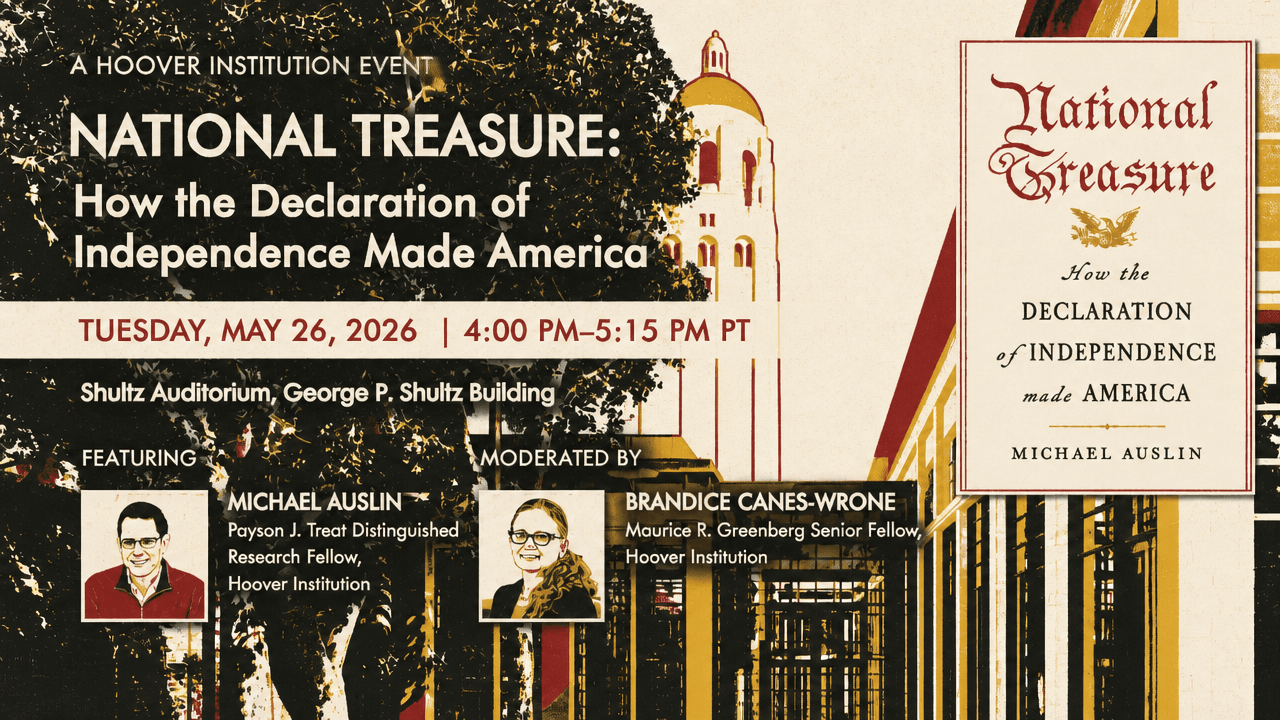
In a Hoover Institution book launch for National Treasure, historian Michael Auslin argues that the Declaration of Independence began as a wartime instrument and diplomatic necessity before Americans made it a sacred national text. Auslin’s central claim is that the document’s afterlife — as parchment, symbol, commercial object, equality claim and constitutional touchstone — shows it was not only about liberty and equality, but also about creating “one people” out of divided colonies.
The Declaration began as an instrument of war, not an object of reverence
Michael Auslin argues that the Declaration of Independence became a sacred American text only after a long afterlife. In 1776, it was something more immediate and practical: a necessary step in a war the colonies were losing.
The Continental Congress needed foreign aid, especially from France and Spain. Auslin’s formulation is blunt: the colonies could not plausibly seek outside help if their real goal was merely to rejoin Britain on better terms. Independence made possible diplomacy, loans, arms, and formal relations with other powers. On June 11, 1776, the same day Congress appointed the Committee of Five to draft what became the Declaration, it also appointed committees to prepare a model treaty with foreign nations and to devise Articles of Confederation. The Declaration belonged to that same urgent administrative and strategic moment.
That is not how Americans usually remember it. Auslin described the familiar “heroic image” of Thomas Jefferson struggling by candlelight to produce “the greatest thoughts ever written.” He did not reject the importance of the myth, but he insisted that the working reality was different. Jefferson wrote quickly, in roughly a week to ten days, while serving on four other committees. Congress did not stop everything to honor the text. The document was debated, edited, printed, sent out, and only later engrossed on parchment. The signing of the parchment copy did not happen on July 4, but began weeks later, probably on August 2, and continued after that.
This was the midst of a losing war, and there was a lot to do.
The Declaration also had an internal audience. It was not written only for King George III. It was meant to tell the colonists why they were fighting, why the break had become necessary, and why they now had to choose sides. Auslin cited John Adams’s later estimate that, at the time of independence, roughly one-third of Americans supported independence, one-third remained loyalists, and one-third had no clear opinion. The Declaration had to encourage patriots, sway the undecided, and perhaps win over some loyalists.
That is why it was printed immediately. John Dunlap produced perhaps 200 copies on the night of July 4, and those copies were sent through the colonies. What most Americans now treat as the document’s core — the preamble, the claim that all men are created equal, the appeal to self-evident truths — was not necessarily what contemporaries emphasized. Auslin said they were more focused on the justification for rebellion: the 27 charges against the king.
The date itself became part of the afterlife. Congress voted for independence on July 2, the day Adams expected Americans would commemorate. July 4 became the national date because someone — Auslin said the person is unknown — placed “In Congress, July 4, 1776” at the top of the first Dunlap printing. The printed form helped fix the memory.
Brandice Canes-Wrone introduced the question of why the founders thought a written declaration was necessary and why it mattered to bring that declaration “to the people.” Auslin’s answer was that the Declaration became an American birth certificate only later. At first, it was a public explanation, a diplomatic signal, a political mobilization device, and a step toward self-government.


Jefferson’s originality lay in phrasing an existing American mind
Auslin does not present Jefferson as inventing the Declaration’s ideas from nothing. Asked how original Jefferson thought the claims were, Michael Auslin answered by invoking John Adams and Richard Henry Lee: not original at all. Jefferson himself later agreed.
The argument over authorship and originality, Auslin said, only became possible once the Declaration had begun to take on a larger symbolic life in the second decade of the nineteenth century. In the first decades after 1776, Americans celebrated independence, but they did not constantly quote the Declaration itself. Newspapers and public commemorations referred to the event more than the text. Only later did the document’s language become a central object of reverence and contestation.
Adams argued that the Declaration contained “nothing original,” nothing that had not been circulating for years in Boston, in George Mason’s Virginia Declaration of Rights, in Locke, and in colonial political argument generally. Richard Henry Lee saw it as essentially a restatement of Locke’s Second Treatise. Jefferson, writing to James Madison, accepted the point. His task had not been to create new doctrine. Had he done so, Auslin suggested, the novelty would have invited argument. Jefferson’s job was to express what he later called “the American mind.”
That mind had been forming in colonial assemblies, churches, pamphlets, street politics, and revolutionary writing. Auslin mentioned Sam Adams and Thomas Paine as figures who helped shape the political atmosphere that Jefferson distilled. The achievement was not conceptual novelty but compression, cadence, and authority.
The Declaration was also heavily edited. Auslin credited Congress’s edits as important and, in many cases, effective. The text that Americans know was not simply Jefferson’s draft. It passed through the Committee of Five and Congress, and the record of who made many changes has been lost. No detailed notes survive from the crucial debates of July 3 and 4. Jefferson later annotated changes, but Auslin cautioned that historians do not know how accurate those retrospective notes are.
One change matters especially for Auslin’s interpretation. Jefferson wrote in the first line that “it becomes necessary for a people” to dissolve political bands. Someone changed “a people” to “one people.” Auslin said many like to think Benjamin Franklin made the change, and he sees evidence for that possibility, but the identity is not certain. The effect, in his reading, is unmistakable: representatives of 13 colonies, soon to be states, announced themselves as “one people.”
That edit supports the book’s larger claim that the Declaration is not only a liberty document or an equality document. It is also, in Auslin’s phrase, “our great unity document.”
The parchment’s fame came late, and commerce helped make it public
The parchment now displayed at the National Archives was not widely known to ordinary Americans in the early republic. Michael Auslin stressed that for roughly the first four decades of American history, most Americans did not know that the formal engrossed parchment existed. It was a state paper, first under Congress and then under the Department of State. It traveled with government papers, was rolled up, stored, and moved through temporary buildings. When the federal government was established in 1789, it became the property of the State Department, making Jefferson, as the first secretary of state, the custodian of his own handiwork.
The parchment’s public life changed after the British burned Washington in 1814. The Declaration, Constitution, journals of the Continental Congress, and other papers were saved less than 24 hours before the State Department building near the White House burned. Auslin emphasized that the familiar story of Dolley Madison saving the Declaration is a later myth. The actual rescue, in his account, was carried out by a State Department clerk.
The story of survival mattered. Americans began asking what, exactly, had survived. The revelation that there was a physical parchment copy coincided with renewed patriotism after the War of 1812. Auslin described the United States as having, for the second time in a generation, fought the world’s greatest empire and emerged as “a going concern.” At the same time, revolutions and independence movements abroad — France earlier, then Latin America and others — were drawing inspiration in part from the American example.
The Declaration’s spread into popular culture came through what Auslin called “a wonderful marriage of civics and commerce.” Entrepreneurs produced artistic reproductions, called facsimiles, and advertised them as objects Americans should hang on their walls. These were not precise facsimiles at first. The signatures were carefully traced, but the text did not closely resemble the original parchment. Still, the reproductions sold. There were knockoffs, pirated editions, subscriptions, cheap versions, and high-quality prints.
John Trumbull’s famous painting of the presentation of the draft Declaration to Congress followed a similar path. Auslin noted that many people mistakenly think the image depicts the vote for independence. It does not. It shows the presentation of the draft. The painting became part of the Declaration’s visual culture through subscriptions and prints, with Jefferson placed at the center.
For Auslin, one transformative moment came on July 4, 1821, the 45th anniversary of independence. The original parchment was taken from the State Department to Congress. The galleries were opened. John Quincy Adams, then secretary of state and soon to be president, read the parchment and delivered the speech remembered for the line that America “goes not abroad in search of monsters to destroy.”
Auslin argued that another part of Adams’s speech deserves more attention: Adams publicly linked the Declaration to the constitutional order. In Auslin’s reading, Adams presented the Declaration as the source of an ordered system of liberty. That helped move the document into a new role. It was no longer just the 1776 instrument of independence, nor simply a statement of liberty. In the nineteenth century, especially as abolitionism and women’s rights gained force, Americans increasingly turned to the preamble and to the claim of equality.
The document that began as a wartime justification became, through politics, commerce, memory, and reform, a text Americans used to argue about the meaning of the country.
The slavery clause was removed, but the equality claim remained available
In Michael Auslin’s account, the drafting process is both fascinating and incomplete in the historical record. Jefferson’s handwritten, hand-edited draft survives in part because he was angry enough about Congress’s edits to copy and circulate versions of his draft. About six such copies exist, and John Adams also made a handwritten copy of an early version now held by the Massachusetts Historical Society. Auslin called that Adams copy important because it may be closest to Jefferson’s earliest text.
Two major deletions are clear. Congress removed Jefferson’s attack on the British people, which Auslin called an “intemperate ad hominem” passage. That made political sense in his telling: many loyalists still lived in the colonies, and many Americans expected some continuing relationship with the British people. Congress also removed Jefferson’s condemnation of the slave trade, which laid responsibility at King George III’s door. Auslin stressed that the passage attacked the trade, not slavery per se. Jefferson had tried to ban the slave trade in Virginia and believed ending the trade would eventually end slavery.
The deletion came from interests that Auslin identified primarily as Southern agrarian, though he also mentioned Northern mercantile interests. He called it “the first deal with the devil” and “the first can kicked down the road.” It was a compromise that avoided breaking the nascent union. Jefferson accepted it unhappily rather than walking out or delegitimizing Congress.
The harder question is what “all men are created equal” meant. Auslin emphasized that Jefferson did not write “all Englishmen,” or “all property-owning white Englishmen.” Congress kept the broader phrase. Whether it included women, Black people, Indigenous people, and others remains debated. But the wording gave later Americans a claim to press.
By the decades before the Civil War, abolitionists and eventually Abraham Lincoln fastened on equality. Auslin did not suggest that the contradiction between the Declaration’s principles and slavery went unnoticed in 1776. Figures such as Jefferson, George Mason, Richard Henry Lee, and foreign critics recognized it. But by the nineteenth century the argument had shifted from hypocrisy at the founding to the illegitimacy of slavery’s persistence.
For Lincoln, as Auslin described him, the Kansas-Nebraska Act of 1854 and the Dred Scott decision of 1857 were deformations of the founding intention. In Auslin’s account, Stephen Douglas treated popular sovereignty as decisive: if a territory voted for slavery, slavery was legitimate because it reflected consent of the governed. Auslin also described Dred Scott as going beyond the merits of the case by denying Black citizenship and treating Black people as property, thereby instantiating chattel slavery at the highest legal level. Lincoln saw such developments as unacceptable distortions of the Declaration.
Auslin situated this within an ongoing conservative debate over Lincoln’s reading. Harry Jaffa’s early work, A House Divided, argued that Lincoln reinterpreted the Declaration. Jaffa’s later A New Birth of Freedom, written nearly half a century later, recast the matter: Jefferson had meant what Lincoln later drew out. Auslin did not resolve the debate as doctrine. As a “nuts and bolts historian,” he said he is interested in how, by Lincoln’s time, this equality interpretation broke through.
The Confederacy offered a competing interpretation. Auslin rejected the simple claim that Confederates hated the Declaration. They hated part of it, but they built their case for secession on another part: consent of the governed. In Auslin’s view, they were not wrong that the Declaration had long been understood to make legitimate government rest on consent, and some Northern newspapers accepted that argument before the war, provided secession occurred peacefully. That was the impossible condition. Lincoln would not allow peaceful disunion, and the South did not depart peacefully.
The war became, in this reading, a fight over whether the Declaration meant union or radical sovereignty. Jefferson Davis and Alexander Stephens themselves differed over whether “all men are created equal” was wrong, or whether the phrase had never meant universal equality. Had the South won, Auslin observed, its interpretation would have gained historical force through victory. Instead, its understanding was “refuted bloodily and thoroughly.”
Lincoln’s Declaration may have been protected as a wartime object
Michael Auslin follows not only the Declaration’s ideas but also the physical parchment. One of his historical claims concerns the Civil War and the long-assumed location of the document. He presented it as an alternative explanation supported by suggestive evidence, not as a settled correction of the record.
Every official or unofficial account Auslin encountered stated without qualification that the Declaration hung in the Patent Office from 1841, when Daniel Webster sent it there, until 1876, when it went to Philadelphia for the Centennial Exposition. The Patent Office building is now the National Portrait Gallery. But as Auslin worked on the Civil War chapter, that settled account began to seem implausible to him.
Washington in 1861 was a frontline city. Virginia lay across the river and became the capital of the Confederacy. Maryland, a slave state, remained in the Union under pressure. Washington contained Southern sympathizers, spies, and saboteurs. Newspapers North and South expected invasion in the first months of the war. After the Union defeat at Bull Run, the danger appeared immediate.
Auslin found it strange that the document Lincoln treated as foundational to his political philosophy would have remained unguarded in a building turned into a military hospital and used as barracks. The Patent Office was, in his account, ransacked by Union troops while they were there. The Declaration had already survived one British burning of Washington in 1814. Auslin asked why Lincoln’s government would leave it hanging on a wall in wartime.
The possible answer emerged through digitized sources. Auslin said he had been trained in the 1990s, when serious archival work meant going physically into archives. He had once regarded digitization as something like a cheat. But digitized newspapers, periodicals, local accounts, and guidebooks allowed him to search obscure material that may not have been consulted since publication.
He found what he called not quite a smoking gun, but real evidence: before Bull Run, people discussed the Declaration in the Patent Office; after Bull Run, people discussed the Patent Office without mentioning the Declaration. That absence was striking to him because for two decades accounts of the Patent Office had routinely mentioned the Declaration. Auslin’s alternative explanation is that the parchment may have been secretly moved from the Patent Office back to the Executive Square, the White House complex where the rebuilt State Department stood, and kept under guard.
He did not claim this changes the course of history. Its importance lies in how it fits Lincoln’s understanding of the Declaration. Lincoln stopped at Independence Hall on his way to Washington for his inauguration in February 1861 and said he had never had a political feeling that did not spring from the Declaration. He also said, in Auslin’s paraphrase of the moment, that he was about to say he would rather be assassinated than surrender those principles.
For Auslin, the possible physical movement of the parchment matters because it makes the document’s “life” more human and less static. The Declaration was not only a set of ideas invoked from a distance. It was a fragile object watched, moved, displayed, hidden, endangered, and preserved by successive generations.
The Declaration’s homes changed whenever Americans feared fire
The physical Declaration moved repeatedly, and Michael Auslin reduced the reason to one word: fire.
- 1841Daniel Webster sent the parchment to the Old Patent Office, now the National Portrait Gallery, because it was considered fireproof.
- 1876The Declaration went to Philadelphia for the Centennial Exposition, then later to what is now the Eisenhower Executive Office Building.
- 1921Charles Evans Hughes transferred it to the Library of Congress, again citing fire safety.
- December 26, 1941Three weeks after Pearl Harbor, the Declaration, Constitution, and Magna Carta were secretly moved under armed guard to Fort Knox.
- 1952The Declaration moved to the National Archives, where atomic fire became the central preservation fear.
Daniel Webster sent it in 1841 to the Old Patent Office because it was considered a new fireproof building. Auslin noted that the building burned only a few months after the Declaration was moved there. The parchment later went to Philadelphia in 1876, returned, and then went to what is now the Eisenhower Executive Office Building, again because it was thought safer. In 1921, Secretary of State Charles Evans Hughes transferred it to the Library of Congress, saying that building was more fireproof. In 1952, it moved to the National Archives.
By then the feared fire was atomic. The building itself could not survive an atomic attack, so the Archives developed the famous Mosler vault system. Older visitors may remember the earlier display arrangement: the Declaration in one case, the Constitution in another. Auslin said the connected cases descended every night into a concrete vault with steel doors.
That nightly descent became, for him, a Cold War symbol. The United States displayed the Declaration as an icon of freedom, the antithesis of fascism, totalitarianism, and communism, but hid it every night for safekeeping.
The Declaration had already been evacuated once in the twentieth century. On December 26, 1941, three weeks after Pearl Harbor, it was secretly taken from the Library of Congress under armed guard and moved to Fort Knox, along with the Constitution and Magna Carta, which the United States was then holding for Britain. Auslin said newspapers at the time discussed the possibility of giant Nazi bombers, German control of the Azores, and raids on Washington. Studies based on the Blitz suggested the Library of Congress could not protect the document, especially because it was displayed on an exterior wall. The documents returned in 1944.
Auslin said he still wants to know whether the Declaration was lowered into the Mosler vault during the Cuban Missile Crisis. He suspects it was, but the Archives found no record for him. He also believes the archivist would have lowered it during 9/11, when reports suggested another plane might be headed toward Washington, except that by then the documents were already at Archives II in College Park, Maryland, while the rotunda was being redone.
Today, the Constitution is displayed in the center, the Bill of Rights on the right, and the Declaration on the left. Auslin joked that the Declaration looks “a little forlorn” and said he has asked for flag stands to draw more attention to it. A new vault system exists, though he said he could not describe it in detail. The Declaration is still vaulted every night.
The anniversary claim is unity, not nostalgia
For the 250th anniversary, Michael Auslin wants the Declaration read through what he calls its three lives: the relic, the symbol, and the cultural object. He said he wrote the book because he wanted to read a complete “soup to nuts” history of the Declaration from 1776 to the twenty-first century, one that combined the physical parchment, the ideas, and the object Americans reproduced, displayed, mythologized, and argued over.
He wants readers to know the whole history, including the reproductions Americans have hung on walls for two centuries, and “fall in love with it again,” as he did as a child. He also wants to dispel myths without destroying their value. Myths matter, in his view, but they need to be set beside the reality of drafting, compromise, politics, and preservation.
His more substantive claim is that Americans usually treat the Declaration as making two great claims: liberty and equality. He accepts both, but places above them what he calls a unity claim. The change from “a people” to “one people” is part of that. So is Jefferson’s “We hold these truths to be self-evident.” The “we,” Auslin said, was not merely Jefferson and not merely Congress. It was the American people Jefferson was helping call into being. The closing pledge matters too: the signers pledged their lives, fortunes, and sacred honor to each other, not abstractly to the new country or only to their states.
I believe it can be read that way, and I believe they were thinking clearly of it in that way along with all the other things that they were thinking about, liberty and equality and charges and the like.
Auslin connected that reading to present worries about civic friendship and political hatred. He described the founders as idealistic but realistic: ambitious, vain, brilliant, acerbic men who did not expect Americans necessarily to love each other, but understood that the nation could not survive if Americans hated each other.
The institutional frame for the discussion made that claim more than antiquarian. Joseph Ledford introduced Hoover’s Center for Revitalizing American Institutions as a project concerned with declining public trust, institutional legitimacy, civic education, and the responsibilities of democratic citizenship. Auslin’s anniversary message fit that setting: not that liberty and equality should be displaced, but that the Declaration’s unity claim may be the most urgent one for the present.


“If people think you can go through it somehow not together,” Auslin said, “then we will simply relive our terrible times.”
Unity required restraint before it became a theory
Auslin’s unity claim depends partly on how he reads the founders’ conduct. They were not, in his account, men without partisanship, ambition, vanity, or bitterness. But at decisive moments some of them understood that the project could not proceed without restraint.
The American Revolution’s contrast with the French Revolution sharpened this point. Michael Auslin said the Americans did not foresee the French Revolution; rather, the French made their revolution the counterpoint to the American one. Drawing on a broad distinction he attributed to writers on the French, British, and American Enlightenments, he described the American Revolution as mostly a variant of the British Enlightenment, shaped by Locke, the Scottish Enlightenment, English common law, Magna Carta, and the English Bill of Rights. In his telling, that inheritance made it more moderate than the French version and gave a larger role to inherited rights and limits on power.
Auslin also emphasized the Bible’s influence. He referred to Calvin Coolidge’s 1926 sesquicentennial speech, which he described as arguing that American equality claims emerged from a religious tradition. Coolidge, in Auslin’s account, cited figures such as John Wise, who around 1700 wrote in a church context about human equality and rights to life, liberty, and property. Auslin described this as a biblical understanding of ordered liberty: a view that places boundaries on human action.
The French Revolution, by contrast, tried to erase boundaries and begin at year zero. Auslin treated Thomas Paine’s line in Common Sense about having it in Americans’ power to begin the world anew as perhaps the most radical expression of the American revolutionary period. But he stressed that many American leaders did not understand themselves as revolutionaries in the French sense. They saw themselves as conservators of English rights they had exercised in the colonies for more than a century, rights they believed king and Parliament were conspiring to take away.
That habit of restraint appeared in the founders’ conduct as much as in their theories. Auslin said the founder who most impressed him in this project was not Jefferson, but George Washington, even though Washington is largely absent from the Declaration’s drafting story. Washington was not the intellect of Madison, the polymath Jefferson was, or the constitutional thinker Adams was. Yet his moderation, prudence, stability, and steadiness struck Auslin as extraordinary.
John Dickinson offered another example. On July 2, Dickinson and Robert Morris of Pennsylvania absented themselves rather than vote against independence. Their absence allowed Benjamin Franklin and the remaining Pennsylvania delegation to support independence and helped secure unanimity. South Carolina, opposed on July 1, asked for another day and then joined. Caesar Rodney’s famous ride helped Delaware support independence. Congress knew independence would pass; the goal was unanimity, for tactical and symbolic reasons. Dickinson, then among the most famous men in America because of Letters from a Farmer in Pennsylvania, did not denounce Congress or try to delegitimize it. He stepped aside and then went home and enlisted in the army.
For Auslin, this revealed something essential from the nation’s birth: compromise was not an afterthought. It was present at the decisive moment. Partisanship and viciousness existed too, but in moments of peril some leaders understood that compromise was necessary to proceed. The moment when compromise failed — the Civil War — left a scar Americans still live with.
The Declaration remains Jefferson’s document, but not only Jefferson’s. Auslin accepted the view, raised in the discussion, that Jefferson is unavoidable: cosmopolitan, prolific, central to the Declaration, religious liberty, and later political conflict. Jefferson’s letters, longevity, later reflections, and role in the Federalist versus Democratic-Republican struggle make him a figure Americans continue to wrestle with. But the document’s history is larger than one author. It is original in language more than doctrine, edited by many hands, used by opposing causes, preserved through war and fear, commercialized, mythologized, and reinterpreted.