NVIDIA’s GPU Bet Turned Parallel Simulation Into an AI Platform
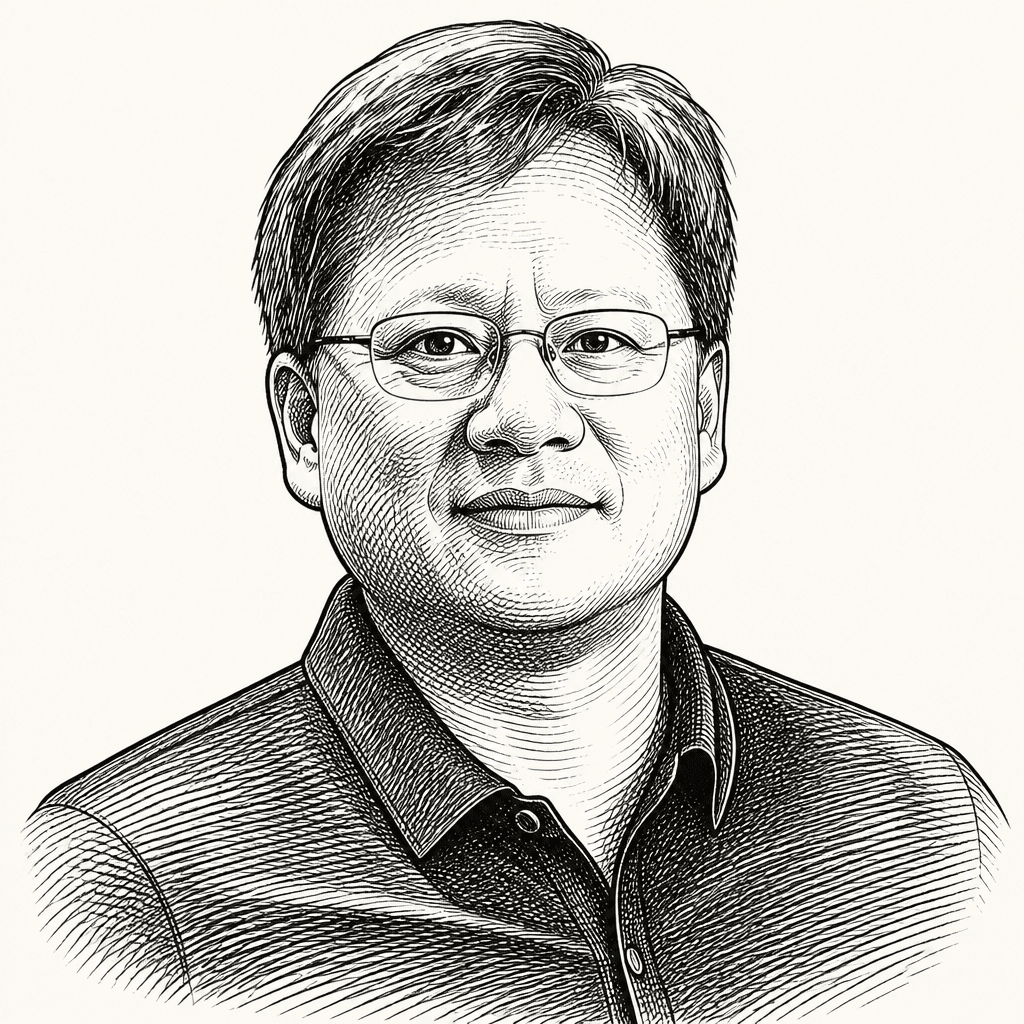

In a Hoover Institution interview with Condoleezza Rice, NVIDIA founder and chief executive Jensen Huang argues that the company’s rise began with a contrarian bet that the CPU could not remain computing’s only serious architecture. He links that bet to a broader account of simulation, parallel processing, and artificial intelligence, while also making a civic claim: that NVIDIA’s improbable path, and his own immigrant story, depended on American institutions that supplied capital, talent, legal predictability, and tolerance for risk.
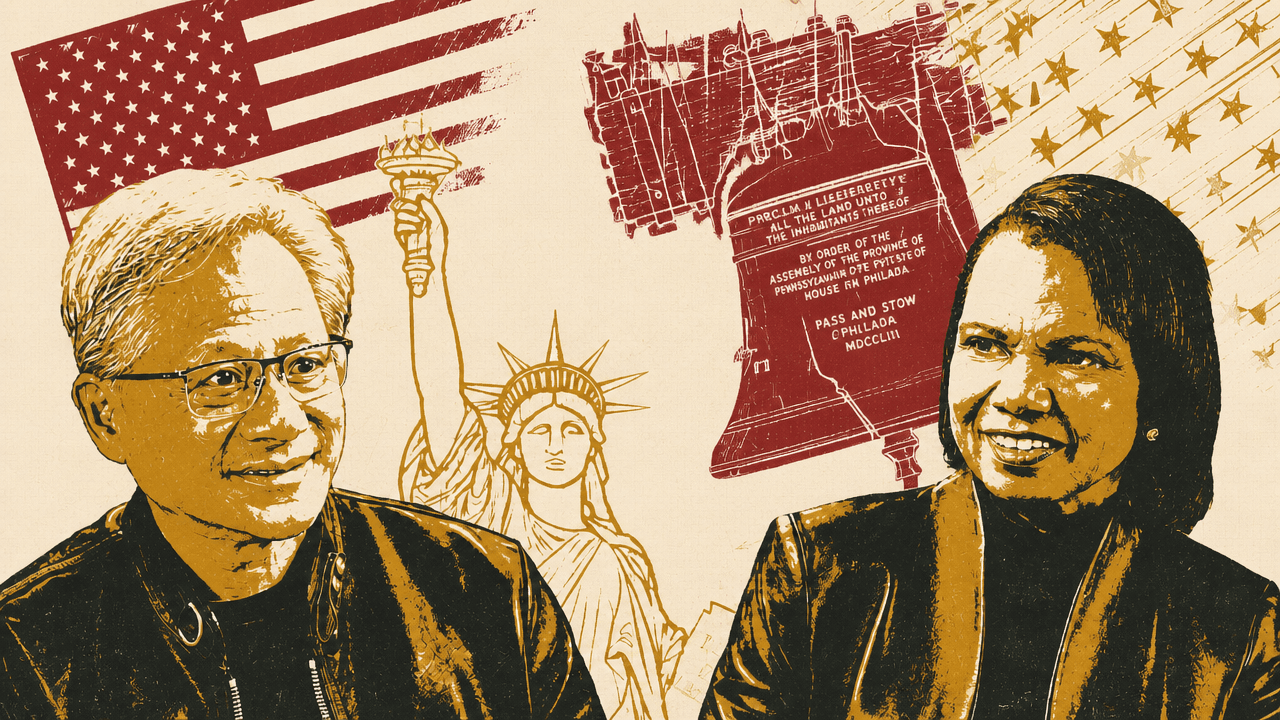
NVIDIA began as a bet against the CPU monoculture
Jensen Huang describes NVIDIA’s founding idea as simple in principle and nearly impossible in practice: the general-purpose CPU could not be the only architecture for computing.
At the time, he says, Silicon Valley was organized around the PC revolution, Moore’s Law, and the CPU. “Everything was about general purpose computing.” Huang, Chris Malachowsky, and Curtis Priem believed that many important problems — real-time computer graphics, simulation, and other forms of computation — were not well matched to sequential, general-purpose processing. The analogy Huang uses is domestic: a kitchen, garage, or company with only one tool would be absurd. Computing, he argued, also needed the right tool for the right job.
That first-principles view implied a second problem: even if a new processor architecture was technically right, how would anyone get developers to use it? Huang describes the computer industry as a reinforcing loop. If an architecture produces benefits for applications, the install base grows; as the install base grows, more applications support it; as more applications support it, sales increase. By the time NVIDIA was founded, that loop had been compounding around the CPU for decades. Huang says the hard question was how to persuade application developers to consider another architecture at all.
The answer was to find a first application that both needed the architecture and could generate enough volume to make the architecture matter. Computer graphics alone, as then represented by Silicon Graphics, was too small by the standards of computer architectures. The sharper opportunity was 3D graphics for video games.
Archival clips from the GeForce era framed gaming as a consumer force that pushed computing power forward. A presenter says that “computer games are not only fun, but they perhaps more than any other application, push the edge of computing power,” and that many PC upgrades were driven not by adults but by children wanting more powerful gaming machines. In another archival clip, NVIDIA’s Tony Tamasi describes the GeForce 3 as a 57 million transistor graphics processor — “more transistors than a Pentium 4, plus a Pentium 3 put together” — and emphasizes that, for the first time, the graphics processor was programmable like a CPU, with an instruction set game programmers could use for special effects.
Huang’s own summary of the original plan is blunt: “I just described a business plan that is impossible to fund.” It required a new architecture, a new developer ecosystem, a high-volume application, and a solution to several chicken-and-egg problems at once. Yet, he says, Sand Hill Road financed it. Sequoia Capital and Sutter Hill invested, and NVIDIA was able to attract “the brightest computer scientists in the world” to work on a bet that most people did not believe.
We were just determined that on first principle basis, the general-purpose computer cannot possibly be the only computing platform.
The GPU’s deeper logic was simulation, not gaming
Jensen Huang does not present gaming as a detour from NVIDIA’s later role in artificial intelligence. He presents it as the first viable market for a broader architecture built around parallel simulation.
Computer graphics, in his account, is “basically a simulation of the world.” Artificial intelligence is, “in a lot of ways,” a simulation of the mind or brain. Simulation differs from “task execution,” which he compares to following a recipe: step one, step two, step three. The world, by contrast, happens concurrently. If the problem is quantum, Newtonian, visual, medical, or otherwise a simulation of something happening in parallel, Huang argues that it naturally calls for an architecture different from sequential instruction execution.
That is how he connects NVIDIA’s early graphics work to later markets. After graphics, he says, the company found seismic processing and inverse physics. He groups CT reconstruction, ultrasound, and seismic together as similar problems. Then came molecular dynamics and Newtonian physics. NVIDIA “just kept finding one problem after another.”
The visual examples range across domains: fabric moving, a car represented by glowing particles, airflow over a sports car, Microsoft Flight Simulator 2024, storm clouds, neural pathways in a human brain, CT scan interfaces, lattice structures, data center racks, RTX game footage, Earth-scale weather modeling, medical imaging, and PhysX fire simulations. Together they illustrate the range of problems Huang groups under simulation and parallel computation.
Deep learning entered this trajectory when researchers including Andrew Ng at Stanford, Geoffrey Hinton at the University of Toronto, and Yann LeCun at New York University were working on similar problems. Huang says they reached out to NVIDIA. He says he was “alert” to the fit and believed NVIDIA could contribute. The collaboration, in his telling, helped achieve a level of computer vision capability “that no one had ever imagined.” Its success then triggered a broader set of questions: why did it work, what else could it do, how far could it go, and what did it imply for computer science and the industry built around it?
Huang describes the company’s response as a repeated return to first principles. NVIDIA broke the problem down, rebuilt its view of where the company should go, and navigated step by step into an unknown future. The required ingredients, as he lists them, were “reasoning, vision, strategy, discipline, patience.” Condoleezza Rice adds “belief.” Huang accepts the word, then immediately gives it a harsher edge: “At the core of grit, we suffered our way here.”


That suffering, in his account, was not a single crisis but the condition of building without external validation. “Nobody believed in it,” he says. NVIDIA had the “benefit” of building for a decade before many people paid attention. The hard part was pursuing something with “no positive feedback, no external motivation.”
Even the campus is treated as a simulation problem
At NVIDIA’s Silicon Valley headquarters, Jensen Huang treats the building itself as an example of the same habit of mind: model the system, reason from constraints, and adjust the design until it fits the problem. He says the building was “completely built in a simulation first” and designed to make maximum use of California’s sunlight and weather while remaining energy efficient.
The roof includes light wells, but Huang notes that light wells make heat removal difficult. The triangular features are placed only where needed. Although the roof appears flat from inside, he says it is undulated to track the sun, allowing in enough light without admitting unnecessary heat. NVIDIA simulated the building every hour of the day over an entire year and moved elements until, in Huang’s words, it was “perfectly harmonious, mathematically.”
One feature he calls the building’s “baseball cap”: a sloped design that responds to low afternoon sun by moving offices farther back so light does not come directly into the workspace. Huang describes the whole exercise self-deprecatingly as “an engineer trying to be an architect.” The example is modest compared with NVIDIA’s technical history, but it makes visible the method he later applies to company strategy: begin with physical constraints, simulate the system, and keep moving the parts until the design works.
Motivation had to come from a future others could not yet see
Condoleezza Rice presses Huang on how NVIDIA kept employees motivated during the years when it was not a dominant Valley story. Huang’s answer is not managerial technique in the narrow sense. It is an argument about leadership under conditions of weak feedback.
First, he says, “we have to believe in what we’re doing.” That belief has to be grounded in core values and core foundations. A leader has to see a future in the mind’s eye even when nobody else can, then tell the story so that others can see it too.
Archival footage from GTC 2010 shows Huang welcoming attendees to what he calls “the world’s first conference dedicated to our industry, dedicated to the visual computing industry.” He describes the GPU Technology Conference as a celebration of discoveries and inventions made possible by the GPU computing revolution. The clip shows NVIDIA trying to build not just a product line but a community around a computing architecture before that architecture was broadly accepted.
Huang’s emphasis on belief is not presented as optimism detached from discipline. The company had to keep finding applications, prove the usefulness of the architecture, and sustain a workforce through long periods when the market did not yet reward the underlying thesis. He characterizes the work as “swimming upstream” for 30 years.
Rice connects that willingness to persist with a broader American pattern: risk-taking, the willingness to fail, the expectation of a second chance, free speech, and reliable laws. Huang compresses that institutional bundle into one word: “freedom.”
Huang’s immigrant story is inseparable from his theory of America
Jensen Huang’s account of America begins not with capital markets or Stanford but with childhood displacement. He was born in Taiwan. When he was five, his father took a job in Thailand helping start an oil refinery. In 1973, after a coup, his parents decided Thailand was unsafe and sent Huang, then nine, and his ten-year-old brother to the United States.
His first American stop was Tacoma, Washington, where an uncle lived. Huang remembers carpets as strange because he felt as if he were walking on his bed with his shoes on. He remembers cereal, morning television, Speed Racer, The Partridge Family, Snickers bars, cars, and what he calls an “amazing country.” After about three months, he and his brother were sent to what his parents could afford: a boarding school in Oneida, Kentucky, a small rural place Huang recalls as population 600.
Huang includes difficulty as well as gratitude. He says that in 1973 Kentucky, the school had never seen a Chinese child before. There were biases and the things that come with being a stranger in a town where nobody has seen someone like you. But he also says he had a “wonderful, wonderful childhood” there, joined the swim team and soccer team, and encountered American abundance through details such as sausage and gravy, hamburgers, and McDonald’s after a swim meet — a restaurant that, to him, seemed like a spaceship because the food came in boxes and the menu was lit up.
The key interpretive point for Huang is expectation. Immigrants, he says, come by choice, with little expectation and great hopes. They appreciate everything. His father had first seen the United States in the 1960s during training in New York and wanted his family eventually to come to America. Huang says he still remembers what it was like to see the country for the first time as “this miracle.”
His parents later reunited with the children in the Pacific Northwest. Huang says they had nothing, literally putting their belongings on the plane and arriving with a suitcase. His mother worked as a maid at a Catholic school, his father was an engineer, and they saved what they could. One family vacation, he recalls, involved his father buying a green van with no seats, putting carpet and milk crates in the back, and driving the family from Oregon to Los Angeles to see Disneyland.
This background matters to Huang’s view of entrepreneurship. Near the end, he says the entrepreneurial spirit and the immigrant spirit are “rather similar.” Both are marked by desperation to succeed and the absence of a fallback. He says his constant desperation to do better at NVIDIA is the same feeling his parents had in trying to secure a life for their family.
I am certain my feelings about NVIDIA and my constant desperation to do better is exactly the same feelings my parents had to secure a living for their family.
The institutions mattered because the odds were so low
Jensen Huang does not describe his path as inevitable meritocracy. He calls it “a chain of extremely low probability events” leading to NVIDIA.
He went to Oregon State largely because his best friend Dean Verhei planned to go there and because the school had a good engineering program. He jokes that he met his wife, Lori, by strategically maneuvering into her lab class: in an engineering class with 250 boys and three girls, he reduced the competition to four and then asked whether she wanted to see his homework. They have been together since college.
Stanford entered the story through AMD. Recruiters from Silicon Valley came to Oregon State, and Huang took a job at AMD because the work was interesting and the colleagues were strong. The offer also included a program under which he could work at AMD while AMD paid for Stanford. Huang recalls asking, in effect, whether he could receive a salary and have Stanford paid for at the same time. When the answer was yes, he saw it as a dream come true.
His Stanford degree took about eight years, interrupted and intertwined with work, marriage, children, and eventually founding NVIDIA. He says that while school can feel academic when one does not see the purpose of the material, working and studying at the same time made the principles legible. At Stanford, he could see how the concepts mattered in what he was doing. He describes that period as “one giant soup” of family, children, company, Stanford, and work.
Condoleezza Rice characterizes Silicon Valley and Stanford as a kind of stew, not merely an ecosystem label. Huang agrees that Stanford shaped his attitude toward computer science, its industrial impact, and the intersection of technology, applications, fundamental science, and strategy.
For Huang, the American part of this story is not reducible to individual drive. America, he says, provides “tailwind, not headwind.” That tailwind consists of laws and rules that are understandable and reliable; a business and industrial environment where people play by rules one can count on; the ability to identify underserved market segments; and confidence that a market opportunity will not be foreclosed randomly, arbitrarily, unknowingly, or unpredictably.
Rice’s framing is similar but more civic: the role of free speech, reliable law, risk-taking, willingness to fail, and the possibility of a second chance. Huang’s response is that these are the conditions entrepreneurs rely on, and that they are “alive and well here.”
For students anxious about AI, Huang separates tasks from purpose
Condoleezza Rice says she sees fearfulness among students: fear that they will not be able to achieve, that the American dream may not be available, or that AI may take their jobs. Huang’s answer again begins with first principles.
When uncertain or when things are moving too fast, he says, he returns to core values: what makes him great today, what he aspires to, and what foundations remain. He tells young people that it is possible to hold several feelings at once: gratitude for what one has, dissatisfaction with where things are, and aspiration toward greatness.
Technological change, in his view, is precisely when greatness becomes possible. Under the status quo, it is hard to make a difference. His practical advice is to “deeply dive” into AI and use it in every possible way. But he makes a distinction between mastering science and mastering the use of AI within a field of science.
The more important distinction is between tasks and purpose. If someone goes into medicine, Huang says, the purpose is to care for people; that is different from studying a radiology scan. If someone becomes an engineer, the purpose is to solve known problems or discover unsolved problems worth solving. Jobs consist of tasks, but they are not defined by those tasks.
In Huang’s framing, anxiety about AI should be answered by returning to the purpose of a profession rather than treating its current task bundle as the profession itself. His argument is not that AI leaves work unchanged. It is that people should learn to use AI within their fields while keeping sight of the reason the work exists.
Cautious optimism about AI means making it functional and winning the application layer
Condoleezza Rice describes Huang as an optimist about AI. Huang corrects the phrasing: “Cautious optimist.”
His optimism begins from the premise that intelligence is foundational to nearly every aspect of society, industry, and human endeavor. If the fundamental ingredient in almost everything people do is intelligence, then expanding access to artificial intelligence is potentially transformative.
The caution is about function. Huang says AI has to advance quickly enough that it works as promised, behaves as expected, and does not produce outputs that sound intelligent but are flawed. “Functional things are safer,” he says. His analogy is a car: he wants a car to function as promised; AI also needs to function as promised.
On international competition, Huang argues that one challenge is defining AI properly. He offers a five-layer model. The first layer is energy: land, power, and shell. The second is chips, where NVIDIA operates. The third is infrastructure, comparable to cloud services. The fourth is the AI model layer, which he says is where most public attention goes. The fifth and, for the nation, most important layer is applications.
Those applications include healthcare, military uses, defense, cybersecurity, transportation, and manufacturing. Huang’s policy warning is that the United States is ahead and is the world leader, but technological inflections are exactly when leadership can change. Policy should not hinder the application layer, because, in his view, whoever advances that layer the most will benefit most from the industrial revolution around AI.
In Huang’s framework, “winning AI” is not only a matter of building models. The country must have energy capacity, chips, infrastructure, models, and applications. But the layer that converts the technology into national and industrial advantage, as he describes it, is the one closest to real use.
The American dream, in Huang’s telling, is institutional as much as personal
Jensen Huang’s final claim is expansive but grounded in the particulars he has laid out: a child sent from Thailand to Tacoma and then Kentucky; working-class parents who gave up everything; public and private institutions that created opportunity; Stanford, AMD, Sand Hill Road, and Silicon Valley; a risky architecture financed despite skepticism; and a company that endured for decades before its computing thesis met the AI era.
He says NVIDIA is “genuinely” an only-in-America story, and that in many ways he is one too. The emphasis is on one generation, “one body,” not a fifth-generation or third-generation inheritance. His parents had no way to fall back. They sacrificed their lives so their children could have more opportunities than they did. America, in his account, provided the systems, institutions, resources, and foundations that made a company like NVIDIA possible.
Huang’s claim is not that effort alone guarantees an outcome. It is that improbable effort needs a surrounding structure that supplies capital, talent, legal predictability, educational pathways, tolerance for risk, and room for reinvention. That is the sense in which he calls himself “the embodiment of the American dream.”