Policymakers Need Broader Historical Comparisons, Not Familiar Analogies



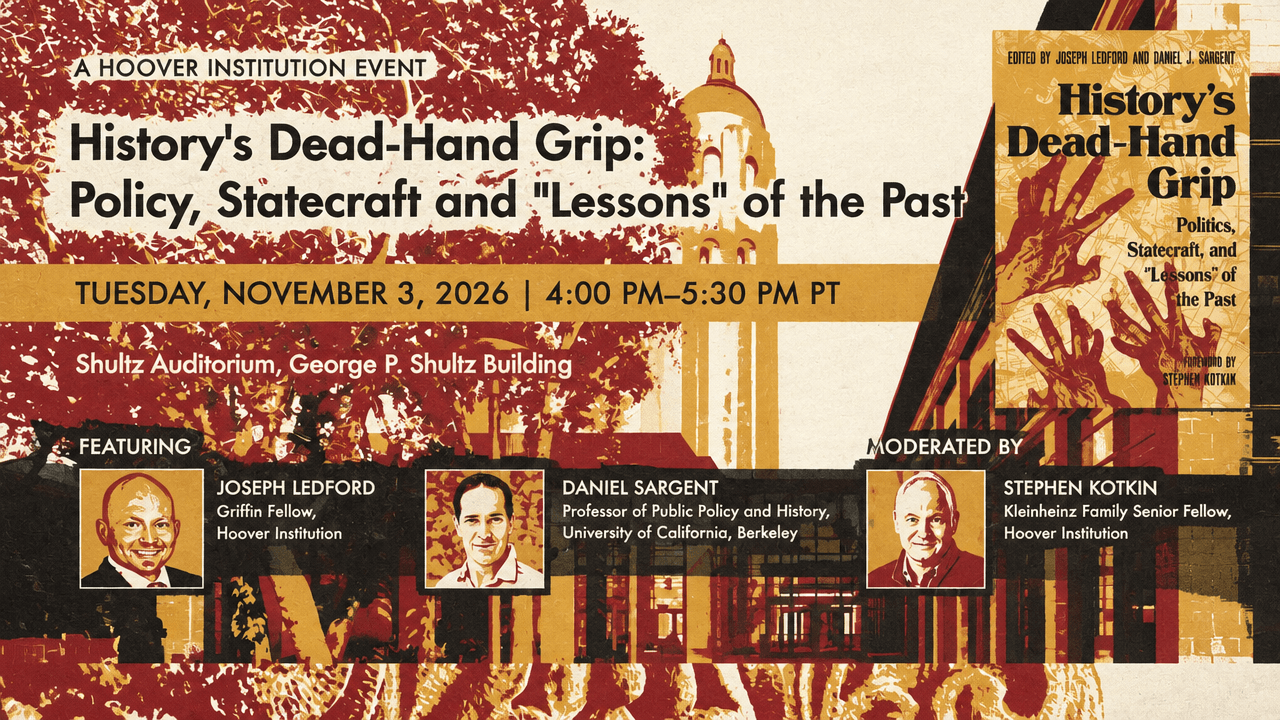
In *History’s Dead-Hand Grip*, editors Joseph Ledford and Daniel J. Sargent argue that policymakers cannot avoid using history, but can mistake familiar analogies and inherited narratives for reliable guides to action. Drawing on international case studies, they make the case for comparing a wider range of evidence before drawing lessons from the past. Historical analysis, they contend, can clarify what policy choices are feasible and widen the options decision-makers see, but it cannot determine the purposes those choices should serve.
Policymakers already reason through history; the question is how
The Hoover History Lab’s aim is to use history to address contemporary policy challenges. At the book launch, moderator Stephen Kotkin framed the problem as more than a lack of historical knowledge: policymakers routinely use the past, but they may use it badly. A persuasive analogy can shape a decision even when the evidence does not support it. Kotkin calls this “junk history”: an account a decision-maker accepts as true and uses to justify a choice.


Ignorance of history is terrible. Junk history is even worse.
The alternative is not to ban analogy or treat history as a storehouse of ready-made instructions. The History Lab’s stated purpose is to examine how people use historical reasoning—and how that reasoning can be improved. Kotkin’s test is evidentiary: rather than treating an interpretation as a matter of belief, ask what supports it. The evidence may not settle every dispute, but an argument should account for evidence that cuts against it as well as evidence that supports it. As Kotkin put it, “never tell me I don’t believe that. Just ask me, what’s the evidence for that?”
That distinction matters because people cannot help reasoning historically. As Joseph Ledford puts it, “history pervades the policy arena”: people draw on past experience when making decisions in government, business, and private life. Effective policymaking therefore requires understanding not just the history of an issue, but also the people and institutions involved. The task is not to make decision-makers stop using history. It is to help them recognize what their historical assumptions are doing.


The book grew from an effort by Ledford and Daniel Sargent to examine historical reasoning in policymaking, then widened into an international collection of case studies. The editors wanted to look beyond the United States and Western Europe, which have dominated much of the literature, and show that historical reasoning shapes politics across different political systems, regions, and levels of state power. The cases are distinct, but together they show history acting as a double-edged resource: it can narrow or legitimize policy choices, but it can also help policymakers imagine alternatives.


Sargent situates the project in the tradition of Ernest May, whose 1973 book Lessons of the Past: The Use and Misuse of History in American Foreign Policy examined how US policymakers drew on history. May’s core propositions, as Ledford presents them, are that policymakers are influenced by history, often use it badly, and can learn to use it more discriminatingly. The editors retain “lessons” in quotation marks because the book does not treat history as a source of universal rules.
For Sargent, that caution reflects a difference between historical inquiry and social science. A social scientist may use cases to develop a general concept or model. Sargent describes the historian’s starting point differently: the case is not merely evidence for a higher-level theory, but an object of inquiry in its own right. The historian’s work is to understand the case on its own terms, rather than assume that comparing cases will reveal a general form of, for example, appeasement.
That commitment to particular evidence is history’s empirical strength. Historians are concerned with facts and with building an account grounded in them. Its corresponding limitation, Sargent says, is analytical: if each case is treated as distinctive, it can be difficult to gain traction by comparing cases. Yet policymaking problems rarely arrive neatly contained within one historical case. They require deciding which past experiences are relevant, what features they share with the present, and which differences matter.
May’s practical advice, Sargent argues, is to resist reaching immediately for the most familiar example. A policymaker considering appeasement may reach for Munich because it is rhetorically available, then use it to endorse or condemn a preferred course of action. That short circuit—analogy first, evidence afterward—turns history into an argument for a position already chosen. Better applied history would consider a broader set of cognate cases, examine their differences, and look for recurring dynamics that might illuminate the present problem.
This is not a search for a higher law that turns past experience into a forecast. Sargent says historical experience is the only “laboratory” available for understanding the complex social phenomena policymakers face, but the cases do not function like controlled experiments. Applied history, in his account, means systematically comparing cases because the evidence of human experience is limited and difficult to interpret—not because a pattern guarantees the same result next time.
The practical standard is therefore neither “history repeats itself” nor “every case is unique.” It is to identify a wide enough range of relevant cases, parse them carefully, and ask whether recurring patterns or dynamics illuminate the present. That work can challenge a convenient analogy without promising certainty. It can also expose how much a decision-maker’s confidence depends on a thin comparison set.
Competing histories produce different estimates of American agency
Sargent’s account of postwar American foreign policy became a point of disagreement—and a demonstration of why historical interpretation matters to current choices. He challenges what he calls the “legend of the liberal world order”: the story that the United States learned the lessons of the 1930s and deliberately built a global system to secure peace and prosperity. He argues that this story is appealing but substantially wrong.
After the Second World War, Sargent says, the United States rushed to demobilize, as it had after the Civil War and the First World War. In his account, escalating Soviet-American misunderstanding and hostility during 1946 and into 1947 pushed a reluctant United States toward security commitments, first in Western Europe and later in Northeast Asia. These commitments formed what he calls a Cold War order, not a global liberal order. It operated within a divided world and was hierarchical: the United States led, while subordinate allies accepted the necessity of following.
Sargent’s concern is that treating the postwar settlement as a ready-made template encourages policymakers to reproduce late-1940s decisions without asking whether the circumstances that produced them apply now. The Cold War order, he argues, was neither global nor especially egalitarian. It was built in the Western portion of a divided world, under American leadership. For him, that makes it a poor historical template for foreign policy in the mid-2020s.
An audience member challenged this account, pointing to earlier American ambitions and a 1947 memorandum by Will Clayton warning that global leadership was slipping from Britain and could pass to the Soviet Union if the United States did not act. The question was whether the emergence of American power might reflect a will to replace Britain, rather than primarily a reaction to events.
Sargent accepted this as a credible alternative interpretation. He noted that the United States had possessed substantial geopolitical capacity for decades before it assumed a global role. The question, in his view, is why it did not exercise that role earlier. He argued that a well-institutionalized will to power did not shape government choices preponderantly until the 1940s, even though individual Americans, including Theodore Roosevelt, had expressed ambitions for American power before then.
The disagreement was not simply about whether American leaders had ambitions. Sargent distinguished a general will to power from the particular commitments—such as the Marshall Plan and NATO—that became central to the postwar order. He argued that those commitments emerged from the interaction between American ambitions and the circumstances of the late 1940s. The audience member’s interpretation, which Sargent called credible, put more weight on an endogenous American will to power than on external circumstances.
Ledford pressed the question of whether the United States could have refused the demands placed on it after the war. Even if there was a will to power, he suggested, the need for American action—over Greece and Turkey, Berlin, Korea, Japan, West Germany, and the Marshall Plan—might have been the greater force. Could different policymakers have refused those demands? Sargent agreed that American elites coalesced around globalism during and after the war. His qualification was that the particular form of American commitments was shaped by the circumstances those elites faced, not simply by an abstract ambition to dominate.
The competing interpretations matter because they change what policymakers might infer about their own room to maneuver. If the postwar order was principally an expression of American will, then the United States may be able to choose a large-scale retreat. If it was chiefly a response to circumstances that constrained policymakers, then a new administration may have less freedom to reverse commitments than it assumes. Sargent illustrated the point with an imagined president seeking retrenchment: on his account, the history of policymakers struggling to revise earlier commitments suggests that a dramatic reorientation may be difficult.
Kotkin offered a way to reconcile intention and circumstance without erasing the disagreement. Even if some Americans wanted greater power, he argued, the demand for American power after the war exceeded any putative will to power. The relevant question becomes whether the United States could have refused the role that circumstances placed before it. Sargent’s response was that it could have—but that the specific commitments it eventually made reflected the interaction between a newly established willingness to assume a global role and the problems policymakers confronted.
The disagreement does not yield an automatic policy answer. It changes the estimate of how much agency a president can exercise, and which features of the past should guide that estimate. Sargent’s larger point is that history cannot decide what American foreign policy is for. Those purposes must ultimately be settled democratically. But policymakers should be more explicit about the values they mean to uphold. He contrasts possible answers: preventing great-power war, as might have been emphasized by Richard Nixon or Henry Kissinger, and promoting human rights and universal values, an answer more associated with the Clinton administration’s second term. The United States, he argues, has not consistently confronted the question of ultimate purpose.
History’s role is more limited and more practical. It can help identify what is feasible, expose the limits of past policy solutions, and suggest alternatives through comparison. It cannot tell a democracy what ends to choose; it can help explain how to pursue them. Ledford adds that the value of historical study is often less a “lesson” than an expanded imagination: a better grasp of the interaction between human agency and structural forces, the likely consequences of choices, and the limits of what policy can accomplish.
Historical narratives can open options—or close them
Historical memory can shape policy by making some options visible and leaving others out. In Ledford’s account of the international case studies, a chapter on Brazilian foreign policy examines three enduring axioms about Brazil and its place in the world, beliefs that persist across administrations. In Indonesia, the relevant reference point is not primarily the future of great-power competition but the past of the non-alignment movement: policymakers draw on the 1960s to think about Indonesia’s position in the twenty-first century.
Other cases concern what happens when historical memory is selective or deliberately constructed. Sargent describes Yonatan Roll’s chapter on Israel as an account of how selective memory can circumscribe policy options. Ledford calls the pattern “misuse by omission”: rather than invoking a past success to justify repeating it, policymakers may leave out earlier diplomatic initiatives with Arab neighbors. In Ledford’s account, that omission can narrow the perceived menu of options, favoring military action over the possibility of new diplomacy.
Ria Roy’s chapter on North Korea, in Ledford’s summary, complicates the idea that the country’s leadership cult is simply a one-man project. It examines collaboration between the regime and intellectuals in constructing a history that legitimizes the Kim dictatorship, including a particular political language. Cole Bunzel’s chapter on Saudi Arabia presents a different relationship between historical accuracy and political utility. Ledford says it examines Crown Prince Mohammed bin Salman’s effort to rewrite the country’s foundational story by reducing the place of Wahhabism, in service of a modernizing agenda. Ledford characterizes the account as historically false, while arguing that the political agenda it serves—moving toward a state less wedded to Wahhabism—is intelligible.
Together, these cases resist a simple division between history used correctly and history used incorrectly. An account can be inaccurate and still serve a political purpose; selective memory can suppress options; and a historical narrative can help organize political power. The relevant questions are not only whether a claim about the past is true, but also how it shapes what decision-makers consider possible.
Sargent makes a related point in discussing China, while cautioning that he is not a China specialist. He describes the Chinese leadership as having constructed a national legend in which territory considered culturally Chinese must come under Beijing’s rule, making exceptions unacceptable. He compares this to Abraham Lincoln’s account of the American founding: Lincoln presented the federal compact as an irreversible transformation, a narrative that helped foreclose negotiated alternatives during the Civil War. Sargent argues that such a legend can be politically useful. He says Lincoln was right to close the parameters of possibility for his war strategy; whether China’s leadership has been wise to bind itself to a similarly rigid account is a question he leaves open.
The danger is path dependency: beliefs about history can make a course of action seem inevitable, even when it is not. In response to a question about Chinese claims involving Taiwan and the South China Sea, Ledford cautioned that he was not a China specialist but noted that historical beliefs can make a path dangerous. He also pointed to the Cuban Missile Crisis as a case in which President Kennedy recognized the risk of being trapped by a course of action and drew lessons from Barbara Tuchman’s book. Historical thinking can help leaders see inherited constraints, but it can also reinforce them.
The Monroe Doctrine shows how inherited frameworks are repurposed
The Monroe Doctrine illustrates how a historical framework can outlive its original circumstances, acquire new political force, and be used to justify actions that depart from its initial principles. Ledford’s account traces that transformation: the doctrine began in a particular domestic and diplomatic context, but later became a durable lens through which Americans interpreted their role in the Western Hemisphere.
In 1823, the concern was that a Franco-Spanish alliance might restore colonial governments in newly independent Latin American republics. British Foreign Secretary George Canning proposed joint Anglo-American opposition. John Quincy Adams, seeking to avoid appearing too close to Britain and to strengthen his nationalist standing as he looked toward the presidency, persuaded Monroe to make a unilateral statement instead. The United States did not possess the naval capacity to enforce it. The resulting principles opposed new colonization, intervention by extra-hemispheric powers, and the transfer of colonial territories between empires.
The statement was not meaningfully enforced by the United States until the turn of the twentieth century. In the meantime, domestic events helped give it political force. During the Civil War, France installed Archduke Maximilian in Mexico. Americans rallied to the Mexican cause, mostly with moral support, though Ledford says some material support was also provided. Lincoln had to manage the issue while fighting the Civil War and seeking to keep European powers out of it. After Maximilian was dethroned and killed, Americans believed they had played a part, and the Monroe Doctrine took on a life of its own. Later, under President Rutherford B. Hayes, Congress argued that the doctrine covered a proposed interoceanic canal in the hemisphere.
Once the United States became a great power, it had greater capacity to act on the doctrine. But Ledford separates that development from the interventionism often associated with President Theodore Roosevelt. The Roosevelt Corollary concerned the possibility that European governments might intervene in Central America to collect debts. Roosevelt said the United States would assume responsibility for those debts and for policing the situation. Ledford describes Roosevelt’s own actions narrowly: he operated the Dominican Republic customs house and installed a new government in Cuba under the Platt Amendment. He attributes the broader interventionism associated with the Roosevelt Corollary to Roosevelt’s progressive successors, including Taft and Woodrow Wilson.
Ledford describes Franklin Roosevelt’s Good Neighbor policy as a high point in hemispheric relations, though not without problems. He points to Pan-American cooperation and a defense perimeter that extended from Iceland and Greenland to South America and Antarctica during the Second World War. In his account, hemispheric relations had never been better by the war’s end. The Cold War changed that relationship.
Ledford says the Cold War Monroe Doctrine revolved around Cuba, both through US interventions in the hemisphere and during the Cuban Missile Crisis. He emphasizes that the crisis brought the doctrine into a nuclear standoff: the Kennedy administration debated whether to accuse the Soviet Union of violating it. The Justice Department undertook a study of the doctrine’s status in international law and its application to intervention in the hemisphere. Kennedy ultimately chose to imply the doctrine rather than explicitly invoke it, believing Americans would understand what he meant. For Ledford, the debate itself shows the force the doctrine had acquired, irrespective of its earlier history.
Ledford says the current administration has consciously invoked the doctrine in national security and defense strategies to support a more muscular approach to the hemisphere. His point is not that the doctrine’s meaning has remained constant, but that an inherited framework can lie dormant and reappear when geopolitical circumstances make it useful. Its defensive principles have also been used to justify actions that depart from them. The doctrine’s history therefore makes visible the broader problem: policymakers inherit not only past events, but also frameworks whose meanings have been reshaped by earlier uses.
Three modes of reasoning explain what history can and cannot do
Sargent’s chapter offers a typology for how Americans use history: as legend, as analysis, and as axiom. These are not three equivalent techniques. The third, he says, is “quasi-historical or even anti-historical,” because it begins with principles assumed to hold across time and place rather than with the circumstances of a particular case.
History as legend is the Lincolnian mode. Sargent reads the Gettysburg Address as a compact account of the nation’s founding and trajectory, giving the Civil War a direction and meaning. Lincoln’s address, in Sargent’s telling, rendered the nation’s story in roughly twenty words. A national legend can mobilize people and define what they understand themselves to be defending. It can also narrow the range of outcomes that appear acceptable.
History as analysis is the Madisonian mode. In the winter of 1785–86, Madison studied federal constitutions to understand why federations held together or fell apart. Sargent argues that this comparative work informed Madison’s thinking about the Constitution drafted in 1787. For Sargent, this is the mode most closely associated with applied historical work: using comparison to understand what has worked, what has failed, and under what conditions.
History as axiom is the Jeffersonian mode, illustrated by the Declaration of Independence’s assertion that “all men are created equal.” Such an assertion is not limited to the circumstances of a particular historical case. It supplies a standard that can constrain both legend and analysis. Sargent stresses that his use of “axiomatic” differs somewhat from May’s and Ledford’s use of the term: he means transhistorical values or assumptions, not simply recurring beliefs about a country’s behavior.
The three modes clarify what history can and cannot do for policy. A legend may provide political purpose and cohesion, while also closing off alternatives. An axiom can impose a normative constraint across cases. Historical analysis can compare cases and help identify what is feasible. None of these modes, on its own, settles what purposes policy should serve.
Sargent argues that the Jeffersonian mode forces policymakers to confront the values they want foreign policy to uphold, while the Madisonian mode can help them understand how to pursue those purposes. He applies the typology to the American debate on world order, arguing that recent discussion has relied heavily on a legendary account of the liberal world order. That narrative, which he says was central to the Biden administration’s foreign policy, describes the United States as having founded a liberal order after the Second World War to secure peace, security, and prosperity for the world. Sargent calls the story appealing but mostly untrue.
For Sargent, the actual Cold War order emerged incrementally, as US commitments developed in response to Soviet-American misunderstanding and hostility. It was constructed within a divided world, not for the world as a whole. The danger of the legend, he argues, is that it can imply that renewal means replicating choices made in the late 1940s. History, instead, should help policymakers ask what circumstances they face now and what values they intend to promote.
That distinction also sets a limit on historical advice. History does not determine the purposes of policy; those must be resolved democratically. Nor does historical comparison produce easy answers. It can help identify what is feasible, caution against sustaining solutions whose relevance to current circumstances has passed, and suggest new options. History helps explain how to advance the purposes people choose, not what those purposes should be.
Counterfactuals widen the comparison set, but not every case is equal
The question of relevant cases includes what did not happen: the wars avoided, the leaders not elected, the decisions not taken. An audience member asked how historians should account for these “dogs that didn’t bark,” including alternative leaders such as Henry Wallace, and for selection bias in diplomatic history. Ledford answered that hypotheticals can be useful under particular circumstances, while cautioning that the cases do not all receive equal weight.
His starting point is to cast a wide net. A policymaker facing a problem should not automatically reach for Vietnam—or, in Washington, for Iraq—simply because the analogy is familiar. The relevant comparison set depends on the issue, the institutions, the people, and the historical context. The point is not that every conceivable counterfactual deserves the same attention. It is that analysts should use their imagination to consider a broad range of possibilities before deciding which cases bear on the present problem.
Sargent connected that challenge to May’s work with Richard Neustadt, Thinking in Time: how can analysts expand the set of cognate cases so that decisions draw on the broadest possible historical understanding? He also stressed the cost. Historians’ knowledge is necessarily limited, and identifying relevant cases may require detailed work in specialist literatures. That work takes time; it is difficult to do comprehensively without substantial research support.
Sargent offered a concrete example of how new tools might help. He had worked with Berkeley technologists advocating inference-only chips as a possible response to AI risk. The group wanted to find historical precedents that could illuminate the political and diplomatic feasibility of an international treaty requiring inference-only chips in consumer-facing AI applications. Sargent used Claude to build an interface for posing queries to the Foreign Relations of the United States series, the official documentary history of US foreign relations. He described the series as more than 600 volumes, averaging around 800 pages each.
Using the interface, Sargent said, he identified a range of cognate cases that expanded the group’s understanding of the treaty’s possible parameters and technical obstacles. His claim was not that AI could decide whether such a treaty would work. It was that a tool could help an analyst search a large documentary record and find precedents that might otherwise be difficult to locate. He sees this as a way of opening historical experience to applied inquiry on a scale that was previously hard to manage.
The case also clarifies why expanding the comparison set matters. A single analogy can make a present proposal look either impossible or inevitable. A wider set of cases may reveal different obstacles, different routes to agreement, or reasons that the comparison does not hold. The broader record does not eliminate judgment: researchers still have to decide which cases are genuinely cognate and how much weight to give them. But it can reduce dependence on the most obvious example.
Historians can disagree, but should make the evidentiary ground visible
Sargent rejected the idea that history and social science are simply competitors for policymakers’ attention. He argued that many models are, in effect, applied historical analysis—and can fail when they mistake recent patterns for stable relationships. As an example, he cited the Harvard Economic Survey’s November 1929 forecast that a recession as severe as that of 1921–22 was exceedingly unlikely. The forecast relied on an analytical model built from roughly a decade of data, projecting recent trends into the future, even as signs of the Wall Street crisis were already visible.
For Sargent, the example shows that social scientists and historians are engaged in related work and vulnerable to related mistakes. A model can make its assumptions less visible by presenting a projection as a technical result. Historical inquiry can help show that the model’s apparent regularity rests on a particular stretch of past experience. Neither method is infallible; neither can make the future predictable.
Ledford’s practical advice was to produce empirically rich historical work and make it available to students and decision-makers. He also noted that biographies can affect policy: powerful people may look to earlier leaders who faced comparable challenges and consider how they responded. What people carry into government, he suggested, often shapes how they act when confronting the day-to-day work of putting out problems. In his description, policymakers are often firefighters; history happens to them rather than remaining at a distance.
The more difficult question is what historians should do when two well-supported interpretations point toward different policies. An audience member asked how historians could advise a president if one account of the postwar years supported a different conclusion from another—and if a president might simply choose the interpretation that fits a preferred policy. Sargent called this one of the hardest questions the project had faced.
He invoked Aaron Wildavsky’s phrase “speaking truth to power,” arguing that it is sometimes misunderstood as a call to confront policymakers with programmatic demands. Wildavsky’s point, in Sargent’s account, was the need to present robust, evidence-based conclusions. Sargent connected that idea to Ernest May’s approach and to what he calls “analytical presentism”: interpreting the past through the intellectual or moral needs of the present.
Sargent is not opposed to historical presentism in every form. He said that teaching an account of American history in which students can see themselves represented can help consolidate a shared sense of national belonging. But he draws a line when history is used to inform policy. Applied historical work, he argues, requires maximal objectivity and empiricism because normative filters can distort the reconstruction of past experience. Historians should strive for all the objectivity they can muster.
That standard does not require pretending that interpretation disappears. Sargent acknowledged that two accounts of American global power can both be credible, and that deciding between them turns on how the available evidence is read. The responsibility is to make the evidentiary basis and the interpretive disagreement visible, rather than presenting a preferred reading as an inevitable lesson.
His proposed discipline was concrete: before meeting the president, historians who disagree should try to establish a consensual understanding of where the evidence places them. They may have only 45 seconds to make their case. Agreement on the evidence would not guarantee agreement on its implications, but it would give the decision-maker a clearer account of what is known, what remains contested, and how the competing interpretations affect judgments about policy agency.