Renoir’s Cahen d’Anvers Portraits Became a Record of French Anti-Semitism

Catherine Ostler tells Andrew Roberts that the Dreyfus affair was not an isolated miscarriage of justice but the eruption of a France already “soaked in anti-Semitism.” Using the Cahen d’Anvers sisters, painted by Renoir as children and later scattered by conversion, war and deportation, she links the military frame-up of Alfred Dreyfus to the social world that first admitted wealthy Jewish families and then turned on them. The paintings, in her account, survive as evidence of both Belle Époque assimilation and the limits of that acceptance.
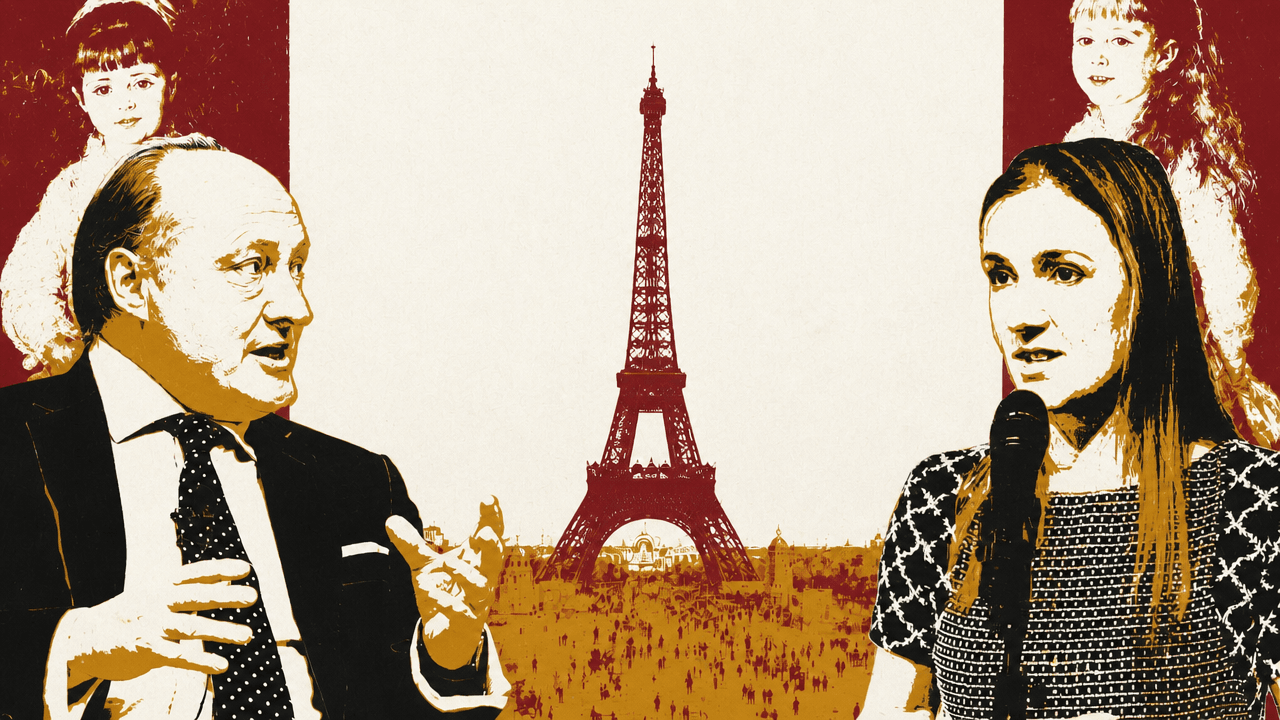
The Dreyfus affair began in a France already prepared to believe the worst of Jews
Catherine Ostler describes the Dreyfus affair as a military case that “blew up France for 12 years”: a torn document, known as the bordereau, was found in a bin at the German embassy in Paris. It contained notes about artillery and appeared to have been written to a German diplomat by someone inside the French army. Captain Alfred Dreyfus, a Jewish officer, was convicted of treason on false evidence.
Ostler does not treat the affair as an isolated miscarriage of justice. By 1894, when Dreyfus was arrested, France was already primed for the accusation. The Catholic Church in France had a long-standing prejudice against Jews, but the immediate triggers in the 1880s and 1890s were more specific: financial scandals, immigration fears, resentment of wealth, and scapegoating after the assassination of the Tsar in St. Petersburg.
French society is already sort of soaked in anti-Semitism.
The assassination was claimed by a group called the People’s Will, within which Ostler says there was “a small Jewish element.” That element was scapegoated, Russian pogroms began, and, by her estimate, of the 4 million Jews then living in Russia, a third left. A large number came to Paris and settled in the Marais. In French society, she says, two resentments were combined into one “Jewish problem”: anger at rich Jewish banking dynasties and anger at poor Jewish immigrants competing for work.
The financial backdrop intensified the accusation. The collapse of the Catholic bank Union Générale in 1882 was, Ostler says, “pinned completely unfairly on the Rothschilds,” amid a perception that they did not want a Catholic bank to survive in France. In her account, the real cause was mismanagement. In 1886, Édouard Drumont published La France juive, a tract blaming Jews for “every conceivable problem” in France; it began as a pamphlet and became an enormous bestseller. Then came the Baring panic in 1890, which began in London after overinvestment in Argentine securities. When a consortium of bankers saved the situation in France, resentment rather than gratitude followed. The Panama scandal added another layer.
Into that climate came Dreyfus. The bordereau supplied a pretext; France’s accumulated anti-Semitism supplied the force.
A secret conviction became a public ritual of humiliation
The first Dreyfus trial was a secret court-martial. Dreyfus was convicted, but people quickly began to realize that the evidence was shaky. French Jews, observers abroad, and even Queen Victoria, Ostler says, began to understand that the case was becoming an international scandal and a miscarriage of justice.
The army, however, did not merely punish Dreyfus. It staged him. Although the trial was secret, the punishment was public. The night before the degradation ceremony, Dreyfus’s uniform was stripped of its insignia and then lightly sewn back together; his sword was broken and then loosely repaired. In January 1895, at the military academy in Paris, a sergeant major ripped the uniform apart in front of a crowd of drunk Frenchmen, journalists, and army personnel, then smashed the sword over his knee. The crowd, Ostler says, roared: “Death to the Jew.”
Dreyfus was sent to Devil’s Island in French Guiana, which Andrew Roberts notes was infamous as a place from which prisoners were not really expected to return. Ostler describes him being held in a cell with ants and insects crawling over him.


Knowledge of his innocence began to spread through channels outside the French army. The Germans knew he was innocent, Ostler says, because they knew who their spy was. She adds that someone in the German embassy was having a homosexual affair with someone in the Italian embassy, meaning the Italians also knew. The Italian embassy was sympathetic to the French, and word circulated that Dreyfus had been set up.
- 1894Dreyfus is arrested after the bordereau is found and attributed to him on false evidence.
- January 1895The army publicly degrades Dreyfus at the military academy in Paris before sending him to Devil’s Island.
- 1899Dreyfus is retried, found guilty again, and then pardoned.
- 1906Dreyfus is exonerated, given the Légion d’honneur, and reinstated in the French army.
By the second trial, more evidence had emerged, and Dreyfus was, in Ostler’s words, “obviously innocent.” Yet he was found guilty again. The state tried to soften the outrage by granting a pardon. During that second trial, his lawyer, Fernand Labori, was shot while walking into court; the would-be assassin escaped and was never caught. Labori went to hospital and, two days later, returned to court to give evidence. The verdict still went against Dreyfus by one vote.
Even exoneration did not fully settle the matter. Ostler says Dreyfus’s promotions were not backdated in 1906, and that the correction happened only in the last five years. She presents that late administrative correction as evidence that the affair was not fully settled in the French state’s own records. The mishandling had been so public, and the abuse of ordinary fairness so prolonged, that the case remained, in her phrase, “a live issue in France” into the 21st century.
Dreyfus divided France because France was already divided
Catherine Ostler argues that the Dreyfus affair split France into Dreyfusards and anti-Dreyfusards, but that the split did not come from nowhere. The Dreyfusards included politicians, writers, intellectuals, Jews, and sympathizers who saw the case as a setup. The anti-Dreyfusards were those who could not accept that the army or the French state might have framed an innocent man. They treated Dreyfus’s guilt as a matter of institutional faith: the army would not do such a thing, therefore he must be guilty.
The word “intellectuals,” Ostler notes, emerged here as an insult. The affair’s social effects were immediate and intimate. She invokes Proust’s description of high society, where Jews who had been living comfortably in Paris, buying houses and art and hosting salons, suddenly found doors closing and the temperature dropping when they entered a room. Anti-Semitism, she says, touched every part of society.
The division also reflected the structure of the French elite. The old Ancien Régime aristocracy survived in part after 1789, though many had been guillotined or had lost châteaux, furniture, and art. Much of that property circulated through the Hôtel Drouot in Paris, helping make the city a center of 19th-century luxury and commerce. Walter Benjamin’s phrase, which Ostler cites, was that Paris became “the capital of the 19th century.”
A second aristocracy came through Napoleon: generals and marshals made into dukes and titleholders. The older aristocracy looked down on them as newer. A third wave came after 1848, when Jewish families arrived and, in cases such as the Cahen d’Anvers family, acquired titles from the King of Italy in exchange for loans during Italian reunification. These new Jewish aristocrats were newer still.
France’s elite, in this telling, was not a unified class. Its members loathed one another, intermarried, competed, and belonged to overlapping factions: monarchists, republicans, anti-capitalists, Catholics who wished France were still a Catholic country. The Dreyfus affair gave these factions a single line of division, but the fissures were already there.
The consequences did not end in 1906. During the First World War, French Jews were eager to demonstrate loyalty and fought alongside other French citizens; for a moment, Ostler says, it seemed as though France was united against its enemy and the divisions of Dreyfus had slipped away. But by the 1920s, after the Wall Street crash and amid the rise of anti-Semitism in Germany, the appetite for anti-Semitism was ready to return. One of the shocks of her research, she says, was how many relatives of anti-Dreyfusards later became part of the Vichy government.
The Cahen d’Anvers family lived inside the culture that would later reject them
The Cahen d’Anvers family occupied the world that seemed, for a time, to promise acceptance: money, salons, art, titles, marriage alliances, and proximity to the great Jewish families of Paris. Andrew Roberts frames them as rich, socially prominent, connected to the Ephrussis, Camondos, and Rothschilds, and based in a beautiful house on the Avenue Montaigne. Catherine Ostler adds that Louise Cahen d’Anvers, born Louise de Morpurgo in Trieste, was not merely glamorous but intellectually serious: raised among poets and linguists, known as someone novelists brought proofs to, and the host of a literary, musical, and artistic salon.
Louise had been married young in an arranged match to another Jewish family. In Paris, she began an affair with Charles Ephrussi, a younger son of a Jewish banking dynasty, art critic, and editor of the Gazette des Beaux-Arts, which Ostler describes as the most important art journal in Europe at the time. Roberts notes that Ephrussi was also Proust’s model for Charles Swann.
Renoir entered the story through Ephrussi. At the time, he was in his late 30s, still financially insecure, with some success but not enough money to live on. He wanted portrait commissions. Ephrussi promised introductions and made Louise, his mistress, commission Renoir.
The first portrait, painted in 1880, was of the eldest daughter, Irène, then eight years old, in the garden of the Avenue Montaigne house: red hair, blue ribbon, leafy background. Ostler emphasizes how avant-garde the picture would have seemed to contemporary eyes accustomed to more photographic, classical portraiture. The family loved it.
The following year, Renoir expected two more commissions, one for each of the younger daughters. Instead, the family commissioned a single portrait of both girls together. Renoir was angry because he expected double the money and would get only one fee. The resulting painting showed Alice and Elisabeth in white lace dresses, one with a blue satin sash and the other in pink, standing indoors amid gilded furniture, carpets, and the richness of the Belle Époque. The girls hold hands; the older looks slightly bossier; the younger has her feet splayed. Ostler says they resemble the Jumeau dolls then fashionable among Parisian girls.
Yet the parents disliked the painting. It remains mysterious why. A portrait is both a work of art and a representation of a person, and there is no photograph of the girls at exactly that age to show whether the family thought the likeness failed. The painting was also much larger than the portrait of Irène. Ostler speculates, cautiously, that Louise’s husband may have tired of his wife’s lover pressing him into buying paintings he did not like. She links this to a passage in Proust in which the Duc de Guermantes complains that Swann had made his wife buy “awful daubs” by Elstir, Proust’s version of Renoir.
Renoir himself, in Ostler’s account, was anti-Semitic in a drifting rather than ideological way. Renoir’s son Jean described him as “a cork in the current”: whatever people around him felt, he tended to go along with. The Impressionists, she says, are a useful test case for Dreyfus because they split over it. Manet and Monet were Dreyfusards. Degas was a vicious anti-Dreyfusard and stopped speaking to Pissarro, who was Jewish. Renoir sat in the middle. He might complain that he did not want to work for Jews because they did not pay well enough or on time, yet he kept a Jewish dealer and Jewish friends. Ostler calls him a casual anti-Semite rather than a committed anti-Dreyfusard.
Assimilation, conversion, and patriotism did not protect the sisters
Catherine Ostler says she chose the Cahen d’Anvers sisters because she first encountered them in Edmund de Waal’s The Hare with Amber Eyes, where Charles Ephrussi appears collecting netsuke with his mistress, their mother. De Waal mentioned that Renoir had painted the girls. Ostler looked up the painting and found it beautiful. Later in the book, she encountered the fact that one of the girls died in Auschwitz. Her project began with that gap: a beginning in art and an ending in murder, with the middle still to be recovered.
That middle includes the ways the sisters moved away from Jewish identity during and after the Dreyfus affair. As women in their class, Ostler says, they were also bargaining pieces in dynastic marriage strategies. The eldest sister was married young to a fellow Jewish banker, a friend of her parents, 12 years older than she was. They had two children but were unhappy. After Dreyfus, she became more unhappy, left him, converted to Catholicism, and ran off with his horse trainer, who presented himself as an Italian count.
All three sisters, Ostler says, “left behind their Jewish roots and married out.” Conversions from Judaism increased during Dreyfus. One sister became, in later description, “more English than the English” after marrying the soldier Charles Townshend. Elisabeth, the girl in the blue sash, married a succession of French aristocrats, including Jean de Forceville. Within a short period, the three Jewish sisters had become Comtesse Sampieri, Comtesse de Forceville, and Mrs. Charles Townshend.
Their family’s First World War record makes the later racial logic still starker. At the height of the Dreyfus affair, the parents had bought a large château outside France, a decaying “money pit” with grand ancestry: Madame de Pompadour had lived there for two years. They restored it in what Ostler calls the most loyal style, copying statues from the gardens at Versailles. By the war, the family considered itself French. The children had been born in France; the men served in the army or air force, and Charles Townshend was in Mesopotamia. The women worked as nurses, and the château stables became a hospital.
Roberts draws out the bitter point: patriotism, bravery, and service did not save them when race became the criterion. Alice, by then an Englishwoman, was living in England. As France fell to the Germans, she went to France to remove her grandchildren, aged eight and twelve, because they had Jewish ancestry. Their parents were in the Belgian Secret Service. Alice got the children out of Bordeaux during Operation Aerial, which Ostler calls Churchill’s second miracle of deliverance after Dunkirk.
One child had a broken leg. They slept in a ditch for two nights and boarded what they thought was a Dutch ship bound for England. A British sailor realized the ship had been taken over by Dutch fifth columnists and was being sailed to Hamburg. He jumped off, reached a British boat, returned to Bordeaux, called the British Navy, and the Navy rescued the ship, tied up the Dutch, and took it to Falmouth. The crossing took four days. Ostler heard the story from Marina, then 94, who had been the eight-year-old girl. Her older brother, then twelve, fell in love with the Royal Navy; four years later, having lied about his age, he returned on Juno Beach at fifteen as part of D-Day.
Irène survived in Paris, but not without family bitterness. In the Rothschild archive, Ostler found letters in which other siblings described her as a collaborator and were appalled by her. Irène had procured a certificate saying she was not Jewish and lived with her daughter by her second marriage. Her daughter and son-in-law from the earlier family line, along with two grandchildren, were arrested and died in Auschwitz. Irène inherited the money and became, in Ostler’s description, “a sort of gambler in the south of France.” Ostler does not offer an easy verdict: “What would we all do if we had to survive?” But she notes the bitterness.
Elisabeth, hidden in rural France and nearly 70, was betrayed by the local mayor, the Marquis de Vrinnes, who had known her as a child. Local French historians in the Loire reconstructed the process, and Ostler says the mayor repeatedly filled in forms stating that he knew she had Jewish ancestry. In January 1944, when she may have thought she was safe because the war was so late, a knock came at the door. She was taken to Drancy, the transfer camp outside Paris, and then sent to Auschwitz. Ostler says she died either on the way or on arrival.
The paintings survived by routes as morally tangled as the family history
The two Renoir portraits did not merely outlive their subjects. Their wartime trajectories became part of the same history of art, dispossession, survival, and compromised restitution.
The portrait of Irène had been given to her daughter, Beatrice Reinach, who died in Auschwitz. Beatrice’s husband sent it to the Château de Chambord in the Loire, where the Louvre and private collectors stored works for safekeeping. It was looted by Hermann Göring’s men. Léon Reinach wrote to the authorities asking for its return, arguing that his family and his wife’s family had given so much art to the French state that the Louvre had needed an extra wing to hold it. Ostler says this was true. He asked that they at least be given back this one picture because it meant so much to them.
They did not get it back. Ostler adds, more cautiously, that the letter may have drawn the authorities’ attention to the family and may have contributed to their arrest. The painting went to Germany, was traded for a Florentine picture, and at the end of the war was found by the Monuments Men and returned to Paris from Munich. It hung in a show of returned art. Irène walked in, saw it, and said: “That’s me.” She then fought a legal battle to recover it and won.
Her next decision was striking. She sold it to the Swiss collector Emil Bührle, whom Ostler describes as both a philanthropist who built a major collection and an arms dealer who had sold weapons to the Nazis. The portrait is now in Zurich as part of the Bührle collection, on loan to the Kunsthaus. Ostler says it is at the center of a major dispute as Switzerland examines its supposed wartime neutrality.
The portrait of Alice and Elisabeth took a different route. The father had disliked it. It was bought by the Jewish dealer Gaston Bernheim de Villers. In 1938, either because he sensed what was coming or by an extraordinary accident, the Louvre’s chief curator organized a tour of treasures of French art through North and South America. About a hundred major French paintings — Delacroixs, Renoirs, Monets, and others — were packed up and sent abroad. The Alice and Elisabeth portrait was among them.
When war broke out, the American government said the art could not be sent back because it would be stolen. The painting was wrapped and stored in a New York vault for the duration of the war. Ostler thinks of it as “in hiding itself,” representative of the Jewish diaspora. It never returned to France. In the 1950s, as Bernheim de Villers faced the loss of much of the art that had remained in France, much of it never returned, his money gone and his gallery closed, he sold the picture in New York. It was bought by a Brazilian tycoon establishing a gallery in São Paulo.
There it remains. Ostler says it is the most popular picture in the São Paulo gallery, where little girls dress in party dresses and pose in front of it.
When Roberts asks how she felt seeing it there, Ostler says she was deeply moved. For her, the power of the painting is that time falls away: the girls are standing together in 1881, one perhaps bored and itchy in a new dress; Renoir is at the canvas trying to capture the luminosity of a soft cheek; everything between then and now dissolves.
You are there, and it's 1881, and everything else has dissolved.
The counterfactual turns on a scrap of paper
Asked for a historical counterfactual, Catherine Ostler returns to the bordereau itself. A French cleaner in the German embassy, Marie Bastian, was also a spy; her job was to go through the rubbish. She found the document because it had not been torn up very much and could be pieced back together. She brought it to her superiors, and the Dreyfus affair began.
Ostler imagines small changes: the German diplomat might have ripped the paper up more thoroughly; he might have had a shredder; Bastian might have been ill that day; someone else might have thrown it away. In any of those cases, she suggests, the Dreyfus affair would not have happened, and France would not have ripped itself apart for 12 years.
Andrew Roberts offers a sharper version: the German military attaché might have paper-clipped Esterhazy’s name to the document. That would have identified the real traitor and saved a great deal of trouble. Esterhazy was eventually discovered and went into exile in England, Roberts notes, but justice did not reach him in the same way. Ostler adds that Dreyfus’s grandchild died in Auschwitz. Justice was done in the end, she says, but too late and after too much division.