Three Centuries of Recessions Undermine the Boom-Bust Theory

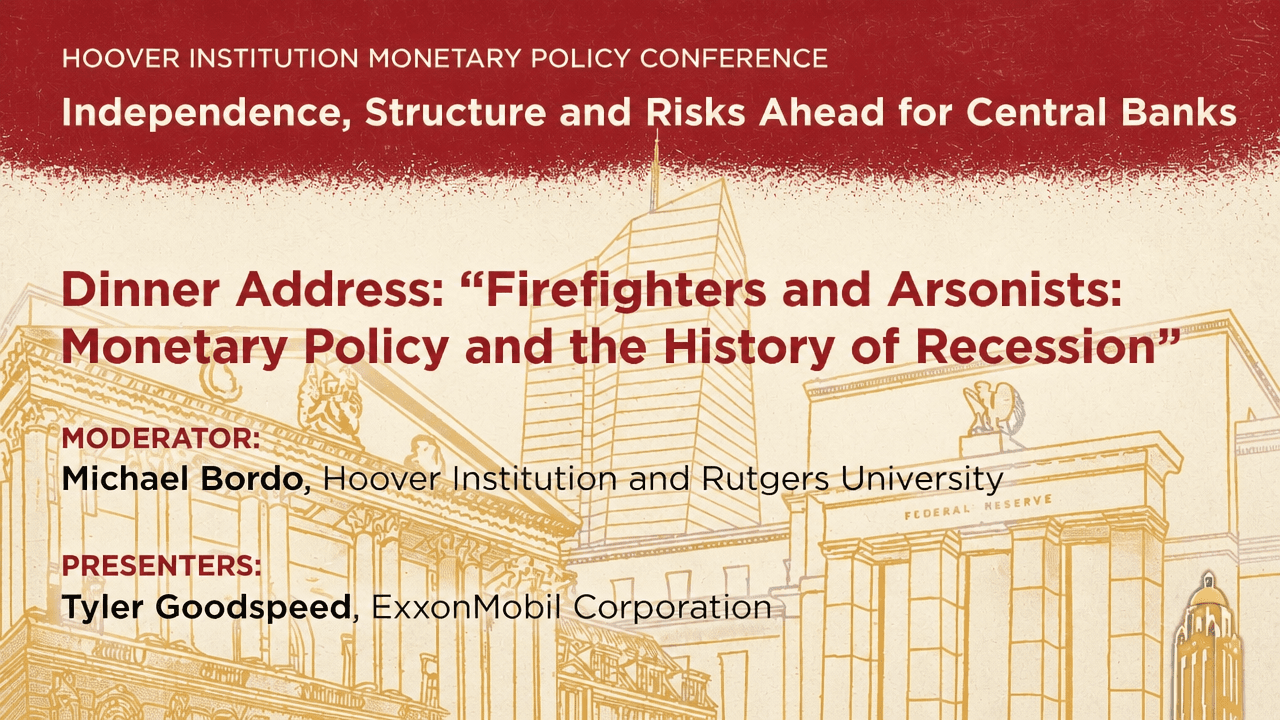
Tyler Goodspeed argues in a Hoover Institution presentation that recessions are usually misread as the inevitable result of excess in the preceding boom, when the longer historical record points instead to shocks filtered through institutions that either absorb or amplify them. Drawing on UK and US data back to 1700, he says expansions do not die of old age, recession warnings routinely fail, and downturns are often given retrospective moral labels — from dot-coms to housing — that obscure what actually caused the contraction.
Recessions are usually named for the wrong culprit
The label attached to a recession often reflects a moral story about excess during the preceding expansion, not necessarily the shock that did the decisive damage. Tyler Goodspeed’s central example is 2008: a contraction remembered as the housing bubble or subprime crisis, even though he argues it began as an energy recession.


Asked when the inflation-adjusted price of oil reached its all-time high, Goodspeed says many would guess 1973, 1979, or 1990. His answer is June 2008. By that summer, he says, the inflation-adjusted cost of energy had never been higher in the post-1945 period. In 2026 dollars, the average American household was paying $8,500 a year for energy goods and services, about $2,000 more than a few years earlier. Gasoline reached $6.17 a gallon in 2026 dollars. Higher energy costs pushed up fertilizer costs; farmers shifted toward ethanol production from corn in part because of new policies; food inflation rose above 6%.
For households with little or no savings after tax, the pressure was not marginal. Driving to work, taking children to school, heating and cooling a home, and buying food are not expenditures that can be easily avoided. By summer 2008, about 5% of American homeowners had fallen seriously behind on mortgage interest payments.
Yet the recession that followed is not commonly called the 2008 energy crisis. Goodspeed treats that naming habit as evidence of a deeper interpretive reflex. Economic contractions are like storms in that they are named, but unlike hurricanes they are often named after an ex post perceived excess of the expansion that preceded them.
The same pattern appears in his account of 2001. That downturn is usually called the dot-com recession, not the 9/11 recession. In the United Kingdom, he notes, many economists still assign blame for the 1973 recession on the so-called Barber Boom. Earlier in 2026, he says, commentators were already writing obituaries for the current expansion on the assumption that an AI bubble would end it.
The question is whether expansions really die because of accumulated excesses, imbalances, fragilities, age, or infirmity — or, borrowing Ben Bernanke’s phrasing, whether they are “murdered.” The boom-bust view associated with Charles Kindleberger’s Manias, Panics, and Crashes has, in Goodspeed’s telling, an important virtue: it generates testable hypotheses. But he argues that the evidence does not support those hypotheses when the sample is expanded beyond the 12 US recessions since 1945.
To escape the limits of a small postwar US sample, Goodspeed says his book extends recession chronologies and multiple macroeconomic time series back to 1700 for the United Kingdom and the United States on a consistent basis. The resulting sample contains 132 recessions. His use of the longer record is aimed at testing whether the prevailing stories about recessions survive contact with several centuries of evidence.
The long record undermines the boom-bust story
The boom-bust view carries six empirical implications in Goodspeed’s account. If recessions arise from human psychology or processes inherent in expansion, their frequency should be roughly constant across time and space. If booms generate busts, then larger, faster, or longer expansions should be followed by deeper, faster, or longer contractions. If fragilities accumulate, expansions should become more likely to die as they age. If warning signs are embedded in the expansion, indicators should forecast the subsequent recession. If countercyclical government has become more effective, recessions should have become shorter or shallower. And if recessions perform a cleansing function, economies should look meaningfully reallocated several years afterward.
Tyler Goodspeed says each implication fails in the long-run UK and US evidence.
| Boom-bust implication | Goodspeed’s finding |
|---|---|
| Recession frequency should be roughly constant across time and space. | It is not: the United States was about twice as recession-prone as the United Kingdom over the past 200 years, and recessions have become less frequent over three and a half centuries. |
| Bigger, faster, or longer expansions should be followed by deeper, faster, or longer recessions. | He reports estimated coefficients of zero for GDP, consumption, investment, and bank credit. |
| Expansions should die of old age. | He finds no rising probability of expansion death with age; expansions have been “Peter Pan rather than the picture of Dorian Gray.” |
| Indicators inside an expansion should help forecast the next recession. | Yield curves, Sahm indicators, credit spreads, CAPE ratios, leading indicators, Markov-switching dynamic factor models, and skyscraper indices produce false positives and false negatives. |
| Countercyclical policy should have made recessions shorter or shallower over time. | He says recession depth and duration have been statistically constant in the United States and United Kingdom since 1700. |
| Recessions should cleanse and reallocate the economy. | He argues that several years after recessions, people, capital, and output typically look close to long-run trend, while younger workers, younger firms, and R&D are harmed. |
The contrast between the United States and the United Kingdom is central. Over the past 200 years, Goodspeed says, the United States was about twice as recession-prone as the United Kingdom. In the past century, the United Kingdom avoided recessions the United States experienced in 1937, 1948, 1953, 1957, 1960, 1970, 1981, and 2001. Recessions in both countries have also become less frequent over three and a half centuries, a long-run structural trend dating back to 1700. He says a Chow test does not find a statistically significant breakpoint at any particular moment, with the possible exception of 1785 in the United States, a date he links only obliquely to “recent institutional changes” at the time.
The expansion itself, in his results, carries little usable information about the recession that follows. Higher, faster, or longer expansions are not followed by deeper, faster, or longer recessions. Goodspeed reports estimated coefficients of zero for GDP, consumption, investment, and bank credit. Nor does expansion age raise the probability of death. Contrary to the earlier work of Francis Diebold and Glenn Rudebusch, he says expansions on both sides of the Atlantic have “never died of old age.” They have been “Peter Pan rather than the picture of Dorian Gray.”
The warning systems do not rescue the boom-bust story. Goodspeed lists the yield curve, the Sahm indicator, credit spreads, the cyclically adjusted price-to-earnings ratio, leading economic indicators, dynamic factor models with Markov switching, and skyscraper indices as devices that abound in both false positives and false negatives over four centuries. His conclusion is blunt: recessions are fundamentally unforecastable.
There is no information whatsoever in the contours of an economic expansion that can explain variation in the likelihood or contours of the recession that follows.
The modern policy state also does not produce the expected break in recession depth or duration. Goodspeed says both have been statistically constant in the United States and United Kingdom going back to 1700. Within-cycle macroeconomic volatility has declined since 1945, but only to levels that prevailed before the period from 1914 to 1945, which he describes as “incredibly martial.”
The “cleansing” theory fares no better. Using either an HP filter or a Hamilton filter, Goodspeed says the allocation of people, capital, and output several years after recessions typically looks remarkably similar to the counterfactual continuation of long-run trend. Far from improving creative destruction, he argues, recessions discriminate against younger workers, younger and more dynamic firms, and research and development. They impair creative destruction rather than enhancing it.
The 2001 recession is a warning against retrospective storytelling
The 2001 recession is Goodspeed’s example of how a remembered label can crowd out the actual quantitative importance of shocks. The downturn is conventionally attributed to a peak and decline in US equity valuations. Yet technology stocks, in his account, had already begun to recover by the start of that recession. More important, the US economy was hit by at least four shocks in 2001, while the UK economy was not hit in the same way. Tyler Goodspeed says the decline in equity valuations was quantitatively the least important of those four shocks.
His argument rests partly on the estimated responsiveness of consumer spending to changes in financial wealth. Those estimates, he says, cannot explain the magnitude of the decline in consumer spending in the third quarter of 2001. That is especially true because technology stock ownership was skewed heavily toward high-net-worth and high-income individuals, who tend to be less responsive to changes in financial wealth.
The terrorist attacks of September 11 were, for Goodspeed, the most important of the 2001 shocks. All of the output decline during that relatively short recession, he says, occurred during the three months that included the attacks, the closure of US airspace, widespread fear among consumers, households, and businesses, and economic activity grinding to a halt in the economic center of what was then the second-largest economy in the United States.
The point is not only that 9/11 mattered. It is that the relevant shock was not forecastable from the shape of the preceding expansion. A model focused on valuations, excess enthusiasm, or the psychology of the dot-com boom would have been aimed at the wrong object.
Goodspeed connects this to a broader psychological claim. Humans are pattern-seeking mammals. Patterns help people connect observed stimuli with subsequent harm: eating colorful mushrooms and falling ill, or too much sun followed by sunburn. Recessions are also negative, sometimes traumatic events, and people therefore search for precipitating actions to blame and correct.
He gives this pattern-seeking a technical name: apophenia, “the opposite of an epiphany.” Recession stories, he argues, abound in apophenies because they search the height, speed, duration, and composition of an expansion for a pattern that can explain the likelihood, depth, speed, duration, and composition of the contraction. Crucially, those stories often supply a moral lesson. Goodspeed notes that parables endure for a reason.
The danger, in his view, is not merely intellectual error. If policymakers misdiagnose healthy expansions as dangerous because they are old, fast, or associated with some visible investment boom, they may try to sedate or medicate them. Goodspeed argues that such interventions are based on the mistaken belief that recessionary death can be prevented by suppressing the expansion itself.
A shock becomes a recession through institutional resilience or failure
Recessions are inevitable in the broad sense that no economic expansion is immortal. But any particular recession in any particular year is not inevitable. For Tyler Goodspeed, the relevant distinction is between a shock and the institutional response that determines whether the shock remains contained.
His 2008 account turns on that distinction. In a counterfactual he describes as not improbable, 2008 could have been a typical post-1945 energy-related recession. What transformed it into a much deeper contraction, he argues, was “a British commission of a very American error.”
The British tradition in moments of financial stress, as Goodspeed describes it, went back to 1826 and often involved some form of Bagehot’s rule, with the Bank of England coordinating and facilitating the acquisition of weaker banks by stronger banks. He adds a historical texture — “ham sandwiches and whiskey over late nights and exhausting weekends” — but the institutional point is direct: the British response had often been to prevent a weak institution from disorderly failure by arranging a takeover.
Goodspeed says that approach helped the United Kingdom avoid recession in 1866, 1873, and 1890, and avoid a much deeper recession during the oil embargo recession of 1973. In September 2008, the pivotal decision went the other way. The Chancellor of the Exchequer “blinked” and allowed institutional barriers to block the timely acquisition of Lehman by Barclays, which Goodspeed describes as stronger, healthier, well-run, and well-capitalized. The authorities then proceeded to publicly bail out other financial institutions amid the disorder that followed.
The consequences were mechanical and severe. Reserve Primary Fund broke the buck because of its nearly $1 billion investment in Lehman commercial paper. Because Lehman US conducted a global cash sweep at the end of each trading day, the US parent’s Chapter 11 filing forced Lehman International in London immediately to file for protection under an administration order. That froze Lehman International’s assets and liabilities, including collateral belonging to institutional clients whose funds had been rehypothecated. The result, Goodspeed says, was a run on UK financial institutions by institutional investors.
In this version of 2008, the central error was not simply that officials failed to prick a housing bubble earlier. It was that, at a decisive moment of financial stress, they failed to execute the kind of stabilizing institutional response that had historically prevented panic from becoming collapse. Recessions are not moral verdicts on the preceding boom; they are contingent shocks filtered through systems that either absorb or amplify them.
Unforecastable recessions can still become less frequent
Expectations create a hard limit on recession forecasting. If a bank run tomorrow were knowable today, investors would pull their funds today. If households and firms knew a recession would arrive tomorrow, they would save more, invest less, and hire less today. The anticipated recession would be pulled forward.
Tyler Goodspeed accepts much of that logic. He says a prominent macroeconomist recently made a similar argument in response to Queen Elizabeth II’s 2009 question about why no one saw the crisis coming. If the shock were predictable, behavior would adjust before the event. Economists can simulate shocks and estimate impulse response functions, Goodspeed says, but they cannot predict the shocks themselves.
His objection is that economists and commentators often accept that prior in theory but abandon it after the fact. Asked what to call 2001 and 2008, the same logic often gives way to “the dot-com bubble” and “the housing crisis.” Those labels imply that information inside the preceding expansion — price-earnings ratios, housing prices, or similar indicators — should have predicted the downturn. Goodspeed says the main message is that macroeconomists should take the unforecastability prior more seriously and resist retrospective storytelling, an insight he associates with Robert Shiller.
A second challenge from the audience reframes recessions as a Poisson process: each arrival may be unpredictable, while reforms can still reduce the arrival rate. Civil wars were offered as the example. Across countries, large-scale civil wars were said to be almost guaranteed to trigger recession or depression; reducing violence would reduce the frequency of recession-inducing shocks even if any given arrival remains unpredictable.
Goodspeed calls this distinction “essential” because it separates the unconditional probability of shocks in a given year from the predictability of any particular recession. Over the past century, he says, the unconditional probability of a pandemic-related recession has been about 1 in 100. The probability of a war-related recession has declined. In the 18th and 19th centuries, especially the 18th century on both sides of the Atlantic, war — particularly war that visited domestic soil, or world war — was one of the most prolific killers of expansions. He says all of the longest recessions in the United States and United Kingdom were war-related, with the exception of the Great Depression, for which “there’s a lot else going on.”
He then points to two reasons the United Kingdom was historically less recession-prone than the United States. First, from 1826 onward it had a nationwide system of branch banking, creating a broadly diversified national banking portfolio. Second, from 1926 to 1972 the United Kingdom had no official coal strike. During that period the UK economy was overwhelmingly reliant on coal rather than oil, while the United States experienced oil-related recessions in 1948, 1953, 1957, and 1970.
For Goodspeed, the diversification of banking systems and energy systems is exactly the kind of structural change that can lower the long-run frequency of recession-triggering shocks without making recessions forecastable.
AI investment may be more likely to suffer from a recession than cause one
The 2026 analogue to earlier boom-bust stories is the data-center buildout around AI. The concern, as posed to Tyler Goodspeed, is that a large construction surge must eventually slow, just as housing construction slowed before 2008. If that slowdown coincides with an energy shock, the worry is a recession-producing confluence of factors rather than a single visible bubble.
Goodspeed declines to forecast after having written a book whose conclusion is that recessions are fundamentally unforecastable. But he does address the historical analogy.
Looking back at transformational technologies — canals, railroads, fiber-optic cables in the 1990s and 2000s — Goodspeed says the real physical infrastructure tends to be remarkably faithful to long-run trends. Those trends resemble a smooth S-shaped adoption curve. On that basis, as commentators worried about an AI bubble causing recession, his historical baseline was different: AI investment was more likely in the near term to be a casualty of a recessionary shock elsewhere than the cause of the recession itself.
Energy shocks remain a more plausible class of recessionary shock in the US historical record. Goodspeed says that over the past century, the unconditional probability of an energy-related recession in any given year in the United States has been one in ten, though that probability has declined over time. Before the better-known postwar oil shocks, industrial action in coal was a recurring contributor to recessions in the late 19th and early 20th centuries. Before that, he says, the relevant energy categories were peat and provender: peat for residential heating and industrial power generation, and provender as the fuel for animal draft power, then the primary source of ground transportation.
The historical sweep changes the emphasis. Goodspeed is not saying that visible investment booms are irrelevant to economic conditions. He is saying that, across several centuries, the physical adoption of major technologies looks less like a cycle of manic overbuilding and collapse than a smoother infrastructure diffusion process. The shocks that kill expansions are more often external, contingent, or institutionally mediated.
Expansions matter more than recessions for prosperity
Recessions matter because they hurt people. But Tyler Goodspeed argues that societies should be at least as concerned with expansions, because the majority of years in which economies grow matter more for long-term prosperity than the minority of years in which they contract.
His comparison is the United Kingdom and the United States. The United Kingdom has historically been much less recession-prone than the United States. It has also, he says, long been at least 30% poorer. Avoiding recessions is not the same as achieving high long-run prosperity.
That distinction follows from the broader argument Goodspeed presents. If recessions are not the necessary purging of accumulated excess, then there is no reason in his account to romanticize them as corrective. If expansions do not die of age, there is no reason to treat longevity itself as a warning sign. If warning indicators produce false positives and false negatives over centuries, his evidence argues for humility about recession forecasting. And if structural change can reduce exposure to some categories of shock, then prevention is less about reading the moral meaning of the last boom than about building systems that absorb shocks better.