The Declaration of Independence Endures as America’s Unity Document

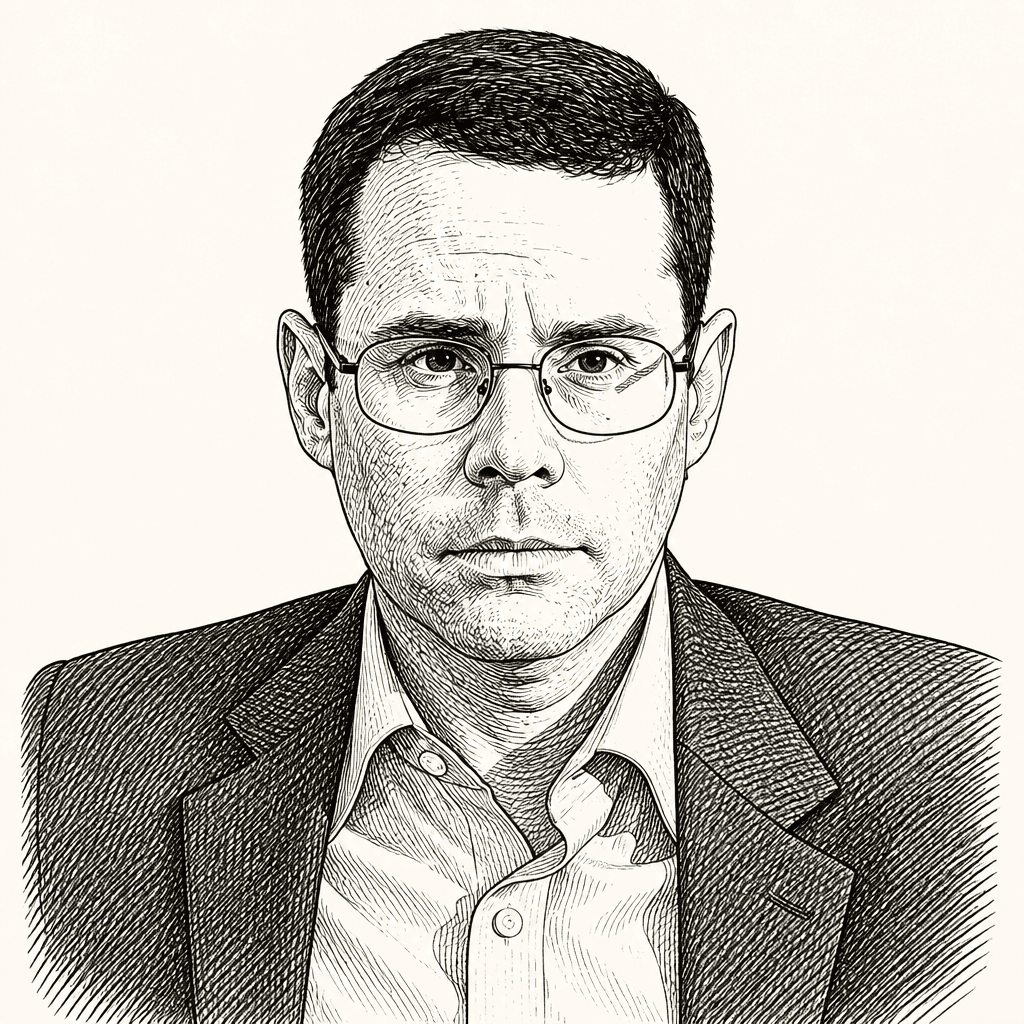
Historian Michael Auslin argues in his new book, National Treasure: How the Declaration of Independence Made America, that the Declaration’s endurance rests not only on its claims about liberty and equality but on its assertion that Americans are “one people.” In this Hoover Institution discussion, Auslin presents the Declaration as a unity document whose authority grew through compromise, preservation, reproduction and repeated use by later movements seeking fuller membership in the American project.
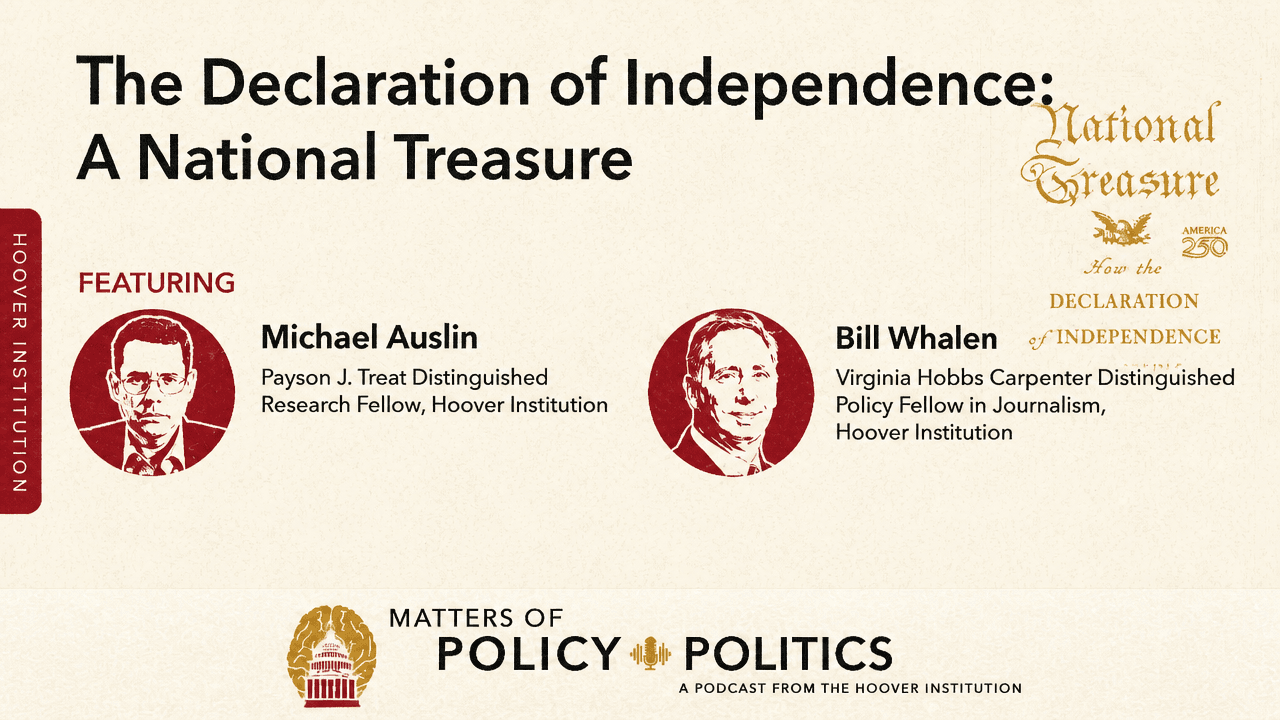
The Declaration’s endurance rests on a claim of unity
Michael Auslin recasts the Declaration of Independence as America’s recurring unity document: not only a founding text of liberty and equality, but a statement that Americans are “one people” before they are a constitutional system, a party coalition, or a set of competing claims.
The Declaration’s history is America’s story.
That claim organizes the rest of Auslin’s interpretation. The Declaration endures because it has lived three lives at once: as a set of ideas, as a fragile parchment that repeatedly had to be saved, and as a cultural object Americans copied, displayed, imitated, argued with, and returned to. Its history includes broadsides read from pulpits, reproductions hung on walls, abolitionists and suffragists invoking its promises, Lincoln building his political philosophy around it, awkward socialist imitations, local July Fourth readings, and archivists devising increasingly elaborate ways to protect a document whose symbolic power kept growing.
The project that became National Treasure: How the Declaration of Independence Made America began, Auslin said, almost accidentally. While working on a different project about Washington, D.C., he visited the National Archives and went again to see the Declaration. He had seen it before, but this time found himself drawn to the object and to the stories around it. After speaking with an archivist, he realized he did not know the history he wanted to know: not only the philosophical background, but the full material and cultural life of the parchment. He looked in the Archives gift shop for a general history of the Declaration and did not find the kind of book he wanted. The result, he said, became “a love letter to the Declaration” and “a love letter to America.”
The Declaration is often presented as a liberty document or an equality document. Auslin does not reject either reading. The claim of consent of the governed matters. So does the assertion that “all men are created equal.” But the thread he thinks is underemphasized is unity. One significant revision to Jefferson’s draft changed “a people” to “one people”; Auslin said the edit was quite likely Franklin’s, though not certain. The final text says “we hold these truths,” not “I hold” or even “the Congress holds.” At the end, the signers pledge their lives, fortunes, and sacred honor “to each other,” not abstractly to a new government.
I call the Declaration our great unity document.
That unity claim is not sentimental in Auslin’s version. The founders were divided, vain, ambitious, and often furious with one another. Their compromises, especially over slavery, left unresolved conflicts that later tore the country apart. But the Declaration became a recurring American reference point partly because it stood above ordinary governing mechanics. Unlike the Constitution, it is not amended, litigated, or treated as the procedural battlefield of national politics. It informs politics without being reducible to politics.
The first Declaration most Americans saw was not signed
The signed parchment at the National Archives was not the first Declaration Americans encountered. The first Declarations were broadsides: large single sheets carrying the printed text. On the night of July 4, 1776, after Congress adopted the announcement of independence, Philadelphia printer John Dunlap printed about 200 copies at Congress’s order. They were returned the next day, and John Hancock sent them through the colonies by post riders.
The original purpose was not ceremony. Congress had to tell “the world,” Americans, patriots who needed courage, undecided colonists, and possibly some loyalists. The news traveled unevenly. Some places received the Declaration within days; Savannah, Georgia, received it more than a month later. As newspapers and local printers obtained copies, they printed their own versions.
That process made independence national and local at the same time. Public readings took place in town squares and colonial or state capitals, but those gatherings reached only some people. Additional printings were often sent to ministers, pastors, and reverends so the text could be read on Sunday. Auslin said that when he examined local printings at the Library of Congress, copies were sometimes addressed on the back to a specific clergyman, with printed or handwritten instructions asking that the text be read from the pulpit.
A locally printed copy, then, was not merely an inferior substitute for the signed parchment. It was one of the ways Americans learned what had happened. It was how people heard that they were now “citizens of a new nation,” as Auslin put it, and that events in Philadelphia, Boston, or New York also belonged to local communities. The Declaration declared 13 sovereign states, but it also described them as part of a unified country.
The spread of printed copies also supports a larger point Auslin returned to later: the American Revolution was deeply shaped by religion, not merely by political theory. The language of liberty, freedom, and rights was heard not only in assemblies or street politics, but from pulpits. For the colonists, he argued, the political and religious imagination were intertwined.
Jefferson wrote it, but Congress made the document stronger
“Thomas Jefferson wrote the Declaration of Independence” is true only if it is immediately complicated. Auslin described the fuller version this way: Jefferson wrote it, gave it to a committee that edited it, and then Congress performed much more extensive editing. The precise speakers behind many changes are unknown, but the changes themselves are known. Jefferson was angry about them.
Jefferson believed Congress had mutilated his draft. Auslin said Jefferson thought the edits weakened the force, passion, and charges he had written. But Auslin’s own judgment is that the editing improved the document. Jefferson came to accept the final version’s importance; by the end of his life, he wanted authorship of the Declaration carved on his tombstone.
The most controversial deletion was Jefferson’s condemnation of the slave trade, which placed blame on George III. Congress also removed a sharp attack on the British people. Auslin argued that retaining that passage would have made postwar reconciliation with Britain even harder than it already was.
Other edits sharpened the document. Congress tightened the 27 charges against the king and, in Auslin’s phrase, made them “a little bit more based on reality.” It also added more references to God. The most consequential edit may have been a single word. Jefferson’s draft began: “When in the course of human events it becomes necessary for a people to dissolve the political bands...” The final version reads “one people.” Auslin said the change was likely Franklin’s, though not certain, and called it crucial because it set the tone for both the document and American history.
Jefferson’s authorship remains central. The structure, cadence, and spirit were his. But the Declaration was not the solitary act implied by the sentence “Jefferson wrote it.” It was drafted under time pressure, revised by a committee, and subjected to congressional negotiation. In June 1776, the Committee of Five had only about three weeks before Congress returned from recess. Jefferson was serving on four other committees. To the men involved, the assignment was not yet a sacred literary commission. Auslin described it as an administrative task that had to be completed.
Jefferson’s selection was both natural and practical. He was known for his writing, especially his 1774 Summary View of the Rights of British North America, but he was not known as a congressional speaker. Roger Sherman was occupied with the Articles of Confederation. Robert Livingston was not yet in favor of independence. Franklin had gout and had also said he would not write anything a committee could revise. Adams later claimed he “put the pen” in Jefferson’s hand because Jefferson wrote better, was less disliked, and because a Virginian should lead the business.
Auslin estimated, from Jefferson’s account book, that the drafting took roughly a week to ten days. The Committee of Five was formed on June 11. Around that time Jefferson’s account book, which had been recording dinners and purchases such as stockings, pen knives, and hats, went quiet for about a week. A letter shows him sending a draft to Franklin around June 21, and the account book resumes around then. It goes quiet again for a few days after Jefferson likely received the draft back from the committee, before the committee turned it over to Congress on June 28.
That June 28 moment is the one John Trumbull later depicted in the famous painting in the Capitol: Jefferson at the center as the Committee of Five presents the Declaration to Congress. Auslin stressed that the painting is not historically accurate. John Quincy Adams, he said, called it an “absolute disgrace” to what actually happened. Yet Auslin also called it one of the most important acts of American myth-making, alongside Washington Crossing the Delaware. It helped make the Declaration visible as a cultural object.
The Declaration became famous again after Americans had largely forgotten it
Auslin does not describe the Declaration’s cultural power as an unbroken inheritance from 1776. Americans largely forgot the document for a time. It was a state paper kept by Congress, not yet a universally recognized shrine. The War of 1812 and the burning of Washington changed that trajectory.
The Declaration’s rescue in 1814 became part of its later aura. When British forces approached Washington, Stephen Pleasonton, a State Department clerk, acted on warning from Secretary of State James Monroe and removed important documents. Auslin said Pleasonton put the Declaration in a linen sack and took it to Leesburg, about 40 miles outside Washington, where it sat in the cellar of a house for weeks in August heat and humidity. Auslin visited the house and cellar while researching the book.
After the war, a “Big Bang” of what Auslin jokingly called “Declarationiana” began. Trumbull’s painting was first displayed in 1818 and 1819 and installed in the Capitol in 1826. The Stone engraving, commissioned by John Quincy Adams in 1820 and completed in 1823, became the basis for the familiar reproductions of the handwritten Declaration. Artistic reproductions, facsimiles, cheap knockoffs, and more expensive reprints brought the image of the document into homes.
This was the point, Auslin said, when Americans widely learned there was an official parchment. The document became a thing to hang on walls and incorporate into daily life. That transition—from state paper to visual and cultural object—is one of the histories Auslin believes previous accounts have not sufficiently identified.
The process also complicates the way Americans now imagine the Declaration. The signed parchment can seem eternal and immovable, but its prestige as a national object grew through printing, copying, display, and myth-making. The familiar image owes much to nineteenth-century reproduction.
A fragile parchment survived war, flight, and modern security planning
The Declaration’s physical history contradicts the image of a static relic. Its symbolic value repeatedly made it a wartime target or concern; its material fragility forced each generation to invent new forms of protection.
- 1776–1783During the Revolutionary War, Auslin said the Declaration traveled with the Continental Congress as it fled British forces.
- August 1814Stephen Pleasonton removed the Declaration from Washington as British forces approached, taking it to Leesburg in a linen sack.
- 1861–1865Auslin questioned the standard account that the Declaration simply remained hanging and unguarded in the old Patent Office during the Civil War.
- 1941Officials secretly sent the Declaration to Fort Knox after studying the risk of bombing attacks on Washington.
- 1952The Declaration was finally placed in the National Archives, with Cold War-era vault protection beneath the rotunda.
During the Revolution, the parchment traveled with the Continental Congress as it fled the British, moving through Baltimore, parts of Pennsylvania including Lancaster and York, and New Jersey. It was not kept in modern preservation conditions. It was carried in sacks or chests, exposed to humidity, rain, cold, and heat. If the British had captured Congress, Auslin said, they likely would have destroyed the Declaration or sent it back to London as a prize.
The War of 1812 brought the most famous rescue. In August 1814, as the British advanced to burn Washington, Pleasonton removed the Declaration from danger. Even that rescue was improvised. Washington was chaotic, some people minimized the risk, and the document ended up unguarded in a Leesburg cellar before returning to a burned capital and being crammed into an attic because the State Department building had been destroyed.
The Civil War episode is where Auslin is most careful to distinguish suspicion from established record. Standard histories said the Declaration hung in the old Patent Office from 1841 until 1876, when it went to Philadelphia for the Centennial Exposition. The old Patent Office is now the National Portrait Gallery; at the time, it functioned as part of a National Museum, a precursor to the Smithsonian’s role. During the Civil War, however, the Patent Office was used first as a barracks for Union troops, who damaged the building, and then as a hospital, with wounded soldiers, doctors, nurses, and visitors moving through.
Auslin found it implausible that the Declaration, by then a fundamental American symbol, was simply left unguarded in a frontline capital. Washington sat across the river from Virginia, the Confederacy’s capital state. The city contained Southern sympathizers, secessionists, spies, and saboteurs. There was also living memory of the British burning Washington less than 50 years earlier.
The question was especially striking because of Abraham Lincoln. Auslin emphasized that for Lincoln, the Declaration was the central American document. On his way to his inauguration in 1861, Lincoln stopped at Independence Hall and said he had never had a political thought that did not derive from the Declaration. Auslin argues that Lincoln built his philosophy and policy on its promises. The idea that such a symbol would be abandoned in wartime did not make sense to him.
Auslin said his book presents evidence for what may have happened to the Declaration during the Civil War, but he did not lay out that full evidence in this exchange. The claim here is narrower: the standard version, in which the document simply remained hanging and unguarded through the war, struck him as historically implausible given the city’s danger, the building’s wartime uses, and Lincoln’s reverence for the Declaration.
World War II produced another secret removal. In 1941, officials feared Nazi bombers might reach Washington if Germany captured the Azores. At that point the Declaration was in the Library of Congress, on an outer wall. Officials studied bomb damage from the Blitz and concluded the Library might not survive an attack. The National Archives existed, but the Library was not yet ready to relinquish the Declaration, and officials still considered the Archives at risk.
Archibald MacLeish, the Librarian of Congress, and his staff concluded that Fort Knox was the best secure and reachable location. The Declaration was secretly packed, taken to the Baltimore and Ohio Railroad, moved by train through the countryside at night, and lowered into the Fort Knox vault for much of the war.
When the Declaration returned and was finally placed in the National Archives in 1952, preservation took a Cold War turn. Officials built the Mosler vault beneath the rotunda, intended to be atomic-bomb resistant. Auslin noted that the Archives still displays a model of it and that newsreel footage exists of testing the vault. During the Cold War, the Declaration was lowered into that vault every night. Even now, he said, it is placed in a vault nightly. Preservation evolved from sacks and cellars to glass, helium, argon, and advanced security.
Its originality came from inheritance, not novelty alone
The Declaration is groundbreaking, Auslin said, but not because it appeared from nowhere. Its originality came from “a long tradition of American beliefs and statements on self-government and liberty. And equality.”
That formulation captures his balance. The Declaration drew on the Bible, the English and Scottish Enlightenment, English common law, colonial political experience, and British constitutional documents. Jefferson himself acknowledged that the Declaration did not express wholly new ideas. Richard Henry Lee, in Auslin’s telling, said Jefferson had essentially taken from John Locke’s Second Treatise. The colonists understood themselves as Englishmen in North America, heirs to the rights of Englishmen.
But Auslin argued that the Declaration did something no prior document had done. It announced a nation’s birth. Other nations simply were: France, England, Russia, China. The Declaration said that “we are a nation together,” even while the states still understood themselves as sovereign and before the later federal system had been created.
British precedents matter, but they do not erase the difference. Magna Carta asserted rights against the king, but originally for nobles, not all people. The English Bill of Rights of 1689, which Auslin called more important for the colonists, reflected the Glorious Revolution and helped shape colonial expectations. Yet neither Magna Carta nor the 1689 Bill of Rights created a people or justified a new experiment in independent self-government.
The Declaration also was not a governing document. It did not create institutions; that was the role assigned to the Articles of Confederation, later superseded by the Constitution. For Jefferson, the delegates, and most Americans at the time, Auslin said, the heart of the Declaration was not the language now most celebrated as “the words that changed the world,” but the 27 charges against George III. Those charges justified separation.
Modern readers often skip the charges because the grievances no longer describe current problems. Auslin’s point is that they still have philosophical significance. They show how a just government should not act. The Declaration does not lay out a positive governing design, but by describing violations of consent and right, it points toward what just government must avoid.
Its most consequential originality may have been its capacity for extension. Auslin said it was groundbreaking because it could be extended to those not included at the time. Whether Jefferson and the signers fully meant the later universal implications remains an interesting question, but, for Auslin, not finally decisive. Over time, Lincoln’s view prevailed: the Declaration’s ideas became universal and eternal in American usage.
The French comparison shows the importance of inherited limits
The Declaration’s influence abroad is real, but Auslin treated that influence cautiously. The French Declaration of the Rights of Man and of the Citizen came 13 years after the American Declaration, with Jefferson still alive and present in France as minister. Yet Auslin did not present France as a simple failed copy of America. He framed the difference as a contrast between enlightenments.
The American Revolution drew, in his view, from a British and Scottish Enlightenment that was more moderate and more religiously grounded. The claim that rights come from God was not merely ornamental; it placed limits on human action. American political thinking, he argued, retained guardrails because it inherited common law, British constitutional tradition, and a religious understanding of rights.
The French radicals and philosophes, by contrast, sought to begin the world anew. Auslin invoked Thomas Paine’s line about beginning the world over again as an example of radicalism at the edge of American thought, not the center of the Declaration’s political tradition. Paine’s attacks on monarchy resonated, but Auslin said that spirit did not quite fit the American Declaration or its enlightenment.
Jefferson himself, while in France, worried that drafts of the French declaration were too radical. Auslin said Jefferson objected to including property as a right in the same way as inalienable rights because property could be alienated—given away—while natural rights could not. Jefferson’s biographer Dumas Malone, Auslin said, captured the tension by suggesting that Jefferson was considered a radical in America but a conservative in Europe.
The French Revolution’s descent into the Terror, reaction, and Napoleon demonstrated for Auslin what can happen when revolutionary forces are unleashed without the same traditions of individual rights and constraint. France lacked, in his comparison, Magna Carta, the 1689 Bill of Rights, and English common law’s embedded protections of the individual. America’s Declaration had its own radical implications, but Auslin argued that it also operated inside inherited limits.
Pressed to identify a later nation closest to the American experiment in its declaration, Auslin did not offer a confident answer. He said he had not treated the subject as a comparative study and worried that emphasis on the Declaration’s global influence can shift focus away from America itself. He noted that Ho Chi Minh quoted the American Declaration in Vietnam’s 1945 declaration of independence while having no intention, in Auslin’s view, of respecting individual rights or property. Influence abroad, he said, is real but separate.
If forced to look for analogues, Auslin said he would probably look within the Anglosphere: Britain, perhaps Canada until recently, perhaps Australia. The persistence of common law, religious inheritance, Locke’s philosophy, and case-law traditions make those political cultures closer comparisons, he suggested, even though their parliamentary systems differ from the American constitutional structure.
Compromise made independence possible
John Dickinson was not peripheral to the founding argument. Auslin described him as one of the most famous men in the colonies, author of Letters from a Farmer in Pennsylvania, and a leader in the colonial movement. But Dickinson believed independence in July 1776 was the wrong step at the wrong time.
His importance lies in what he did with that conviction. On July 2, when Congress voted on independence, the colonies voted by delegation, not by individual member. Patriot leaders wanted unanimity among the 13 delegations. Pennsylvania was divided. Dickinson and Robert Morris, the financier of the Revolution and one of the richest men in the colonies, chose not to appear. They did not abstain; they absented themselves. That allowed Pennsylvania’s delegation to vote yes. New York lacked instructions and formally abstained, then later received authority to support independence.
By not appearing, Dickinson effectively ended the political career he had built over decades. But he also did not delegitimize Congress or destroy the project. Auslin described this as a personal compromise: Dickinson stood by his view, accepted that the larger cause required unity, and then went home and enlisted in the army.
That example underwrites Auslin’s broader contrast with modern politics. Congress operated under oaths of secrecy. Its journals recorded mostly what was done, not what was said. Members understood that they were committing treason and that open leaks could destroy the project. Auslin doubted the process could have survived social media, leaks, and public factional warfare.
Auslin connected Dickinson’s restraint with Jefferson’s. When Congress removed Jefferson’s condemnation of the slave trade, Jefferson was angry, but he did not seek to invalidate Congress, call for it to be packed, or demand that the process be replaced. He accepted the result because larger principles were at stake.
The Continental Congress was not free of partisanship; Auslin noted that Jefferson and Adams later undermined each other in the early federal government and did not speak for decades before reconciling. But the Declaration’s making still offers, in his view, a lesson in compromise and unity at decisive moments.
For Lincoln, the Declaration became the Union’s moral source
The Civil War is the great test of Auslin’s unity claim because the Declaration was used by both sides. Before the war, he said, the Declaration was often understood primarily through the consent-of-the-governed passage Bill Whalen quoted from the film National Treasure: when a long train of abuses shows a design to reduce people under despotism, they have the right and duty to throw off the government and provide new guards for their security. That passage formed a justification for separation from Britain.


The South adopted that logic for secession. Confederate states wrote declarations of independence and repeated the 1776 language because they saw themselves as the true heirs of the revolutionary tradition. That created the central problem: a document meant to justify one people’s independence from empire could be invoked to sunder the nation it had helped create.
Lincoln’s response, in Auslin’s account, elevated a different understanding. For Lincoln, the Declaration was the source of America’s promise, especially equality. Auslin quoted Lincoln’s 1861 Independence Hall statement that he had never had a political thought that did not derive from the Declaration. The Declaration became, in this interpretation, not a license for perpetual fragmentation, but the moral standard by which the Union had to be preserved and slavery ultimately judged.
Whalen introduced an irony through Dickinson College. John Dickinson, who freed his slaves during the Revolution and opposed slavery, had a college named after him. Two of its noted alumni were Roger Taney and James Buchanan. Auslin unpacked the irony. Taney, as chief justice, wrote the Dred Scott decision of 1857, which Auslin called one of the worst judicial decisions in American history. The decision denied Dred Scott’s claim to freedom after being taken into free territory and went beyond the immediate case to state that enslaved people and Black Americans were not citizens but property. Auslin described it as the highest judicial instantiation of chattel slavery and a stain on the Court and American history. It helped propel Lincoln back into politics.
Buchanan, president from 1857 to 1861, watched the nation fracture and, in Auslin’s account, did essentially nothing. He treated the issue as settled when it plainly was not, wasting chances for reconciliation as the political system failed to stop the “cannonball” of disunion. The Kansas-Nebraska Act had already produced violent conflict, radical abolitionism was rising, and the nation moved toward war.
Yet the broader lesson Auslin drew from American irony was not despair. Writing across 250 years, he said, gave him hope because the United States has repeatedly endured periods of severe conflict over politics, identities, ideologies, ethnicity, economics, and power. The Civil War remains the horrific exception, never to be repeated. But in many other clashes, Americans returned to the Declaration not because they agreed, but because they understood it as a shared standard.
Later movements used the Declaration to claim membership in America
Auslin was surprised by how often the Declaration appears in later American struggles, including through the civil rights era. He expected references to the Constitution, capitalism, or legal rights. Instead, he repeatedly found the Declaration in Black newspapers, presidential speeches, labor agitation, women’s rights activism, immigrant communities, and heritage organizations.
Abolitionists used it. Suffragists used it. The temperance movement used it. Nineteenth-century socialist movements also imitated it, though Auslin described their versions as stylistically “execrable,” more like Marxist exhortations than Jeffersonian prose. The literary quality varied; the underlying pattern remained.
The crucial distinction, for Auslin, is whether these movements used the Declaration to separate themselves from America or to claim full membership in it. He argues that, for the most part, they used it to say: we want to be part of this nation, and we want fairness within it. They did not merely wield it as a weapon of group struggle against other groups. They identified as Americans and demanded that America live up to its stated principles.
The founders were vain, brilliant, irascible, difficult, visionary men who were so realistic that they certainly didn’t expect us to love each other. But I think they understood that we could not hate each other and survive as a nation.
That matters for how Auslin would teach the Declaration. He would ask students why the Declaration is important and what ideas it shares with the Constitution. But he would also ask students to identify its influences: the Bible, the English Enlightenment, English common law, and the long tradition from which it emerged. He would ask how later Americans interpreted it: Lincoln, Susan B. Anthony, Martin Luther King Jr., immigrant groups on New York’s Lower East Side.
His aim would be to show that the Declaration was not created “out of thin air,” and therefore cannot simply be ignored “out of thin air.” It came from a tradition and then became a tradition of its own. Its later use by excluded or marginalized groups was a tool “to create a more perfect union,” not only a tool of struggle. It unified those who felt denied full freedom and those who recited it every July Fourth in towns and civic groups across the country.
Auslin described forgotten Americans reading it in local communities, Boy Scouts and Girl Scouts reading it before pledging allegiance to the flag, and communities west of the Mississippi, the Colorado River, and the Sierra Nevada taking pride that they had the same rights as older East Coast communities. The Declaration gave distant Americans a way to understand themselves as part of the same national project.
The Constitution is the battlefield; the Declaration is the spirit behind it
The Constitution, Auslin said, has been written about continuously and rightly so. It is “the battlefield on which we fight our political battles.” That is what it was designed to be. The Declaration is not such a battlefield. It is not amended. Americans do not usually speak of tearing it up. They do not debate it in the same terms of originalism, original intent, or living constitutionalism, even though Auslin acknowledged it is in some sense a living document.
That difference is why he saw a gap. The philosophical ideas behind the Declaration have been studied by academics, but the broader American engagement with it—its reception, preservation, recitation, imitation, and invocation—has received less attention. Auslin was especially struck that histories of the civil rights movement did not leave him with a strong sense of how often the Declaration was referenced.
He saw value in tracing other public texts and speeches, but his point was not simply that another famous document could receive the same treatment. He singled out Calvin Coolidge’s 1926 sesquicentennial speech as critically important, and John Quincy Adams’s 1821 address on the 45th anniversary of independence, including the famous line that America “goes not abroad in search of monsters to destroy.” He mentioned Harry Truman’s speeches around the 175th anniversary as important mortar between the larger rhetorical “bricks” of American political life.
He also closed with an unexpected founder whose reputation grew in his mind during the project: George Washington. Washington did not attend the Continental Congress that adopted the Declaration, did not sign it, and played a tiny direct role in its making. Many people mistakenly think he signed it. Yet Auslin came to admire Washington’s prudence, moderation, and instinctive understanding of the Declaration’s spirit.
Washington’s Farewell Address, which was printed rather than delivered as a spoken address, returns above all to unity. Its warning against foreign entanglements, in Auslin’s reading, is connected to the fear that foreign adventures would shatter domestic unity. That foresight remains relevant, Auslin said, without settling any particular present policy question. The point is that Washington closed a circle with the Declaration by emphasizing the unity necessary for the republic to survive.