Falling Approval and Independent Shifts Point to Democratic House Gains


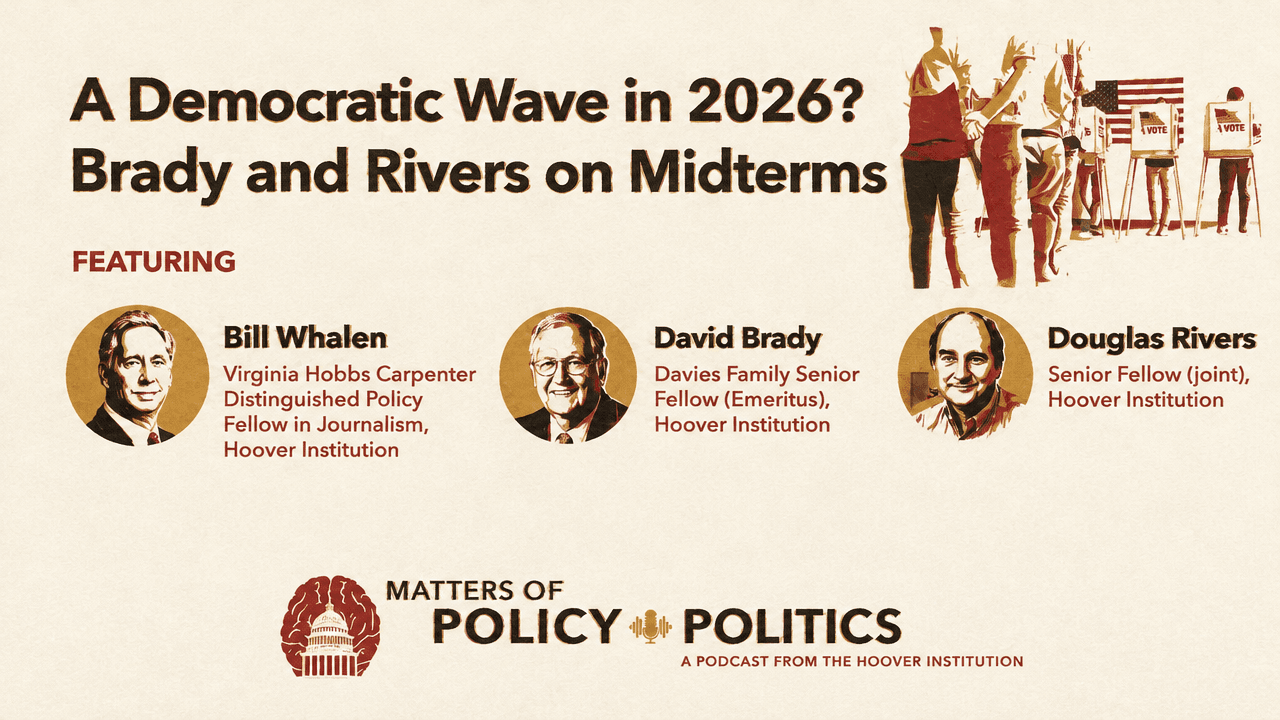
Stanford political scientists David Brady and Douglas Rivers see a plausible path to a Democratic wave in the 2026 midterms, particularly in the House, where Brady estimates the party could gain about 30 seats. Brady bases that forecast on falling presidential approval and a shift among independent voters, while Rivers is more cautious about race-by-race predictions but says the overall direction is easier to estimate. They warn that voter dissatisfaction with Donald Trump does not necessarily amount to support for Democrats, leaving the party’s Senate prospects and post-election strategy less certain.
The case for a Democratic House wave rests on independents
David Brady sees a plausible path to a Democratic gain of about 30 House seats in 2026, comparable to the party’s House gains in 2006. His forecast rests less on a simple reading of the national generic ballot than on three conditions he associates with wave elections: falling presidential approval, an election fought over issues on which the president is weak, and independents moving toward the opposition.
Brady argues that the generic congressional ballot has limited value as a long-run measure of party strength. Before 1990, Democrats held the House for 60 of 64 years and had an average generic-ballot advantage of roughly 11 points. That reflected a durable Democratic majority, not a series of meaningful tests of which party could win a national majority. In Brady’s account, the more useful comparisons begin when Republicans became competitive nationally. He identifies four House wave elections since then: 1994, 2006, 2010, and 2018—the last a partial wave, when Democrats gained about 40 House seats but did not take the Senate.
Brady says the president’s approval was falling in each of those elections, and that Donald Trump’s standing in 2026 is lower than the presidents’ ratings in those earlier cases. He also finds the movement among independents especially consequential. Democratic and Republican voters, he says, generally remain with their own party at rates above 90 percent; the larger shifts come from independents. This year, Brady says, the Democratic increase in the generic vote among independents is greater than in the earlier elections he examined.
That combination leads him to estimate a 30-seat Democratic gain in the House despite the constraints of gerrymandered districts. He cautions that the number of seats in play may be larger than a standard count of competitive races suggests. While roughly 50 House seats are commonly considered competitive, he notes that both parties were spending more than $1 million in each of 70 seats in the final week of the campaign.
Douglas Rivers is more cautious about predicting individual races than about the broad direction of the result. He counts roughly 40 to 50 competitive House contests and says polling in individual congressional races is uncertain. But estimating the overall seat change, he argues, is more tractable because the races tend to move together. A forecast is “playing the averages,” not claiming certainty about each contest.

The polling record offers grounds for caution, but not for discarding the polls, Rivers says. In the last three midterms, he considers polling reasonably good. Presidential polling has tended to understate Republican support in elections where Trump ran, but he describes the typical miss as one or two percentage points—enough to change the result of a close contest, but within the range of what polling can generally achieve.
Rivers says Democrats are more likely than Republicans to take polls, and Trump voters are less likely still. Pollsters account for that by weighting samples to reflect reported past vote. YouGov, he says, asked respondents in November 2024 how they had voted and found it had overstated the Democratic vote by a couple of points; it adjusted its weighting accordingly. He rejects the claim that polls are simply missing Republican voters by five or ten points: “We're not missing by five or ten points.”
The political test, then, is not whether every poll has captured every voter perfectly. It is whether the broad signals—presidential approval, issue concern, and independent movement—translate into a common shift across enough districts to produce a House wave.
Voters’ dissatisfaction is not the same as enthusiasm for Democrats
Brady describes Trump’s position as weak on the issues that helped him in 2024. The economy, especially lowering prices, was his strongest issue, followed by immigration and keeping the country out of wars. Brady says the public is disappointed on each of those fronts, including about 20 percent of Trump voters. He does not characterize that as a wholesale abandonment of Trump, but says his support has eroded, including within the MAGA base.
Whalen cites polling figures that illustrate the election’s referendum-like character. According to the figures he drew from YouGov, inflation was the most important issue for 23 percent of respondents in January 2025 and 32 percent in October 2026. He also cites a CBS News/YouGov poll in which 41 percent of voters said they were voting to oppose Trump. Whalen compares that figure with past midterms, while noting that Trump’s job approval varies across pollsters: he cites a YouGov figure of 39 percent, a Reuters/Ipsos figure of 32 percent, and a Civiqs tracker showing Trump underwater in 30 states. These are Whalen’s cited poll results, not a single consistent measure across pollsters.
Brady’s broader point is that the president’s presence on the campaign trail may not help Republican candidates much. Research on presidential visits, he says, has found effects of only about half to three-quarters of a percentage point, often disappearing.
Rivers argues that voters are not necessarily arriving at the polls with a detailed policy checklist. They want their concerns addressed. In his view, Trump is failing to show that those concerns are his focus. Rivers points to the president’s comments about gas prices and to his attention to projects such as a ballroom, reflecting pool, or arch as examples of what can distract from the issues voters care about. Whalen makes a related point through the idea of “command focus”: candidates can repeatedly foreground a few issues, while a president who shifts from one subject to another risks looking unfocused.
Brady adds that the contest is not simply between a popular Democratic program and an unpopular Republican one. He says Democrats are held in slightly lower esteem than Republicans, by about two points. Rather, voters may see Democrats as the better alternative because they are dissatisfied with what Trump is doing. Brady cites tariffs on Canada as a particular liability in states such as Michigan and Maine, where he says cross-border commerce matters. His argument is comparative: Democrats need not be especially popular if voters judge the president’s handling of their concerns more harshly.
That distinction shapes Rivers’s expectations for the Democratic message. He says Democratic candidates have generally been reasonably disciplined, emphasizing Trump rather than “defund the police” or socialism. He expects that approach to work in a midterm. But a strong election would not necessarily mean voters had endorsed Democrats’ broader agenda. Rivers expects the party to face the problem of winning largely as a vote against Trump rather than a vote for Democrats.
A Senate gain is possible, but the routes are narrow
The House forecast does not settle the Senate question. Brady says six Democratic Senate gains are possible, but thinks three or four more likely. Rivers’s central estimate is more restrained: beyond a possible Democratic pickup in North Carolina, he would expect about one and a half additional seats, as an average across uncertain races. He stresses that this is not a literal outcome; the point is that several contests are close, not that the party can win half a seat.
The candidates’ race-by-race assessments differ. Brady names Ohio and Texas as likely Democratic pickups among the states Whalen lists, and says Alaska had looked close before a controversy involving the Democratic candidate’s campaign and Alaska’s ranked-choice voting system. He had previously thought the candidate might win by one or two points but is unsure how the episode will affect the contest.
Rivers identifies Maine, Ohio, and Texas as the most likely pickups beyond North Carolina, while emphasizing that none is certain. He notes that Susan Collins was behind in polls in 2020 and won, while Sherrod Brown was roughly even in 2024 polling and lost. Iowa, Kansas, and Alaska, he says, are also within a point or two. He regards Alaska as close but notes that a substantial amount of voting may already have taken place.
The comparison with earlier Senate cycles cuts both ways. Whalen points to 2014, when Republicans flipped nine Democratic seats, and 2016, when Democrats flipped six Republican seats. Rivers says 2014 involved Democrats defending seats in states Barack Obama had won in 2008, including Indiana, Iowa, and North Carolina, and Brady adds that Republicans had some weak candidates. A more relevant warning for Democrats may be 2018: they won the House in a wave but lost two Senate seats.
Rivers says Democrats could gain no Senate seats—or even lose one—if, for example, they lose Michigan and Republicans hold Maine, while Democrats still pick up North Carolina. But Brady and Rivers agree that competitive races can move in the same direction, particularly as independents shift. Rivers says he would not be surprised by a larger Democratic gain than his central estimate: South Carolina is in play, even if Democratic hopes in Florida or Mississippi look to him like “hopium.” Those races, he adds, are unlikely to be landslides.
The post-election test is whether either party can hold its coalition together
For Democrats, a strong result would sharpen a disagreement about what the party should stand for in 2028. Whalen raises three proposed litmus tests associated with Representative Ro Khanna: a wealth tax, Medicare for All, and opposition to foreign wars. Brady argues that moving away from the center would make a Democratic candidate more likely to lose. Douglas Rivers distinguishes between the popularity of broad goals and the risks of specific policy designs.
Taxing billionaires is popular, Rivers says, but the details of a wealth tax can raise questions about negative consequences. Medicare for All also polls well in general terms, he argues, but voters may hesitate when asked whether people with existing employer coverage—such as UAW workers—should move to a public plan. Rivers sees expanding the Affordable Care Act and lowering health costs as more popular than rebuilding the health system from the ground up. He says these issues can work for Democrats when approached moderately, and points to moderate Democrats doing well alongside moderate Republicans performing better than MAGA Republicans. As examples, he contrasts Collins’s competitive race in Maine with Ken Paxton’s less competitive one in Texas.
Brady expects the Democratic argument over direction to persist into the 2028 primaries. He thinks a narrow victory by Michigan’s Elissa Slotkin, if that is the result, may be interpreted by progressives as support for their position, even if a more moderate candidate could have performed better. He also points to the state’s Democratic governor candidate, whom Rivers describes as a moderate polling six or seven points ahead while the Senate contest is close.
Republicans face a different succession problem. Rivers says Trump’s approval among Republicans has slipped from its usual level near 90 percent into the 80s, with strong approval down in the 20s. He expects Trump to become a weaker force, though not one who willingly gives up the center of attention. Brady sees a possible opening for Republicans who want to challenge Trump’s direction, especially if the economy is weak or the war has gone badly by 2028. Trump has kept Republicans in line by threatening primary challenges, Brady says; a poor midterm result could make more of them willing to speak up.
Rivers doubts that this will restore a small group of Reagan-style Republicans. He thinks the party has moved on, though a loss could create room for more conventional, or “normie,” Republicans. He also describes a possible irony: a large Democratic victory could enable the party to pursue left-wing policies and investigations that prove unpopular, potentially helping Republicans later. Brady’s reservation is that a revived traditional Republicanism would have to appeal to voters who moved from Democrats to Trump, including people with a high-school education or less. Whether that kind of Republicanism can hold that coalition is, in his view, an open question for the 2028 nomination.
Volatile coalitions keep cultural politics in play
The larger pattern behind the midterm forecast is a shift from long periods of one-party control toward closely balanced parties and changing congressional majorities. Rivers traces the older Democratic advantage to a coalition of Northern urban voters and Southern voters that began to unravel in the 1960s and was effectively finished by 1994. Since then, he says, the parties have been close to even nationally: the party that wins the presidency and gains a majority often loses that majority in the following midterm.
Rivers also describes a familiar midterm mechanism. Presidential elections bring out more peripheral voters, some of whom do not turn out for the president’s party in the midterm—a pattern associated with the “surge and decline” explanation. But he notes that recent presidents have not begun their terms with majority support: Trump never exceeded 50 percent approval, and Joe Biden was above it only briefly.
Brady places that volatility in a broader context. He says populism and unstable coalitions are not unique to the United States, pointing to party instability in Britain and across Europe. As economies diversify and labor unions weaken, he argues, it becomes harder for parties to sustain stable coalitions long enough to govern. Cultural issues therefore remain politically salient, particularly for Democrats trying to regain rural voters, rural evangelicals, and young men. Brady says the party has not overcome the political damage associated with Hillary Clinton’s remarks about rural voters or Obama’s comments about “guns and God.” He also worries about Democratic candidates who advocate defunding police, abolishing ICE, or eliminating prisons.
The Cheesecake Factory controversy—sparked by Barack Obama comparing the White House ballroom to a restaurant decorated by Saddam Hussein—struck Rivers as a story with a half-life of about three days. Brady agreed that the restaurant argument would fade, while cultural conflicts would not. Rivers says Republican campaign ads about transgender issues, which he says hurt Democrats in 2024, do not appear to be penetrating as much this year. Brady also observed that Democratic candidates seemed to have backed off some previous signals, including personal pronouns in campaign materials, though he could not assess that systematically.
For election night, Rivers plans to watch Kentucky’s Sixth District, which he describes as a competitive Trump-plus-11 seat where he expects the Democrat to win. Brady is watching Virginia’s First and Second Districts, particularly the Second, which he says has historically aligned with the party holding the House majority. Rivers says Democrats are ahead in both districts in YouGov polling and describes them as examples of the Trump-plus-five seats he expects to move toward Democrats.