AI’s Economic Test Is Broad Diffusion, Not Frontier Capability


Microsoft chief executive Satya Nadella told a New York Times Hard Fork live audience that AI’s economic test is not whether a few companies build stronger frontier models, but whether the technology spreads widely enough to raise productivity, justify its token costs and create visible benefits for workers and communities. He argued that Microsoft’s role is to build platforms for that diffusion, while warning that job displacement, data center burdens and concentrated gains will make the backlash rational unless humans remain stakeholders through new “glue work” and local upside.
AI only matters economically if the frontier spreads beyond a few firms
At a New York Times Hard Fork live event with Kevin Roose and Casey Newton, Satya Nadella framed Microsoft’s AI strategy around a distinction he returned to repeatedly: frontier capability inside one model or one company is not the same thing as an AI economy. The goal, as he described it, is not to keep talking about AI “as a one thing,” but to build an ecosystem in which every enterprise and every country can operate closer to the frontier.


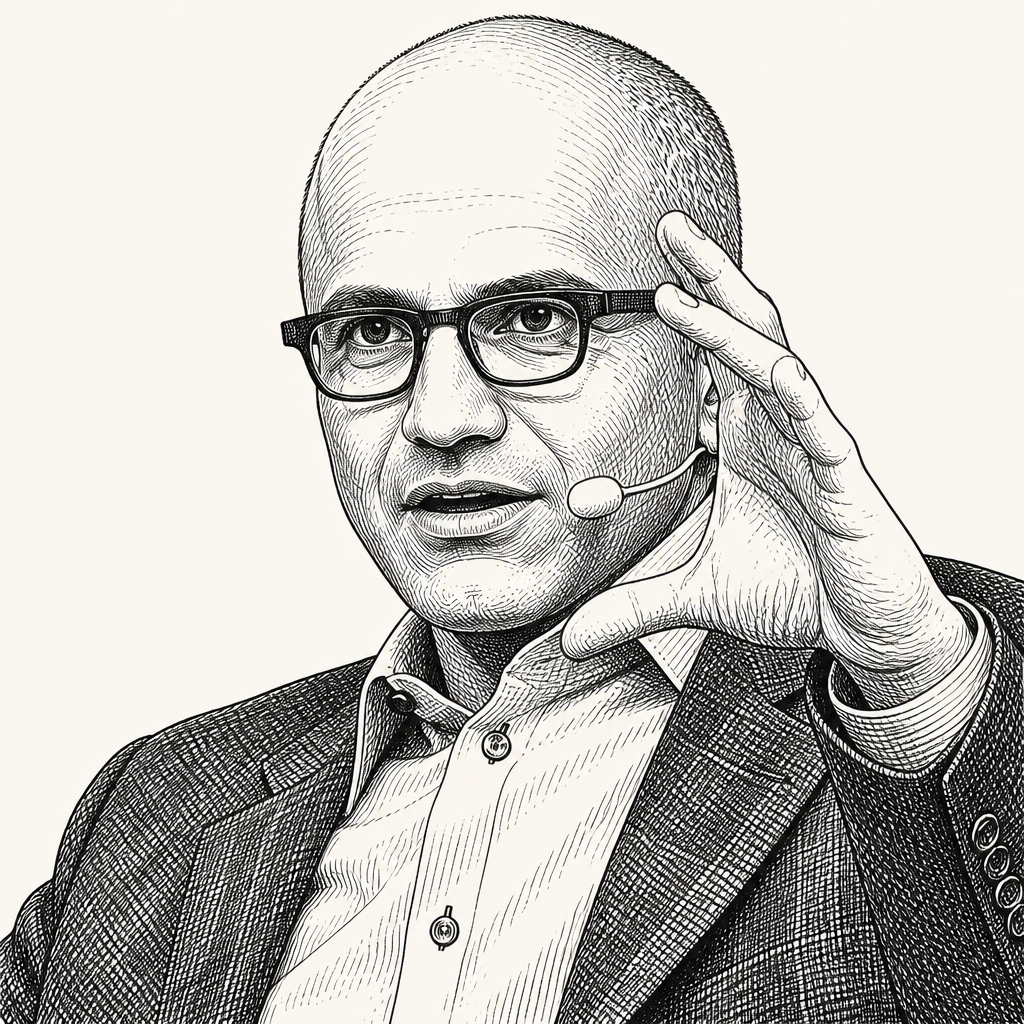
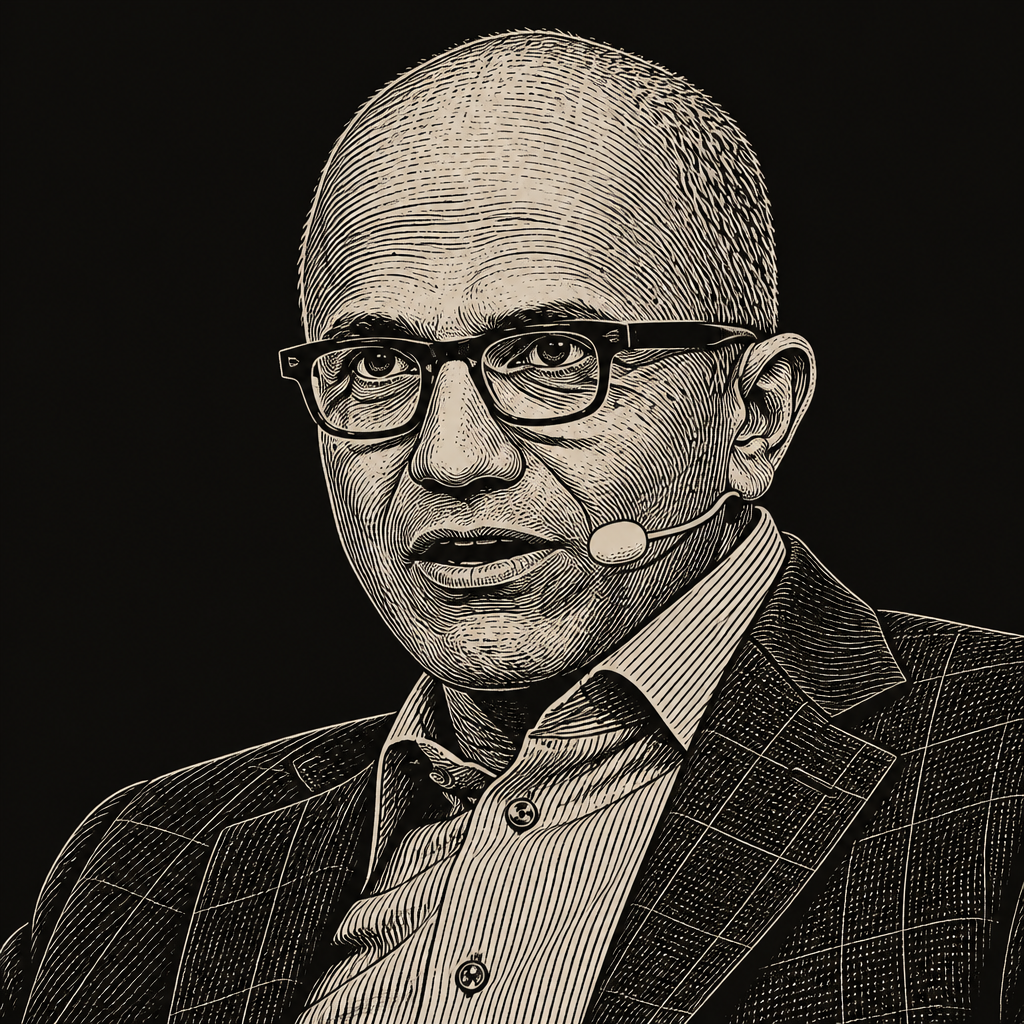
For Nadella, that is the role Microsoft wants to play as a platform company. A model that can do impressive things while the broader economy continues growing at roughly 2 percent is, in his words, not a successful end state. General-purpose technologies matter only when their benefits spread widely enough to change productivity and growth. He put AI in the lineage of electricity and other general-purpose technologies, but with a warning: unless the gains are “broadly felt,” the concentration of the frontier in a small number of firms or models will not “end well.”
That stance also shaped how he described Microsoft’s own model ambitions. Newton pressed him on whether Microsoft’s goal is to build the best frontier model in the world and overtake ChatGPT, Gemini, or Claude. Nadella did not answer as if the prize were a single leaderboard. He described frontier-model development as a process of hill climbing, reinforcement learning, and data — and said that, in his view, “we have saturated the data,” leaving companies to hoover data from every place.
His alternative framing was to make Microsoft’s models useful as a base layer for companies that want to build their own AI systems around their own context, workflows, harnesses, and reinforcement-learning feedback. Nadella said companies should be able to bring a base model into their own RLHF, keep “definitely the harness and the context,” possibly “even the weights,” and replace Microsoft’s model if another one works better. The larger vision, he said, is that the future firm will have both “human capital and token capital” on its balance sheet and income statement.
If the future of the firm is human capital and token capital, I want every balance sheet, every income statement in every company to have both.
That is not a retreat from Microsoft’s own model work. Nadella said Microsoft had recently launched MAI models, “hill climbed from the ground up,” and published a paper intended to show that Microsoft has a pure-lineage model capability of its own. He linked that to the earlier OpenAI thesis that “intelligence is log of compute,” arguing that Microsoft now has compute, model capability, and the continuing OpenAI partnership.
But the strategy he described was explicitly not to make the world dependent on Microsoft’s single best model. It was to make Microsoft useful if other organizations become more capable around AI.
Agents require new devices, not just smarter PCs
Microsoft’s agent hardware vision has two parts: more intelligence inside familiar devices, and new form factors built for work that does not fit the phone-and-app model. In discussing Project Solara, which Newton described as “agent-first hardware,” Satya Nadella first pointed to Nvidia’s Jensen Huang showing desktops and laptops with RTX-related chips and “essentially a petaflop of compute” on the PC. Nadella treated that as new functionality arriving inside an old form factor.
Local compute matters, in his account, because agents that run continuously cannot depend only on metered, remote intelligence. Nadella called the desired state “unmetered intelligence” and described Windows computers running large local models as part of what will be needed if agents are to run around the clock.
The second shift is more fundamental: devices designed for agents rather than apps. Nadella’s example was a nurse moving around a hospital. Instead of centering the phone, the agent-first device could be something like a badge that scans, captures input, converts speech into a prompt, and connects that ambient context to the model. The phone, he said, will remain central for many apps, but agents imply “ambient intelligence” — a sensor field that works with models over time.
That changes the hardware question. In an app world, the device is a surface for user interaction. In an agent world, Nadella’s examples point to devices that also gather context from the surrounding work environment and pass it into models. He described Microsoft’s goal as inventing “new form factors that are not beholden to the old form factors for this functionality.”
The same logic appeared later when he described one of his own AI projects. Nadella said he wanted a code repository that stayed synchronized with discussions happening elsewhere in the organization — including conversations he was not part of. He connected Microsoft 365’s Work Graph, the database underneath Microsoft 365, as an MCP server to a coding agent and instructed the agent to monitor discussions related to the repo and update the repo accordingly.
The example was not only about an agent writing code. It was about an agent watching the organization’s work context and keeping an artifact aligned with evolving requirements. For Nadella, that is the kind of long-running agent behavior that requires both local compute and systems that can convert ambient signals into useful prompts and actions.
Xbox is another version of the sustainability problem
Xbox sits outside the AI platform story, but Nadella described it through the same constraint he applied to AI: technical ambition has to become economically sustainable. Kevin Roose raised the issue after Xbox leaders circulated a memo saying the business faced a “hard reset,” higher component costs, and the possible need for a new business model. Nadella placed Xbox inside a longer Microsoft gaming history: gaming, he said, is older at Microsoft than Windows and Office, with Flight Simulator as the company’s first app, and Xbox itself now in its 25th year.
The problem, in his telling, is not lack of investment. “No one can accuse Microsoft of not having invested” in Xbox over the past 25 years, he said. The question is how to innovate in both hardware and games in an economically viable way. Xbox remains “one of the best sources of entertainment,” but Microsoft has not been monetizing that entertainment adequately. Nadella said more monetization of Xbox games is happening on YouTube than at Microsoft, and that Microsoft has been subsidizing the entertainment.
Casey Newton pressed for what that might mean for players: more expensive consoles, more expensive games, or some other change. Nadella did not give a concrete product plan. He said the company has to find ways to deliver games that are economically relevant for both customers and Microsoft.
He separated a temporary pressure from a permanent strategic question. The temporary issue is component pricing. Because of demand from cloud and AI, he said, prices have gone up across PCs, phones, and Xbox, with semiconductor and memory scarcity having a “massive impact” on consumer electronics. He called that temporal, not permanent. The permanent issue is “what’s the Xbox model going forward,” in a world where PCs, consoles, mobile, and other places to play all have roles.
Nadella said Ashra, who had recently taken over Xbox, was 100 days in and had said she would use the next 100 days to take a fresh look at both hardware and publishing. His answer left the business-model reset unresolved, but the constraint was clear: Microsoft wants to keep building games and hardware while finding a model that no longer relies on subsidizing the entertainment.
Microsoft says OpenAI remains central while it builds its own models
The 2023 OpenAI crisis came up as a counterfactual about Microsoft’s place in AI: if Sam Altman, Greg Brockman, and a large number of OpenAI employees had actually joined Microsoft under the hastily imagined “Microsoft Advanced AI Research,” would Microsoft be better off today? Kevin Roose presented Nadella with a sweatshirt bearing that nonexistent division’s name. Satya Nadella said he would remember the weekend forever, though he joked that what he most remembered was India being thrashed by Australia in cricket.
Nadella avoided the counterfactual. He said Microsoft is “thrilled” that Altman and Brockman returned to OpenAI. He described the original OpenAI investment as a bet on a research lab with a nonprofit structure and a for-profit unit that was looking for backing for the “crazy idea that intelligence is log of compute.” Many people at Microsoft thought the idea was “nuts,” he said, but Microsoft backed it.
The current relationship, as he laid it out, has several forms of value. Microsoft is on OpenAI’s cap table. OpenAI is a large Azure customer. OpenAI remains a source of intellectual property for Microsoft “all the way till ’32.” Microsoft also has flexibility to reuse IP and build its own.
That combination matters because Microsoft’s posture toward OpenAI includes both the continuing partnership and its own model work. Nadella credited the OpenAI partnership with helping Azure reach its current infrastructure position. He also made clear that Microsoft now wants its own model lineage and the ability to continue developing independently.
Newton characterized the recent OpenAI-Microsoft renegotiation as giving OpenAI more room to work with multiple cloud providers and commercialize its technology more openly. Asked what Microsoft got, Nadella pointed to Microsoft’s investment position in OpenAI, OpenAI’s role as a large customer, Microsoft’s IP access through 2032, its flexibility to reuse and build IP, the infrastructure advances tied to the partnership, and its own newly launched MAI models. He did not describe the relationship as zero-sum. But he also did not describe Microsoft as merely OpenAI’s cloud partner.
The backlash is rational if AI takes jobs, water, and power without local upside
Nadella’s answer to the AI backlash was blunt. If the industry tells people it has an extraordinary technology, but “you’re not going to have a job,” and it will take their water and energy, “good luck,” then anxiety is inevitable. He said the industry cannot deny that the perception is terrible.
You can’t go out there and say, I have this unbelievable technology, except you’re not going to have a job, and in fact we’re going to take all your water and all your energy, and good luck.
His proposed response was not primarily messaging. It was evidence that more people are stakeholders. For data centers, he cited Microsoft’s 20-year presence in Quincy, Washington. In Nadella’s account, over that period Quincy’s tax base rose, local taxes went down, employment increased, and the town became, in effect, a data center town. He described a Microsoft cookout where people celebrated what he called the rejuvenation of Quincy because of the company’s presence.
He presented that as the kind of longitudinal case AI infrastructure companies need to create in communities hosting data centers. Those data centers, he said, cannot raise energy prices for local residents, should replenish the water they use, and should create local economic opportunity. The bar, in his telling, is not that data centers merely operate; it is that their presence leaves a community with visible benefits.
The employment question was harder, and Nadella did not deny disruption. When Newton pressed him on whether he was saying there would be the same number of jobs, just with higher pay, he said he was not claiming there would be no displacement or that workflows would remain unchanged. He used software development as the clearest example: development is already becoming “agentic,” but managing that change creates new work.
His analogy was the spread of typing. If someone in the early 1980s had predicted that 3.5 billion people would become typists, he said, the idea would have sounded absurd. Yet people now type constantly as part of information and knowledge work. In the same way, Nadella expects roles to be renamed, restructured, and wage-supported around new tasks.
In software, he described a developer of the future as someone managing groups of 100 or 1,000 agents. The new technical need is not only test coverage, but what one of his colleagues calls “cognitive coverage”: understanding code produced by agents, checking what happened, and using tools to reason about the generated work. That, he argued, remains a software-development job, and it still requires studying computer science.
The broader claim was that automation does not eliminate all human work; it changes the “work artifact,” the workflow, and the work itself. Nadella’s name for the remaining and newly discovered human role was “glue work.” Even with digital systems already in place, he said, human capital often consists of connecting, interpreting, coordinating, and resolving what systems do not capture. With more automation, he expects new glue work to appear.
In spite of all the digital systems we have at our disposal, we do the glue work. We will discover the new glue work that happens with all this automation.
The token economy has to justify its own cost
Nadella’s benchmark for AGI, raised by Kevin Roose from a prior interview, was 10 percent GDP growth. Asked whether anything now points toward that level of acceleration, Satya Nadella focused less on model capability and more on diffusion, management, and economics. A powerful general-purpose technology does not automatically transform growth, he said. It requires change management across systems.
The immediate management problem is token economics. Nadella’s “hard truth” was that the marginal cost of productivity improvement must match the marginal cost of the token. Businesses cannot treat token use as automatically valuable simply because employees enjoy it or because it feels like “money in my bank.” The business must benefit.
He described the 10 percent growth case as a kind of matching equation: if the marginal cost of the token matches its marginal value and price, then 10 percent growth becomes plausible. But the current pattern of people using AI to produce code and “token max” is not, in his view, a path to that level of growth.
Nadella admitted there is “a lot” of token-maxing inside Microsoft and said he is “a token maxer too.” The behavior is addictive, he said: people like the tool and use more of it. But when novelty wears off, the relevant question becomes what value the user is trying to create.
That is why he praised Copilot’s “auto mode,” which he said has an economic model feeding it. His operating principle was to avoid using the most expensive or capable model where the problem does not require it.
Don’t use frontier models for non-frontier problems.
Matching model capability to task value is part of the discipline. The goal is not to maximize token consumption, but to produce outputs whose economics make sense. Nadella did not say better models are unimportant. He said their economic impact depends on whether organizations can deploy the right amount of intelligence at the right price against the right workflow.
Political legitimacy is part of the AI economy, not an afterthought
The through-line in Nadella’s answers was diffusion: AI has to move from frontier demonstrations to broad productivity, sustainable business models, and visible benefits for workers and communities. That is why his political-economy answer treated markets, democracy, and technology as inseparable rather than as separate domains.
Casey Newton asked about proposals reportedly floated by Sam Altman and discussed by President Trump for the U.S. government to take direct investment stakes in frontier AI companies, as a way for citizens to share in AI wealth. Asked what percentage of Microsoft he would like the government to own, Satya Nadella replied: “MSFT, you can trade.”
His fuller answer was cautious but not dismissive. He called the idea of a U.S. sovereign fund taking equity stakes on behalf of citizens “novel,” while noting that other countries have done versions of sovereign wealth funds and that Alaska has a form of citizen benefit tied to oil wealth. He also connected it to arguments that Social Security would be better funded if some portion had been invested in the S&P 500.
Nadella did not endorse a specific policy design and did not argue that the government should own Microsoft. But he said he was not opposed to innovative ideas of this kind. To the extent such ideas can be tried and succeed, he said, “we’ll all benefit from it.”
That answer fit his broader political-economy frame. When Newton asked what San Francisco AI leaders get wrong about the political economy of AI, Nadella declined to accuse them of being wrong, but said history shows technology cannot be separated from markets and democracy. Drawing on a book he had recently read about long-run Western and Chinese economic development, he said the West’s distinctive success came from putting technological revolutions, markets, and democracy into a virtuous cycle, each checking the others.
There is, he said, “no such thing as an economy” separate from political economy. Democracy controls markets; technology disrupts both; checks and balances keep the system functioning. His view is that the same model must be redefined for the AI age, whether in San Francisco, Washington, or elsewhere.
He expects major disruption, not a final technology
Roose’s final question pressed Satya Nadella on how “AGI-pilled” he is: whether he believes the jagged frontier will keep advancing until today’s automatable tasks become whole automatable jobs. Nadella accepted part of the premise. Anything where loops can be closed is vulnerable to rapid AI progress. Coding is one such area. AI research may be another. He said there is now enough evidence for that.
But he resisted the leap from closed-loop tasks to full replacement of messy knowledge work. The issue is verifiability. In real-world work, many important actions are not captured as traces that can be used to train or reinforce a model. In meetings, a person says things, notices things, interprets signals, and later acts on them — but what matters about that work is not necessarily recorded in a way that can be optimized through reinforcement learning.
That is where Nadella thinks some forecasts “sell short” the unverifiable part of human capital. He expects advances to continue and acknowledged that the tools will be powerful and disruptive. But he placed AI among the great general-purpose technologies rather than outside history altogether. Electricity and steam were transformative too. AI is “a big step up” in the pantheon of technologies, he said, but he does not think it is the last technology humanity will invent.