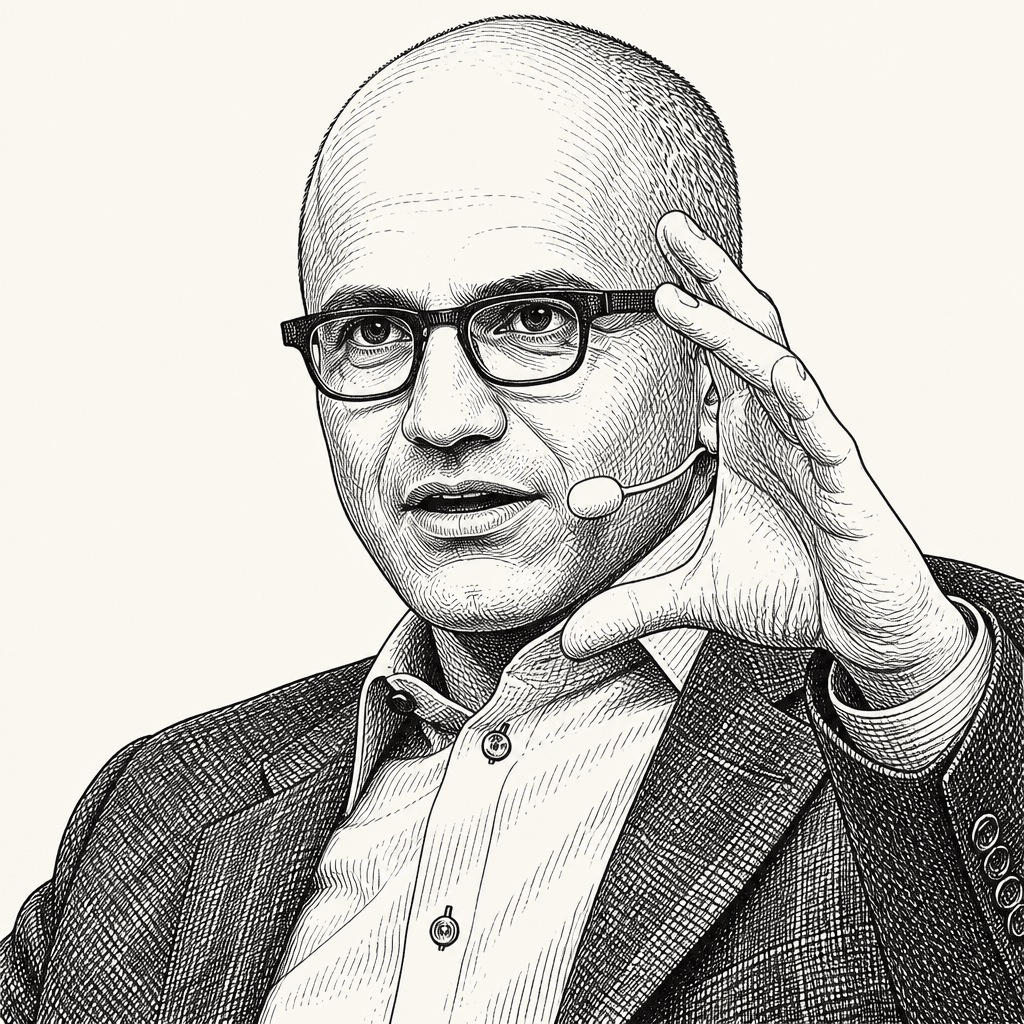
Satya Nadella
Chairman and CEO of Microsoft. Nadella joined Microsoft in 1992 and previously led its Cloud and Enterprise group, helping drive the company’s cloud infrastructure and services business; he now leads Microsoft’s AI strategy across products, platforms, and infrastructure.
AI’s Economic Test Is Broad Diffusion, Not Frontier Capability
Microsoft chief executive Satya Nadella told a New York Times Hard Fork live audience that AI’s economic test is not whether a few companies build stronger frontier models, but whether the technology spreads widely enough to raise productivity, justify its token costs and create visible benefits for workers and communities. He argued that Microsoft’s role is to build platforms for that diffusion, while warning that job displacement, data center burdens and concentrated gains will make the backlash rational unless humans remain stakeholders through new “glue work” and local upside.
Private Evals Are Becoming the Core IP of Enterprise AI
Microsoft chief executive Satya Nadella argues that the AI frontier is shifting from single models to company-specific systems built from private evals, traces, tools, data and multi-model harnesses. In a Microsoft Build conversation with Sarah Guo, Elad Gil and Shawn Wang, Nadella says those private evaluation loops may become a company’s most important intellectual property, allowing enterprises to build their own specialist intelligence rather than merely consume frontier models. He also frames the broader test for AI as legitimacy: whether customers, workers and communities see measurable gains from the technology and the infrastructure behind it.
Microsoft Bets Enterprise Agents Will Run Through the Cloud
John Coogan reads Microsoft Build 2026 as a sign that Microsoft is trying to make the cloud, not the phone, the center of enterprise AI agents. On Diet TBPN, he argues that Project Solara, Scout, OpenClaw support and Microsoft’s own models point to a platform strategy built around Azure, Microsoft 365 data, security boundaries and cost-efficient deployment rather than frontier-model supremacy. The open question, he says, is whether agent hardware and workflows can win adoption outside environments where companies can mandate them.
Useful AI Systems Are Emerging Inside Controlled Enterprise Workflows
TBPN’s latest discussion framed the commercial AI moment less as a race to looser autonomy than as a shift toward bounded systems. Across Microsoft’s Build announcements, Suno’s funding, creator films, stablecoins, crypto markets, cybersecurity, and workflow software, the central argument was that AI becomes useful when it is embedded in infrastructure that can price, route, audit, secure, or constrain it. John Coogan and guests applied that lens most directly to Microsoft’s agent strategy, where Azure and Microsoft 365, not a new phone, become the controlled operating environment for enterprise agents.
Companies Can Build Frontier Intelligence Without Owning the Frontier Model
Satya Nadella used Microsoft’s Build 2026 AI announcements to argue that the next phase of AI will be defined by ecosystems, not by companies consuming a single frontier model. In a crossover conversation with No Priors and Latent Space, Microsoft’s chief executive said enterprises and startups should be able to build their own “frontier intelligence” from models, tools, data, context, and private evaluations. His case is that durable value will accrue to companies that control those loops, rather than simply rent intelligence from a general-purpose provider.
Microsoft and NVIDIA Redesign PCs and Data Centers for Agentic AI
At Microsoft Build, NVIDIA chief executive Jensen Huang joined Microsoft chief executive Satya Nadella to frame their expanded partnership around a single premise: agents are becoming a primary computing workload. Huang argued that this shift requires redesigning PCs, data centers and software together, from RTX Spark devices that can run local autonomous assistants to Grace Blackwell and Vera Rubin systems built for large-scale reasoning and low-latency agent execution. Nadella positioned the work as an extension of Microsoft’s infrastructure and developer platform strategy across Windows, Azure, Fabric, Foundry and GitHub.