Religious Pluralism Depends on Trust Built Through Everyday Relationships
 Betsy Shirley
 Tonya Butler-Truesdale
 Dexter Nutall
 Fish StarkHamza Yusuf
 Walter Kim
 Josh GoodThe Aspen InstituteTuesday, September 29, 202615 min read
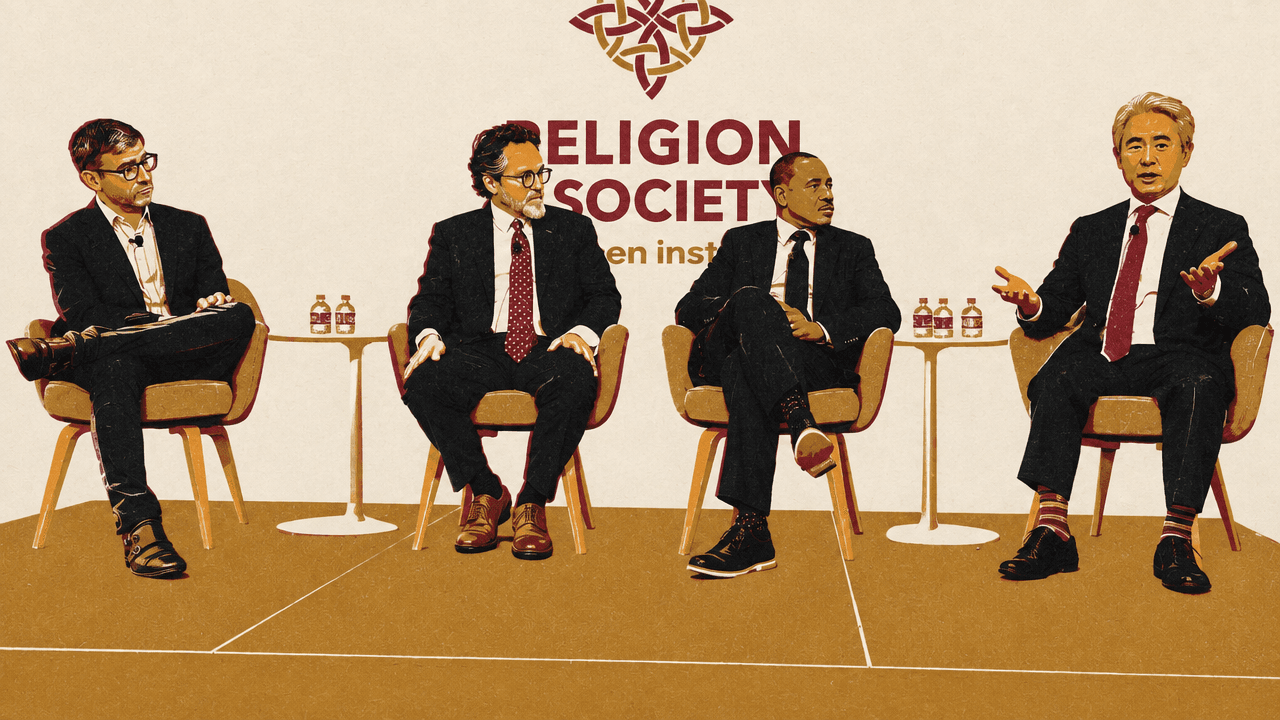
In this Aspen Institute panel, Muslim, evangelical and Baptist leaders argue that religious pluralism requires more than acknowledging that people hold different beliefs: it depends on how communities protect freedom of conscience and treat their neighbors. Walter Kim emphasizes non-coercive expression and the relationships that build trust; Dexter Nutall asks whether congregations turn conviction into practical care; and Hamza Yusuf calls for humility toward other traditions without abandoning one’s own beliefs. Together, they make the case that pluralism is tested in ordinary encounters, not just affirmed as an ideal.
Pluralism requires more than acknowledging difference
Pluralism, Walter Kim argues, is both a fact and a theory. The fact is that people with different religious commitments share a society. The theory is the moral framework for how they should live together: what freedoms they should have, what posture they owe one another, and what norms allow difference without coercion. Acknowledging that a society is diverse does not, by itself, answer how its members should treat one another.
That framework must account for traditions beyond the Abrahamic faiths, a question raised by Reverend Tonya Butler-Truesdale, who said discussions of religious pluralism often leave out pre-Abrahamic practices. Hamza Yusuf’s response was that Hinduism and related traditions cannot be treated as marginal. He noted Hinduism’s scale and its relationship to Buddhism, Jainism, and Sikhism. At Zaytuna College, a Muslim institution, students are required to read the Bhagavad Gita. Yusuf also said early Muslim scholars quoted Hindu and Buddhist sources and incorporated wisdom from other traditions.
Yusuf grounds pluralism more broadly in the recognition that no tradition is the only one people inhabit. He points to the presence of Hinduism, Buddhism, Christianity, and Islam across the world, and argues that the existence of many adherents should produce humility and respect for others’ rights. He describes Islam as pluralistic from its beginnings, citing the Quran’s rejection of compulsion in religion and the Prophet’s multi-faith community. He also acknowledges that Muslim history, like other religious histories, has had “checkered” periods.
His account is not a claim that religious traditions have always lived up to their ideals. Yusuf distinguishes the “ego of religions” in human history from their essence or spirit, and argues that the distinction matters when assessing coexistence. He cites long-standing Christian, Jewish, Hindu, and Muslim communities in Muslim-majority societies while acknowledging that history includes oppression as well as coexistence. His point is not that these histories were uniformly peaceful, but that the record should not be reduced to conflict alone.
Kim locates a scriptural basis for civic pluralism in the early Christian story. In the Book of Acts, he argues, Paul makes a case before Roman authorities for the right to express and share his belief in Jesus without forcing it on anyone. The tribunal finds that Paul has done nothing wrong. For Kim, this is an early vision of religious liberty: freedom of conscience and worship, alongside the freedom to persuade through open exchange.
The same history also shows the danger of a state imposing an ideological test. Christians were persecuted, Kim says, because they refused to worship Caesar as god; their confession that Jesus was Lord was treated as treason. He sees both possibilities at Christianity’s origin: a model of non-coercive religious expression and a warning about what happens when a government makes conformity compulsory. The freedom to hold and share a conviction matters precisely because people may disagree deeply about what is true.
Dexter Nutall agrees that pluralism is both fact and theory, but says theory matters only when it is lived in a particular community. At his Thanksgiving table, a Muslim, a Christian, and an atheist may sit together. A congregation can appear unified in worship while containing many different perspectives and convictions. The practical question, as he describes it, is whether people can work together on immediate needs: food, resources, and the daily problems they share.
For Nutall, a scriptural anchor is the call to seek the good of the city while living in a pluralistic culture. That means leaving theological abstractions long enough to ask what neighbors can do with the resources and leverage they have. At New Bethel Baptist Church in Washington’s Shaw neighborhood, the question is sharpened by geography: multimillion-dollar houses stand on one side of the church, public housing on the other. The congregation’s beliefs, he says, should become visible in how people across those lines engage one another. This does not require pretending that differences have disappeared; it asks what people can do together amid them.
The panelists do not define pluralism as setting aside religious convictions. Kim emphasizes a civic framework that protects freedom of conscience and non-coercive expression. Nutall asks whether convictions lead people to care for neighbors and remain open to learning. Yusuf stresses the humility required to believe one is right while recognizing others’ right to their own opinions. As he put it, “I believe I’m right, but I have to have that fallible understanding that other people have a right to have their opinions.”
Trust is made visible in ordinary encounters
Josh Good asks whether congregations can help rebuild social trust at a time when confidence in major institutions is low. Kim’s answer begins with a distinction: trust is not created by teaching an abstract principle. It is built through relationships and lived experience. Children learn to trust through relationships with adults and peers long before they read philosophers on civic virtue.
Kim points to religious communities as a kind of mediating institution: a place between private life and the wider society where people meet across generations and build support. He cites a Harvard Human Flourishing Project study that followed 66,000 nurses over 16 years. Kim said the study found a 68 percent decrease in deaths of despair—including drug overdose and suicide—among people who attended religious services once a week. He also recalled a Baylor study of homelessness in 14 to 16 major cities. As Kim described its conclusion, people become homeless not first because they run out of resources, but because they run out of relationships.
Kim describes the support itself in practical terms. In his church, someone who is hurt can expect a meal train to cover meals for a month and people to sign up to visit. He calls this kind of support “relational capital”: the experience of being cared for, which can engender trust. Congregations, he argues, can offer this connection because they bring people together repeatedly, across age groups and circumstances. The studies and example support his broader argument that relationships and support networks matter to trust.
Nutall illustrates the importance of an everyday encounter with a story about a woman who arrived at a church after missing an aerobics class. Dressed for exercise and carrying a backpack, she was late when she entered. At one church, she received “the look”; an usher told her she could sit toward the back. She left resolved never to go to church again.
On Ninth Street, she saw people entering New Bethel and walked in. She was greeted with a hug and a smile, then seated on the second pew, where people with titles usually sit. That day, she decided to begin a relationship with God through Christ. Nutall’s point is that a congregation’s culture can make someone feel safe, seen, and affirmed—or send them away. Its beliefs become visible in how members treat the person in front of them.
That emphasis on conduct grows out of Nutall’s account of the Black church, formed in a history of oppression and marginalization while holding a high view of scripture and the Lordship of Christ. He says conviction and humility come from the same source: beliefs should shape behavior, especially in relationships with other people. The biblical emphasis on “one anothers”—care and concern for one another—offers a guide. Before debating doctrine or systematic theology, he says, love is an ethic people can recognize. Humility also means leaving space for a divine being to be greater than any one person’s understanding. For Nutall, those commitments make it possible to learn from people whose beliefs differ from one’s own.
Yusuf approaches trust through the language of faith itself. He notes that the New Testament word pistis is also used for trust, and that the Quranic terms iman and amanah are related. People, he argues, are disposed to trust one another: a patient trusts a doctor with degrees on the wall; a passenger may take a stranger’s claim to be a nuclear physicist at face value. That basic trust also makes people vulnerable to deception. Repeated betrayal does not necessarily extinguish hope, he observes, but it can expose how much institutions depend on people’s willingness to trust.
Where Kim emphasizes relationships and practical support, Yusuf asks what makes authority and shared standards credible. He argues that when every hierarchy is leveled in the name of egalitarianism, authority becomes difficult to sustain. Family, he says, is the first hierarchy people encounter. His concern is that young people may be taught to distrust authority while also being exposed to relativism and nihilism. He invokes Dostoevsky’s The Demons, in which a teacher is surprised when students act on ideas he has taught, as an analogy for the difficulty of condemning destructive consequences after undermining the grounds for trust.
Yusuf also sees the loss of traditional gatekeepers for ideas as part of the problem. He says people increasingly get news from online commentators rather than from outlets such as CNN or Fox News. His larger point is that information environments are changing and that familiar institutions no longer have the same role in filtering ideas. He does not treat institutional authority as automatically trustworthy: his concern is how people can distinguish reliable guidance from deception when trust itself is strained.
He points to the possibility of renewal in what he calls “remnant people”—those who preserve a culture’s virtues when its vices become more dominant. For Yusuf, restoring virtue is part of rebuilding the grounds on which trust and authority can rest. Kim’s account emphasizes the repeated experience of being supported by other people; Yusuf raises the separate question of what shared moral commitments and legitimate authorities can sustain trust. Nutall’s story adds a concrete example of how a congregation’s commitments appear in the way a newcomer is received.
Learning across traditions need not erase their differences
Kim describes a formative experience from his first year of college: a late-night dorm conversation with a Hindu, two people from Jewish backgrounds, a Christian, an aspiring Buddhist, an atheist, and an agnostic. Their beliefs differed, but he saw a shared concern with meaning, transcendence, and human connection. The experience led him to explore the biblical idea that all people are created in the image of God.
Kim emphasizes the political force of that idea in its ancient context. In the ancient Near East, he says, the king alone was understood to bear the image of God. He cites an Assyrian letter that describes a hierarchy in which the slave is in the image of the free person, the free person in the image of the king, and the king alone in the image of God. Genesis, by contrast, says that all people—male and female—are created in God’s image. Kim reads that as a “democratization of dignity,” a claim about the value of every person.
That conviction has informed Kim’s work across religious lines. He describes representing Protestant Christianity at the first multi-faith summit held by the Muslim World League in Riyadh in 2022. Participants discussed poverty and religious extremism without compromising the specific beliefs of their traditions. Their common concern, he says, was the rise of violence and the decrease in aid to those most affected. The point of the meeting, in his account, was not to make the traditions interchangeable, but to identify shared problems they could address together.
Asked what non-theistic communities might learn from religious communities, Kim returns to the same account of human dignity. He says that a community—religious or humanistic—should make room for three features of human life: dignity shared by all, an inherently relational existence, and embodied life. These are grounded, in his own theology, in creation. But he argues that their effects matter even to people who do not accept that source. A community need not share his theological explanation, he says, to recognize the practical importance of dignity, relationship, and embodied existence.
Yusuf’s response to Butler-Truesdale’s question about pre-Abrahamic faiths was not simply that all traditions share the same beliefs. He described concrete forms of intellectual exchange: the Bhagavad Gita is required reading at Zaytuna College, and he said early Muslim scholars quoted Hindu and Buddhist sources. He pointed to the influence of Buddhism in Central Asia and to stories in Rumi that, he said, draw on Buddhist material and are given an Islamic form. He also described his own appreciation for Christianity, including an ongoing exchange with an evangelical friend in which each tries to persuade the other toward his own tradition.
Yusuf uses humor to suggest that human concerns recur across traditions, but his more serious argument is about intellectual openness. Religious learning, he says, requires the tools to read scripture responsibly. Invoking Augustine’s writing on Christian doctrine, he argues that readers need to understand language and interpretation before approaching sacred texts. Scripture can be “a double-edged sword,” he says; religious literacy can help distinguish careful interpretation from misunderstanding and fanaticism.
He also extended his argument to language and culture, objecting to what he sees as the normalization of vulgar speech and arguing that shared, precise language helps societies communicate. He distinguished that from dismissing vernacular forms, citing Malcolm X as someone who spoke excellent English and used slang deliberately as a rhetorical device. Yusuf connected language to the capacity for people to communicate across differences. This was his cultural argument, not a point on which the other panelists offered a parallel position.
Butler-Truesdale’s question also asked how to measure a congregation’s civic contribution beyond attendance and charitable output. Nutall answered by turning to practical needs that shape human flourishing. His predecessor at New Bethel, Walter Fauntroy, served as a U.S. representative while pastoring the church and often spoke about five areas that recur in congressional committee work: housing, healthcare, education, jobs, and money.
For Nutall, those categories offer a way to think about civic contribution in context. Congregations can ask how they organize their resources and collaborate around neighbors’ needs, including the needs of people outside the membership. The categories point to concrete questions: whether a congregation’s work connects with housing or healthcare needs, supports education or employment, or helps people navigate financial needs. The answer will vary by community, but the measure is not simply whether a congregation gathers or gives. It is whether it uses what it has to address conditions that affect people’s lives.
Nutall does not propose a universal score or a fixed set of indicators. Instead, he shifts the emphasis from counting activity to asking whether a congregation is using its resources and relationships to respond to needs in its particular setting. In Shaw, the contrast between expensive homes and public housing makes that question immediate: what opportunities does the church have to bring its resources and neighbors into meaningful engagement?
Changing minds takes more than a louder argument
Betsy Shirley asks how religious leaders should respond to people within their own traditions who oppose pluralism. Should leaders try to persuade them, or model a different way and hope the example changes minds? The panelists’ answers differ in emphasis: Yusuf points to resources within traditions, Nutall to the posture of being a neighbor, and Kim to a gradual process of changing what people encounter and learn.
Yusuf’s answer is to draw on the resources within religious traditions themselves. He points to a Quranic passage that says God could have made people one community, but instead gave them different ways and called them to “vie in virtue.” He also tells the story of the three rings from Lessing’s Nathan the Wise: a father gives each of his three sons a ring, but none can know which is the original. A judge tells them that the way to establish the ring’s value is to live so that they become beloved by God and by other people. Yusuf’s lesson is that a tradition’s claims should be tested in the life its adherents lead.
Nutall agrees about the importance of humility, but focuses on a particular confusion he sees among believers: treating pluralism as if it required compromising one’s faith. He sees particular risk among younger Christians who are new to church and become zealous in ways that can turn dangerous. Engaging someone of another faith does not require browbeating them with a Bible, he says. Religious leaders should learn to be neighbors before trying to be voices of authority.
For Nutall, the impulse to dominate can come from insecurity, and it can feed movements such as Christian nationalism. A healthier posture begins with the possibility that a person encountered along the way may have something to teach you. This is not a request to abandon conviction. It is a claim about how conviction should shape conduct: if beliefs produce arrogance or obstruct learning, they have failed to govern the believer’s behavior in the way Nutall describes.
Kim describes the challenge as a question of how people change. One ineffective theory of change, he says, assumes that more evidence, a louder voice, and greater insistence will persuade someone to abandon an error. His alternative is the difference between an orange and an onion. An orange is peeled once, yielding the fruit; an onion has layers, and removing one reveals another. Difficult social and religious disagreements, he argues, require sustained work through those layers.
Complex problems are like onions. You peel one layer and discover, oh my, there’s another layer.
For a church, that work involves what is preached from the front, the illustrations used to make a point, the curriculum, the people members encounter, and the relationships the church creates. Kim returns to the relationship between experience and explanation: often people experience something first, then receive an explanation that helps them understand what they felt. Exposure and teaching need to work together. A congregation’s approach to pluralism is therefore not limited to what its leaders say about other groups; it is also shaped by whom members meet and what forms of shared life become familiar.
He illustrates the approach with a church in Memphis that worked with World Relief, which Kim described as the humanitarian arm of the National Association of Evangelicals and one of the country’s 10 refugee resettlement agencies. Through sermons, curriculum, and experiences engaging with the city’s racial history, the congregation concluded that it wanted not only to proclaim its teaching but to demonstrate it, and signed up for a refugee resettlement project.
An Afghan woman arrived in the country with two children, uncertain what would happen next or how she would find a place to live and get her children into public school. Kim says that people from the church were at the airport with signs bearing her name. They drove her to doctors’ appointments and accompanied her as she learned to fill out forms for her children’s school enrollment. The friendship became profound. After she found a mosque and began attending, she said that the Christians had made the transition possible and suggested that the mosque and church do something together. They held a potluck.
Kim presents the sequence as a layered process: education, practical engagement, and sustained proximity, followed by a relationship that opened the possibility of collaboration between the church and mosque. It was not a single act that resolved a complex disagreement. It was a series of experiences in which people encountered one another in practical and personal ways. The church’s work, in Kim’s account, was a way its beliefs became tangible to someone outside its membership.
Yusuf emphasizes humility and the ethical resources within religious texts; Nutall stresses neighborliness and the danger of mistaking engagement for surrender; Kim argues for patient, layered change through teaching and relationships. Their answers are distinct, but each addresses the same practical problem: how religious conviction can shape conduct toward people who remain free to differ.