Parity Homes Proved West Baltimore Demand Before Capital Arrived

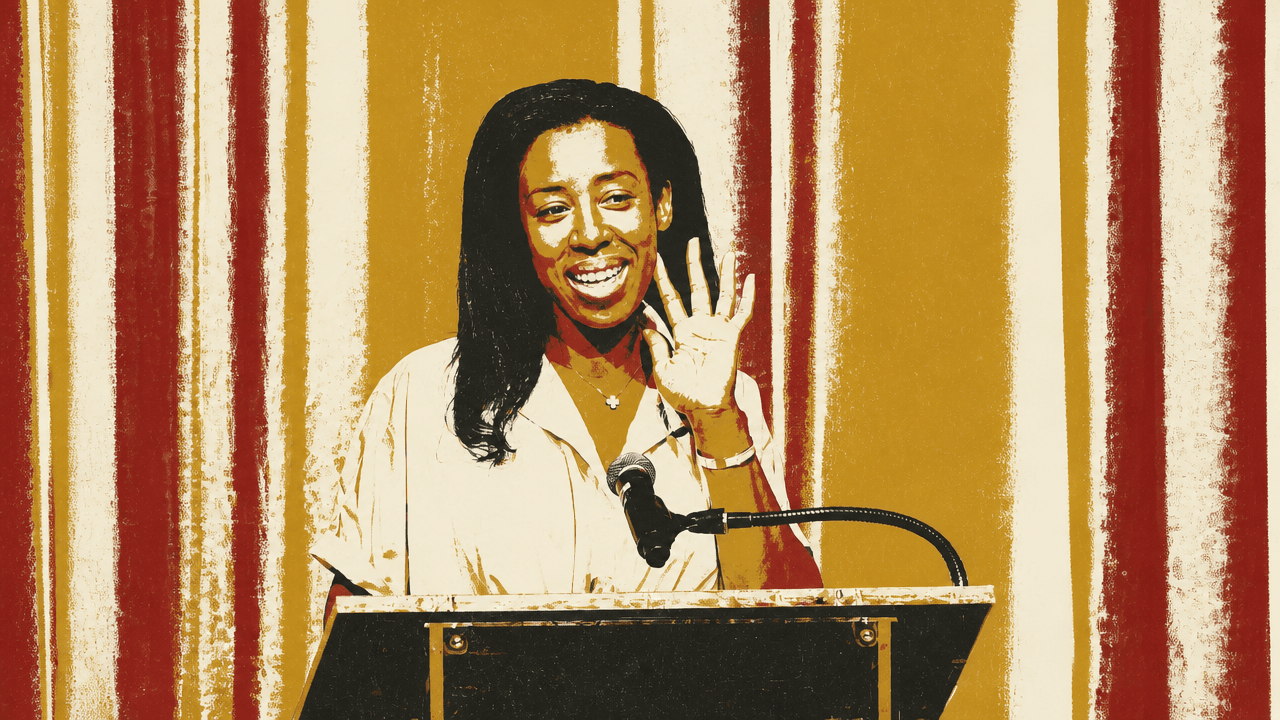
Bree Jones, founder and chief executive of Parity Homes, used her Trust in Practice Summit keynote to argue that trust can operate as development infrastructure in neighborhoods damaged by disinvestment. In her account, Parity proved demand in West Baltimore before major capital arrived by using a $100 rendering, repeated conversations and an 800-person waitlist, then turned that social trust into a resident-led housing effort. Jones’s broader claim is that restoring vacant homes in historically Black neighborhoods requires rebuilding residents’ relationships to land, to one another and to collective power.
Parity proved demand with trust before capital arrived
Bree Jones’s central claim was that trust can function as practical development infrastructure. Before Parity Homes had a large grant, before it could acquire a block of vacant buildings, and before it had a finished house to show, it used a $100 rendering and repeated conversations to test whether people would choose to live in West Baltimore if the homes were restored.

Traditional investors had told Jones that even if they funded the work, and even if Parity built the homes, the homes would sit empty because no one would choose to live in West Baltimore. She recognized the claim as the same deficit-based language she had heard about the Bronx, where she grew up. Rather than begin with those investors, she decided to begin with potential residents.
The method was deliberately small. A full rehabilitation of a single home cost about $350,000. Parity’s first minimum viable product cost $100.
Jones took a cell-phone photo of a vacant block of rowhouses and posted it on Craigslist. She then commissioned an artist to render the same block as lived-in: windows where boards had been, doors restored, trees added to a street that had none, and people walking on the sidewalk. The slide made the contrast plain. The original block was empty and boarded; the imagined version was not cleared or replaced, but repaired, occupied, and socially alive.
She carried that image across Baltimore and asked a direct question: if these vacant homes could be bought and renovated, would you want to live here? She asked it in churches, food halls, neighborhood associations, young professional groups, Slack channels, and anywhere else people would listen. From that rendering and those early conversations, Parity built an 800-person waitlist of people who said that if the homes were built, they would want to live there.
For Jones, the waitlist answered the investor objection. The problem was not a lack of interest in West Baltimore. It was that structural barriers had prevented people from participating in the market that outsiders claimed did not exist.
The false story of abandonment hides a capital cycle
Bree Jones framed Baltimore as “a tale of two cities”: a city of landmarks, parks, murals, and historic architecture, and also a city where a person can move from a tree-lined block to an adjacent block that is vacant, dilapidated, and abandoned. That visible contrast matters because it invites a misleading interpretation. If someone “didn’t know any better,” they might ask who failed to care enough about the community to keep it from deteriorating.
Jones argued that this is the wrong story. The deterioration was not evidence of a community’s indifference. It was the result of systems “intentionally designed to disinvest black communities,” including redlining, urban renewal, and blockbusting. Those systems restricted the flow of capital into Black neighborhoods, and that restriction set off a cycle.
A homeowner who wants to sell may be unable to find a buyer who can get a mortgage if banks have restricted lending in the neighborhood. A homeowner with 20 years of deferred maintenance may need a loan to repair a roof, but if banks will not lend, the leak worsens until the owner has to leave. Once homes sit empty and no one can fill them, deterioration compounds. Banks can then point to the abandoned conditions as evidence that the neighborhood is too risky to invest in.
A diagram in Jones’s presentation rendered the loop as a cycle linking structural racism, disinvestment caused by lack of capital, depopulation, and neighborhood deterioration. The loop is self-fulfilling: a neighborhood denied capital becomes visibly distressed, and that visible distress is then used to justify denying it more capital.
In Baltimore, she said, historically rich Black communities in West and East Baltimore became abandoned over time through that process. The city’s phrase for this geography is the “Black butterfly,” because East and West Baltimore appear like the wings of a butterfly on a map. The question at the center of Jones’s work is therefore not how to market neglected neighborhoods, or how to make abandoned properties attractive to outside investors. It is how to repair trust when the systems governing land, capital, and neighborhood life have frayed it so deeply.
The Bronx taught Jones that waiting for the market means arriving too late
Bree Jones connected Baltimore’s vacancy to her own history in the Bronx. She grew up in a neighborhood that, for years, many outsiders described through avoidance and fear: don’t go there; there is crime; it is a place of things people do not want to experience. As she learned the Bronx’s history, she saw a pattern that mirrored Baltimore’s: hyper-vacancy and abandonment caused by structural restrictions on capital, and the disenfranchisement of Black and brown people.
That history has since been followed by gentrification. Many people once thought gentrification would not reach the Bronx, even after it had taken hold in Harlem and Brooklyn. In the neighborhood where Jones grew up, she said, homes now sell for a million dollars and more.
Before gentrification fully took hold, she bought one of the last vacant buildings in her neighborhood. She used much of her own capital to rehabilitate it, learning firsthand what it took to turn a vacant, dilapidated building into housing. The building had previously belonged to elders who died without anyone to inherit it; Jones said that pattern happens often in Black communities. Through the project, she created three units of perpetually affordable housing.
The lesson she drew was not that she should keep doing scattered rehabilitation projects in New York. After building one herself, she joked that she did not recommend the experience and had had enough of personally doing that kind of construction. More seriously, she concluded that in New York “the ship had sailed.” Once gentrification has begun, the work becomes mitigation and harm reduction. It is no longer possible, in her view, to fully control the dynamics or ensure equitable outcomes.
Her thesis for Baltimore came from that constraint. If investment could arrive early in cities with high vacancy, and if large swaths of formerly vacant land and buildings could be assembled, then those homes could be used differently. Instead of pushing people out, the work could keep people in.
The Collective made residents co-creators, not just buyers
Bree Jones said that from the 800-person waitlist, about 15 people became deeply committed. They met every Sunday for two years, co-creating and building the vision together. That group became what Parity calls its Collective: people who are socially connected to one another, who already have trust in their own lives, and who bring that trust into a shared effort larger than themselves.
The Collective was not presented as a conventional outreach list or a pool of leads. In Jones’s account, it was part of how the development work took shape before Parity had the money to build. The work grew slowly and steadily after two years during which she was unpaid and operating as a solo founder. Jones said that work got the attention of JPMorgan Chase’s philanthropy team, which made what she described as a large catalytic grant to Parity in 2022; the presentation identified the award as $2 million.
That capital allowed Parity to acquire buildings. Jones said Parity has acquired 65 vacant, dilapidated buildings in its neighborhood. The work also included 620 tons of garbage removed. The conditions she showed were severe: facades standing with interiors gone, collapsed walls, missing roofs and floors, and trees growing inside structures.
Parity pre-sells its homes to Collective members. Because those members are involved from the beginning, they can choose “just about everything” that goes into the home: floor plans, colors, cabinet colors, floor colors, and whether the home is configured as a single-family or two-family residence. In 2022, Parity unveiled its first homes.
The standard Jones described was deliberately not minimal. The goal was to build homes “that anyone across the country could see and think, I want to live in West Baltimore. What’s going on there?” The houses were meant to stand the test of time, not merely remove blight.
A three-year wait became evidence of trust, land, and power
Bree Jones used the story of Jamie and her daughter, Zuri, to show what a trust-based development process required from residents. Jamie went under contract to purchase a home that, at an early stage, still had a tree growing in the center of the building. Jones explained that weeds can become trees inside vacant structures and eventually bring the structure down. Parity calls some of these properties “blue sky houses” because, after debris is cleared and the first-floor deck is built, the sky is effectively the roof.
Jamie believed in the project from the beginning. For her, the point was to create a neighborhood where her daughter could grow up “where she was the rule, not the exception.”
Parity brought Jamie and Zuri through the whole process: the ruined structure, the clearing, the open-air blue-sky phase, and finally the completed home. At the reveal, Zuri reacted to the finished house with “Oh my gosh!” and, when asked whether she loved it, answered, “I love it.”
The detail that mattered most was duration. From the moment Jamie began with Parity, when the organization was still a startup without raised capital, to the moment she moved into the house, the process took three years.
Jones treated that timeline as evidence of a deeply trust-based process. Jamie could have bought a home elsewhere in the city, state, or country. Instead, she chose to spend time and energy on something radical and community-rooted. Before she ever stepped into her finished home, she and her daughter already knew their neighbors deeply.
If that’s not evidence of a deeply trust-based process, I don’t know what is.
The claim extends beyond patience with a difficult construction process. Jones’s broader theory of change is that restoring Black Americans’ relationship with land and space must happen socially, because that relationship has historically been shaped by forced enslavement, displacement, Jim Crow, gentrification, and ghettoization. Every attempt to build a stable relationship with land, in her telling, has been “frayed” or “ripped apart.”
If people rebuild relationships with one another and rebuild social trust, she argued, that trust leads to power. It gives people more ability to advocate for themselves, whether the immediate issue is a pothole, a street lamp, or an institution meant to serve them.
The renewable resource was the community itself
Bree Jones said Parity has completed 15 units for Collective members and is on track to do another 20 homes this year. Those numbers mark material progress, but she did not frame them as the only measure of the work. The deeper resource, in her closing account, was social capital: the bonds among neighbors.
She described that resource as “free, so to speak,” and almost unlimited. “If we have nothing else,” she said, “we have one another.” In difficult times, her instruction was to tap into that.
Her final story came from a podcast anecdote about Marty Nesbitt, whom she identified as an adviser to Barack Obama. During Obama’s presidential campaign, Obama asked Nesbitt what the most critical and transformative thing he could do for young Black boys would be if he became president. Nesbitt’s answer, as Jones retold it, was: “Well Barack, the first thing you could do is win.”
Jones used the line to narrow the scale of action. Repairing trust, land, and neighborhood power can sound grandiose. Her closing instruction was simpler: take the first step.