High-Stakes Team Sports Leave Many Boys Without a Way to Play
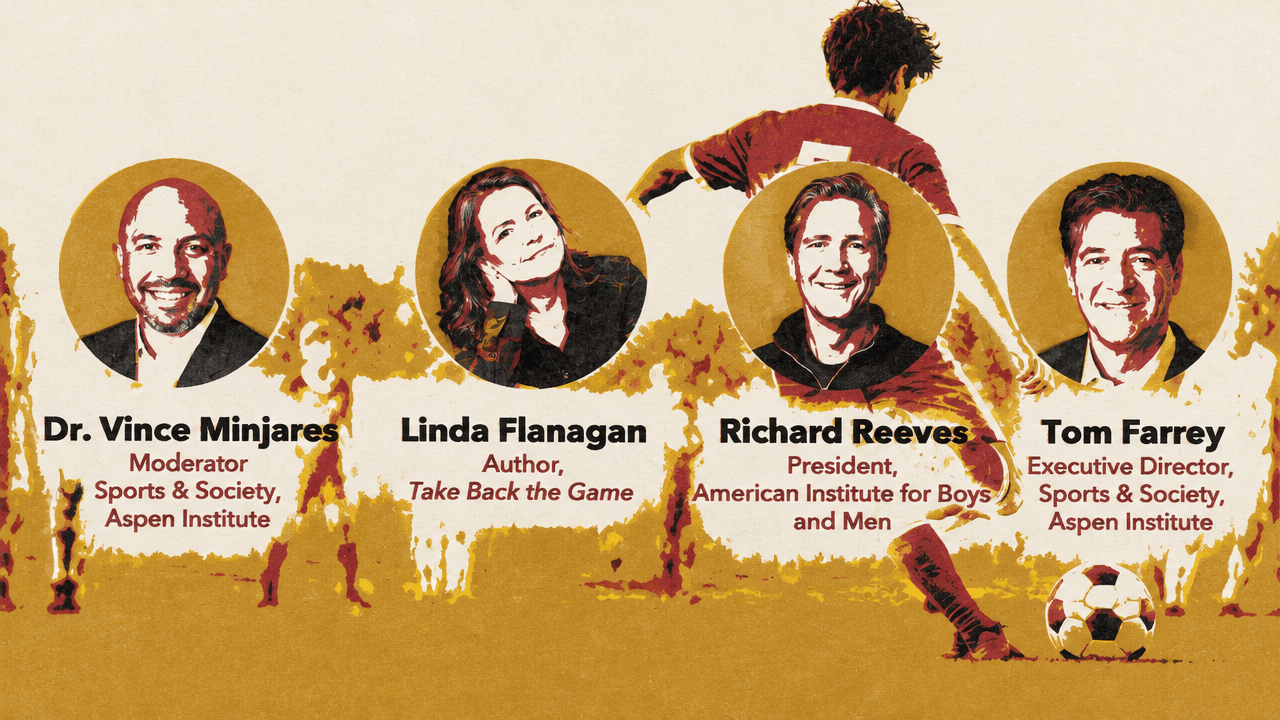
 Vincent Minjares
 Tom Farrey
 Linda Flanagan
 Richard ReevesThe Aspen InstituteThursday, November 5, 202616 min read
A report from the Aspen Institute’s Sports & Society Program and the American Institute for Boys & Men finds that boys’ participation in sports is declining even as youth participation overall has risen. Aspen’s Tom Farrey and AIBM’s Richard Reeves argue that many boys value sports for fun and connection but face high-stakes, narrow routes into play, shaped by cost, coaching and pressure to be good enough. They call for schools and communities to offer more ways to participate without reducing opportunities for girls.
Boys are leaving sports even as participation overall rises
Tom Farrey says overall youth sports participation has risen since the end of COVID, from 49% to 58%, and girls’ participation has increased. But several measures point in the other direction for boys: the Sports & Fitness Industry Association reports an 8% decline in boys ages 6–17 regularly playing sports from 2013 to 2024; the Youth Risk Behavior Survey reports an 8% decline in high school boys on at least one sports team from 2011 to 2023; and Monitoring the Future reports a 9% decline among 12th-grade boys on a school team over the same period. The American Time Use Survey also shows boys and men ages 15–24 spending two fewer hours a week playing sports than a decade earlier.
Farrey says the decline warrants attention because sports are one of the few extracurricular activities boys are more likely than girls to do. If schools and communities want to keep boys engaged, sports can provide a route to relationships, activity, and connection to school that other available activities may not. Farrey also sees the trend as a change in a long-standing way of raising boys: organized sports were promoted at scale more than a century ago partly to channel adolescent boys’ energy into team settings, where they could learn to compete and benefit physically, socially, and mentally. He describes school sports, playgrounds, and the introduction of sports such as basketball and volleyball as part of that history.
The report, produced by the Aspen Institute’s Sports & Society Program and the American Institute for Boys & Men, draws on a youth athlete survey, focus groups with 20 high school- and college-aged boys and young men, interviews with school leaders and industry experts, and secondary research. Its focus is adolescent boys ages 10–17. Vincent Minjares describes a central finding: boys value sports for fun, connection, challenge, and personal growth, yet the available opportunities can feel socially, psychologically, and physically high-stakes. Many boys see too few ways to enter, participate, or stay involved.
For Richard Reeves, the issue connects to boys’ engagement in school more broadly. He says boys are about a year behind girls in literacy by the end of high school and half as likely to be at the top of their class by GPA. He also points to differences in how engaged boys feel at school and argues that sports can make that period of life better. Reeves says boys’ declining participation deserves attention without slowing efforts to expand opportunities for girls. In his view, treating the issue as a zero-sum choice has obstructed good-faith progress: a participation gap is a reason to ask what is happening, not an answer to whether anything should change.


Farrey likewise distinguishes investigating boys’ experiences from retreating from work to improve girls’ access. The report’s recommendations, he says, include measures intended to benefit girls as well as boys. The question is whether schools and communities can understand what each group wants and make room for more ways to participate.
The cost of being a beginner can be especially high for boys
Boys in the report often asked themselves whether they were good enough. Minjares says feeling not good enough for the sports on offer was among the most common reasons boys gave for disliking sports. In high school, the familiar options—football, basketball, soccer—can reward early specialization and years of prior access. A boy who starts late, develops later, changes sports, or lacks the family resources to play for years may find himself on the margins.
The barrier can arise at different stages. A boy may reach a growth spurt later than his peers, take up a sport as an older teenager, or decide he wants to switch after spending years in another activity. If the available route is a tryout for an established team, those differences in age and experience can determine who gets to play. The report recommends adapting strategies to account for boys’ age and stage differences; the panel’s discussion makes clear why a single entry point or level of competition may not work for everyone.
Linda Flanagan says her own informal survey at a boys’ school found that boys valued sports for much the same reasons: friendship and fun. What they disliked varied more widely, but included pressure, exhaustion, injury, and being yelled at. One boy described how his father’s mood could depend on how well he played, affecting the father for the rest of the week. Flanagan says those pressures help explain why boys may hesitate to try a sport in the first place.
For boys, she argues, being unathletic can carry a particular social cost in high school. Someone who has not played before may already feel behind; the prospect of failing in public, or having a mistake recorded and shared on social media, can make trying seem riskier still. Minjares recalls boys asking why they would try out if they expected to perform badly and become the subject of rumors. Flanagan agrees that the possibility of embarrassment can make avoiding the court feel like the sensible choice.
The problem is not only whether a boy gets onto a team. It is whether there is a valued place for him if he is not among the best. Reeves says US youth sports can make participation instrumental: a route to a college scholarship, admission, or a professional opportunity. When the point of playing is framed as advancement, there is little room for being merely competent. He calls himself “a huge fan of mediocrity” in this context: most people will be bad at most things, he says, but should still be able to play for enjoyment and friendship.
Flanagan’s own son, who is not interested in athletics, illustrates the status problem. When asked whether he would play intramurals, he said he might find it embarrassing because he was not good enough for junior varsity. Intramurals, he thought, would be seen as a club for people who did not play sports. The option may exist, but it does not necessarily feel like a legitimate way to participate.
The panel discussed whether college admissions and scholarships intensify these pressures. Reeves wondered how much the narrowing of sports opportunities between ages 12 and 18 is driven by the possibility that athletic performance might help with college admission. Flanagan thought peer pressure and the intensity of high school were more immediate barriers for boys who had not played before: high school can feel like a fishbowl, while college intramurals may be less exposed and less consequential. The exchange does not settle how much college incentives contribute. It distinguishes that possibility from the social pressure a teenager may face simply by joining a team or trying out.
The pressure may be sharper in some communities. In response to a question about minority boys, Farrey says sports may be less varied in low-income Black communities than in suburban schools, and may be presented as a means to a scholarship or professional career rather than as an activity with intrinsic rewards. If a boy feels he is not on a path to those outcomes, he may conclude that there is no reason to continue.
Reeves asks whether the gender gap in sports participation is often wider for Black boys and girls, and suggests that the way sport is understood—as a means to an end—could be relevant. He offers an anecdote about a Black family he knows in Baltimore: the boy’s basketball career was treated as a possible “golden ticket,” while his sisters pursued other routes. That example is his own, not a finding the panel presents as representative of Black families. The broader concern raised in the exchange is that when sports are understood chiefly as a route to a scholarship or professional opportunity, participation can feel all-or-nothing.
Broader access means asking what students want
Farrey argues that schools need better information about what students want to play, at what level, and when. In Project Play’s community work, surveys ask children what they play, what they would like to play, and why they are not participating—whether the barrier is transportation, coaching, or something else. He says the answers can give communities a clearer picture of both demand and the obstacles that keep children from taking part.
He points to Oakland as an example of a substantial change in participation. With support from Steph and Ayesha Curry’s foundation, a 2021 assessment found that only 17% of children were participating in middle school sports. Farrey says participation later rose to 62%, over roughly five years, as local organizations and other actors rallied around middle school sports. He describes the increased attention to the opportunity as useful data for local efforts; he does not present the figure as proof that surveys alone caused the rise.
Farrey proposes making student-interest surveys a regular practice in schools, for girls and boys. Surveys could ask which sports students want, when they want to play, and what level of commitment they are looking for: intramurals, student-led clubs, casual play, or more serious competition. If schools know that students want a sport or kind of experience that is not offered, the information can help administrators, community partners, or funders decide where to act. Without it, he says, it is difficult to know where to invest or how to design policy.
He suggests that the US Department of Education could certify an approved survey and that schools could distribute one each year. The purpose would be to create a reliable flow of information about what students want, rather than assuming that the existing menu of teams reflects their interests. Farrey’s proposal applies to girls as well as boys: understanding demand could help schools and communities identify gaps for either group.
He also argues that schools should recognize a wider range of meaningful sports opportunities. Title IX has been crucial to expanding girls’ access, he says, but school-based evaluations of participation tend to focus on interscholastic teams. Intramurals, student-led clubs, community partnerships, and more casual activities could also count toward a fuller understanding of access. Farrey wants incentives and accountability structures that recognize those opportunities, not only varsity or other school teams. The aim is not to replace girls’ opportunities, but to widen the range of options available to all students.
A school may not be able to provide every activity itself. In Farrey’s model, information about student interest can help point to community partnerships or philanthropy as ways to fill gaps. He says those partnerships are harder to plan without data about what students want. The recommendations therefore connect two actions: make demand visible, then give schools and community partners more ways to respond.
Flanagan adds a measurement problem: participation statistics often capture teams more easily than activities such as running after school or lifting weights. She believes those forms of exercise matter for health and well-being, even if they do not provide all the social benefits of team sports. Her distinction is between the value of exercise and the additional social experience that can come from playing with a team; the two should not automatically be treated as identical.
Reeves describes how one of his sons found badminton locally and brought friends into it. It was not a major school offering or an obvious route to a scholarship, but the group became good enough to enjoy playing. For Reeves, the example illustrates how a less familiar activity can offer a way to play without the same pressure to be exceptional. He says the son and his friends could enjoy being pretty good at badminton without needing to be the best.
Farrey connects the shortage of lower-stakes options to school policy. He says No Child Left Behind did not create incentives for physical education or recess, which were consequently cut in some schools. Schools also reduced middle school, freshman, and other non-elite teams. The result can be a stark mismatch: 80 boys try out for a basketball team, 15 make varsity, and nine get playing time. Farrey says that supply of opportunities does not meet demand.
He points to communities trying different approaches, including leagues or intramural opportunities for students who do not make school teams. In some places, these opportunities can still allow students to represent the school. He mentions Oswego, Oregon, and Spokane in connection with local efforts described in the report. These examples are presented as pockets of inspiration and room for local innovation, rather than as one standardized model.
A coach can decide whether a boy stays
The report identifies coaching as another point where sports can fail boys. Minjares says boys recognized the value of teams but sometimes felt their coaches did not care about them as individuals, particularly when they were not the best players or rarely played. The presentation of the report lists “Bad Coaching” as boys’ least favorite thing about sports and notes that many felt coaches “didn’t really care about us as individuals.” It also says coaches feel least prepared to respond to boys’ needs off the field, even though engaged coaches can affect students’ academic lives.
Flanagan says many teenagers want to be seen—to know that a coach recognizes them as a person, even if they are not a strong player. She contrasts that need with an old-school approach built around punishment, such as making the last runner do push-ups. Coaching education for boys, she suggests, could learn from programs developed to help coaches understand girls’ physical, developmental, and emotional needs. She points to girls’ coaching initiatives and says boys-focused education could similarly address how boys develop and what support they need. The goal would not be to divert attention from girls, but to help boys feel understood and supported too, especially those who are new to sports or on the margins.
The recommendation is not simply to tell coaches to be more supportive. The report calls for education focused on coaching boys, as well as research and guidance around hazing. Minjares says the boys’ experiences with coaches can intersect with other parts of school life, including academics and hazing. The report also proposes building coaching pathways through workforce development, connecting the quality of young people’s sports experiences to the preparation and support of the people who lead them.
Reeves argues that sports can matter particularly for boys who are looking for connection and male role models. Coaches in the United States can serve as mentors, supporters, or father figures, he says—not just as people teaching a game. He cites the teacher-coach model as one place where school relationships and sports can reinforce each other. Reeves says 23% of K–12 teachers are men, down from 33% in the 1980s, and that 31% of male educators coach, compared with 7% of female educators. He stresses that this is not an argument against women coaches; it is a reason to consider how schools can attract and support more teacher-coaches.
One proposal is to pay teacher-coaches for their additional work. Reeves estimates that compensating them at something closer to their classroom hourly rate, for a reasonable number of coaching hours, could mean an additional $10,000–$20,000 a year. He argues that if coaching matters, the work and the people doing it should be valued accordingly. Better support could also make teaching more attractive to men who want to coach. He describes his own son, a sixth-grade teacher who coaches, as someone who values both parts of the job.
Farrey broadens the proposal beyond schools. Club sports increasingly pay coaches, he says, but organizations may not know what training those coaches have. Basic safety, coaching competencies, and preparation to work with boys all matter. Parents are often the gatekeepers who first sign children up; coaches, in Farrey’s view, are central to whether children continue. A bad experience can lead a child to leave not just a team but the sport.
He calls for treating coaching as a workforce-development and public-policy issue. Possible measures include tax credits for coaches who complete training, requirements that national governing bodies report on coach recruitment and training, and more university programs or certifications in coaching. Farrey asks whether governing bodies could adopt grassroots performance plans with annual reporting on coach recruitment, training, and partnerships with schools. He also argues that the route into coaching should be easier to navigate: people may be motivated but face training spread across platforms, costs, and other administrative barriers. In his view, accountability and incentives should accompany efforts to make it easier for coaches to get involved and do the work well.
Reeves adds that pressure on athletes often reflects pressure on coaches. If a coach’s standing depends on winning, the incentives can flow down to the players. His son, who coaches a girls’ soccer team at a Baltimore public school, is not judged by whether the team wins; the aim is for the girls to have a good time and improve. Reeves argues that changing what coaches are rewarded for could help lower the stakes for young athletes.
Video games are a competitor—and a clue
Nine in ten boys in the survey said they played video games regularly. Among boys who had previously played sports, 26% said gaming made them less interested in sports. Among boys who had never played sports, 55% said gaming made them more interested. Reeves sees those findings as a reason to avoid treating video games as a single, uniformly harmful influence.
For some boys, he says, gaming offers fun, friendship, and competition. Friends can meet on a server, play together, win and lose, and make mistakes without the same public scrutiny or concern about making a team or earning a scholarship. Gaming can even increase interest in playing sports in real life. The concern, in his account, is not gaming itself but what it displaces: physical activity, in-person relationships, and the experience of winning and losing as part of a team.
Reeves cautions against making video games the enemy. The experiences vary: some gaming is social, while some may be isolating or displace other activities. He says there is not much evidence that video games are harmful to boys in themselves, and that some of the things adults hope sports will provide—fun and social connection—can be present online. If boys are choosing gaming over sports, he argues, it is worth looking at what sports offer rather than blaming the boys or the games.
Flanagan says sports could learn from what makes games appealing. Boys may value the agency of playing without parents monitoring every decision or keeping score. More casual, lower-pressure sports options could let young people enjoy activity without having to commit to an all-consuming team environment. She argues for letting boys do both, rather than treating gaming and sport as mutually exclusive.
Minjares adds that some of the motivational principles found in games already appear in research on coaching and learning environments; the gap is translating them into coach education and the way programs are structured. He says sports may have relied too heavily on the assumption that a coach with experience in a sport will automatically know how to create those kinds of environments.
The report’s digital-life recommendations include having coaches talk with boys about their online lives, setting healthy organizational boundaries around phone use, reducing constant digital surveillance that may discourage healthy risk-taking, and elevating positive male role models in sports culture. The panel’s discussion points toward understanding what boys find compelling online and considering what sports can change, rather than treating gaming as a problem to eliminate.
Lower the stakes around playing
Farrey says No Child Left Behind was well-intentioned but did not create incentives for schools to promote physical education or recess. He says those activities were cut in some places, alongside middle school teams, freshman teams, and other non-elite opportunities. The result, he argues, is that schools can offer a small number of places on competitive teams while many students want some way to play.
He sees a potential bipartisan opportunity to support sports and coaching. Reeves agrees that concern about boys and men is bipartisan, pointing to a Virginia Commission on Boys and Men that passed with broad support in both legislative chambers and to Senate bills concerning men in service, including coaching and teaching. Both speakers emphasize that attention to boys should not come at the expense of girls’ participation. Farrey argues that there is room to rally around getting and keeping more boys and girls involved through policy.
Reeves offers a possible measure of whether sports are working: how much laughter there is while children play. He says he has seen boys laugh at their own mistakes and at one another’s, and contrasts that with serious teams where nobody is laughing, sometimes not even the parents. He suggests comparing how often young people laugh while gaming and while playing sports. In his account, the question is not whether competition should disappear, but whether the experience leaves room for enjoyment.
The report’s proposed responses are practical: ask students what they want, broaden the opportunities schools recognize, build partnerships where schools cannot provide an activity themselves, and recruit and support coaches. The panel does not present one fix that will make sports work for every boy. Its recommendations address the mismatch between boys’ stated reasons for playing—connection, fun, and growth—and experiences that can make participation feel like a test of ability, status, or future prospects.