35% of U.S. Workers Lack a Durable Employment Bargain


MIT Sloan professor Paul Osterman argues that roughly 35% of U.S. workers occupy “disposable” jobs—through contracting, organizational freelancing, or marginal W-2 employment—that leave them outside a durable employer commitment to training, benefits, and advancement. In his account, firms use these arrangements to cut costs and preserve flexibility, while contractors and marginal employees report lower earnings, satisfaction, and attachment to their organizations than standard employees. Osterman argues that training can improve individual options, but changing the system requires stronger classification rules, labor standards, benefits, and bargaining power.
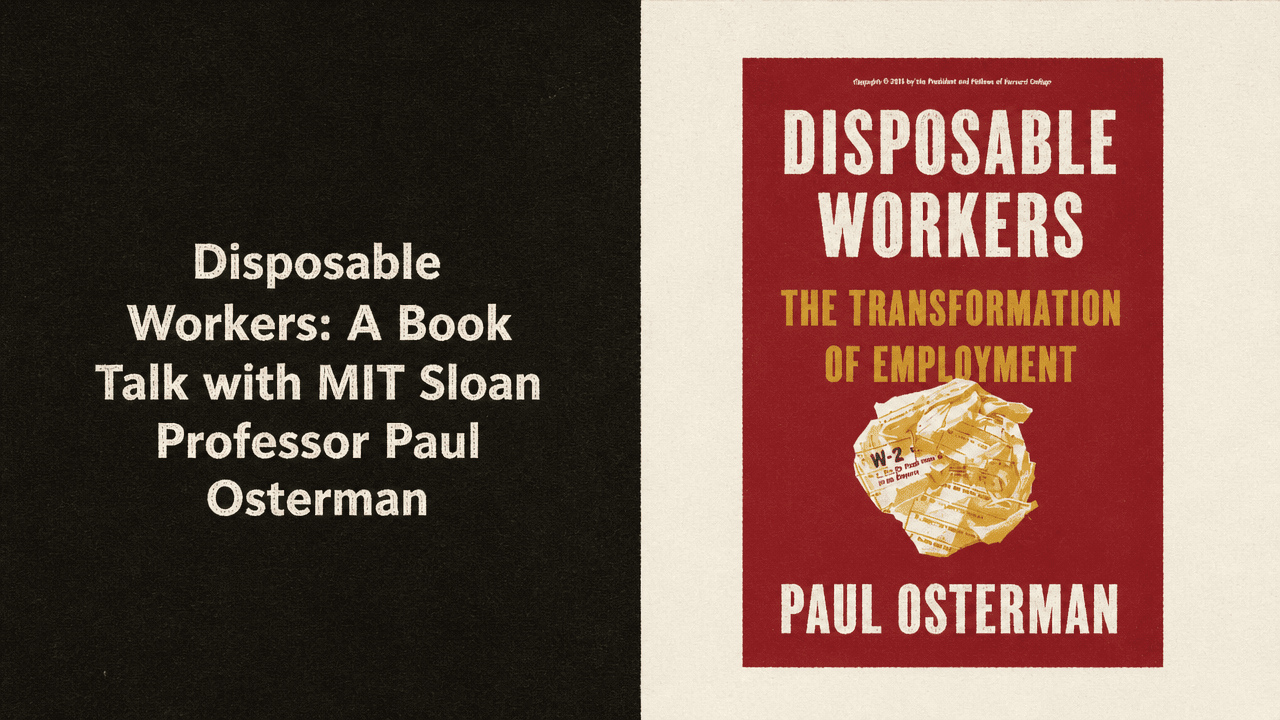
A third of the workforce is outside the durable employment bargain
Paul Osterman estimates that 35% of U.S. workers occupy jobs he classifies as disposable: positions in which the organization benefiting from the work limits its obligation to the person doing it, whether through contracting, freelance classification, or a W-2 job detached from a career path.


The category is broader than gig work. Osterman’s examples run from a building concierge employed by a contractor, to overnight cleaners, travel nurses, freelance indexers and journalists, staff attorneys doing discovery work, and high-turnover, low-training sandwich-shop employees. The common feature, in Osterman’s account, is a thin relationship between the organization benefiting from the work and the worker performing it.
His estimate comes from a cross-sectional survey of 6,000 people conducted two years before the discussion. The survey distinguishes organizational freelancers—people who work for organizations—from people who independently walk dogs or clean gutters. It also separates contractors, who work through staffing or contracting firms, from a third group Osterman says is new to this discussion: “marginal” W-2 workers.
Marginal workers are directly employed by the organization, but are not part of its internal labor market. They may be adjunct faculty on short-term contracts with no prospect of tenure, staff attorneys assigned temporary document-review work, or part-time workers whose turnover is not an accident but an intended feature of the staffing model. Osterman classifies a worker as marginal when they are on a fixed-term contract without a guaranteed renewal, or when they are neither contractor nor freelancer and receive neither employer training nor an employer pension.
| Worker category | Share of workforce | Relationship to employer |
|---|---|---|
| Organizational freelancers | 5% | Independent workers serving organizations |
| Contractors | 13% | Workers supplied through staffing or contracting firms |
| Marginal W-2 workers | 17% | Direct employees outside a durable career-and-investment relationship |
| Total disposable workforce | 35% | Workers in one of Osterman’s three categories |
The argument is not that every nonstandard arrangement is exploitative or unwanted. Freelance journalists Osterman interviewed offered sharply different accounts of the same status. Some valued the ability to manage work and family, select topics they cared about, and avoid a conventional newsroom schedule. Others said they had been pushed out of newsrooms and were now competing with writers around the world for work.
That distinction matters in his data. Contractors and marginal workers are much more likely than organizational freelancers to say they would prefer standard employment. Among contractors, 69% would rather be standard employees; among organizational freelancers, only 14% would.
Disposable work also cuts across demographic lines more than a conventional low-wage-work account would suggest. Men and women appear at similar rates across standard, freelance, contractor, and marginal categories. Workers of color and people without college degrees are more likely to be contractors or marginal workers, but neither category is confined to workers without formal credentials: 31% of contractors and 41% of marginal workers in Osterman’s survey have college degrees.
That breadth is central to Osterman’s political claim. The problem is not only that low-income people are poorly served by the labor market. A college graduate can be misclassified as a freelancer or excluded from a career track just as a cleaner or retail worker can be held in a contingent position. That gives the issue a potential constituency across education, occupation, race, gender, and industry—if it becomes politically visible.
Firms buy flexibility by weakening attachment
Disposable work is an organizational strategy for reducing labor costs, avoiding benefit obligations, and retaining the ability to shed workers quickly, Paul Osterman argues. Worker preference matters, in his view, but it cannot explain how many jobs are deliberately designed around tenuous attachment.
For contracting, he describes a straightforward procurement logic. A company seeking security guards, night cleaners, or similar services asks staffing firms to bid. When the work is put out to bid again, the staffing firms’ principal means of competing, he argues, is to lower labor costs. In his account, that creates pressure on wages and benefits even though the workers remain essential to the building, hospital, or business in which they work.
The same calculation shapes part-time staffing. Census measures distinguish “voluntary” from “involuntary” part-time work, with involuntary work defined as wanting a full-time job and being unable to find one. Since roughly 80% of part-time workers are counted as voluntary under that definition, the category can appear unproblematic. Osterman does not reject the distinction, but says it obscures employer design.
Employers may create part-time jobs precisely because high turnover lowers their obligations. Workers who cycle through short-hour positions need not be connected to internal career ladders, offered benefits, or given substantial training. Osterman cites Walmart and Home Depot as firms that were unusually explicit about using part-time staffing because turnover and lower benefit costs served the business model. He also points to repeated conflict at United Parcel Service over management’s push to expand part-time work and the union’s opposition.
A worker can be classified as part-time even while working intense seasonal hours. As Osterman describes the practice, a retail employer can schedule someone for 10 hours most of the year, raise them to 50 hours around Thanksgiving and Christmas, then reduce their hours again. If annual hours remain below the relevant threshold, the employee retains the legal part-time classification. That gives employers an added reason, in his account, to maintain low baseline hours while using the same people heavily during peak demand.
Benefit rules can reinforce those decisions. Osterman says part-time employment grew faster than trend after the Affordable Care Act introduced health-insurance requirements, as firms sought to keep workers below eligibility thresholds. He also points to a Medicare-related rule under which larger employers had to keep workers who turned 65 on the firm’s health plan; after that requirement took effect, he says, reclassification into freelance status increased at large firms.
Cost and flexibility are not the whole explanation. Osterman also sees a cultural judgment embedded in the way firms distinguish a supposedly valuable core from everyone else. He points to a 2023 McKinsey report stating that 95% of a firm’s value is produced by 5% of its employees. The implication, in his view, is that the remaining workforce can be treated as peripheral—or at least as undeserving of comparable respect and investment.
All employers care about is maximizing profits, which is not a bad thing. Not a bad thing at all. Employers create jobs. Employers innovate on products. But you're not going to convince them, I don't think, to follow a path that leads them to treating disposable workers better.
Osterman does not offer a clean long-run series for the entire 35% estimate. His survey is cross-sectional, and prior federal surveys do not ask enough detailed questions to reproduce its classifications five or ten years earlier. But he sees converging evidence of growth: the expansion of temporary help, more building-services contracting, and the reversal in higher education from a faculty workforce that was roughly 30% adjunct and 70% tenure-track to one with the proportions reversed.
He is similarly skeptical of familiar business-school prescriptions to focus on “core competencies” and outsource the rest. He cites a McKinsey study of firms that embraced corporate reengineering and core-competency strategies, saying those firms did no better over time than comparable companies in the same industry. In his account, such slogans rationalize deeper motivations: profit maximization, flexibility, and a diminished sense of obligation to much of the workforce.
The measurable costs reach workers and the organizations that use them
The pattern in Osterman’s survey is clearest in job satisfaction and earnings. Contractors and marginal W-2 workers fare worse than standard employees on both measures. Organizational freelancers are the qualified exception: they report the highest job satisfaction, consistent with Osterman’s account of freelancers who value the arrangement’s autonomy.
| Worker category | Very satisfied with job | Average annual earnings, full-time and full-year |
|---|---|---|
| Standard employees | 43% | $70,346 |
| Organizational freelancers | 55% | $65,187 |
| Contractors | 31% | $56,981 |
| Marginal W-2 workers | 33% | $60,321 |
Freelancers earn less than standard employees in the full-time, full-year earnings comparison, but Osterman attributes much of that difference to their working fewer hours by choice. Contractors and marginal workers, by contrast, earn noticeably less while also reporting lower satisfaction.
He treats job satisfaction as a useful composite measure because it captures more than earnings. It reflects whether workers feel respected, exercise some control, and are treated well. By that measure, the result is not merely a distributional problem. It is a deterioration in the experience of work.
The same divide appears in what Osterman calls organizational citizenship: workers’ willingness to commit to the organization’s success and provide extra effort for it. In the initially presented chart, standard employees reported the strongest outcomes on both measures. Contractors reported the weakest commitment to their organization’s success, while marginal workers reported the lowest willingness to provide extra effort. A later version of the displayed chart showed somewhat different values, but the same overall pattern.
| Worker category | Committed to organization’s success | Willing to provide extra effort |
|---|---|---|
| Standard employees | 58% | 65% |
| Organizational freelancers | 45% | 48% |
| Contractors | 40% | 38% |
| Marginal W-2 workers | 53% | 34% |
Those results support an employer-side argument against disposable staffing, though Osterman does not think it is enough on its own. He says hospitals that use contractors as cleaners have higher infection rates than hospitals that employ cleaners directly, which he attributes to communication and commitment problems. He also cites industrial accidents as another area in which contractor use may carry costs, without detailing that evidence during the discussion.
Paying workers better and treating them better can reduce turnover, theft, and pilfering, Osterman says. It can also increase effort. Yet the direct costs are immediately visible to management, while the benefits may be diffuse or long-term. Advocates of “high-road” employment practices have not established, in his view, that those practices reliably raise profitability in the short or medium term.
Maureen Conway adds that management-support approaches can benefit both workers and firms, including in smaller businesses, but such assistance requires resources. Osterman notes that technical assistance for firms has historically focused more on production systems than on human-resource policies. Extending it to employment practices would require public funding.


A policy response must change the floor as well as workers’ options
Well-designed job training programs improve participants’ outcomes, Paul Osterman says, rejecting the claim that training broadly fails or wastes money. He cites randomized controlled trials as well as observational evidence. The constraint is scale: quality programs must be available at far greater scale, and scale requires funding.
Training and a stronger labor exchange can give workers in low-wage service jobs, short-hour work, cleaning, security, and other disposable positions routes into better employment. But that is an intervention in workers’ options, not in the underlying employer demand for a disposable workforce.
Conway puts the problem directly: if training moves one person from a poor job into a better one but another similarly situated person fills the vacancy, the local labor market remains fundamentally unchanged. Osterman agrees. In his terms, training is a supply-side intervention. It can improve an individual’s prospects, but it does not reduce the perimeter of disposable work.
The evidence on temporary work as a stepping stone is particularly discouraging. The temporary-help industry presents itself as an entry point into stable work. Osterman says research, including a randomized controlled trial, does not support that general claim. Some workers do move from temporary to permanent jobs, but on average, people entering temporary jobs do not fare better than comparable people who enter directly into standard employment.
That does not mean every temporary job is harmful or should disappear. A person coping with a crisis—such as suddenly becoming a single parent—may need a flexible way to earn income. Osterman’s objection is to the scale and design of the system, not to all labor-market flexibility. At 35% of the workforce, he says, disposable status is no longer a limited accommodation for varied needs.
Changing the structure of those jobs requires a different set of tools. Legal classification is Osterman’s most direct target for freelancers. Whether an Uber driver or an Amazon delivery driver is an employee or an independent contractor determines which protections and obligations apply. He favors a federal version of the ABC test used in more than 30 states for state employment purposes, describing it as a relatively straightforward way to establish employee status and end the policy whiplash in which successive federal administrations alter the classification standard.
For contractors and marginal W-2 workers, the central task is raising the job-quality floor. A higher minimum wage is one tool. Osterman says evidence has contradicted the older economic expectation that moderate minimum-wage increases necessarily produce job loss: within a reasonable range, wages can rise without that result. He calls the federal minimum wage of $7.25 an hour “a joke” and notes that more than 30 states have higher minimums.
But minimum wages do not reach every form of disposable work. Raising the wage floor will not resolve the position of a former journalist now classified as a freelancer, for example, nor will it solve every problem facing workers whose main loss is benefits, training, security, or access to advancement.
Portable benefits and public health coverage could also reduce incentives to structure employment around eligibility thresholds. Universal public-payer health care would remove health insurance as a driver of nonstandard staffing, Osterman says. The Affordable Care Act embodies a narrower version of the idea: employers either provide coverage or pay a penalty that helps workers obtain insurance through the exchange. Firms’ response, he says, has often been to keep workers’ hours low enough that they are not eligible.
Tax policy offers another lever. Osterman points to training expenditures, which the tax system treats as a current cost rather than an investment. If firms could treat workforce training more like capital equipment—depreciating the investment over time—that would lower the apparent cost of investing in workers’ skills.
Unions and organizing can improve conditions where they have reach. Rideshare and food-delivery workers in New York, Massachusetts, Illinois, and California have organized outside traditional unions and pressed city councils and state legislatures for basic standards. Osterman does not dismiss those efforts, but regards their scale as limited: they are concentrated in politically favorable states and lack the stable funding base of unions.
Traditional unions show stronger effects where they exist. Unionized building cleaners earn more and receive benefits; the same is true, Osterman says, for hotel workers who make beds and for comparable service jobs. At UPS, union power has constrained the company’s use of part-time work to some extent. But private-sector union density is about 6%, he says, and is not increasing.
Osterman places that weak reach in a broader restructuring of work since the mid-1970s. Employers moved auto plants southward where unions were weaker; Ronald Reagan’s firing of air traffic controllers signaled a more aggressive employer posture; and firms dismantled internal labor markets that had favored incumbent workers for promotion. Employers increasingly hire from the outside, requiring workers to compete against the whole labor market rather than advance through a protected internal ladder.
Political and public pressure may also change company behavior. Osterman describes examples in which Senate hearings prompted firms facing antitrust review to reclassify contractors or freelancers as regular employees. Consumer pressure has sometimes altered labor practices as well; he invokes attention to sweatshop conditions and Nike as an example of the broader possibility.
He is skeptical, however, that a new social compact will arise voluntarily from employer goodwill. A firm that accepts lower profits to improve treatment of workers may be underpriced by competitors that do not make the same choice, while Wall Street reinforces pressure toward profit maximization. Legislative action, rather than an employer-led stakeholder consensus, is therefore the more plausible basis for broad change.
AI may make contingent staffing more attractive without determining employment’s future
Artificial intelligence creates uncertainty about future staffing and skills requirements, not a settled forecast of immediate mass job loss, Paul Osterman argues. He juxtaposes conflicting Wall Street Journal headlines: one describing tens of thousands of white-collar jobs disappearing as AI takes hold, another reporting that large companies had resumed hiring despite predictions of an AI wipeout.
His historical comparison is the computerization of offices. IBM introduced the System/360 mainframe in 1964, followed by minicomputers and then personal computers. Those technologies could perform many routine clerical functions: filing, calculations, invoicing, payroll administration, sales and financial-data management, list keeping, and record management.
The displayed series tracks harmonized clerical occupations—including telephone operators, file clerks, bookkeepers, payroll clerks, secretaries, typists, insurance clerks, mail clerks, and general office clerks—as a share of total employment from 1960 through 2024. Rather than collapsing after office computers arrived, clerical employment first rose as a share of total employment and then declined gradually over decades.
Osterman’s point is not that automation has no effect. Clerical work did decline. But the pace of that decline is a reason, in his view, to temper claims that AI will quickly eliminate vast categories of work. He argues that the office computer was at least as consequential for clerical work as AI appears to be today.
The more immediate risk concerns firms’ response to uncertainty. An employer that does not know what staffing levels or skills it will need may view contractors and freelancers as less binding commitments than regular employees. Osterman calls it a “reasonable bet,” rather than a prediction, that AI will increase the incentive to use disposable workers. The academic evidence remains ambiguous, he says, though it indicates reduced hiring of new entrants.
In the face of uncertainty, if you're a firm, do you want to hire regular employees, or do you find a safer bet to use more disposable workers to deal with the uncertainty?
The policies governing classification, benefits, training, labor standards, and bargaining power will therefore shape whether technological uncertainty becomes another reason to expand a contingent workforce.