People Underestimate How Rewarding Small Social Interactions Will Be


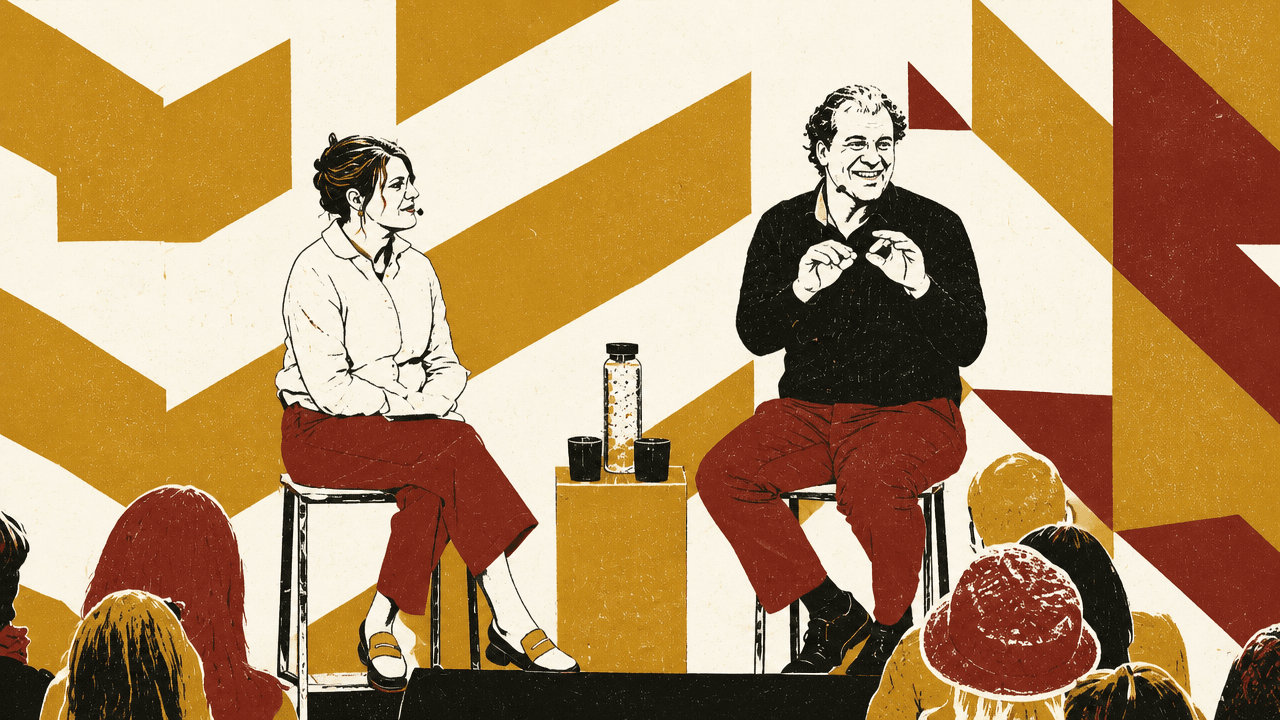
University of Chicago behavioral scientist Nicholas Epley argues that people routinely forgo small acts of connection because they wrongly expect them to be awkward, unwelcome or unrewarding. In a research-focused Aspen Ideas Festival conversation with Kelly Corrigan, Epley says that misprediction affects encounters with strangers and friends alike, from starting a conversation to expressing gratitude or offering condolences. His case is not for constant sociability, but for testing the pessimistic forecasts that keep people from reaching out.
People leave connection unrealized because they mispredict it
Nicholas Epley argues that people routinely pass up ordinary chances for happiness, warmth, and connection because they are too pessimistic about how other people will respond. The social act may be small: saying hello to a stranger, calling instead of texting, moving beyond shallow talk, expressing gratitude, sending a condolence note, or having an honest conversation that has been avoided. The forecast is often the same: it will be awkward, unwelcome, irrelevant, or poorly done.
Epley describes this as the choice to move from “zero to one” — from stranger to acquaintance, from an unexpressed kind thought to an expressed one, from private gratitude to shared gratitude. The obstacle is usually not evidence that connection has failed. It is a prediction that the attempt will not be welcome, useful, or pleasant.
That premise is also the premise of Epley’s book, A Little More Social: How Small Choices Create Unexpected Happiness, Health, and Connection, which was shown on screen with the book cover and a collage of people reading it or interacting. The subtitle matters because the argument is not about a single dramatic intervention. It is about small, repeated choices that alter the texture of ordinary life.
Kelly Corrigan identifies the first step as overriding pessimism. Epley adjusts the prescription: test it. He does not claim that reaching out always goes well, or that people should reach out constantly or indiscriminately. He compares the advice to exercise: a doctor’s recommendation to exercise does not mean exercising 24 hours a day. People choose moments. But when the mind produces thoughts such as “this won’t matter,” “they won’t like me,” or “I won’t be able to do this,” his research suggests those signals are often systematically off.

The point is not merely etiquette. Loneliness is a major determinant of well-being. Epley distinguishes chosen solitude from feeling lonely; the latter, he says, “kind of sucks.” Spending a day completely alone, or feeling alone, is on par with days when people report having a headache.
Loneliness is physically harmful as well. Objective isolation carries practical risks: people are not around to help when something goes wrong. Epley gives the example of someone having a stroke at home with nobody there to respond. He also recalls a 1990s Chicago heatwave in which hundreds of people died, many living alone in apartments that became dangerously hot. Some, he says, were so isolated that their bodies were not claimed, and they were buried in a cemetery near where he lives.
Feeling alone has physiological consequences too. Epley describes the brain as a “three-pound meatloaf” evolved to encourage human connection and to signal distress when a person is isolated. Loneliness is a psychological stressor. It produces cortisol spikes. Over time, he says, sustained cortisol compromises immune functioning, making people more likely to catch illnesses such as colds, pneumonia, or COVID, and compromises cardiovascular functioning, raising the risk of stroke or heart attack.
The opposite side of the ledger is not only grand belonging: marriage, children, lifelong friendship. Epley gives large importance to frequency. Positive mood and even life satisfaction, he says, come less from the intensity of experiences than from their frequency. A memorable few days in Aspen can be followed immediately by bad traffic, and the feeling drains away.
His metaphor is a leaky tire. A good experience pumps happiness up; then it leaks. The implication is not nihilism. It is maintenance. A 30-minute conversation with someone one may never see again can still make that 30 minutes better for both people. “What else is there in life,” he asks, “other than making that 30 minutes a little bit better for yourself and somebody else?” String enough of those moments together and they become a good day, then a good week, then a good month, and eventually part of a good life.
The mistake is often made before anything happens
Nicholas Epley traces the research question to a train ride into the University of Chicago, where he works as a professor of behavioral science. He was writing about the human mind’s capacity to connect with other minds while sitting in a silent train car full of neighbors on Chicago’s South Side. The scene was ordinary and, to him, revealing: “perfectly delightful, happy people,” sitting alone together in complete silence.
The explanation he gives is not that people are antisocial. It is that they are “overly pessimistic about how other people will respond” when they reach out. If someone expects a conversation to be unpleasant, they will not start it; if they do not start it, they never learn that the expectation may have been wrong.
If I think talking to you won't be pleasant, I won't try, and I might never find out that I'd be wrong.
He tested the thought informally that morning. A professionally dressed woman sat next to him, wearing what he remembered as an “amazing red hat.” His own mind produced the usual objections: she will not want to talk, she may think he is “some kind of creep,” they probably have nothing in common, and he has no good way to begin. He opened anyway: “Hi, my name is Nick. I love your hat. I have one just like it.” She laughed politely, and they spoke for the next 30 minutes.
The point is not that every stranger wants a conversation. The narrower claim is empirical: people often refrain from social actions because their forecast is too pessimistic. That forecast affects whether the world ever gets a chance to correct them. Epley says this question became the beginning of roughly 20 years of research on the barrier that keeps people from moving from zero to one.
Kelly Corrigan presses the skeptical question: is the pessimism actually reasonable? Is it based on prior bad experiences, on the memory of a terrible airplane-seatmate, or on a psychological overweighting of the worst possible interaction?
The research began with that possibility. Psychologists have documented “negativity dominance,” the tendency for negative information to loom large in the mind. Epley and colleagues considered whether people were avoiding connection because they remembered bad conversations or could vividly imagine them. But he says they did not find much evidence for that account. When people are asked about prior conversations, including deep ones, they usually report that they were “pretty good.” Some people remember an unpleasant approach, but that did not seem to drive decisions very much.
Instead, pessimism is usually constructed in the moment. The person considering a social action doubts the other person’s interest or response right then. That pattern appears not only with strangers, but also in choices between typing and calling, staying shallow or going deeper, withholding a kind thought, not sharing gratitude, or avoiding an honest conversation.
People judge their own competence while others receive their warmth
Nicholas Epley identifies three mechanisms that help explain why people mispredict the value of reaching out. The first is a mismatch in perspective. People experience themselves as agents trying to do something, so they focus on competence: What will I say? How will I carry the conversation? How will I write the letter? Will I do this well?
Other people often receive the social act primarily in terms of warmth. They are less concerned with the exact wording of a gratitude letter than with the fact that someone expressed gratitude. They are not “checking your grammar,” as Epley puts it. They care that a kind act was made.
This distinction comes from a broader psychological framing in which people judge one another on two major dimensions: competence and warmth. Competence concerns ability and effectiveness. Warmth concerns whether someone is friendly, kind, trustworthy, decent, and approachable. In many acts of connection, warmth is doing more of the work than the actor realizes. A person focused on producing the perfect sentence may underestimate how much a sincere, civil gesture already communicates.
The second mechanism is that people misunderstand the temporal structure of interaction. They imagine their own action in isolation: I say hello; what if the other person reacts badly? But conversation and many other social acts unfold reciprocally. If one person says hello, the other commonly says hello back. If one person smiles, the other often smiles back. If one person ignores the other, that too tends to be returned.
People underestimate the power of this reciprocity. They imagine the social world as more chaotic and less responsive than it often is. The feared outcomes — being given the middle finger, being punched in the face — are possible in the abstract but not likely in the everyday situations his work studies.
The third mechanism is that social pessimism can become self-fulfilling. An optimistic prediction invites action, which then calibrates the belief. A pessimistic prediction prevents action, which protects the belief from correction. If someone thinks a kind word will not matter, that honesty will not be appreciated, or that a deeper conversation will be unwelcome, they may never test the prediction.
Pessimism tends to be self-fulfilling.
Epley borrows former colleague Robin Hogarth’s language of a “wicked teacher” to describe this kind of feedback environment. The world does not always correct beliefs cleanly. Some beliefs shape the evidence a person receives. In social life, pessimism can reduce the very data that would disconfirm it.
Corrigan adds that pessimism can also shape interpretation after the fact. A person may enter an interaction expecting it to go poorly, have an ordinary exchange, and then conclude, “I don’t think he likes me.” Epley agrees that some of that can happen. The central emphasis remains on the entry barrier: the untested belief that prevents contact.
Text strips out signals people rely on more than they notice
Kelly Corrigan describes texting as a medium where intention becomes ambiguous enough that people begin treating punctuation as emotional evidence: the missing exclamation point becomes a possible sign of anger. Her practical instinct is that when intent matters, the better move may be to “upgrade” from text to a phone call, FaceTime, Zoom, or in-person conversation.
Nicholas Epley centers the answer on voice. People are often insensitive, he says, to how the medium of communication affects the outcome. They may understand abstractly that talking and typing differ, but they underestimate the difference in the moment.
He cites research he conducted with Justin Kruger in 2005 on sarcasm and sincerity. Participants created 20 sentences, half sincere and half sarcastic, and communicated them either by typing or by voice. They predicted how well the recipient would interpret their intent, and researchers compared those predictions with actual interpretation.
When people typed, recipients were no better than chance at detecting whether a message was sarcastic or sincere. Yet senders thought they were communicating correctly about 75 percent of the time. When recipients heard the speaker’s voice, they did better, but senders again estimated about 75 percent accuracy. Communicators thought typing and talking were similarly clear, while actual comprehension differed sharply.
The reason is that people know their own intent while composing a message. That private knowledge makes it hard to detect how little of the intent survives in text. Voice conveys more than semantic content. It includes intonation, pitch variability, pace, and other cues that reveal the speaker’s state of mind.
Voice does not only communicate what someone thinks; it communicates that the person has a mind. Movement helps people detect that a body is alive. Voice has a kind of movement too. It rises and falls, speeds up and slows down. Excitement may raise pitch and pace; sadness may slow speech. “I can’t see you thinking,” Epley says, “but I can hear it in your voice.”
He describes a study with MBA students at the University of Chicago. Students gave an elevator pitch to a desired employer by writing it, typing it, or speaking it. They expected to be judged about equally across formats. Potential employers evaluated the candidates on thoughtfulness, intelligence, rationality, emotionality, employability, and interest in hiring. Candidates were judged more mindful, thoughtful, intelligent, rational, and human-like when employers heard them than when they read the same content. Seeing the person did not add much beyond hearing them; the voice carried the effect.
He also applies the point to political disagreement. In work around the 2016 election, people explained why they were voting for Donald Trump or Hillary Clinton. The explanation was captured as video, audio, and transcript. Others who supported the opposing candidate rated the speaker. People were seen as more mindful, thoughtful, and intelligent when listeners heard their explanation than when they read it. Even when the speaker supported the candidate the listener opposed, voice reduced the tendency to see the other person as less thoughtful, intelligent, or rational.
This does not make voice socially neutral in every respect. Corrigan raises the example of her husband losing his Southern accent after going to Yale because he felt the accent caused others to devalue his comments. Epley says he and his colleagues have not studied that question. Others have studied accents, but he is cautious about extrapolating from evaluations of recorded or broadcast speech to live interaction. Actual one-on-one conversation, he says, is often more charitable, friendlier, kinder, and more trustworthy than distant evaluation. On accents in live conversation, he does not claim to know the answer.
Conversation is not a tennis match
Live conversation contains low-level social signals that text lacks. Kelly Corrigan identifies eye contact, smiling, and nodding as simple indicators of intent. Nicholas Epley agrees and calls attention to her nodding as a signal that she is interested. He jokes that a nod is “worth four exclamation points.”
Conversation is often imagined as alternating turns, like tennis: one person speaks, then the other. Actual live, synchronous, voice-based conversation is not like that. It includes constant small signals from the person who does not have the floor: “uh huh,” “yeah,” and other backchannel cues. Those signals communicate attention and interest.
Corrigan notes that podcast training suppresses some of this because hosts often avoid making sounds while guests talk. Epley says that when backchanneling is removed, people feel less connected because a signal of interest has disappeared. Text has none of this. It is, in his blunt phrase, “dead.” His children may say they “talked” to someone when they typed to them, and he asks whether they used “mouth parts” or just thumbs. They treat those as the same, he says, but “they’re not the same. Not close to the same.”
This part of the argument connects two forecasting errors. People underestimate how much better social contact may go, and they also underestimate how much the channel of contact changes the experience. The absence of vocal and conversational signals does not merely remove decorative information. It removes some of the information by which people infer interest, humanity, and intent.
Practice calibrates social prediction
Some people seem natural at starting conversations. Nicholas Epley’s best guess is practice. Social connection is both a habit and a skill. The more a person practices, the better calibrated their expectations become, and the more skilled they get.
He gives an example from experiments with people leaving Midway Airport. Participants who said they normally talked to cab drivers did not underestimate how much they would enjoy talking to a driver. The people who underestimated the value of the conversation were those who reported routinely not talking to their driver. In those experiments, the “loners” were the ones who were wrong.
That matters because the supposed personality difference may partly be a learning difference. Some people have more data. They have repeatedly seen that an interaction can go well, so they do not experience the same anticipatory fear. Epley says his own research changed him in this respect. He has fewer anxieties about starting conversations, writing gratitude letters, or having honest conversations in relationships, though some remain hard.
He also thinks about modeling this for his children. The important thing to model is not only the behavior. It is the expectation beforehand. He describes taking his daughter Sion to New York and, before talking to someone on the subway, telling her to note how she felt and then watch what happened. Each time, he says, it went well. The teaching comes from the contrast between belief and experience — the contrast people often miss because the belief prevents the experiment.
Wisdom lies in that gap between our beliefs about the world and reality. And it's only by testing those beliefs that we sometimes correct them.
Kelly Corrigan calls this exposure therapy. Epley accepts the comparison. In the cognitive behavioral tradition, exposure therapy means actually doing the thing that produces anxiety. Simulation is not enough. A person afraid of public speaking must speak publicly; a person afraid of talking to strangers must talk to a real stranger. He quotes psychologist Stefan Hofmann as saying that “anxiety is a parasite” that thrives on lack of information.
Exposure therapy does not work for everything. If someone is terrified of being shot by a bullet, exposure to bullets is not the solution. Exposure helps when the belief is wrong to begin with. Social anxiety is often treatable, Epley says, because the underlying expectations are likely miscalibrated.
Interest comes before the perfect question
Kelly Corrigan connects the discussion to intellectual humility: the awareness of how much one does not know. She wonders whether some people begin with a mindset that everyone is interesting, while others assume they already know enough based on appearance, clothing, status, or social cues.
Nicholas Epley says this is an area where he is just beginning research, but he sees it as important. People often ask him for “magic words” that will make conversation deeper. There are useful questions, but the more important first step is taking an interest in other people. Curiosity is closely related to intellectual humility. Once someone is genuinely interested in knowing people and paying attention to them, opportunities appear that might otherwise be missed.
He describes unpublished research with speakers and listeners. Speakers were asked to tell either the most interesting story from their lives they could think of, or a boring story. Listeners were asked either to be as interested as possible or to listen as they normally would. Interested listeners expected to make the conversation only a little better. In fact, Epley says, they made it “way better.” They could make a boring story as interesting and enjoyable to listen to as an interesting story. Speakers did not anticipate this; they thought the quality of the story would be what mattered.
The tactical advice is simple. Psychologists once thought people needed many steps to reach depth in conversation, as in the 36-question “fast friends” procedure associated with Arthur and Elaine Aron and popularized by Mandy Len Catron’s New York Times essay. Epley says depth can come quickly. He likes a two-step maneuver.
The first step is an ordinary launch pad: where someone lives, what they do, or some outward fact. The second step moves inside the person. “Do you love where you live?” “Do you love your job?” “Was it your dream job?” He says if the second question can involve the word “love,” the person is probably on the right track.
Corrigan adds that “tell me more,” “what else,” “go on,” and “why” can carry a conversation far. Epley agrees, linking that approach to Rogerian therapy’s invitations to unpack experience. He gives an example from dinner with his father, who had turned 80. Wanting a meaningful conversation, Epley asked what advice his father had for Epley’s son Nathan about how to live. His own recurring prompt was “and then what?” When people are asked for more, he says, they tend naturally to go deeper.
On possible generational differences, Epley is cautious. Claims that “kids are different today” should be treated skeptically unless researchers measured the same thing decades ago and now. Apparent differences may reflect ordinary person-to-person variation or context. His experience is that when people are asked meaningful questions in an appropriate setting, they almost never say “that’s none of your business,” “I don’t care to tell you,” or “go to hell.”
Choosing to approach is not the same as accepting every approach
A bad interaction initiated by someone else should not be treated as evidence about every possible interaction one might choose to initiate. Kelly Corrigan raises the point through the difference between being approached by a stranger and deciding oneself to approach someone. Those are different samples.
Nicholas Epley says this is a confusion statisticians call “confusing the conditional.” The probability of an event depends on the condition one is in. People who approach you in the world are not necessarily representative of the people you might choose to engage. He remembers traveling in Cairo as a college student with his fiancée and a small group and feeling as though they “met every single pickpocket in Cairo.” The people approaching them were selected.
The distinction is important for safety and for interpretation. Epley’s work concerns what happens when a person chooses to reach out and use their own power to engage someone else. It does not imply that people should talk to everyone who approaches them. A person who comes up to someone on the street in Chicago may be different from a person one randomly chooses to engage. The probabilities should not be confused.
The same in-the-moment uncertainty can block people from offering kindness they know they would appreciate receiving. People know how good it feels when someone says “I’m sorry your mom died” or “thank you so much for helping me.” Yet when they consider offering the same gesture, uncertainty dominates: Will I bring up something painful? Are they thinking about it? Will I make it worse?
Epley applies this to the loss of his daughter Sophie. When his wife was taking their other children to school after the loss, other parents often did not know what to say. They did not want to make her think about something painful. Epley says she was thinking about it all the time. The uncertainty in the mind of the person approaching can block lessons from past experiences of being comforted.
Corrigan connects this back to the competence-warmth mismatch. The fear of writing the wrong note after a death is, in her view, almost beside the point. Once the envelope arrives with a return address and stamp, the act has already communicated love. The recipient may not care what the sender wrote as much as that the sender took the trouble to write.
Epley’s own family decision became an extreme version of the research question
Nicholas Epley says no research has changed how he lives more than his work on people underestimating how well it will go when they reach out to connect. The most personal example is his family. He and his wife Jen have five children. They did not enter marriage with that plan, but life put doors in front of them and they decided whether to approach or hold back.
The first adoption decision came after the 2010 Haiti earthquake, while the family was on sabbatical in California at Stanford’s Center for Advanced Study. They had two biological children, and Jen wanted a bigger family. Epley felt stretched thin by work. The earthquake made the need for parents prominent. He was also watching the documentary This Emotional Life, made by his friend Dan Gilbert, and took from one marriage-counseling segment the idea that part of his job was to keep his wife happy. He also concluded that love was not a fixed quantity. “It’s like jumping into a lake,” he says. “You get wet.” They adopted Haptamu and Sion.
The family story he ties most directly to the research came later. In 2016, Jen became pregnant unexpectedly. Three months in, they learned their daughter, already named Sophie, had Down syndrome. The diagnosis “hits you like a ton of bricks” if you are not expecting it. Because they knew they could not understand the reality from the outside, they reached out to parents raising children with Down syndrome. Almost every parent, he says, described their child as a blessing.
That testimony gave him courage, and they continued the pregnancy. At six months, they went in for an ultrasound and learned there was no heartbeat. Sophie had died. Epley describes the loss as “just the worst,” leaving a hole where a life was supposed to be. They struggled for about a year.
Then he told Jen they had been ready for another child, had adopted before, had the resources, and could do it again. Jen immediately asked whether he would consider adopting a child with Down syndrome. His mind returned to the fear and anxiety he had felt at the diagnosis: Could they handle it? Could they connect with a child with intellectual disability and different challenges?
His answer came from seeing himself as a participant in his own experiment, “jacked up a thousand-fold.” He had tens of thousands of data points showing people underestimating how well it would go when they reached out — to strangers, in deep conversations, with gratitude, or in hard relational conversations. The data, he says, gave him courage.
He does not present the decision as universal advice. He notes the requirements: a strong marriage, financial resources, and a job that could handle the demands. But the research shifted his belief from fear toward the expectation that the experience might be “surprisingly good.”
About nine months later, the family flew to China to adopt Lindsey, who was two years old. He describes the family as a “traveling circus”: two white parents, two white children, two Black children, and a Chinese baby with rough skin from crying. Lindsey, he says, has been the blessing other parents predicted. She is also hard — “hard, like, hard” — with challenges distinct from the other children. The point is not that difficulty disappears. It is that pessimism can underestimate the connection and meaning on the other side of approach.
For Epley, the research produced a sense of empowerment. People have more power to lift others up and connect than they imagine. Many people he interviewed for the book who regularly talk with others described it as a kind of superpower. Once the fears that prevent outreach are recognized as “not steel bars” but “wet pasta noodles,” the world changes. People see possibilities they had missed.
Third spaces work best when they lower the first speed bump
Public spaces can help connection, but the first problem is often not the lack of a topic. It is the hesitation to begin. Gabe Hagen, who owns a coffee shop in Arizona after leaving a corporate career during the pandemic, asks how people creating third spaces can help others build confidence in connection. One possibility he raises is putting conversation starters on tables.
Nicholas Epley says conversation prompts are not necessarily a bad idea, but they may miss the key speed bump. People may be too nervous to try. A table card with a deeply personal question — he jokes about “the last time I cried in front of another person” or a high point or low point in life — may trigger avoidance. The obstacle is not only lack of content; it is the uncertainty about whether starting will be welcome.
He is interested in signals that indicate openness. One idea he wants to study is nametags in third spaces: “Hi, my name is Nick.” A nametag reduces the initial uncertainty by signaling willingness to engage. Another possibility is for the person at the counter to introduce customers to each other: “Hey Gabe, this is Jamie.” The core problem is lowering the first barrier, not merely supplying better topics.
Jen Bird asks about games as a way to create connection, citing Mahjong’s popularity in her town and her own enjoyment of it as an engaging activity that allows spontaneous connection.


Epley strongly agrees. Activities that pull people together in community can bypass the awkwardness of connection for connection’s sake. Sports create this effect; people at major sporting events may hug strangers because they are already oriented around a shared activity and identity. Bowling did something similar for Epley as a child in a league with his grandmother. Church has served that function for many people, though he notes attendance in religious services has dropped.
The principle is that shared activities supply a reason to gather other than “let us connect.” When people come together for the activity, conversation can be “sprinkled” on top. That structure can overcome the initial fear that it will be weird or unwanted.