AI Investment Accelerates as Treasury Faces a $10 Trillion Refinancing Wall
 Chamath Palihapitiya
 Jason Calacanis
 David Sacks
 David FriedbergAll-In PodcastSaturday, August 29, 202616 min read
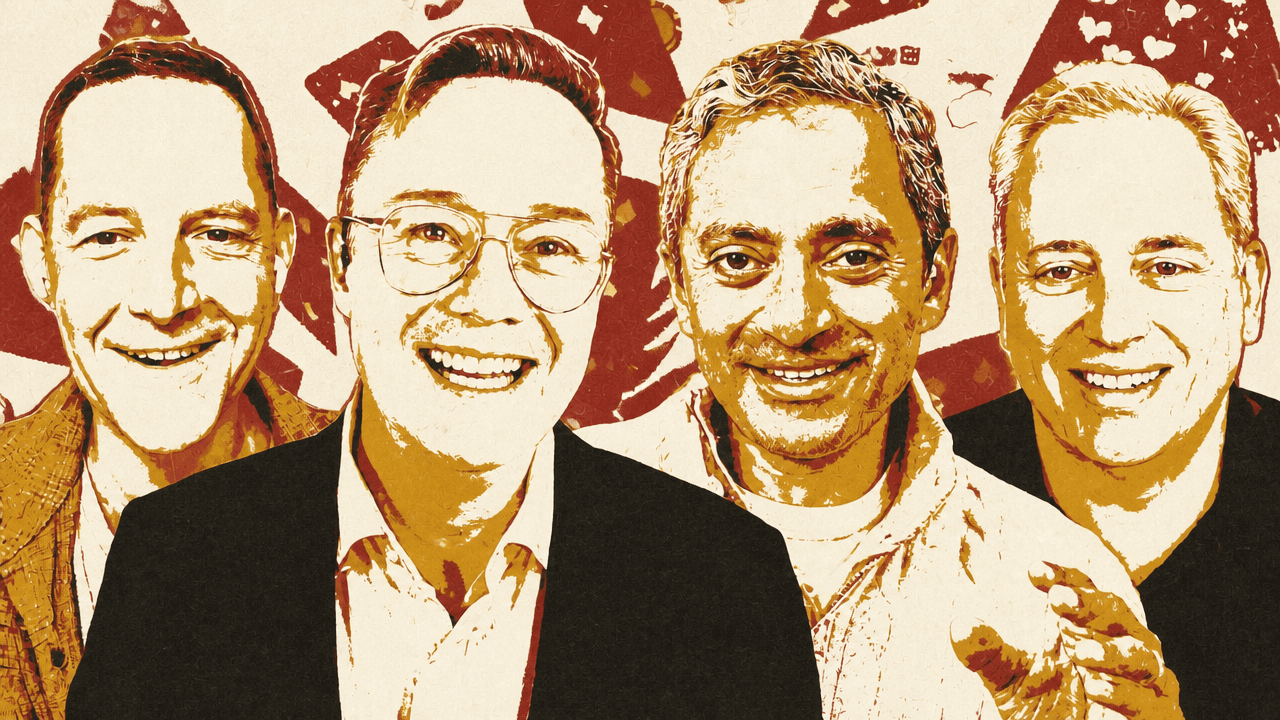
All-In’s David Friedberg, David Sacks and Chamath Palihapitiya argue that the US is entering a fiscal squeeze that Treasury buybacks cannot resolve, as trillions in debt must be refinanced at higher rates. They see continued private investment in AI infrastructure—bolstered by Nvidia’s earnings—as one of the few plausible sources of growth large enough to ease that burden, while Salesforce’s results challenge the broader claim that AI agents will erase enterprise software. Their distinction is between replaceable workflows and systems of record whose data, controls and organizational context agents still need.
Private AI investment is accelerating as public fiscal capacity narrows
Treasury buybacks may suppress yields at the margin, but the more consequential fiscal problem is the mismatch between the debt Treasury must refinance and the capacity it has to influence bond prices. David Friedberg David Friedberg put the comparison at approximately $10 trillion of debt coming due in the next 12 months against, at most, $1 trillion Treasury could use to buy debt.


The immediate backdrop was a 30-year Treasury yield that reached 5.3%, described in a CNBC headline shown on screen as a 19-year high. Treasury then doubled planned buybacks of off-the-run long-dated securities from $2 billion to at least $4 billion. A displayed excerpt said Treasury Secretary Scott Bessent had indicated that the operations could become larger. Stanley Druckenmiller’s Wall Street Journal commentary opposed the strategy on the grounds that rising rates signal an underlying problem and that artificially suppressing them heightens the danger.
| Maturity | December 2020 yield shown | August 2026 yield shown |
|---|---|---|
| Short end of curve | Below 0.5% through intermediate maturities | About 3.8% at one month |
| 30-year Treasury | About 1.6% | About 5.2% |
Friedberg explained the yield curve as the price investors charge the federal government to borrow at different durations. In his diagnosis, persistent inflation driven by government spending and concern about long-run fiscal solvency explain why that price has increased. He put the government’s average interest cost at 3.4% across $40 trillion of outstanding debt and estimated that every one-percentage-point rate increase adds annual interest expense equal to 1.25% of GDP.
The refinancing schedule is central to his argument. Maturing bonds must be repaid or rolled into new issuance. As debt issued at lower rates comes due and is replaced at current market rates, interest costs rise; as interest costs rise, the deficit expands. Treasury can purchase securities in the market, but it still has to sell far more securities to refinance the maturing obligations.
It is not Bessent’s fault or Bessent’s responsibility to solve the yield curve problem. It is Congress’s responsibility. It is the president’s responsibility. It is the responsibility of the holders of the budget and the accounts that should stand up and say, we are going to cut spending.
Friedberg read Druckenmiller’s criticism partly as cover for Bessent. He did not think the former colleagues were coordinating; rather, he saw Druckenmiller as signaling that the Treasury secretary cannot solve a problem created by fiscal policy. The responsibility, in this account, lies with Congress and the executive branch, which control the budget.
Chamath Palihapitiya Chamath Palihapitiya made the tactical case for buybacks more directly. Buying bonds bids up their prices and lowers the yields against which new Treasury issuance is priced. “Yield-curve suppression,” as he called it, can lower near-term financing costs as Treasury approaches what he described as a refinancing tsunami.


But Palihapitiya also treated that tactic as inadequate to the larger problem. He characterized the issue as congressional rather than partisan: both parties, he said, have consistently spent more than they should. In his telling, debt is growing at roughly 7% while GDP grows between 2% and 4%. His shorthand was that a higher long-term yield represents declining confidence: as yields rise, trust falls.
A 30-year yield of 6%, Palihapitiya warned, would be the beginning of a debt spiral—not an immediate collapse, but the start of years of severe pain. The necessary response, he said, is budget control enacted by Congress.
The awkwardness, in his view, is that this is also a period when the United States needs a large financial build-out to support AI. In an earlier era, he argued, the federal government might have supplied the balance sheet for such national-scale investment. Its fiscal position now leaves Nvidia, Google, Microsoft, Meta, and Amazon carrying more of that burden. Palihapitiya credited the president with finding $2 trillion through trade deals to support the build-out, while describing capital from other nation-states as slow-moving and only a short-term bridge.
David Sacks David Sacks offered a political explanation for why budget control remains elusive. He called it a tragedy of the commons: 435 House members, 100 senators, and a president participate in a process where individual actors have incentives to protect their own programs. The president lacks a line-item veto and does not have the constitutional authority to impose comprehensive cuts alone.

Sacks argued that DOGE illustrated the political cost of spending reform. In his account, attempted cuts to an agency or sub-agency generated intense backlash and inaccurate media coverage. Nor did he see a change in congressional control as an obvious remedy, arguing that Democrats were oriented toward large new spending proposals as well.
Friedberg’s concern was that voters will experience the effects without tracing the mechanism. Higher Treasury yields can lead to higher mortgage rates and weaker housing affordability, but he did not think people would naturally connect those pressures to deficits and government spending. They will look for someone to blame, he said, and may support candidates promising more government-financed relief—the response he believes compounds the original problem.
He argued that emergency spending after the global financial crisis and COVID had become a persistent baseline. Had spending remained at 2019 levels while the economy grew, Friedberg said, the federal budget would now be in surplus. He anticipated political strain between the 2026 midterms and the 2028 election, followed by more severe pressure around 2030 to 2032 as Social Security and state obligations become harder to meet.
Palihapitiya doubted reform would arrive through gradually accumulating public pressure. Structural changes in expectations, he said, tend to follow acute shocks such as 9/11, the global financial crisis, and COVID. Sacks feared that a crisis could become an opening for a larger government power grab rather than fiscal discipline.
Sacks’s alternative diagnosis was growth. AI, he argued, may be the only source of sufficiently rapid economic expansion to let the country grow out of its debt burden. That makes the private AI build-out more than a market story: it is one of the few routes he sees for outgrowing a fiscal problem that current politics has not resolved.
Nvidia is becoming evidence that the private build-out has real legs
Nvidia’s fiscal second-quarter results were presented as evidence that the investment cycle Sacks wants to continue is not yet running out of demand. A chart shown during the discussion put Nvidia’s revenue at $96.2 billion, versus $45.7 billion a year earlier. Jason Calacanis said that represented 106% year-over-year growth, ahead of Wall Street expectations of $92 billion.
| Measure | Q2 FY26 | Q2 FY27 |
|---|---|---|
| Revenue | $45.7B | $96.2B |
| Year-over-year change | — | +106% |
The larger signal was guidance. Nvidia said it expected 70% revenue growth for fiscal 2028, against analyst expectations of roughly 45%. A graphic shown on screen said memory-chip shortages would limit what otherwise would have been higher growth. Calacanis put quarterly net profit at $60 billion, calling it the most profitable core-business quarter by a public company, excluding one-off gains at companies such as Google and Amazon. Nvidia’s materials also cited roughly $15 billion in sequential revenue growth and $26 billion returned to shareholders alongside spending on R&D, supply capacity, and its ecosystem.
The market response was immediate: a news graphic said Nvidia shares rose nearly 9%, adding about $440 billion in market capitalization. Yet Calacanis noted that the company had entered earnings only about 12% higher year to date, roughly in line with the S&P 500 and behind the broader semiconductor index. The remaining concern, as he framed it, was that Nvidia’s customers and competitors will increasingly develop alternatives.
Sacks treated the quarter principally as evidence against the claim that AI capital expenditure is a bubble nearing its end. The current quarter showed demand, but Nvidia’s forward guidance was the stronger rebuttal: the company forecast substantial continued expansion while saying supply, rather than a shortage of buyers, constrained revenue. Sacks added that Nvidia was trading at roughly 12 times earnings even after the share-price jump.
The other narrative that’s getting shredded today is that this AI CAPEX is a bubble. It’s basically going to end very soon. And what Nvidia is basically saying with its numbers and forecast is actually this AI CAPEX is going to continue well into the future. It’s got real legs.
The claim was not that every AI investment will work. It was narrower: Nvidia’s results and forecast suggest that the largest buyers are still committing enough capital to AI infrastructure to support substantial further growth. For Sacks, the fiscal stakes make that growth unusually important. He said the country would need something like a decade of quarters resembling Nvidia’s and Salesforce’s in order to expand its way out of the debt burden.
Palihapitiya took the point beyond Nvidia’s immediate earnings. The familiar categories of customer, supplier, cloud provider, chipmaker, model company, and infrastructure owner are dissolving, he argued. Nvidia still relies meaningfully on hyperscalers for revenue, citing $24 billion in the quarter, but it has also built what he called a “neo-cloud” business of comparable scale.
If hyperscalers develop their own silicon, Palihapitiya argued, Nvidia can reasonably develop models, host them, offer APIs and inference, and move further up the stack. In five years, he said, the largest companies may each have cloud businesses, models, silicon, and data centers. Competition will turn on whose complete stack works best.
Calacanis and Sacks also discussed reports that Nvidia had acquired Hugging Face for $12 billion and made a $6 billion deal involving Poolside. They treated the reports as evidence that Jensen Huang was pursuing open-source distribution and developer reach. Palihapitiya cautioned that Poolside has both a coding model and an agent-harness product, and said the announcement did not make clear which assets were central to the transaction. Sacks likewise qualified the acquisitions as reported rather than confirmed, returning to the earnings guidance as the clearer signal.
The underlying point was convergence. Hyperscalers are no longer only Nvidia customers if they build chips; Nvidia is no longer only their supplier if it sells models, agent tooling, hosted inference, and cloud services. The AI build-out is producing companies that compete across one another’s former boundaries.
AI may weaken workflows while making systems of record more valuable
Salesforce became the counterexample to the simple proposition that if AI agents can write software, existing enterprise software must become worthless. Calacanis said Salesforce reported $11.3 billion in quarterly revenue, up 11% year over year, and raised full-year guidance to $46 billion. He said adjusted earnings per share of $5.90 beat an expected $3.27, while Salesforce’s Anthropic investment also contributed to the market reaction. Its shares rose more than 20% on the day; a chart shown on screen put the gain at 43% since May 15.
The distinction that mattered was not SaaS versus AI. It was between companies that hold a durable record of an enterprise and companies whose principal value lies in a workflow that can be rebuilt, modified, or replaced.
Chamath Palihapitiya Palihapitiya had argued in May that Salesforce was materially oversold. His reasoning was not simply that incumbents would resist disruption. Enterprise agents, he argued, need something models and agent harnesses do not inherently possess: high-quality organizational context.
He described the development in three phases. The first was models—the “brain.” The second was harnesses and agents: giving that brain eyes, hands, memory, and a keyboard, turning a question-answering system into something closer to an autonomous worker. But an enterprise agent must still understand the organization in which it operates. To work intelligently as a lawyer, customer-service representative, or sales agent, it needs data, workflows, permissions, history, and context. Companies that control large systems of record therefore retain a privileged position if they adapt correctly.
You take a brain, you give it arms and legs and limbs and eyes and etcetera, but then you have to train it to be a lawyer or be a customer service rep or be a sales agent or what have you. And to do that next step, you need a ton of contextual information.
For Palihapitiya, the consequential distinction is horizontal systems of record versus vertical software made chiefly of workflows. The former may own canonical business data and long-lived customer relationships. The latter may be more exposed if its functionality can be recreated or materially improved with AI-generated software.
David Friedberg Friedberg supplied an operating example from his own company. His team built an internal CRM over a weekend using Claude Code and Cursor. The initial build was feasible. Making it secure, scalable, permissioned, fully featured, and useful across a company was the harder and less valuable task. The team had to weigh that maintenance burden against software it could build that was genuinely distinctive to its work, including plant-breeding tools.
They concluded that effort belonged in workflows specific to their business, rather than in recreating broad products such as a CRM, Slack, Gmail, or Excel. Friedberg said Marc Benioff persistently pushed his company to try Salesforce; once the system was set up, it became the more effective solution.
That produces a more constrained disruption thesis. AI makes custom internal software more practical, particularly in specialized workflows. It does not follow that an enterprise should replace a mature communications platform or core customer-data repository with an in-house product simply because it can generate code.
David Sacks Sacks made the same point through reliability and risk. A core system of record must work consistently in environments shaped by compliance requirements, access controls, and years of accumulated bug fixes. AI systems remain probabilistic and prone to edge cases, he said. Enterprises are unlikely to jeopardize essential records by replacing mature software with something assembled through a do-it-yourself process.
You need the AI agents to basically go to those systems, get the data from a canonical source of truth.
But incumbents cannot simply defend their existing user interfaces. Sacks’s account of Salesforce’s strategy was that Benioff is accepting a degree of disintermediation to remain central. Salesforce will offer Anthropic models inside Salesforce, but Sacks considered the more important move to be allowing Salesforce data and actions to be accessed from Claude. Claude may become the primary interface through which users create and instruct agents. Salesforce remains useful if those agents can read from it as the canonical source of truth and write actions back into its workflows.
That creates a different stack: databases and systems of record at the bottom; applications and workflows above them; agents above those; and an AI interface on top. The SaaS winner may not be the company that insists its own interface remains the sole place users work. It may be the company that gives agents excellent APIs and command-line access, lets outside agents use its data and functions, and remains indispensable as the reliable underlying record.
Sacks said this could unlock “trapped value” inside Salesforce: functions that users do not know exist or cannot navigate efficiently. An agent that understands both a user’s request and Salesforce’s available actions could become the power user that surfaces those capabilities. Once users trust the agent, they may authorize broader access, making more of the platform useful without a comparable expansion of consultants and training.
The speakers did not claim that every vertical SaaS company will fail. Sacks repeatedly called the outcome case by case, depending on the strength of each company’s moat and whether it genuinely owns a system of record. Palihapitiya was more categorical that vertical SaaS is generally workflow software rather than a system of record, and asked what survives once AI can build and modify processes cheaply.
Their shared objection was to indiscriminate extrapolation. The market narrative, as Sacks described it, reduced to: agents can code, therefore all software goes to zero. Salesforce’s quarter does not settle the prospects of every software company, but it shows why that inference was too broad.
Personalized cancer immunotherapy is a manufacturing process as much as a drug
David Friedberg Friedberg described Moderna’s positive results as part of a longer effort to use a patient’s own cancer biology to direct the immune system against a tumor. Moderna’s market capitalization, he said, had risen from around $20 billion to $60 billion on the news.
He objected to calling the treatment a “cancer vaccine.” A vaccine usually prevents disease before it occurs; this approach is intended to treat cancer already present. He described it instead as personalized neoantigen immunotherapy.
The premise, as Friedberg explained it, is that cancer cells can contain mutations that distinguish them from normal cells. A tumor biopsy can be sequenced to identify genetic changes unique to an individual’s cancer. Those changes produce proteins, or protein fragments, that can serve as identifiers of the tumor. If the immune system is trained to recognize one of those identifiers as an invader, immune cells may then locate and attack other cells carrying it.
For melanoma, Friedberg said, the approach is especially attractive because UV-driven mutations can make a tumor distinct from the rest of the body. The process he described is to sequence a tumor sample, identify a cancer-specific target, introduce that target or instructions to produce it, and activate an immune response against cells carrying the marker.
The idea of neoantigen-based treatment dates to the 1990s, Friedberg said. Improvements in DNA sequencing made it possible to personalize the approach by analyzing an individual patient’s cancer rather than relying on a universal target. He said hundreds of trials have explored different cancers, delivery methods, doses, adjuvants, and combinations with other treatments.
Moderna’s mRNA approach changes the delivery mechanism. Rather than manufacture a target protein outside the body and inject it, the treatment delivers mRNA encoding that protein. A patient’s own cells then produce the protein and expose the immune system to the cancer-specific target. Friedberg compared the mechanism to mRNA COVID vaccines: a shot directs cells to make a protein segment that stimulates an immune response.
The distinction matters to his economic argument. Friedberg characterized the therapy as a technique or process more than a traditional drug. He argued that obtaining a tumor sample, sequencing it, identifying a relevant target, and producing a protein or mRNA sequence should not inherently be expensive. The difficult work, he said, is validating safety, optimizing dosing and combinations, and conducting human trials.
Friedberg objected to what he said could be a $500,000 price for Moderna’s therapy. In his view, the treatment rests on decades of research that he said was substantially supported by NIH and other public funding, as well as a broadly understood therapeutic principle. He said some clinics, including clinics in Montana, are offering personalized peptide approaches to cancer patients for roughly $50,000. He characterized Moderna’s FDA approval and patent position as a form of regulatory capture if they create monopoly control over a general process that hospitals could otherwise learn and provide more broadly.
The process is, take the DNA sequence from my cancer, make a protein, put it back in my body, my immune system goes and destroys the cancer in my body.
Friedberg acknowledged that Moderna appears to have meaningful patent protection around particular mRNA technologies, including methods he said were designed to prevent mRNA from integrating into the human genome or replicating in the body. But he stressed that mRNA is not the only route. In the alternative process he described, a cancer-specific DNA sequence can be inserted into bacterial cells, which produce the corresponding protein in a bioreactor; that protein can then be isolated and injected to provoke an immune response.
He expects personalized cancer immunotherapy to become more widely available, including in lower-cost overseas settings, because he considers the underlying process inexpensive relative to proprietary treatment prices and potentially useful for certain cancers. He also said a shared acquaintance was building a lower-cost business in Montana under right-to-try rules. The question he posed is whether a company should receive broad practical control over cancer treatment because it has patented a delivery technique and completed the regulatory pathway.
The source set neoantigen immunotherapy beside another emerging modality: CAR T therapy. Friedberg explained that CAR T removes T-cells from a patient, reprograms them—potentially using CRISPR or another system—to recognize a cancer-associated protein, and returns them to the body. He said this can be particularly useful for blood cancers, where malignant cells circulate rather than remaining concentrated in a solid tumor. He put the cost of CAR T at around $1 million and described results for conditions such as multiple myeloma as remarkable.
Jason Calacanis Calacanis emphasized early detection as a prerequisite for many cancer treatments and referenced Galleri, a blood test from Grail. Friedberg agreed that new therapeutic modalities create grounds for optimism, while maintaining that affordability and access will determine whether their benefits extend beyond patients able to pay for highly regulated proprietary therapies.