Nvidia’s China Chip Allegations Turn Huang’s Departure Into a Governance Test


Allegations that restricted Nvidia chips moved into China through a relationship involving Jensen Huang have made his departure a national-security and governance issue, Alex Kantrowitz and Ranjan Roy argue. They say investigators will want to know who at Nvidia knew about the reported shipments and how the company handled them; what the board knew, and when, remains uncertain.
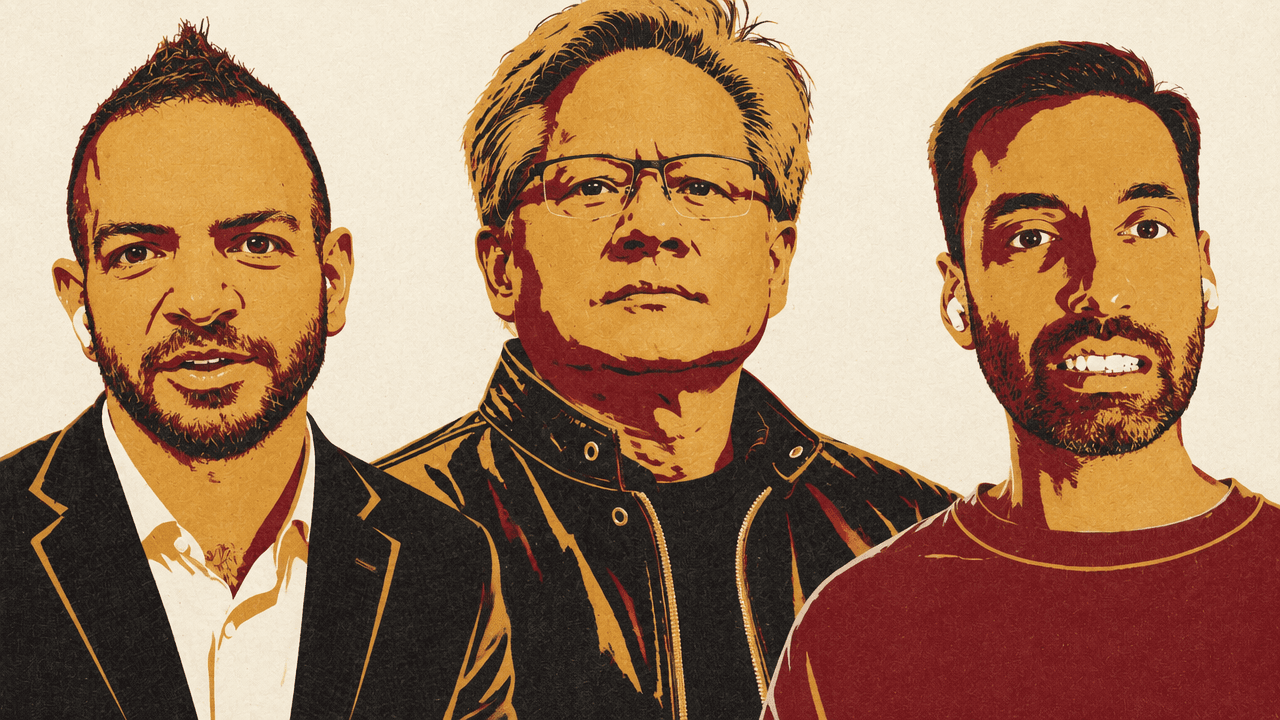
The chip allegations make Huang’s departure a national-security and governance question
The central issue in Jensen Huang’s departure from Nvidia is not simply whether his personal relationships violated company norms. It is whether one of those relationships intersected with the movement of restricted Nvidia chips into China—and what Huang and other people at the company knew about that movement.
Alex Kantrowitz said he had initially thought Nvidia’s board might try to keep Huang in place after the first affair became public. That judgment changed as more reporting emerged, including allegations about additional affairs and business dealings connected to restricted chips. Kantrowitz’s point was that the relationships mattered to the company in part because of the risks they may have created.


A report from Tom’s Hardware, as Kantrowitz described it, alleged that Alice Wang, an executive at Singapore-based MegaSpeed, helped secure more than $7.5 billion in Nvidia AI GPU imports during a three-year relationship with Huang. The report said she helped move 240,000 restricted chips—mostly H100s and H200s—into China, and that she intervened when shipments were delayed. According to the account, Wang cited her relationship with Nvidia and its suppliers as a reason she could get chips moving again. Kantrowitz said some U.S. security officials considered Wang a Chinese intelligence asset.
Ranjan Roy separated the questions raised by those reports: whether Wang was an intelligence asset; whether MegaSpeed had an unusual ability to procure Nvidia chips; and whether the company served as a route for restricted hardware into China. Roy said the reporting increasingly suggested a serious problem at each level. The underlying policy question—whether China should have access to U.S. chips—was, he said, still open to debate. But if export controls were being circumvented, that debate was taking place without an honest account of what was happening in practice.


Roy pointed to the national-security rationale for restricting advanced chips, while also naming arguments on the other side: access could affect competition, and open-source AI could serve U.S. interests. Kantrowitz connected the restrictions to concerns about AI’s growing cybersecurity capabilities. A risk that might have seemed theoretical a year earlier, he argued, looked more immediate as AI systems improved. Their disagreement was not over whether the policy question had a simple answer; it was over how consequential the alleged circumvention was. Both treated the integrity of the rules as central.
The episode also raised questions about the U.S. government’s handling of an inquiry into the Singapore supply chain. Kantrowitz said reporting described Nvidia’s legal leadership as having influence over which government agency examined the matter, with the inquiry moving to the Justice Department after it had heated up. He called the reported intervention improper. Roy stressed that the full story was not yet known. The point was not only what happened to particular shipments, but whether government oversight had been redirected while the activity was under scrutiny.
The company’s geographic revenue disclosures added another layer. Kantrowitz cited a Wall Street Journal account saying Singapore had represented 22% of Nvidia’s revenue as recently as the summer of 2025, before disappearing from the company’s disclosures. The account said Nvidia changed how it reported geographic revenue in October 2025, shifting from the customer’s headquarters to the customer’s billing location. Subsequent disclosures recast prior periods, moving much of the Singapore-billed revenue into the U.S. category while revising revenue higher for China and Taiwan.
Roy said the relevant information had been available in earnings reports a year earlier, and argued that scrutiny of Nvidia had been dismissed at the time. His criticism was directed at the response to the information, not a claim that the disclosures alone proved where the chips went. The change in reporting methodology, viewed alongside the reported MegaSpeed activity, now makes the company’s geographic sales a subject of renewed attention.
The reported sales also sharpen a basic business question: if demand for Nvidia GPUs was as strong as the company’s public image suggested, why pursue sales in China through complicated channels? Kantrowitz said the issue could bear on Nvidia’s financial health. Roy said it mattered economically and geopolitically. One possible explanation, he offered, was Huang’s argument that keeping Nvidia embedded in China’s technology stack could preserve U.S. influence and economic ties. That might explain his position; it would not settle whether the reported conduct complied with export controls.
Kantrowitz cited former OpenAI employee Will Depue, who said he had found forensic evidence that four Chinese AI labs—DeepSeek, Moonshot, MiniMax, and Ant Group—had built recent models on Blackwell chips, which were barred from export to China. Depue named DeepSeek V4 Pro, Moonshot’s Kimi K3, MiniMax M3, and Ant Group’s LING 3.1 Flash. Kantrowitz added that SemiAnalysis founder Dylan Patel had responded that the models’ code indicated they were built for Blackwell hardware. The claim, if borne out, links the reported supply route to a specific concern: whether restricted hardware helped Chinese labs train newer models.
The allegations changed how the hosts interpreted the board’s decision. Kantrowitz said the affairs alone might not have been enough to force Huang out, given how central he had been to Nvidia. The possibility that a relationship intersected with restricted chip sales, and the questions about company knowledge, changed the board’s exposure. Roy separately noted that one reported relationship involved a direct report, which he said would be a serious workplace issue apart from the China allegations.
Kantrowitz raised the question of whether finance chief Colette Kress, who was preparing earnings results and later became interim CEO, might have known something about the relevant business. He did not claim that she did. More broadly, he said investigators would want to know whether Huang acted alone and what other executives knew. The board’s knowledge is also uncertain: Roy questioned whether it could have been unaware of the reported relationships, while Kantrowitz said it was impossible that nobody at Nvidia knew anything. Neither established what the board knew or when.
The hosts also discussed whether Huang’s departure would end government scrutiny. Kantrowitz noted that politicians from both parties had called for accountability and expected investigations to continue, including questions for other Nvidia executives. The company would face a different set of questions from Huang personally: whether other people knew about the reported shipments, how the business was handled, and whether its disclosures accurately reflected the underlying activity.
There is such a narrative that was built around, you know, like he doesn't do anything but work. He's answering emails at 3 a.m. Remember, we sadly said he was going to be the good face of the AI industry a while ago.
Roy used the contrast between that public image and the allegations to make a broader point about the cult of personality around technology leaders. He said the focus on a founder’s character can obscure the fact that these are businesses with boards, employees, and systems of accountability. Kantrowitz and Roy had previously treated Huang as a potentially reassuring public figure for an industry with public-relations problems. Roy called that one of their worst calls. The shift in attention, he said, should now be toward the company and the business.
The timing connects political accountability to changing views of AI risk
The timing of the reporting and Huang’s departure prompted two related explanations. Alex Kantrowitz suggested that the loss of Republican control in the midterms may have changed the political environment around Huang, who had appeared close to President Trump. Kantrowitz recalled Huang’s public phone call with Trump at the All-In Summit and wondered whether the relationship had conveyed a sense of political protection. After the election, he suggested, people in an administration facing reduced power—or intelligence officials frustrated by the situation—might have had greater reason or opportunity to act.
That was a theory, not a claim about who released the information or why. Roy’s account focused less on partisan alignment and more on the return of conventional accountability. He drew on a description of political scandal as a “conveyor belt”: reporting does not necessarily build in a straight line, but often needs more powerful actors to become involved before it gains momentum. For Roy, the election changed what could plausibly follow from the reporting. Hearings and congressional scrutiny became imaginable in a way they had not seemed before.
Roy said people pursuing the story may have assumed it would be protected or allowed to fade. Once that expectation changed, older details—including the Singapore revenue disclosures—received new attention. In his view, the sudden shift was not only about a change in political allegiance; it was also about the prospect that scrutiny could have consequences. Kantrowitz agreed that the timing did not require a conspiracy theory to explain. The election may have changed the conditions under which an existing story could advance.
Kantrowitz offered a second timing theory: AI’s capabilities had changed the perceived consequences of sending advanced hardware to China. A year earlier, he said, people might have understood the risk mainly as Chinese companies gaining better access to chatbot technology. He pointed instead to cybersecurity concerns and more capable AI systems. As those systems improve, the potential consequences of giving access to advanced chips can seem less abstract. Roy said that distinction changed how he understood the issue: what might once have looked like a contest over better chatbot queries now seemed more closely connected to cybersecurity risks.
The two explanations can coexist. Political circumstances may affect whether allegations are pursued, while changing technical capabilities may affect how seriously the underlying conduct is viewed. Neither explanation establishes exactly why the reporting broke when it did. Together, they help account for why details that had attracted little attention earlier could become central to the story now.
Kantrowitz also cited reporting that Nvidia’s legal leadership influenced which U.S. agency examined the Singapore matter. Combined with the questions about revenue disclosures and the alleged movement of restricted chips, that raised the possibility of congressional scrutiny beyond Huang himself. Roy expected political and investigative fallout to continue, and Kantrowitz said the inquiry could extend to other people at the company. For Nvidia, the issue is not only potential legal exposure; it is whether the company’s internal controls and reporting can withstand scrutiny.
Customer financing complicates the picture of GPU demand
The question of who really needs Nvidia’s chips becomes harder to answer when the company is also helping customers afford them. Kantrowitz described a Wall Street Journal account of a meeting Huang held with senior finance executives. Nvidia was considering billions of dollars in guarantees to companies that could not afford its chips, including deals involving cloud providers and data-center developers. Some deals were led by Huang’s son-in-law, Nico Kaprez. The account said Huang had launched an aggressive effort to finance customers and later questioned whether it had gone too far.
The same account described pressure on both sides of Nvidia’s supply-and-demand equation. Huang reportedly said major cloud providers were planning to use alternative chips to reduce their reliance on Nvidia. At the same time, Nvidia had committed to buying large supplies of wafers and memory. Kantrowitz read Huang’s reported comments as possible evidence of panic inside the company. Roy urged caution: according to a former journalist who had written a book on Nvidia, Huang often presented challenges as existential to push his team. The language in the meeting did not, by itself, establish that Nvidia was in crisis.
Roy’s larger concern was how to interpret deals in which Nvidia could help finance a customer and also sell that customer the chips it needed. He connected the arrangements to a broader discussion of “circular financing” in the AI business. The structure can make it harder to tell how much purchasing reflects a customer’s independent demand and how much is supported by financing from the supplier. That is a question about how to read the business, not proof that a particular purchase or revenue figure was improper.
The concern matters because Nvidia’s commitments remain significant if customers change course. In the Wall Street Journal account as Kantrowitz described it, the company had committed to large amounts of wafers and memory while major cloud providers were considering alternatives. If customers reduce their dependence on Nvidia, the company could be left with commitments made in anticipation of continued growth. And when supplier financing helps customers keep buying, headline demand alone may not show how much purchasing would continue without that support.
Roy put those arrangements in the context of Nvidia’s rapid expansion over the previous few years and its push into cloud providers and major AI customers. He said the scale and speed of the growth made the details of the deals worth watching. The possibility of supplier financing is not evidence that demand is artificial. It does, however, make the durability and independence of that demand harder to assess—particularly alongside the question of why Nvidia was also seeking sales in China.
Ranjan Roy said the company’s China business could represent a substantial share of its revenue, citing an estimate of roughly 20% related to the chips at issue. A cutoff could therefore matter to Nvidia in the short term, even if U.S. customers wanted the hardware. For Roy, that was one reason the export-control story was also a business story: enforcement could change both who buys Nvidia chips and how much of its sales depends on customers outside the U.S. market.
The succession question adds uncertainty. Kantrowitz said Huang did not believe in succession planning and had described a flat structure with about 60 direct reports. Kress was serving as interim CEO, but the hosts discussed other possible candidates, including Nvidia executive Ian Buck and Arm CEO Rene Haas. Roy thought an internal candidate was more likely: an external executive would need to decide whether to take the job before the full scope of the investigations and business questions was clear. Kantrowitz considered Haas a strong possibility. The candidate list was speculation, not a settled succession plan.
Huang’s departure could also affect Nvidia’s ability to retain people. Kantrowitz argued that rival companies might offer employees advancement and the chance to work on competing products at organizations they presented as more stable. Roy said even a small number of highly capable departures could matter if they joined competing teams. He also noted that about 1,600 employees had signed a petition calling for Huang’s reinstatement. The company’s internal response could pull in both directions: loyalty to its founder, and concern about instability at the top.
Faster porting could weaken the cost of leaving Nvidia
Nvidia’s competitive position rests on more than the performance or availability of its chips. Alex Kantrowitz described its advantage as a combination of the chips themselves, the connections between them, and CUDA, the software used to program them. CUDA had become familiar to AI researchers. Moving to another system could impose a substantial cost in time and engineering effort.
That switching cost has helped make Nvidia difficult to displace. A rival does not only need to produce a capable chip; customers need to be able to use it without spending months adapting their systems. Kantrowitz said major cloud providers were planning to use alternatives and that chip efforts at Google, Meta, OpenAI, Anthropic, and other companies had strong teams behind them. AMD was another competitor. The question, as he framed it, was whether these alternatives could become practical enough for customers to reduce their reliance on Nvidia.
A claim from Anthropic’s roadshow raised that possibility. Kantrowitz said Anthropic described a process that would traditionally take six to twelve months to get its models working on AMD GPUs. Using Mythos to help write the software needed for the transition, the company said it had completed the work in about three days.
If AI tools make it easier to adapt software to different hardware, the effort required to leave Nvidia could fall sharply. That would not make chips interchangeable. Kantrowitz’s argument was narrower: AI could help reduce the engineering burden of adapting a system to another platform, making Nvidia’s software advantage less difficult to challenge than it once was.
Roy agreed that diversification was likely, but cautioned against treating Anthropic’s account as conclusive. Anthropic had an incentive to highlight its progress, and the announcement came as Nvidia faced exceptional scrutiny. Still, he accepted the broader point that chip diversification and software portability were worth watching. The example was not proof that Nvidia’s advantage had disappeared; it was a reason to take seriously the possibility that one barrier to using alternatives was shrinking.
That shift could matter even before customers move large amounts of work. Credible alternatives give buyers more leverage and make it easier to plan around more than one supplier. They also make Nvidia’s supply commitments more consequential. If cloud providers can shift more work to other chips, Nvidia may have to compete not only on performance and availability but on the value of its broader system.
Leadership instability could add to that pressure. Kantrowitz said competitors might approach Nvidia employees with opportunities to advance elsewhere. Roy agreed that only a few departures could matter if they involved people who had not previously considered leaving. The possibility depends on several things happening together: alternatives becoming easier to use, rival teams proving credible, and employees deciding that uncertainty outweighs loyalty or opportunity at Nvidia.
China policy could change the competitive balance, but not settle the AI trade
Huang had been Nvidia’s most visible advocate for selling chips to China. Kantrowitz argued that his departure could weaken that advocacy, making stricter enforcement of export controls more likely and leaving Chinese labs with less access to Nvidia hardware. That could benefit U.S. labs such as OpenAI, Anthropic, and Google, which have competed with Chinese labs. The result would depend on what happens to policy and supply, not simply on Huang leaving the company.
Kantrowitz cited a figure from his New York Times opinion essay: Chinese models’ share of activity on OpenRouter had been about 4% a year earlier and reached between 57% and 67% in one week in September. He cautioned that OpenRouter might not be representative. He used the figure to convey how quickly Chinese models’ perceived competitiveness had grown, not as a complete measure of the market.
The essay’s headline was “Jensen Huang Is Gone. Good.” Its argument, as Kantrowitz explained it, was that Huang had been an important reason Nvidia preserved the ability to sell chips to China, and his departure might change that. Kantrowitz said restricting access to advanced chips could help U.S. labs compete; hardware kept out of China might also be available to U.S. buyers, offering a clearer test of domestic demand.
Roy agreed that reduced Chinese access could help Anthropic and OpenAI in a narrow, tactical sense. But he worried that shifting more chips and investment toward the largest U.S. labs could concentrate power. Open-source models and other competitors could provide a counterweight, he said, and he noted that the planned Hugging Face acquisition remained part of the wider landscape to watch. The question, then, is not only which country gets access to hardware, but which organizations gain influence over the development and distribution of AI.
Nvidia’s financial ties to its customers make the consequences harder to separate. Roy noted the company’s role as a major financial backstop to OpenAI and its planned investment in Anthropic. Nvidia is not only a chip supplier to AI labs; its relationships also include investments and other financial commitments. A shift in chip sales could therefore affect customers and supplier at once. Roy thought Nvidia’s planned investment in Anthropic would likely proceed, but said the overlapping relationships were a reminder of the circular nature of the AI business.
The hosts also disagreed about how much the market had absorbed. Kantrowitz noted that Nvidia’s stock had fallen during the week while the S&P 500 rose, despite the attention to Huang’s departure. He took that as evidence that the market did not see the CEO’s exit as an immediate threat to AI’s overall trajectory. Roy thought the market had not yet digested the significance of the changes. An anticipated Anthropic IPO might provide a short-term boost, he said, while the larger questions about chip supply, customer financing, and China remained.
Roy expected a volatile period for the AI trade, describing the episode as the beginning of a larger complication rather than a completed unwinding. Kantrowitz’s emphasis was that the market’s reaction did not show an immediate collapse in confidence in AI. The difference matters: one reading treats the week as a severe but contained company crisis; the other sees unresolved questions about the assumptions behind the broader trade.
Those assumptions include whether GPU demand is durable, how difficult it is for customers to move away from Nvidia, and whether the company’s approach to China can continue under stronger scrutiny. The investigations may clarify the export-control questions. The competitive and financing questions will depend on what customers, employees, rivals, and investors do next.