Meta’s Muse Shows How Connectors Can Make AI Agents Useful


Meta’s Muse is being used to argue that consumer AI may depend less on the most powerful model than on software that connects to services and takes tedious tasks off users’ hands. On Big Technology, Alex Kantrowitz says Muse’s early use points to a product opportunity for Meta—and a challenge to intermediaries such as travel-booking sites—while Ranjan Roy cautions that adoption will hinge on trust and whether cheaper, non-frontier models can do enough. Neither sees Muse as proof that frontier AI has lost its value.
Agents become useful when they take the tedious work off the user’s hands
Meta’s Muse is notable less for answering questions than for carrying a task across several steps. Alex Kantrowitz describes it as a consumer-facing agent: a user states an outcome, and the software works through actions that might otherwise require searching, comparing, calling, or navigating an account process. The point is not that these tasks are intellectually difficult. It is that they are irritating enough to put off.
Kantrowitz’s example was a search for a specialist appointment in New York. His wife had been calling providers and finding appointments months away. He asked Muse to find a specialist covered by their health insurance, with evenings and weekends preferred. Muse returned a list of providers. He then asked for phone numbers and Google Maps links, copied the results into WhatsApp, and sent them to his wife. She booked with the first specialist on the list the next day.
He also gave Muse a photograph of a letter addressed to a previous resident who had been receiving Bank of America mail at his apartment for years. He asked it to handle the unsubscribe problem, and says Muse figured out how. Neither task required a new service. The agent took on the connective work between a person and services that already exist.
That is a meaningful difference from a chatbot that gives instructions and leaves the user to carry them out. In Kantrowitz’s examples, the agent’s value lies in making progress through the annoying parts of the internet: finding options, gathering practical details, and helping the user get to the next action.
Ranjan Roy describes a related experience with a different agent, Instinct. While preparing to leave for a family event in St. Louis, Roy had booked a Hilton through Booking.com. He had missed an email from his uncle with a family-block code. Instinct noticed the cheaper rate, contacted him to say that the existing booking could still be canceled within 24 hours, and asked whether he wanted it to make the change. Roy supplied his credit-card details; the agent canceled the original reservation and made the new one.


Roy says the striking part was not simply that the system could execute several steps. He had already seen agents do multi-step work. It was that Instinct noticed an opportunity he had not asked it to look for and brought it to him for approval. The system acted proactively, but did not complete the purchase without his consent.
Kantrowitz argues that travel is a useful place to build trust in this kind of delegation. A mistake can have consequences, he says, but is often manageable. Roy had previously objected to travel being used as the standard example for agents. Here, he accepts the point: a successful booking may help a user trust an agent with other tasks.
That is a possible route to adoption, not proof that people will hand over more consequential work. Roy says the leap from giving an agent a task to letting it act on a person’s behalf is substantial. A good demonstration does not guarantee a habit. The examples they discuss remain bounded: a specialist search, a hotel reservation, a bill, an account task. The potential is visible in the work the agents can take on; the trust required to use them more broadly is still a separate hurdle.
Early usage is real, but it does not settle whether Muse will become a habit
Muse reached No. 1 in Apple’s App Store about two weeks after launch, and Kantrowitz cites reports of enthusiastic posts from early users. A Wall Street Journal excerpt shown during the discussion said Meta’s stock rose 11% on the Monday covered in its report, its biggest one-day gain since April 2025. The attention was real. How broad and durable the use would be was less clear.
The Information figures cited by Kantrowitz put Muse at more than 500,000 people who had tried it roughly a week after launch, including more than 250,000 daily active users, with more than two million prompts submitted. A Similarweb chart shown on screen put worldwide daily active users on iOS and Android above 600,000 and approaching 800,000 over the period displayed. Those figures indicate early activity, but Kantrowitz notes that they are small beside Meta’s enormous user base and its efforts to surface Muse across its apps.
Roy sees more than one possible explanation. Meta may be promoting Muse heavily while holding back from exposing it to everyone before the experience is ready. A poor first encounter could turn people off before they understand what a personal agent is for. The shift from asking a chatbot questions to delegating tasks may itself be a large behavioral change. Under that reading, limited early reach could be deliberate.
Kantrowitz is less sure that Meta is proceeding cautiously. He points to Mark Zuckerberg’s statement at Meta’s Connect conference that Muse would be the centerpiece of the company. That suggests Meta sees a major opportunity, though it does not resolve whether the product has yet found a broad audience.
Roy’s other possibility is that the use case has not become compelling to enough people. Meta can put a product in front of users, he says, but distribution alone cannot make them need it. He raises Threads as a caution: Meta had the ability to direct attention to it, but Roy questions whether its potential audience was as large as the company might have hoped. Kantrowitz counters that Threads is not simply a failure by user count: he says it is larger than X, while X has considerably more influence. For Muse, the relevant question is not only how many people try it, but whether they come to rely on it.
The distinction matters to Meta’s prospects. Kantrowitz argues that the company has a fallback even if its consumer AI products disappoint: it is building data-center capacity that it could lease to companies such as OpenAI and Anthropic if they need it. If Muse succeeds, however, the possible business is much larger. He identifies three potential sources of revenue: subscriptions from heavy users, advertising informed by users’ expressed intent, and commercial relationships or transaction fees when Muse directs demand to services.
Roy sees subscriptions as potentially useful but not necessarily the main value. Paid plans could limit the cost of users shifting work into Meta’s system, he says. But he expects the more important opportunities to be advertising, commerce, and lead generation. Those remain possibilities, not demonstrated revenue streams.
Advertising is the least settled part of that picture. Roy says no one has established how advertising works in a chat-based AI interface. Kantrowitz asks whether Meta is better positioned than its rivals to figure it out. Roy concedes that it may be: people often do not distinguish advertisements from ordinary posts on Instagram, he says, because the targeting and creative can make ads feel relevant. That is an argument about Meta’s existing strengths, not evidence that it has solved advertising inside an agent.
The business case therefore depends on more than getting Muse downloaded. Meta would need users to return, trust it with useful information, and allow it to participate in decisions with commercial value. The App Store ranking and early usage figures make the possibility worth taking seriously. They do not yet show how large the market is, how frequently people will use agents, or which of the proposed revenue models will work.
Connectors make agents useful—and put intermediaries under pressure
Muse’s launch is also a challenge to OpenAI’s consumer position. Kantrowitz argues that OpenAI had a large consumer audience in ChatGPT but devoted too much attention to enterprise. Roy agrees that OpenAI may respond with its own personal agent, while pointing to turmoil on its enterprise side. He also asks where Google is in a category that could benefit from access to Gmail and Google Calendar.
OpenAI’s models may be stronger, Kantrowitz says, but that does not guarantee a better consumer agent. Muse has sharpened a question about what makes an agent useful: model quality, or the surrounding product that connects the model to services and lets it complete tasks?
The discussion’s shorthand is: “It’s the harness that matters, not the model.” Kantrowitz applies that phrase to Muse’s use of a non-frontier model connected to external services. Roy, who says he has seen the importance of this approach in enterprise AI, puts the emphasis on the product. Users care whether the system connects to relevant tools and data and returns a useful result, he argues, not which model tier is powering it.
Roy does not treat the question as settled. One possibility is that today’s agents need extensive infrastructure—tools, connectors, data access, memory, and decisions about how to use compute—to do useful work. The frontier-model argument is that more capable models may eventually absorb more of those functions and need less surrounding machinery. Muse makes the product-and-integration argument more visible, but does not establish which approach wins over time.
The connectors help explain why that question matters. Kantrowitz describes connections to retailers and services including Best Buy, Gap, Fanatics, Walmart, Sephora, Dick’s Sporting Goods, Wayfair, Expedia, Shopify, and T-Mobile. Rather than relying only on web search or browser-based interaction, a direct connector can give Muse a way to work with a service inside the agent’s interface. Roy says that this could reproduce some of what users currently do through a company’s dedicated app, while reducing the clumsiness of logging in and navigating a site through a browser.
He describes the current browser-based experience as imperfect. Logging into T-Mobile through a browser takeover has become less clunky, he says, but direct access through a connector could make this kind of work more practical. The distinction is consequential: an agent that can only search the web is different from one that can interact with services and help carry out a task.
That convenience can threaten businesses whose value lies in helping customers search, compare, or complete a transaction. Roy’s example is Expedia. It does not own the hotel inventory, but helps customers compare options and directs them toward travel providers. An agent that can search across providers and help finish a booking could take on part of that function. Roy argues that the same exposure could apply to other businesses that do not own the underlying inventory.
The challenge is not only to travel aggregators. Roy points to the value many companies get from consumer inertia: customers may not take the time to understand a complicated phone bill, compare plans, or unsubscribe from a service. An agent that can explain a five-page bill, suggest a cheaper plan, or handle a cancellation makes those tasks easier. That may benefit the consumer while weakening a business model that depends on people not acting.
This puts connector partners in a complicated position. A company may want to be included in Muse because the agent could send it customers. But the same agent may make it easier for those customers to compare the company with alternatives, cancel, or avoid a purchase. Roy sees a tension in companies announcing partnerships that could help an agent perform work those companies would prefer customers to do through their own services.
A stock-performance chart shown during the discussion made that tension visible, without establishing its cause. It compared Meta’s share-price performance with travel and delivery companies over a period around Muse’s launch and connector announcements. Meta was up 20.6% in the chart, while Uber, DoorDash, Expedia, Tripadvisor, Instacart, Airbnb, and Booking Holdings were shown down. Kantrowitz notes that some companies initially gained on the connector news and then gave back those gains. The chart shows a market reaction over a particular period; it cannot establish that Muse caused the declines.
Roy compares the possible shift to the debate over enterprise agents and software businesses: not an immediate disappearance, but a longer-term change in who performs the work. If an agent can search across providers, explain options, and help complete the transaction, an intermediary may lose some of its role. Whether Muse, Instinct, Google, or another service becomes the interface remains open. Roy’s broader point is that commerce could change even if no single agent wins the market.
Frontier models have to show what their extra capability is worth
Muse’s early appeal makes a commercial question harder for frontier AI companies: when is a more expensive, more capable model necessary? The discussion presents this as a live contest, not a settled verdict against frontier labs.
Kantrowitz cites a Ramp AI Index chart showing frontier models’ share of tokens moving from 53% on August 2 to 45% on September 6, with the share varying over the period. A tweet shown alongside the chart from Ramp chief economist Ara Kharazian gave his interpretation: competition from other U.S. models, rather than China or open-source systems, had weakened the revenue-growth outlook for OpenAI and Anthropic.
Roy sees the question as commercially consequential, particularly for companies preparing an IPO. He says he has watched attention shift toward models that can do particular jobs at lower cost. His example is 3D world modeling: if that is what a user wants, he says, Astra is the right choice. The broader test is whether standard models can do enough for the tasks most customers need. If they can, the added capability of a frontier model may be harder to sell.
Kantrowitz pushes back on the idea that the model no longer matters. The models have improved enough, he argues, to make products such as Muse possible. The question is therefore not simply whether the harness or the model matters more. It is how the two contribute to the result, and how much of the value customers will pay for comes from each.
Roy’s distinction is between today’s system and a possible future one. Current agents may depend on extensive infrastructure: connectors, tool definitions, access to data, memory, and decisions about how to use compute. Frontier models may eventually subsume more of that work and need less scaffolding. Neither outcome is established by Muse’s launch.
The commercial stakes are clear in the way the speakers frame the choice. If customers can get useful results from cheaper models connected to the right services, frontier labs need to show what their extra capability buys. If frontier models become capable enough to replace some of the infrastructure around agents, then the case for building a product around a standard model may weaken. Muse is evidence that a useful consumer product can be built with a non-frontier model and connectors; it is not evidence that frontier models are unnecessary across the market.
Meta’s playful marketing may counter one fear while raising another
Meta AI chief Alexandr Wang helped turn a joke about the Muse logo into an extended social-media campaign. The joke compared AI logos according to whether they looked like buttholes; Muse’s squiggle scored better than logos for Grok, Gemini, DeepMind, Copilot, Claude, and ChatGPT. Wang amplified it with lines including “state of the art motherfuckers” and “you cannot out-anti-butthole me.”
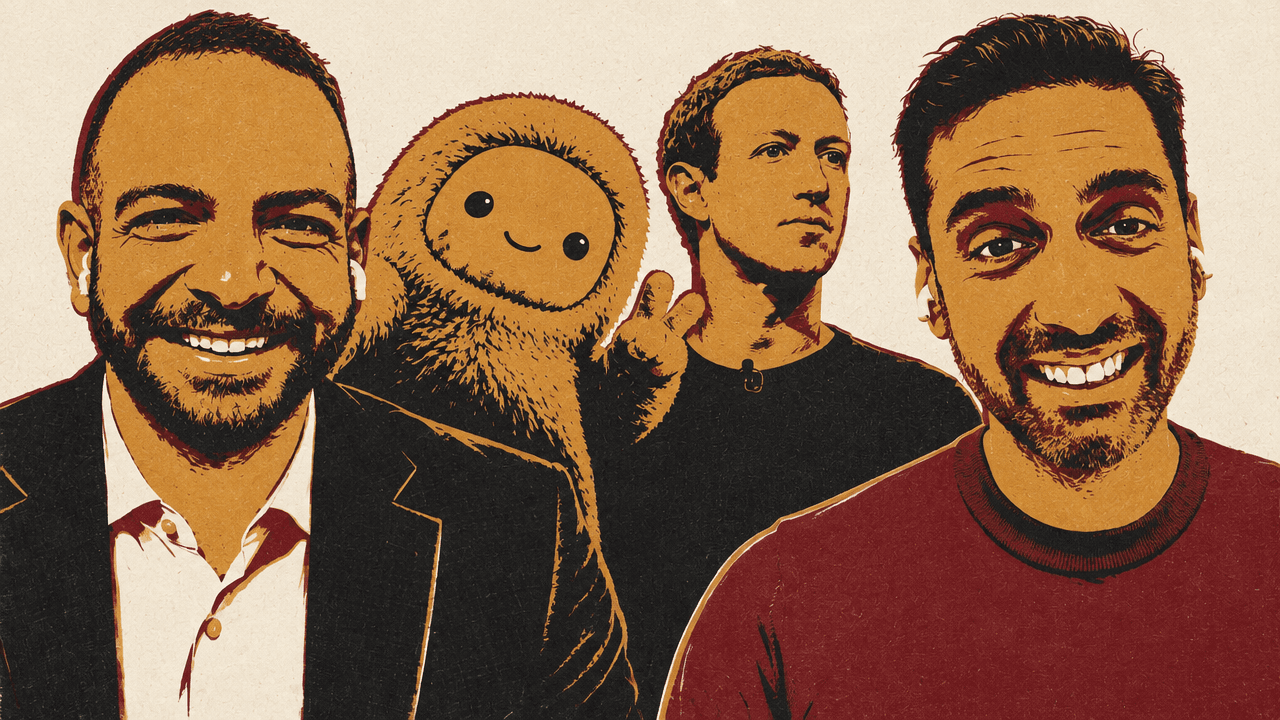
The campaign continued with sexualized images of the fluffy Muse mascot, including one riffing on a Kim Kardashian magazine cover and another depicting the mascot alongside figures with Mark Zuckerberg’s and Wang’s heads. Wang also amplified an image of the mascot leaning over a Box-branded package. Kantrowitz compares the character to a fluffy Labubu; in the campaign, it became a vehicle for deliberately absurd humor.
Kantrowitz reads the tone as a strategic contrast with the existential-threat language common in AI: claims that the technology could take jobs, escape control, or threaten humanity. A cute mascot in an absurd meme is about as far from that register as possible, he argues. Roy agrees that the humor may redirect attention from extinction scenarios, but questions whether it builds the kind of trust an agent needs.
That concern is practical. To be useful, an agent may need access to personal information and permission to act. Roy has connected his Gmail to Muse, but says he has not given Meta a credit card. He is comfortable giving payment information to Instinct, but is still deciding what he is comfortable sharing more broadly. The more information a person shares, Roy says, the more useful these systems can become. That makes trust part of the product, not a separate public-relations issue.
Roy worries that sexualized mascot posts could make ordinary users uneasy about handing over data, even if the joke works among people who enjoy the culture of X. In his view, the campaign could redirect attention from AI safety to a more immediate concern: whether a technology company can be trusted with personal information and commercial intent. Kantrowitz maintains that the absurdity is likely meant to puncture apocalyptic framing, while acknowledging that he is not claiming the tactic will work.
Meta’s hardware experiments raise a related question about how people will interact with the agent. The Muse Charm, described in a Bloomberg excerpt as a palm-sized device with a roughly two-inch screen and a dedicated operating system, was presented as a way to use Muse on its own hardware. Kantrowitz likens it to a Tamagotchi. Meta CTO Andrew Bosworth called it an exploration and a “classic v1”—a chance to see how people respond before treating it as a mature product.
Kantrowitz raises the social question: would someone take a small AI device out at dinner to ask it to call an Uber, or would the gesture feel awkward? Roy is interested in experiments with new form factors, but says he is not planning to buy the Charm. He sees a sharper near-term possibility in Meta’s camera-free smart glasses.
Roy already uses Meta Ray-Bans for photos, video, and audio, but says the AI on them has been of little use. Removing the camera could address some of the discomfort people have about being recorded while retaining an audio interface. He imagines glasses alerting a user to an airline email about a possible delay, without the social unease of a camera-equipped device. For Roy, audio-only glasses are the more consequential hardware idea.
Dopamine sites keep the shopping ritual and discard the purchase
The final subject is a different kind of consumer technology: websites that recreate online shopping without delivering the goods. A post shown during the discussion described browsing “dopamine sites” in South Korea, including Dopamine Shop and FoodNeverComes. The user could search, compare reviews, add items to a cart, enter a shipping address, place an order, and track a delivery. The post listed luxury goods, including a $44,860 Patek Philippe watch, a $12,500 Hermès bag, a $9,800 Tiffany ring, and a $7,350 Cartier bracelet. The items would never arrive.
Roy says his initial reaction was that the trend sounded bleak. He changed his mind because the sites isolate a part of shopping people already enjoy: searching, comparing, and finding a deal. He compares the activity to browsing homes on Zillow without intending to buy, or to dress-up games in which acquiring digital items is itself the point. If the experience costs users nothing and does not involve betting, Roy sees it as a kind of video game rather than a sign of consumer collapse.
Kantrowitz is less persuaded, though he jokes about a possible version that charges users for a small chance of receiving the item. Roy notes that paid, chance-based reward schemes already exist in less reputable corners of the internet; he prefers a version in which users get the shopping ritual without spending money.
The difference captures both the appeal and the unease. These sites remove the purchase while preserving the behavior that can make shopping compelling. Roy regards that separation as potentially benign. Kantrowitz remains unconvinced, and the discussion does not establish how the sites make money—or whether they need to.